

TL;DR:
- Electrostatic films bond to surfaces through static charge, eliminating the need for adhesive or tape. They improve paint quality in spray booths by capturing overspray and reducing application defects. Proper surface preparation and selecting the correct film grade are essential for optimal performance and cost savings.
Electrostatic film is defined as a non-adhesive vinyl or polyolefin material that bonds to surfaces through static charge alone, requiring no glue, tape, or chemical primer. For automotive refinishers, industrial painters, and manufacturing engineers, the advantages of electrostatic films are direct: faster installation, zero adhesive residue, and measurable reductions in surface defects. ESD-related losses cause 8–33% of component failures in uncontrolled manufacturing environments. That figure alone explains why specifying the right film grade is not optional. Standards like IEC 61340-5-1 define the surface resistivity targets that separate effective electrostatic films from generic plastic sheeting.
1. How electrostatic films improve paint quality in spray booths
Corona-treated electrostatic films are the most effective masking solution for spray booth walls and floors. Corona treatment raises surface energy so that wet paint overspray adheres to the film instead of drying into flakes. Those dry flakes are the primary source of finish contamination in automotive refinishing. When overspray stays wet and bonded to the film surface, it cannot break free and settle onto a freshly painted panel.
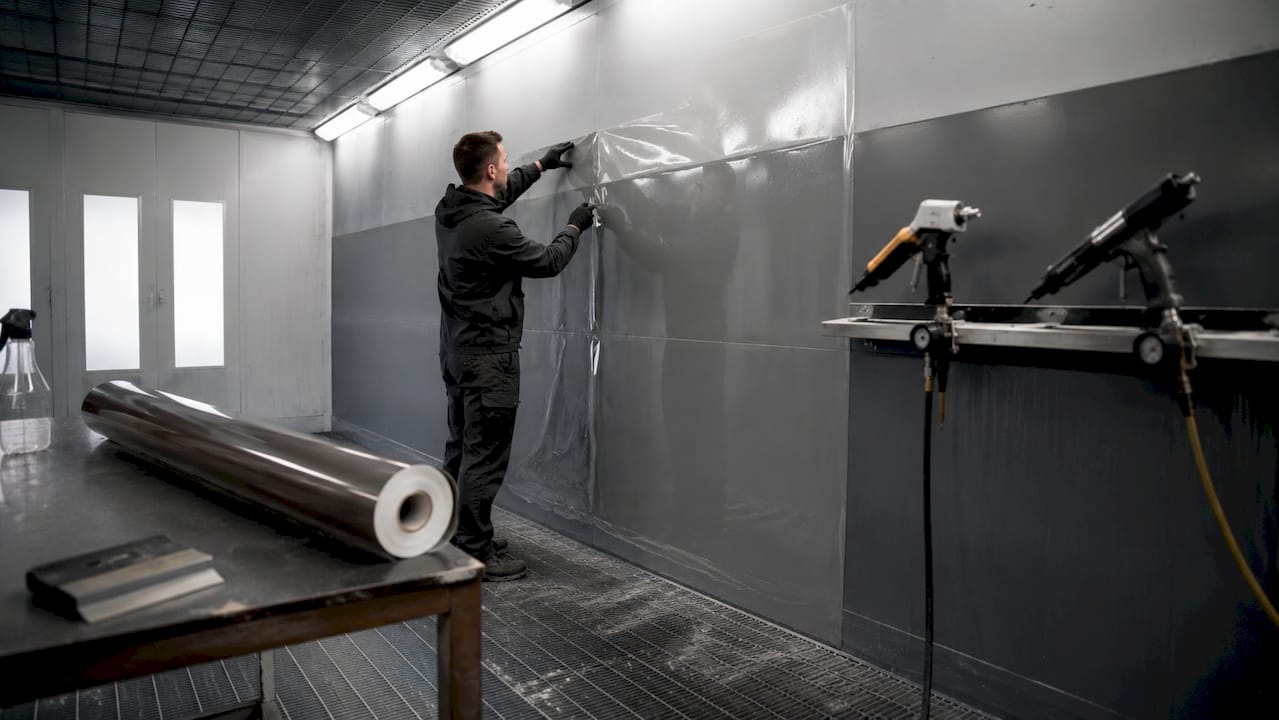
Standard static cling films hold position through electrostatic attraction but do not anchor overspray. Corona-treated films do both. The distinction matters in high-volume booths where multiple coats are applied in a single session. Electrostatic films reduce application defects like wrinkles and bubbles that trap air and create surface irregularities under paint.
Pro Tip: Clean booth walls with an isopropyl alcohol wipe before applying electrostatic film. Even a thin layer of silicone or wax residue breaks the static bond and causes the film to lift at the edges during painting.
Key operational benefits for spray booth use include:
- Faster wall and floor coverage compared to tape-and-paper masking systems
- No adhesive transfer to booth surfaces after removal
- Repositionable during installation without tearing or leaving marks
- Compatible with infrared and convection curing cycles when heat-rated grades are specified
2. Film types and grades: what the resistivity numbers mean
Not all electrostatic films perform the same function. The industry recognizes three distinct categories based on surface resistivity, and choosing the wrong one causes failures that are difficult to trace.
Insulating films have surface resistivity above 10^14 Ω/sq. Standard polyethylene sheeting falls here. These films build and hold static charge rather than dissipating it. In electronics manufacturing, they are a contamination risk, not a solution.
Anti-static and static dissipative films operate in the 10^6 to 10^12 Ω/sq range. Electrostatic films allow static charges to dissipate gradually and safely within this controlled range. Typical anti-static polyethylene film achieves surface resistance below 10^10 Ω/sq, which delivers consistent protection in most manufacturing environments.
Conductive films fall below 10^6 Ω/sq and are used where rapid charge equalization is required, such as in semiconductor packaging.
Substrate material determines the film’s secondary properties:
| Substrate | Key advantage | Best application |
|---|---|---|
| Polyethylene (PE) | Flexibility, low cost | General surface masking, spray booths |
| Polypropylene (PP) | Chemical resistance | Industrial painting, solvent-heavy processes |
| Polyester (PET) | Thermal stability, clarity | High-temperature curing, optical inspection |
Films manufactured in cleanroom conditions carry a lower intrinsic particle load. That matters in ISO Class 5–7 environments where even the film itself can become a contamination source if not produced under controlled conditions.
Pro Tip: Always request the surface resistivity certificate from your film supplier. A label that reads “anti-static” without a resistivity value is not a specification. It is marketing language.
3. Labor savings and operational efficiency
The shift away from adhesive masking solutions to electrostatic films is driven by the hidden costs of adhesives: labor time, solvent use, and substrate damage. Static charge technology eliminates adhesive residue and provides immediate bonding without curing time. A technician can apply, reposition, and remove electrostatic film in a fraction of the time required for tape-and-paper systems.
Adhesive masking requires surface preparation, careful tape application, and chemical solvent cleanup after removal. Electrostatic films require none of those steps. The film goes on, does its job, and comes off cleanly. That cycle repeats without degrading the substrate.
The operational benefits compound across a full production shift:
- No waiting for adhesive to cure before painting begins
- No solvent wipe-down after masking removal
- Reusable film reduces per-job material consumption
- Fewer rework cycles because residue contamination is eliminated
- Lower risk of substrate damage from aggressive adhesive removal
For auto body shops running multiple jobs per day, the time savings per vehicle translate directly into throughput. For industrial painting facilities covering large surface areas, the reduction in material waste and chemical use has measurable environmental impact. Fewer solvents in the shop means lower VOC exposure for workers and simpler compliance with environmental regulations.
4. Surface preparation: the factor most professionals underestimate
Surface cleanliness is the single most critical variable in electrostatic film performance. Even microscopic contaminants disrupt electrostatic adhesion, causing the film to lift, bubble, or fail to bond entirely. This is the most common reason professionals report poor results with electrostatic films, and it is entirely preventable.
The preparation sequence is straightforward:
- Remove loose dust and debris with a dry microfiber cloth or compressed air.
- Wipe the surface with isopropyl alcohol or an approved solvent to remove grease, wax, and silicone.
- Allow the surface to dry completely before applying the film.
- Apply the film with firm, even pressure from the center outward to prevent air pockets.
- Inspect edges and corners, pressing firmly where the film meets irregular geometry.
Matching film grade to process sensitivity is equally important. Corona-treated films are the correct choice for spray booth masking where overspray capture is the goal. Standard static cling grades work for temporary surface protection during transport or assembly. Using a standard cling film in a paint booth will not anchor overspray, and the result is contaminated finishes.
IEC 61340-5-1 provides the benchmark for ESD control procedures in manufacturing. Consulting this standard when specifying film grades removes guesswork from the selection process and gives procurement teams a defensible specification to present to suppliers.
Pro Tip: For complex curved surfaces like wheel arches or door jambs, warm the film slightly with a heat gun set to low. Gentle heat increases flexibility and allows the film to conform to compound curves without lifting at the edges.
5. Why triboelectric charging from conventional films is a hidden defect source
Peeling conventional plastic film from a surface generates triboelectric charge. That charge can reach thousands of volts in milliseconds. Triboelectric charging from peeling conventional films can damage sensitive integrated circuits without any visible discharge event. The failure shows up later as a latent defect, which is far more expensive to diagnose than an immediate failure.
Anti-static films prevent this by managing surface resistivity within the 10^6 to 10^12 Ω/sq range. Charge dissipates gradually rather than building to a destructive spike. For automotive electronics manufacturing, where ECUs, sensors, and driver-assistance modules are handled alongside painted components, this protection is not optional.
The misconception that all static films are alike is widespread and costly. A film labeled “anti-static” without a resistivity specification may perform no better than standard polyethylene. Specifying films by resistivity range, substrate, and manufacturing environment closes that gap and prevents the latent failures that inflate warranty costs.
6. Dustfreefilm’s multi-layer approach and what it adds
Dustfreefilm has supplied electrostatic booth protection since 2012, focusing specifically on spray booth wall and floor applications. Their multi-layer film system addresses a limitation of single-layer electrostatic films: once the outer surface is contaminated with overspray, the entire film must be replaced. Multi-layer construction allows technicians to peel away the contaminated outer layer, exposing a fresh surface underneath without removing and reapplying the base film.
The patented dispenser system Dustfreefilm developed for quick, bubble-free installation solves the most common application failure point. Bubbles trapped under electrostatic film break the static bond locally, creating zones where the film lifts and allows dust or overspray to migrate behind it. The dispenser applies consistent pressure across the full film width during installation, eliminating that failure mode.
Heat resistance is a specification that separates booth-grade electrostatic films from general-purpose static cling materials. Dustfreefilm’s products are rated for the temperature cycles of both infrared and convection curing, which means the film stays bonded during the bake cycle and releases cleanly afterward. That combination of anti-static film performance and thermal stability is what makes the product viable in production environments rather than just controlled laboratory conditions.
Key takeaways
Electrostatic films deliver measurable advantages in paint quality, labor efficiency, and defect reduction when the correct grade is specified and surfaces are properly prepared.
| Point | Details |
|---|---|
| Specify by resistivity, not label | Require a surface resistivity certificate; “anti-static” without a value is not a specification. |
| Corona treatment is required for overspray capture | Standard static cling films do not anchor wet paint; corona-treated grades do. |
| Surface prep determines adhesion quality | Solvent-wipe all surfaces before application to prevent film lift and bond failure. |
| Multi-layer films extend service life | Peeling contaminated outer layers avoids full film replacement during long paint sessions. |
| ESD losses justify film investment | Component failure rates of 8–33% from ESD in uncontrolled environments make anti-static films a cost-control tool. |
What I’ve learned from watching shops get this wrong
The most expensive mistake I see in spray booths is treating electrostatic film as a commodity. A shop buys the cheapest roll available, slaps it on a dirty wall, and then blames the film when it falls off mid-job or fails to capture overspray. The film is not the problem. The specification and the prep work are.
The second mistake is assuming that any film labeled “anti-static” provides ESD protection. I have seen facilities use standard polyethylene sheeting with an anti-static additive that degrades within weeks of exposure to UV or cleaning solvents. The resistivity climbs back above 10^14 Ω/sq, and the film becomes an insulator. Nobody tests it again because it still looks the same.
The trend I find genuinely encouraging is the move toward multi-layer systems with verified resistivity at each layer. That approach removes the guesswork from booth maintenance and gives quality managers a repeatable process rather than a hope-for-the-best approach. The shops that have adopted this method report fewer rework cycles and cleaner finishes, not because they changed their paint or their technique, but because they controlled the environment.
Material innovation in this space is moving toward thinner films with higher surface energy and better thermal stability. That means lighter rolls, faster installation, and compatibility with higher-temperature curing cycles. For manufacturing plants running tight cycle times, those properties translate directly into throughput.
— Dust
Protect your spray booth with Dustfreefilm
Dustfreefilm’s wall and floor protection systems are built specifically for the demands of automotive refinishing and industrial painting. The multi-layer electrostatic film construction, combined with the patented dispenser system, gives your team a repeatable installation process that takes minutes rather than hours.
Every roll is manufactured to European quality standards and rated for heat-cure cycles, so the film performs through the full paint and bake sequence without lifting or leaving residue. Whether you run a single-bay body shop or a multi-line industrial facility, Dustfreefilm offers spray booth wall and floor protection in configurations that match your booth dimensions and production volume. Bulk purchasing options and custom configurations are available for large-scale operations.
FAQ
What are the main advantages of electrostatic films in spray booths?
Electrostatic films adhere without adhesive, install faster than tape-and-paper systems, and remove without leaving residue. Corona-treated grades also capture wet overspray, preventing dry flakes from contaminating paint finishes.
How do electrostatic films work without adhesive?
Electrostatic films bond to surfaces through static charge. The film’s surface holds a charge that attracts it to the substrate, creating a temporary bond strong enough for masking and protection without any glue or tape.
Are electrostatic films effective for ESD protection in electronics manufacturing?
Yes, when specified correctly. Anti-static and static dissipative films with surface resistivity between 10^6 and 10^12 Ω/sq prevent charge buildup that causes component failures. Films without a verified resistivity value do not provide reliable ESD protection.
What is the difference between anti-static and corona-treated electrostatic films?
Anti-static films manage surface charge to prevent ESD damage. Corona-treated films have elevated surface energy that anchors wet paint overspray. Spray booth masking requires corona-treated grades; ESD protection in electronics requires anti-static or static dissipative grades.
How should I prepare a surface before applying electrostatic film?
Wipe the surface with isopropyl alcohol or an approved solvent to remove grease, wax, and silicone, then allow it to dry fully before applying the film. Microscopic contaminants break electrostatic adhesion and cause the film to lift during use.