

TL;DR:
- Airless spray atomizes coatings using hydraulic pressure without involving compressed air, suitable for high-speed industrial applications. It offers faster throughput, higher transfer efficiency, and the ability to spray high-viscosity materials without thinning but produces coarser finishes and requires strict safety protocols. Proper equipment specifications, safety training, and solvent-resistant booth protection are essential for successful airless coating operations.
Airless spray application atomizes coatings through hydraulic pressure alone — no compressed air involved. A high-pressure piston pump forces fluid through a small hardened-carbide tip orifice; the resulting high-speed sheet of material hits the atmosphere and breaks into droplets. That’s the whole mechanism. For facility managers running industrial spray booths, the practical decision rule is straightforward: choose airless when you need speed, mil-build, and transfer efficiency over ultra-fine Class A decorative finishes.
Primary industrial uses where airless excels:
- High-speed protective and industrial coatings on large surface areas
- Thick-film applications (epoxies, zinc-rich primers, elastomeric coatings)
- Situations where masking can be minimized and cut-line sharpness is acceptable
- High-viscosity materials that would require heavy thinning under HVLP
Pro Tip: When writing procurement specs, call out three things explicitly: maximum operating pressure (psi), tip orifice size range (e.g., .017–.023 inch), and rated hose length. Suppliers who cannot answer all three are not ready to quote your booth.
Table of Contents
- How does airless spray application work?
- What are the real benefits and limitations of airless spraying?
- What equipment specs should you require for airless systems?
- How do you operate airless equipment safely in a spray booth?
- What maintenance and troubleshooting does airless equipment need?
- How should you protect your booth during airless application?
- Key Takeaways
- The spec gap nobody talks about
- Booth protection built for airless environments
- Useful sources
How does airless spray application work?
Hydraulic atomization drives the entire process. The pump builds pressure in the fluid line; when the operator pulls the trigger, paint accelerates through the tip orifice at high velocity. Friction between the exiting fluid sheet and the surrounding air disrupts it into fine droplets. No compressed air touches the fluid stream at any point.
Four variables control droplet size and fan pattern: pump pressure, tip orifice diameter, tip fan angle, and fluid viscosity. Raise pressure or reduce orifice size and you get finer atomization. Increase viscosity and you need more pressure to maintain the same droplet quality. Tip fan angle (typically 40°–80°) sets the spray width without changing flow rate.
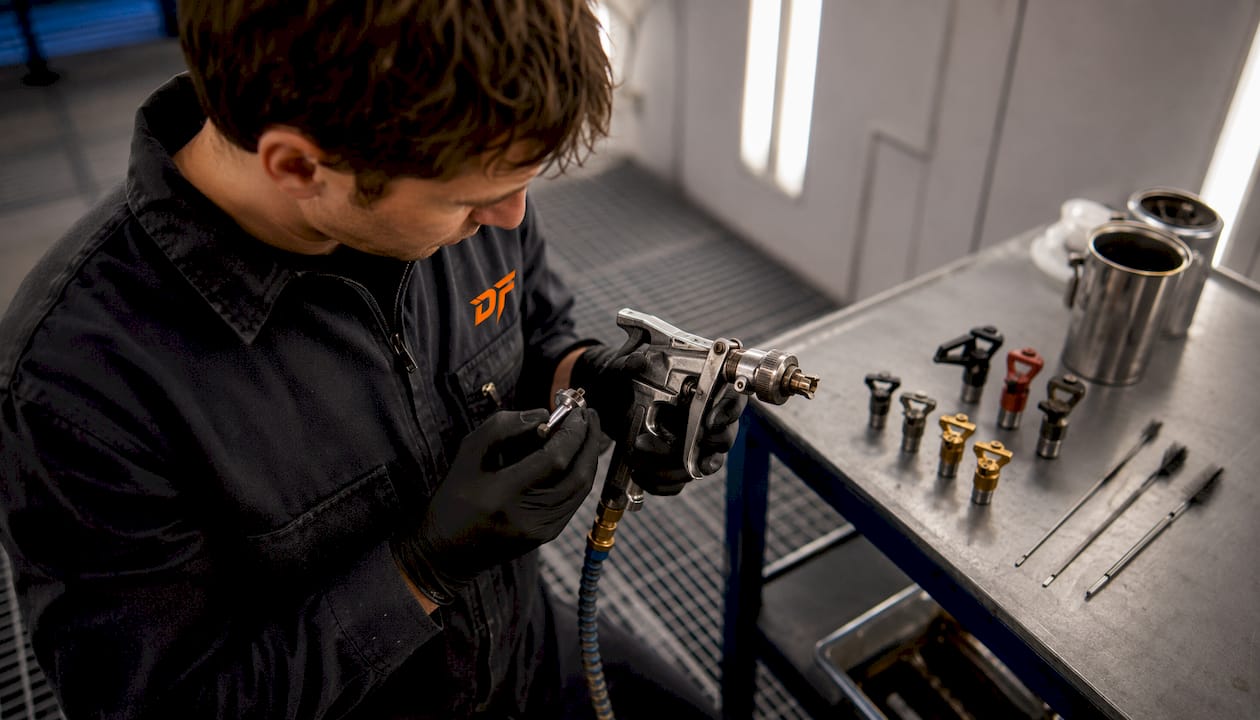
| Pressure Band | Typical Tip Orifice | Common Applications |
|---|---|---|
| 500–4,500 psi | — | Thin primers, stains, lacquers |
| 500–4,500 psi | — | Latex paints, medium-body coatings |
| 500–4,500 psi | — | Epoxies, urethanes, thick protective coatings |
| 4,500–7,500 psi | — | High-build mastics, zinc-rich primers |
Because no compressed air enters the fluid stream, airless systems reduce overspray and fog compared with conventional air-spray. Less airborne mist means booth exhaust filters load more slowly and booth airflow can be planned around lower particulate volumes — a real operational advantage for high-throughput facilities. Airless also lets many coatings spray without thinning, which shortens drying time and cuts solvent release.
What are the real benefits and limitations of airless spraying?
Speed is the headline. Airless application runs up to 15 times faster than brush, roller, or low-pressure HVLP methods for equivalent area coverage. On a production booth running protective coatings, that multiplier translates directly to throughput and labor cost.
The other core advantages:
- Higher transfer efficiency than air-spray, meaning more material lands on the substrate
- Ability to spray high-viscosity coatings undiluted, preserving film integrity and reducing drying time
- Consistent mil-build across large surfaces without roller stipple or brush marks
- Elimination of compressed-air impurities that can cause film defects in thick-coat industrial applications
Limitations matter just as much. Airless atomization is coarser than air-spray, so feathering and blending control are limited. Airless is not recommended for Class A decorative finishes — automotive topcoats and fine furniture work still belong to air-spray or air-assisted airless. High mechanical shear from the pump can also alter thixotropic coatings, so test any shear-sensitive material at machine pressure on a small lot before committing to full production.
| Method | Speed | Finish Quality | Overspray/Fog | Material Range | Typical Use |
|---|---|---|---|---|---|
| Airless | Very high | Industrial/protective | Low | Medium–high viscosity | Structural coatings, large areas |
| Air-assisted airless | High | Good | Low–medium | Medium viscosity | Production lines needing quality + speed |
| HVLP/Air-spray | Low–medium | Class A decorative | High | Low–medium viscosity | Automotive, fine finishes |
Air-assisted airless runs at roughly 700–900 psi fluid pressure with 15–30 psi air assist at the tip, giving finer atomization than pure airless while keeping production rates high. That’s the right call when your booth handles both protective and semi-decorative work.
What equipment specs should you require for airless systems?
Read pump type, max working pressure, flow rate, and tip orifice compatibility first — everything else follows from those four numbers. Piston pumps handle the widest pressure and viscosity range and dominate industrial booth applications. Diaphragm pumps suit lower-viscosity materials and smaller volumes.
| Spec Term | What It Means | Booth/Film Impact |
|---|---|---|
| Max working pressure (psi) | Upper safe operating limit | Must exceed material’s required atomization pressure |
| Flow rate (GPM) | Volume delivered per minute | Sets production speed; size hose ID to match |
| Tip orifice size (.XXX in) | Controls flow and fan width | Determines overspray volume and film loading rate |
| Hose length rating | Pressure drop per foot of hose | Longer hoses need higher pump pressure to compensate |
| Filtration rating (mesh) | Particle size the system passes | Coarser mesh risks tip plugging; finer mesh slows flow |
Typical working ranges run 500–4,500 psi, with some industrial pumps rated to 7,500 psi for high-build applications. Procurement checklist for RFQs:
- Minimum pump psi at rated flow (not just max static pressure)
- Tip orifice compatibility range and recommended tip codes for your coatings
- Hose length rating and inside diameter for your booth footprint
- Filtration mesh size and location (inline, gun filter, or both)
- Service SLA and spare-parts availability in your region
How do you operate airless equipment safely in a spray booth?
The single highest-priority safety issue is injection injury. A high-pressure airless stream can penetrate skin without leaving a visible entry wound, and the resulting injection injury requires immediate hospital treatment to prevent systemic complications. Every operator must know this before touching the gun. Post the emergency protocol at the booth entrance and include it in onboarding for any new technician.
Operational best practices:
- Wear solvent-resistant gloves, eye protection, and a respirator rated for the coating’s VOC profile
- Maintain gun distance of 12–14 inches from the substrate; closer distances increase mil-build and runs, farther distances increase overspray
- Keep gun speed consistent (roughly 12–18 inches per second) and overlap each pass by 50%
- Never point the gun at any person, and engage the trigger safety whenever the gun is not actively spraying
- Adjust booth airflow downward from air-spray settings — lower fog volume means less air velocity is needed to clear the booth, which also reduces overspray drift
Pro Tip: Place the pump outside or at the booth perimeter and run a longer rated hose to the gun. Remote pump placement cuts operator movement, reduces fatigue on long shifts, and speeds up material changeovers without moving heavy equipment.
What maintenance and troubleshooting does airless equipment need?
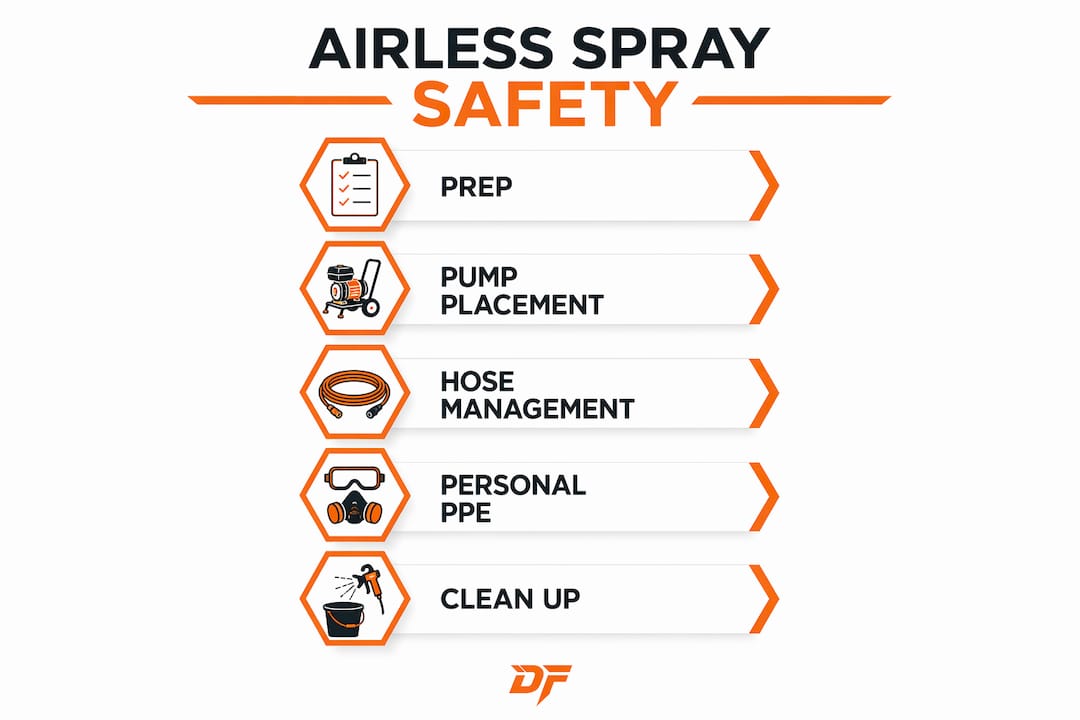
Strict maintenance prevents the three most common production failures: tip wear, pump seal degradation, and blocked orifices. Tip wear changes flow and atomization gradually — operators often don’t notice until finish quality has already dropped. Build tip-wear checks into the daily log and keep spare tips on hand proportional to your runtime.
Routine schedule:
- Daily: Inspect tip for wear (tailing, uneven fan, increased flow), flush pump and hose at end of shift, check gun filter
- Weekly: Inspect pump seals for leaks, check hose for kinks or abrasion, verify pressure gauge accuracy
- Monthly: Full pump disassembly and seal inspection, filtration system service, hose pressure-drop test
| Symptom | Probable Cause | First-Step Fix |
|---|---|---|
| Tailing or uneven fan | Worn or clogged tip | Rotate or replace tip |
| Spitting / pulsing flow | Air in fluid line or worn pump packings | Bleed line; inspect packings |
| Loss of pressure at gun | Hose pressure drop or pump wear | Check hose length/ID; test pump output at inlet |
| Streaky or heavy center | Wrong tip size for material viscosity | Switch to wider fan angle or smaller orifice |
| Material drying in hose | Inadequate end-of-shift flush | Flush immediately after shutdown with appropriate solvent |
How should you protect your booth during airless application?
Select dust-protection films rated for high-solvent, high-mil environments. Airless application deposits more material per pass than HVLP, which means overspray rebound and particulate load on booth walls and floors are both higher. Films that cannot handle solvent contact or elevated curing temperatures will degrade and shed contamination into your finish.
Film attributes to specify:
- Solvent resistance matched to your coating chemistry (check the film’s chemical resistance chart against your material’s SDS)
- Heat tolerance for curing temperatures in your booth (typically 140°F–180°F for forced-cure cycles)
- Static-dissipative surface to prevent particulate attraction during and after application
- Tape-free adhesive profile for fast installation without residue risk
- Multi-layer construction for high-traffic booths where peel-and-refresh between jobs is part of the workflow
For installation, sequence matters. Install films before pump-up and airflow testing so you can confirm film edges are sealed and no wrinkling occurs under booth air velocity. Mask film edges at wall-to-floor transitions — airless overspray at high mil-build can work under an unsealed edge and lift the film mid-job. Conduct a short airflow test at operating velocity before the first production run to confirm film stability.
Pro Tip: Dustfreefilm’s patented dispenser system lets crews install multi-layer wall and floor protection without tape or bubbles in minutes. Specifying the dispenser workflow as part of your booth-prep SOP reduces changeover time and keeps contamination risk consistent across shifts.
Key Takeaways
Airless spray application is the fastest, most transfer-efficient method for industrial protective coatings, but it requires precise equipment specs, strict safety protocols, and solvent-resistant booth protection to deliver consistent results.
| Point | Details |
|---|---|
| Speed advantage | Airless runs up to 15× faster than brush, roller, or HVLP for equivalent coverage. |
| Spec the pump correctly | Require minimum pump psi at rated flow, tip orifice range, hose length rating, and filtration mesh in every RFQ. |
| Injection injury is the top safety risk | Train all operators before first use and post the hospital-referral protocol at the booth entrance. |
| Daily tip checks prevent defects | Tip wear changes flow and atomization gradually; inspect and swap tips daily in high-volume booths. |
| Dustfreefilm for booth protection | Specify solvent-resistant, heat-tolerant, static-dissipative films with the patented dispenser system for fast, tape-free installation matched to airless overspray profiles. |
The spec gap nobody talks about
Most facilities get the pump spec right. They read the pressure rating, match it to the coating datasheet, and move on. What gets skipped is the film spec — and that’s where finish defects actually originate in airless booths.
Airless deposits more material per pass than any other method. That means more solvent contact on booth walls, more particulate rebound, and more thermal stress during forced-cure cycles. A film that works fine in an HVLP booth can blister, lift, or shed contamination within a single shift under airless conditions. The coating application process is only as clean as the surface it happens inside.
The other overlooked item: injection injury training. It gets mentioned in safety manuals and then skipped in actual onboarding because the gun looks like every other spray gun. It isn’t. A high-pressure airless stream at 3,000 psi can penetrate a work glove. That’s not a theoretical risk — it’s a documented emergency-room scenario. Build the protocol into the SOP, not just the manual.
Operational priorities, in order: train on injection safety first, spec the film for your actual coating chemistry second, set the maintenance cadence before production starts. Everything else — tip selection, hose routing, booth airflow — follows naturally once those three are locked in. Understanding dust risks in coating operations is part of that foundation, not an afterthought.
Booth protection built for airless environments
Airless application puts more demand on booth surfaces than any other spray method — higher solvent load, more overspray rebound, and forced-cure heat cycles that standard films aren’t built for.
Dustfreefilm manufactures multi-layer electrostatic wall and floor protection films specifically rated for these conditions: solvent-resistant, heat-tolerant to forced-cure temperatures, and static-dissipative to keep particulates off fresh coatings. The patented dispenser system installs bubble-free in minutes without tape, so changeovers between jobs don’t eat into production time. Facilities running high-volume airless operations use the multi-layer peel-and-refresh format to maintain a clean booth surface across every shift without stopping for full re-lining.
Request a quote or download the technical spec sheet at Dustfreefilm to match the right film configuration to your booth dimensions and coating chemistry.
Useful sources
| Source | Best For |
|---|---|
| Paint and Coatings Association (paint.org) | Safety guidance, injection injury protocols, thixotropic coating warnings, regulatory context |
| Graco — Intro to Airless Paint Spraying | Tip sizing, atomization mechanics, speed benchmarks, tip-wear maintenance |
| Finish Systems — Airless Atomization Overview | Pressure-to-tip mapping, technical atomization explanation |
| MDPI Coatings Research | Academic validation on atomization quality and film defect reduction |
| Wagner Group — Application Notes | Ergonomics, pump placement, hose length guidance |
| Dustfreefilm — Protective Films for Spray Booths | Film selection, installation workflows, efficiency ROI for booth operators |
| Dustfreefilm — Preventing Paint Defects | Defect prevention strategies tied to booth prep and film use |