

TL;DR:
- Ambient dust control in manufacturing involves integrated source capture, ambient filtration, and disciplined housekeeping to reduce airborne and settled dust hazards. Proper process integration, accurate sizing, and regular revalidation of dust hazard analyses ensure system effectiveness and safety compliance. Combining these layered controls protects personnel, maintains product quality, and prevents combustible dust incidents.
Ambient dust control for manufacturing is the systematic, facility-wide approach to reducing both airborne particulate and settled dust through integrated collection systems, source capture, and structured housekeeping. Most plant managers treat dust as a nuisance. The reality is that uncontrolled dust is a production defect, a compliance liability, and in facilities handling combustible materials, a life-safety hazard. The layered strategy combining source capture, ambient air filtration, and disciplined housekeeping is the recognized industry standard for industrial dust management. Technologies like cartridge dust collectors, local exhaust ventilation, and automated suppression systems each play a defined role in this framework.
What are the primary components of ambient dust control for manufacturing?
Effective dust control uses a layered approach combining source capture and ambient air cleaning to reduce background haze and settled dust. Ambient systems handle the facility-wide load. Source capture handles the concentrated emission points. Neither works well without the other.
Ambient air filtration systems
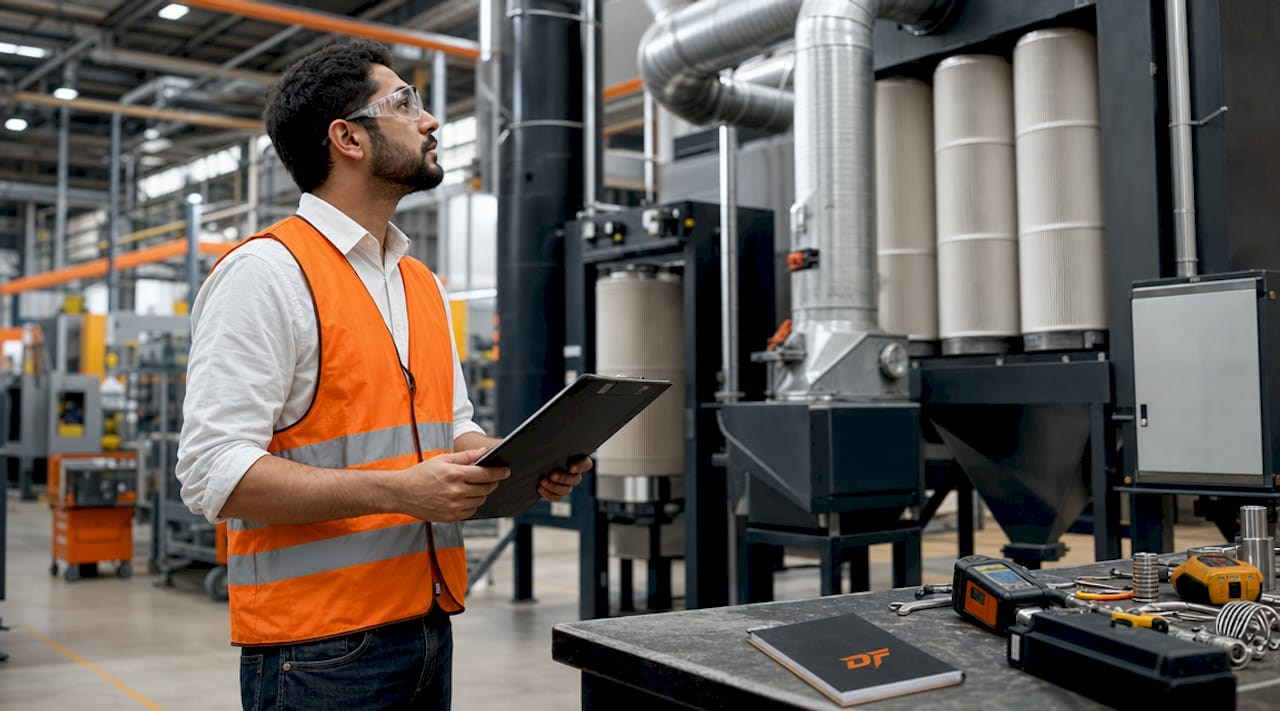
Ambient dust collection systems typically use cartridge-style particulate filters sized to match airflow and dust loading for effective haze reduction. These units recirculate facility air through high-efficiency filter media, capturing fine particulate that escapes source capture hoods or migrates from transfer points. Key performance metrics include air-to-cloth ratio, which measures how much airflow passes through each square foot of filter media, and differential pressure, which signals when filter loading requires pulse-jet cleaning or replacement. A well-sized ambient system maintains consistent negative pressure across the work zone without starving process ventilation.
Source capture and local exhaust ventilation
Local exhaust ventilation (LEV) systems capture dust at the point of generation before it enters the ambient air. Grinding stations, bagging lines, and mixing equipment all benefit from close-capture hoods or enclosures connected to dedicated collectors. Effective dust control depends not just on filter efficiency, but also on hooding, duct design, and capturing to prevent leakage and settling. Ambient systems should be viewed as facility-wide support, not substitutes for source capture at known emission points.
Dust suppression: dry vs. wet systems
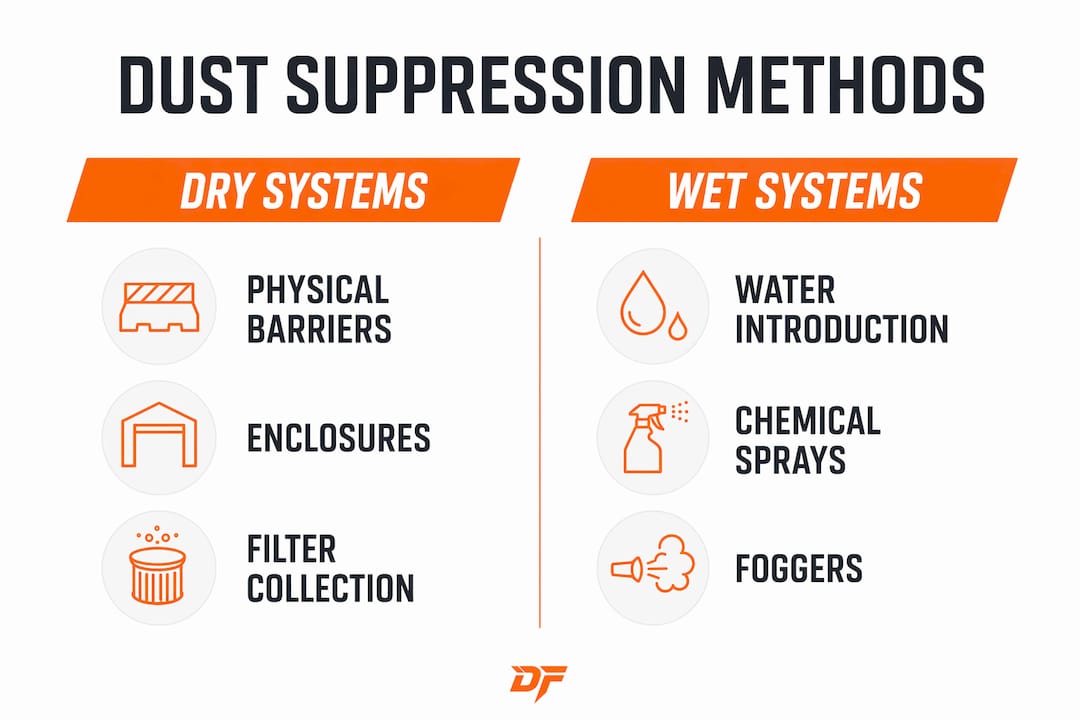
Dry suppression uses physical barriers, enclosures, and filter-based collection. Wet suppression introduces water or chemical misting at transfer points to agglomerate dust particles before they become airborne. Wet systems work well for bulk material handling, quarrying, and outdoor stockpiles. Dry systems are preferred in enclosed manufacturing where moisture would damage product or equipment. Many facilities use both, applying wet suppression at outdoor receiving areas and dry cartridge collection inside the plant.
Housekeeping as a control layer
Control strategies that ignore settled dust risk leaving combustible fuel load available for re-aerosolization and secondary explosions. Housekeeping is not a janitorial function in this context. It is a hazard control that removes the accumulated fuel load that ambient filtration cannot fully address. Industrial vacuum systems rated for combustible dust, pneumatic conveying, and wet sweeping are the accepted methods. Dry sweeping with brooms is prohibited in most combustible dust environments because it re-suspends fine particles.
Pro Tip: Use HEPA-rated or listed vacuum equipment for combustible dust housekeeping. Standard shop vacuums can ignite fine metallic or organic dust through static discharge or motor sparks.
How does process integration improve ambient dust control effectiveness?
Process integration is critical. Simply scaling airflow is insufficient without aligning dust control to how dust is generated and dispersed. A collector running at full capacity during a low-emission phase wastes energy and accelerates filter wear. The same collector running at reduced capacity during peak discharge misses the capture window entirely. The solution is operational timing tied directly to process states.
Here is how to build a process-integrated ambient dust control strategy:
-
Map dust generation events. Identify every point in your process where dust is released: loading, unloading, blending, conveying, and packaging. Document the timing, duration, and estimated volume of each event. This map becomes the operational schedule for your collection systems.
-
Synchronize collector operation with peak discharge. Event-based collector operation aligns with peak dust discharge moments to maximize capture and efficiency. Run collectors at full capacity during loading and blending cycles, then reduce to maintenance mode between events. This approach cuts energy consumption and extends filter life without sacrificing capture performance.
-
Install interlocks and automated controls. Tie collector start/stop sequences to process equipment signals. When a conveyor starts, the associated collector starts. When a mixer stops, the collector runs for a defined purge period before shutting down. Programmable logic controllers (PLCs) handle this reliably in most modern facilities.
-
Maintain controlled negative pressure in enclosed processes. Enclosed mixing vessels, bagging stations, and transfer chutes should operate under slight negative pressure relative to the surrounding work area. This prevents dust from escaping the enclosure during process disturbances like lid opening or material surges.
-
Verify airflow balance after any process change. Adding or removing equipment, changing production rates, or modifying ductwork all affect system balance. Rebalance airflow after every significant process change to maintain design capture velocities.
Pro Tip: Install magnehelic gauges or digital pressure monitors at key duct branches. Real-time differential pressure readings tell you immediately if a branch has lost capture velocity, long before visible dust accumulation confirms the problem.
What are the best practices for sizing and maintaining dust control systems?
Proper sizing and ongoing maintenance determine whether a dust control system delivers its design performance or slowly degrades into a compliance liability. Most underperforming systems were either undersized at installation or never properly commissioned.
Sizing ambient dust collectors
Ambient dust collection systems must be sized based on the total airflow volume of the space, the dust generation rate, and the particle size distribution of the dust. Undersized units recirculate contaminated air without achieving meaningful haze reduction. Oversized units waste capital and operating cost. The air-to-cloth ratio for cartridge collectors typically ranges from 4:1 to 10:1, depending on dust type and loading. Heavier, stickier dusts require lower ratios to prevent premature filter blinding.
Ductwork design also affects sizing. Efficient airflow system design requires matching pipe sizing and flow rates to maintain transport velocity throughout the duct network. Undersized ducts create excessive pressure drop. Oversized ducts allow dust to settle inside the ductwork, creating both a maintenance burden and a combustible dust accumulation point.
Commissioning checks
Commissioning dust suppression systems should include testing water supply, air velocities, capture efficiency, and automated controls. For dry collection systems, commissioning includes verifying design airflow at each hood, testing interlock sequences, confirming pulse-jet cleaning cycles, and measuring differential pressure across clean filters as a baseline. Document every measurement. These baseline values become the reference for future maintenance inspections.
Maintenance schedule by system type
| System component | Inspection frequency | Key indicator |
|---|---|---|
| Cartridge filters | Monthly visual, quarterly differential pressure check | Pressure drop above design baseline signals replacement |
| Pulse-jet cleaning system | Monthly function test | Failed pulses allow filter blinding and airflow loss |
| Ductwork and hoods | Semi-annual internal inspection | Dust accumulation inside ducts signals low transport velocity |
| Housekeeping equipment | After each use | Filter condition and suction performance confirm readiness |
Housekeeping frequency must reflect real accumulation patterns, not uniform schedules. Areas near transfer points and elevated surfaces accumulate dust faster than open floor areas. Assign cleaning frequencies by zone based on measured accumulation rates, not convenience.
How to develop a dust mitigation plan for your facility
A Dust Mitigation Plan (DMP) is a formal document that identifies dust sources, specifies control measures, defines monitoring triggers, and establishes recordkeeping requirements. Dust Mitigation Plans are often mandated by environmental and safety permits, and failure to maintain one can result in fines ranging from hundreds to thousands of dollars per day. The DMP is not a one-time document. It is a living operational record.
Follow these steps to build a compliant and functional DMP:
-
Conduct a dust source inventory. Walk the facility and document every dust-generating operation, the material involved, the generation rate, and the current control measure in place. Include both process dust and maintenance activities like grinding or cutting.
-
Perform a Dust Hazard Analysis. NFPA requires a Dust Hazard Analysis to identify dust fire and explosion risks, and this analysis must be repeated every five years or sooner if process changes occur. The DHA determines which areas require explosion-rated equipment, suppression systems, or enhanced housekeeping protocols. It directly informs the engineering controls specified in your DMP.
-
Define control measures and monitoring triggers. For each dust source, specify the primary control (LEV, enclosure, wet suppression), the ambient backup (cartridge collector, air filtration unit), and the housekeeping protocol. Set measurable monitoring triggers, such as visible dust accumulation on horizontal surfaces or differential pressure readings outside the acceptable range.
-
Integrate with OSHA and environmental permit requirements. OSHA’s General Duty Clause and specific standards like 29 CFR 1910.94 govern dust control in manufacturing. Environmental permits may specify opacity limits, emission thresholds, or required control technologies. Your DMP must address all applicable requirements in a single coordinated document. Review dust control in industrial safety to understand how permit obligations connect to operational controls.
-
Train staff and document procedures. Operator training is the final layer of any dust control program. Workers must understand why controls exist, how to recognize control failures, and what to do when a system goes down. Document training records, inspection logs, and corrective actions as part of your DMP recordkeeping.
Key takeaways
Effective ambient dust control in manufacturing requires layered systems combining source capture, ambient filtration, process-integrated operation, and disciplined housekeeping to meet safety, quality, and compliance standards.
| Point | Details |
|---|---|
| Layer your controls | Combine source capture, ambient filtration, and housekeeping rather than relying on any single method. |
| Integrate with process events | Run collectors synchronized with peak dust generation to maximize capture and reduce energy use. |
| Size and commission correctly | Match airflow and air-to-cloth ratio to dust load; document baseline measurements at commissioning. |
| Right-size housekeeping by zone | Clean high-accumulation areas near transfer points more frequently than open floor zones. |
| Build and maintain a formal DMP | A Dust Mitigation Plan with DHA compliance protects against fines and guides engineering decisions. |
What I’ve learned about dust control that most guides won’t tell you
The most common mistake I see in manufacturing facilities is treating ambient dust collection as the primary control and housekeeping as an afterthought. The engineering logic runs backward. Ambient filtration handles the airborne fraction. Housekeeping handles the settled fraction. Both fractions are hazardous. Ignoring either one means you are managing half the problem.
The second mistake is continuous operation without process integration. Running a collector 24 hours a day sounds thorough. In practice, it burns out filters faster, wastes energy, and gives operators a false sense of security because the system is always “on.” Event-based operation, tied to actual dust generation moments, outperforms continuous fixed operation in every measurable way: capture efficiency, filter life, and energy cost.
The third issue is DHA revalidation. Most facilities do their initial Dust Hazard Analysis and file it. Five years pass. Production rates change, new materials come in, equipment gets relocated. The DHA becomes a historical document rather than a living operational guide. Revalidating the DHA after every significant process change, not just on the five-year cycle, is the practice that separates facilities with strong safety records from those that discover gaps after an incident.
For plant managers prioritizing upgrades, start with source capture at your highest-emission points before investing in larger ambient systems. A well-hooded LEV at a bagging station reduces the ambient load more effectively than doubling the ambient collector capacity. Then layer in best practices for dust prevention to build a program that holds up under audit and under real operating conditions.
— Dust
How Dustfreefilm supports dust-free manufacturing environments

Dustfreefilm has specialized in dust protection solutions for industrial environments since 2012. In spray booths and painting facilities within manufacturing plants, ambient dust control efforts can be undermined by contamination entering the booth itself during coating operations. Dustfreefilm’s multi-layer electrostatic booth wall and floor protectors create a physical barrier that prevents settled dust and overspray from contaminating fresh paint surfaces. The patented dispenser system allows quick, bubble-free installation, making it practical for high-throughput industrial operations. If your facility handles automotive refinishing, industrial painting, or coatings work alongside broader manufacturing processes, Dustfreefilm’s products complement your ambient dust control program at the point where finish quality is most at risk. Request a quote to find the right configuration for your operation.
FAQ
What is ambient dust control in manufacturing?
Ambient dust control in manufacturing is the facility-wide management of airborne and settled dust using integrated systems including cartridge dust collectors, local exhaust ventilation, and structured housekeeping programs. It targets both the airborne haze and the surface dust layers that source capture alone cannot fully address.
How often should a Dust Hazard Analysis be performed?
NFPA requires a Dust Hazard Analysis every five years, or sooner if process changes occur that could affect dust generation, material properties, or equipment configuration. The DHA drives the engineering and operational controls specified in a facility’s Dust Mitigation Plan.
What is the difference between source capture and ambient dust collection?
Source capture uses hoods, enclosures, and local exhaust ventilation to capture dust at the point of generation before it enters the room air. Ambient dust collection handles the residual airborne particulate that escapes source capture and migrates through the facility. Both systems are required for effective industrial dust management.
Why is housekeeping considered a safety control, not just maintenance?
Settled dust on floors, beams, and equipment surfaces is a combustible fuel load. If re-aerosolized by a pressure wave or equipment disturbance, it can fuel a secondary explosion far more destructive than the initial event. Housekeeping removes that fuel load and is classified as a hazard control under NFPA combustible dust standards.
How do you size an ambient dust collector for a manufacturing plant?
Size ambient dust collectors based on the total room airflow volume, the dust generation rate, and the particle size distribution of the material. Maintain an air-to-cloth ratio appropriate for the dust type, typically between 4:1 and 10:1 for cartridge filters, and verify design airflow at each collection point during commissioning.