

TL;DR:
- Static electricity attracts dust, causing defects and increasing rework costs in paint facilities.
- Anti-static films neutralize surface charges, reducing dust adhesion and improving finish quality.
- Proper selection and implementation of anti-static solutions, combined with good airflow, optimize contamination control.
Facilities routinely invest in upgraded filters, pressure systems, and booth lighting to fight dust contamination, yet one root cause keeps triggering rework cycles: static electricity. A single charged surface can pull airborne particulates right onto a freshly prepped panel, even inside a well-maintained spray booth. Anti-static protective films address this problem at the source rather than chasing symptoms downstream. This article breaks down what anti-static films actually do, how to evaluate them against your facility’s real conditions, and what operational gains you can realistically expect once they are properly deployed.
Table of Contents
- Why static is a hidden threat in industrial painting
- How anti-static films work: The fundamentals
- Comparing anti-static films: Key features and selection factors
- Operational benefits: ROI, paint quality, and efficiency gains
- Why anti-static film ROI depends on more than just product specs
- Explore proven anti-static film solutions for your facility
- Frequently asked questions
Key Takeaways
| Point | Details |
|---|---|
| Tackle static-driven defects | Anti-static films help stop dust contamination for consistently higher paint quality. |
| Match film to your process | Effectiveness depends on choosing and testing films under your real operating conditions. |
| Boost ROI and efficiency | Fewer defects and easier maintenance translate to measurable cost and labor savings. |
| Not all films are equal | Key features like humidity resistance and durability separate top performers from generic options. |
Why static is a hidden threat in industrial painting
Walk through most auto body shops or industrial painting facilities and you will hear plenty of conversation about airflow, filter maintenance, and humidity control. Static electricity rarely comes up, and that is exactly the problem. Static charges build up on booth walls, floors, and work surfaces during normal operations, turning every surface into a dust magnet between paint jobs and even during application.
The consequences are not theoretical. Static electricity can attract dust to surfaces, cause parts to stick together, and discharge into nearby electronics, shortening their lifespan while driving up scrap and rework costs. In practical terms, this means a panel you cleaned and tacked off minutes ago may already be attracting fresh contamination by the time the spray gun reaches it.
The financial stakes are significant:
- Scrap and rework costs rise with every contamination event, eating into margins on individual jobs.
- Customer returns due to surface defects damage your shop’s reputation and require costly re-sprays.
- Lost production time compounds across shifts when technicians spend extra hours correcting contamination issues.
- Quality compliance failures become more frequent when defect rates stay elevated.
Up to 30% of painting defects can be traced back to static-induced dust contamination. That is a substantial share of your rework load potentially driven by a factor most facilities are not actively managing.
The common misconception is treating dust as a ventilation or filtration problem exclusively. While ensuring clean paint booths depends on good airflow, filtration alone does not neutralize charges already present on surfaces. Adding dust and dirt capture mats at booth entry points helps reduce tracked-in particles, but static-attracted dust bypasses all of that by pulling directly from the air to charged surfaces. Until you address the charge itself, you are managing symptoms rather than the source.
“Static is not just a nuisance. It is an active driver of defects that most facilities never attribute to their true cause.”
How anti-static films work: The fundamentals
Anti-static films neutralize or dissipate electrical charges on the surfaces they cover, preventing those surfaces from attracting and holding airborne dust particles. Understanding the mechanism helps you evaluate whether a given product will actually solve your specific problem, rather than just carrying an “anti-static” label.
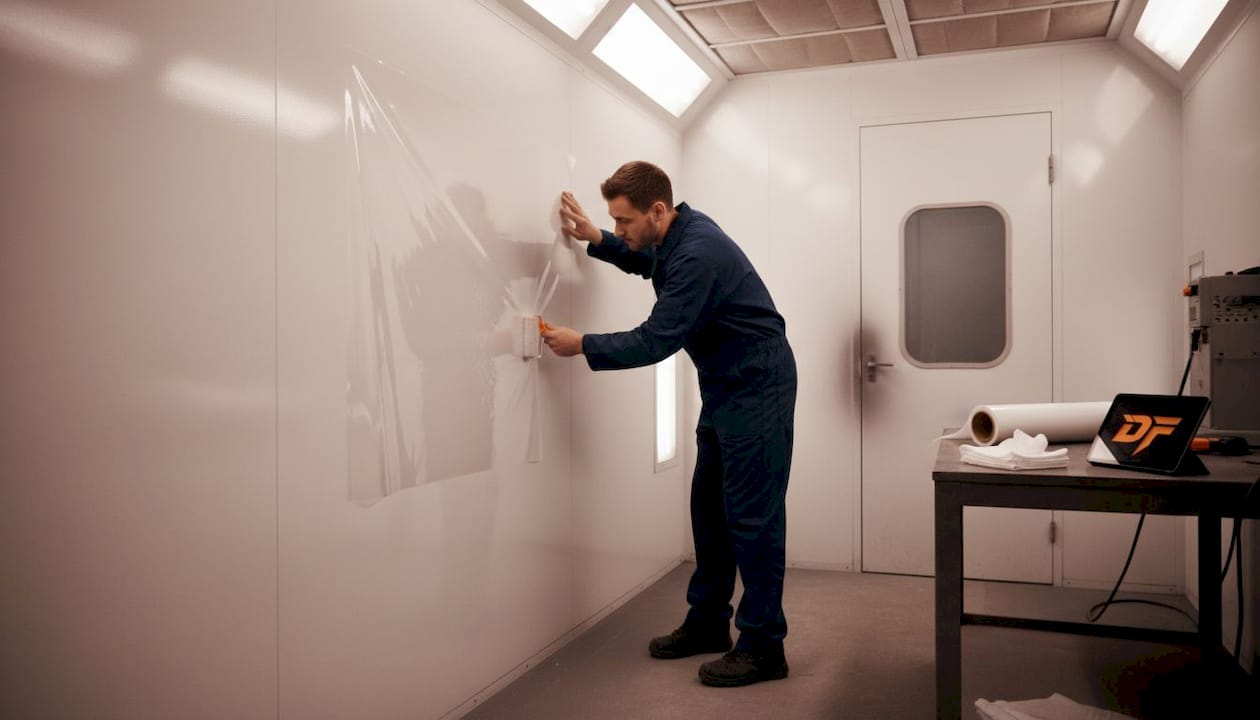
The core function involves surface resistivity. Standard booth wall coverings and many conventional protective films carry high surface resistivity values, meaning charges build up and stay. Anti-static films are engineered with lower surface resistivity, allowing any charge that does form to dissipate quickly across the film’s surface rather than concentrating into a high-voltage spot that aggressively pulls particles.
Beyond resistivity, here is what separates effective anti-static films from ordinary protective films:
- ESD (electrostatic discharge) protection limits the sudden discharge events that can damage sensitive electronics in adjacent work areas or in the vehicles being refinished.
- Anti-smudge coatings prevent fingerprints and surface oils from creating localized contamination hotspots.
- Abrasion resistance matters because films in high-traffic industrial settings get brushed against, dragged, and exposed to cleaning agents. A film rated for over 16,000 abrasion cycles holds its anti-static properties far longer than a lower-rated alternative.
- Transparency becomes essential when films are applied to booth windows or lighting panels, where clarity directly affects work quality.
You can learn more about electrostatic film basics and how charge dissipation works in spray booth environments specifically. Understanding these mechanics helps separate genuine performance from marketing language.
Durable anti-static coating research continues to advance the field, with newer formulations showing improved long-term stability and performance consistency across varying humidity conditions. The practical takeaway for your facility is that material science in this space is actively evolving, and product generations from even a few years ago may no longer represent best-in-class performance.
“Anti-static and ESD solutions are essential for quality assurance in any environment where surface contamination leads directly to costly defects.”
Comparing anti-static films: Key features and selection factors
Not all anti-static films are built the same, and “anti-static” printed on a product spec sheet tells you almost nothing about real-world performance in your facility. The differences in durability, environmental sensitivity, and charge-dissipation speed are large enough to determine whether you see meaningful defect reduction or no measurable change at all.
Here is a comparison of the key features you should evaluate before committing to any product:
| Feature | What to look for | Why it matters |
|---|---|---|
| Static decay time | Measured in seconds under controlled conditions | Shorter decay time means less window for dust attraction |
| Surface resistivity | 10^6 to 10^9 ohms per square for typical anti-static | Too high and the film won’t dissipate; too low and it may not be safe near electronics |
| Abrasion resistance | Rated cycles under standardized testing | Higher ratings mean longer usable life in industrial settings |
| Transparency | Measured as light transmission percentage | Critical for window and lighting panel applications |
| Humidity sensitivity | Performance variation across RH range | Low-humidity environments require specific film formulations |
Anti-static performance can be hindered by environmental factors such as low humidity for certain material types. Some films that perform excellently at 50% relative humidity lose significant effectiveness when your facility drops to 20% or 25% in winter months. This is not a minor edge case; it is a condition many northern and inland facilities face regularly during cold-weather production runs.
When evaluating films, follow these steps in order:
- Map your environment by documenting your facility’s typical humidity and temperature ranges across all seasons, not just peak summer conditions.
- Request test data from suppliers that matches your actual RH range, not just the industry-standard lab conditions used in most manufacturer specs.
- Run a pilot installation in a single booth or bay for at least four weeks, tracking defect rates before and after.
- Measure across job types since static buildup varies depending on substrate material, pretreatment chemicals, and spray equipment used.
- Evaluate longevity by checking film condition and testing for charge dissipation after 30 and 60 days of use.
You can review film type comparisons and detailed guidance on choosing dust protection films for spray booths, which covers how different construction types perform across real industrial applications.
Pro Tip: Never rely solely on manufacturer-provided metrics when evaluating anti-static films. Ask for independent test data or, better yet, run your own controlled comparison using your actual substrate materials, cleaning solvents, and booth conditions before placing a bulk order.
Operational benefits: ROI, paint quality, and efficiency gains
Once you have selected and installed the right anti-static film for your facility’s actual conditions, what should you expect to see? The benefits go well beyond a reduction in visible dust on panels. They ripple across your entire production workflow in measurable ways.
Paint quality improvement is the most direct benefit. When surfaces stop attracting dust particles, you see fewer fisheyes, nibs, and contamination spots in the finished coating. That means less cutting and polishing after cure, and fewer panels that need a full repaint.
Rework rate reduction follows directly. Shops that have deployed static-free protective film in booth environments report measurable drops in jobs that require re-entry for defect correction. Even a 15% reduction in rework events can deliver significant labor savings per month across a busy shop.
Here is what documented operational improvements look like in practice:
| Metric | Typical before implementation | Typical after implementation | Change |
|---|---|---|---|
| Dust-related defect rate | 8 to 12 per 100 panels | 4 to 6 per 100 panels | 40 to 50% reduction |
| Average rework time per job | 45 to 90 minutes | 15 to 30 minutes | 60 to 67% reduction |
| Booth changeover time | 20 to 35 minutes | 10 to 18 minutes | 40 to 50% reduction |
| Customer return rate (dust defects) | 3 to 5% | Under 1% | Significant improvement |
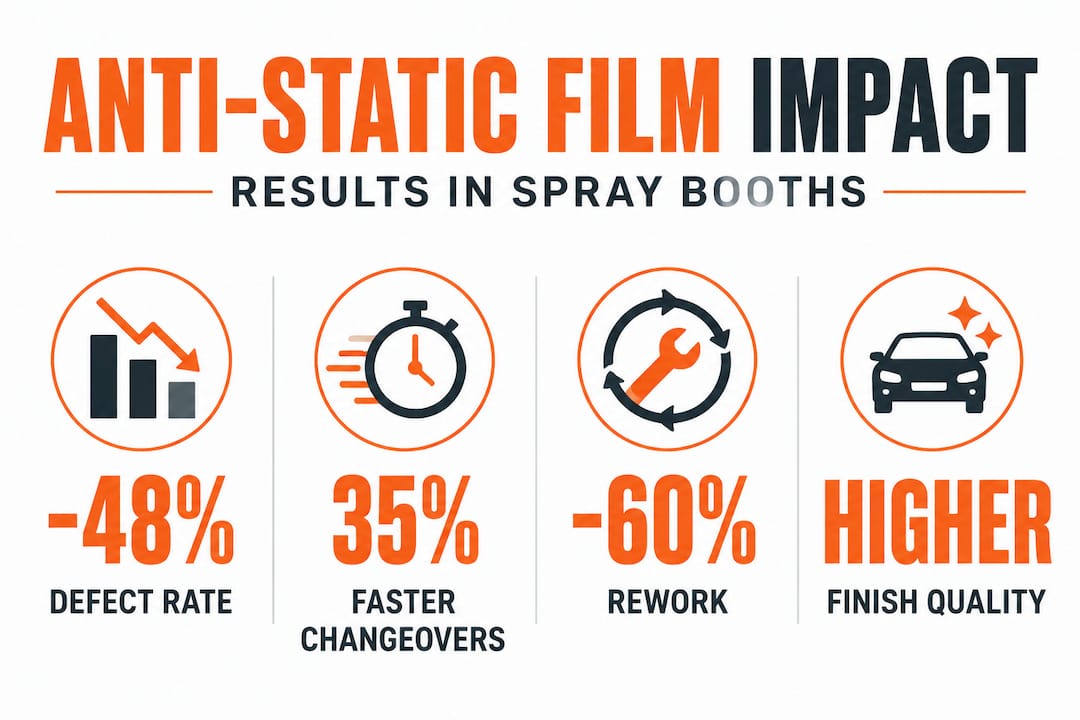
Faster changeovers represent another undervalued benefit. Multi-layer anti-static films let technicians simply peel away the used surface layer and expose a fresh, clean, pre-charged-neutral surface underneath, rather than spending time scrubbing and wiping booth walls between jobs. That time savings adds up quickly across multiple booths and shifts.
Static control improves ROI by cutting the cumulative cost of scrap and rework, which in many facilities represents one of the largest controllable expenses in the painting operation. You can also explore protective film application examples to see how facilities similar to yours have deployed these solutions across different booth configurations.
Pro Tip: Pair your anti-static booth films with high-capacity dust collectors positioned at booth entry and exhaust points. Anti-static films stop surface-level dust attraction while dust collectors manage airborne particulate counts. Using both together delivers best-in-class contamination control that neither solution achieves alone.
Customer satisfaction and compliance outcomes improve because consistent finish quality reduces the back-and-forth on defect disputes and warranty claims. For facilities working with OEM or fleet accounts, where defect thresholds are contractually defined, this is not just a quality goal but a compliance requirement.
Why anti-static film ROI depends on more than just product specs
Here is the uncomfortable truth most suppliers will not say directly: buying an anti-static film, even a technically excellent one, does not automatically generate a return. We have seen well-funded facilities invest in premium products and see zero measurable improvement in defect rates, not because the film failed, but because the implementation missed the actual contamination source.
Anti-static efficacy is not only a material property. It depends on test conditions, particularly humidity, and real-world performance can vary significantly across products and environments. A film that earns excellent marks at 50% relative humidity in a lab may underperform in your 25% RH winter booth. That gap between spec sheet and shop floor is where most ROI disappointments happen.
The more important diagnostic question is this: what specific defects are you actually seeing, and what is causing them? Some static-control claims are context-specific, tied to particular defect mechanisms. An ESD-protection-rated film adds genuine value when electronic components are involved. It adds almost no value if your primary problem is mechanical dust settling from an uncontrolled air path, not electrostatic attraction.
We push our own customers to challenge us on this before purchasing. If your defects are concentrated on horizontal surfaces, the issue may be settling particulate rather than static-attracted contamination. If defects appear most on vertical panels, that points more toward static-driven attraction from walls and floors. These distinctions determine which product class you actually need.
The path to real ROI runs through honest defect analysis first, then product selection, then verified in-field testing against your baseline. You can review guidance on ensuring dust-free finishes to understand how different contamination sources require different responses. Test, measure, and adjust. Do not assume a label does the work.
Explore proven anti-static film solutions for your facility
If this breakdown has helped clarify the gap between what your facility currently controls and what is still driving defects, the next step is straightforward. Evaluate solutions specifically engineered for spray booth and industrial painting environments, not general-purpose anti-static products adapted from other industries.
At Dust Free Film, we design and manufacture anti-static spray booth films built to European manufacturing standards, tested under real industrial conditions, and available in multi-layer configurations that speed up changeovers while maintaining consistent charge-dissipation performance. Our patented dispenser system enables bubble-free installation even in high-traffic settings. Whether you operate a single-bay auto body shop or a multi-line industrial facility, we can configure a solution matched to your booth dimensions, seasonal RH range, and production volume. Request a quote and our team will help you match the right product to your actual contamination challenge.
Frequently asked questions
What problems do anti-static films solve in painting operations?
Anti-static films reduce dust attraction on surfaces by neutralizing static charges, which directly lowers defect and rework rates in spray painting environments.
Do all anti-static films work equally well in any environment?
No. Performance varies with humidity and temperature, so films should be tested and selected based on your facility’s actual seasonal conditions, not just standard lab benchmarks.
Is anti-static film also ESD protection for electronics?
Some anti-static films provide ESD discharge dissipation but not all are designed specifically for electronics protection. Match the film’s mechanism to your actual defect type before purchasing.
What measurable ROI can anti-static films deliver?
Facilities using properly matched anti-static films typically see reduced scrap and rework, with defect rates dropping 40 to 50% and changeover times cut by nearly half, leading to significant monthly cost savings.
Should I still invest in ventilation if I use anti-static films?
Yes. Anti-static films control surface-level charge attraction while ventilation and dust collection manage airborne particulate, and combining both systems produces the most consistent contamination control results.
Recommended
- Static-Free Protective Film: Boosting Spray Booth Results
- How Films Ensure a Superior Paint Finish in Spray Booths
- Maximize paint quality: why innovative protective films work
- 10 benefits of spray booth films for clean, efficient finishes
- How fastener coatings boost durability and prevent failure – Aussie Nails and Fasteners Warehouse