

The best booth door film for a professional spray booth is an electrostatically charged, multi-layer tear-off film paired with a dedicated dispenser box, and certain manufacturers build versions many bulk buyers standardize on. It captures overspray without the sag or wrinkling of paper, and the tear-off layers let one technician expose a fresh surface in minutes instead of stripping and remasking the whole door. Request a quote before your next production cycle to lock in the sizing you need.
TL;DR:
- Multi-layer electrostatic film captures airborne dust more effectively than paper or single-layer options, especially in dry climates with static dust issues.
- Choosing a film with proper tack, visible layer markings, a reliable dispenser, and temperature resistance ensures consistent performance and easier maintenance.
- Proper installation techniques, including tension control and seam overlapping, are critical for achieving a clean, dust-free booth environment.
- Bulk ordering and customized options lower per-unit costs, making the switch to electrostatic tear-off film financially advantageous for multiple booths or facilities.
Table of Contents
- Why Electrostatic Multi-Layer Film Beats Paper and Single-Layer Options
- How to Choose Booth Door Film: A Buyer’s Checklist
- How to Install and Replace Booth Door Film Without Wasting a Shift
- What Does Booth Door Film Actually Save You?
- Proof Behind the Recommendation
- How to Order Dust Free Film for Your Booth Doors
- Making Booth Door Film Part of Your Standard Workflow
- Sources
- FAQ
Why Electrostatic Multi-Layer Film Beats Paper and Single-Layer Options
Paper masking and single-layer plastic film are passive. They block overspray that lands directly on them, but they do nothing to pull fine, airborne dust out of circulation before it settles on wet paint. Electrostatic film works differently. The surface holds a static charge that actively attracts particulate, pulling dust and overspray onto the film instead of letting it drift onto a curing panel. That distinction matters most in dry climates, where static buildup already pushes loose dust around a booth before a single trigger gets pulled.
The multi-layer, tear-off construction is the second piece of the puzzle. Instead of peeling an entire sheet off the door and reinstalling from scratch, an operator strips away the top contaminated layer and exposes a clean one underneath, already in place.
- Faster turnaround between jobs since there is no remasking
- Fewer seams and less tape residue building up on door edges
- Consistent surface quality layer after layer, since each one is factory-identical
Durability under heat matters just as much as particle capture. Booths running elevated bake cycles need film rated for sustained exposure, and the better products on the market hold up to operating temperatures around 80°C without curling at the edges or leaving adhesive behind. A bright, clean booth surface also affects the eye, not just the paint. Film that stays free of buildup preserves light reflectivity, which keeps color matching accurate under booth lighting instead of skewing it through a haze of dried overspray.
Pro Tip: If your booth runs in a low-humidity region, prioritize electrostatic formulations over standard film. Static-driven dust migration is often the hidden cause of “clean booth, dirty finish” complaints.
How to Choose Booth Door Film: A Buyer’s Checklist
Comparing quotes across suppliers gets confusing fast once everyone uses different terms for the same specs. Before you sign a purchase order, run every option through the same set of questions.
- Electrostatic charge and tack level. Vertical door surfaces need enough tack to hold particulate without sagging, but not so much that removal tears the layer underneath.
- Layer count and labeling. Visible layer numbering and printed length markings let a technician confirm how much life is left without guesswork, which speeds up maintenance scheduling.
- Dispenser design. A free-rolling box, reinforced sides, and an integrated cutting bar let a single installer produce a straight, wrinkle-free line without a second set of hands.
- Temperature and puncture rating. Confirm the film is rated for your booth’s peak cure temperature, and ask about puncture resistance if the door sees frequent contact from carts or panels.
- Slip resistance on adjacent floor runs. If floor film borders the door, it needs its own non-slip surface rated for foot traffic near curing zones.
- Packaging and lead time. Roll widths, custom cuts, and how fast a supplier can turn around a bulk order all affect whether you can standardize across multiple booths at once.
Buyers sourcing for more than one facility should also ask whether a supplier offers private-label runs or custom dimensions, since standardizing packaging across sites cuts down on ordering mistakes at the loading dock.
How to Install and Replace Booth Door Film Without Wasting a Shift
Getting a clean install comes down to technique, not luck. Follow these steps in order:
- Stabilize the dispenser box by planting one foot against its base while it sits flush against the top of the door frame.
- Pull the film down in one continuous motion, keeping tension even so it doesn’t ripple or fold on itself.
- Cut using the integrated bar rather than a utility knife, which keeps the edge straight and avoids nicking the layer underneath.
- Overlap edges by the manufacturer’s recommended margin and press down firmly along seams to block paint or dust from working underneath.
- Log the install date on the frame or a nearby whiteboard so the next refresh isn’t left to memory.
Replacement cadence depends on booth volume, but most shops running multiple jobs per day do best scheduling refreshes at the start or end of a shift, never mid-cycle. Before every deep clean, run a 30-second inspection: check for lifted edges, torn corners, or any spot where the film has gone opaque with buildup. If more than one section shows heavy saturation, that is your signal to escalate from a quick refresh to a full booth deep-clean rather than patching it.
Pro Tip: Train new installers on a scrap section of film first. The most common rookie mistake is pulling too fast, which stretches the material and creates micro-wrinkles that trap overspray unevenly.
What Does Booth Door Film Actually Save You?
The math on booth door film comes down to labor hours you stop spending on manual cleanup, and downtime you stop losing between jobs. A customer-cited result from Dust Free Film shows a shop cutting refresh time from 45 minutes down to 8 minutes after switching to tear-off film with a dispenser system. Run that improvement across a facility doing multiple color changes a day, and the accumulated labor savings alone can justify the switch inside a single quarter.
Three variables shape your actual per-door cost:
- Roll yield. More usable layers per roll means fewer reorders per quarter.
- Film lifetime under your specific spray volume. High-throughput booths burn through layers faster than low-volume finishing lines.
- Replacement cadence. Refreshing on a fixed schedule, rather than reactively, avoids emergency orders at premium pricing.
Bulk and custom orders typically lower the unit cost per roll, which shortens the payback window further, especially for operations running more than one booth off the same standardized spec.
Proof Behind the Recommendation
Some manufacturers have produced film lines from Greek factories since 2012, designed specifically for spray booth environments rather than adapting general-purpose protective film. These product lines often center on multi-layer electrostatic film paired with specialized dispenser boxes.
- A freely rotating roll and reinforced wooden sides keep the dispenser stable during a one-person install
- An integrated metal cutting bar produces a straight edge without a separate blade
- Visible layer numbering lets technicians track remaining life at a glance
The 45 to 8 minute refresh improvement cited above came from one customer’s operational setting, not a controlled lab test, so treat it as a real-world benchmark rather than a guaranteed outcome for every booth. Shops with different door dimensions or spray volumes should expect their own numbers to vary, but the underlying mechanism, a faster tear-off replacing a full remasking cycle, applies broadly.
How to Order Dust Free Film for Your Booth Doors
Once you know your spec, ordering is straightforward. A request for quote should include door dimensions, your booth’s peak operating temperature, how often you expect to refresh the film, and your order quantity.
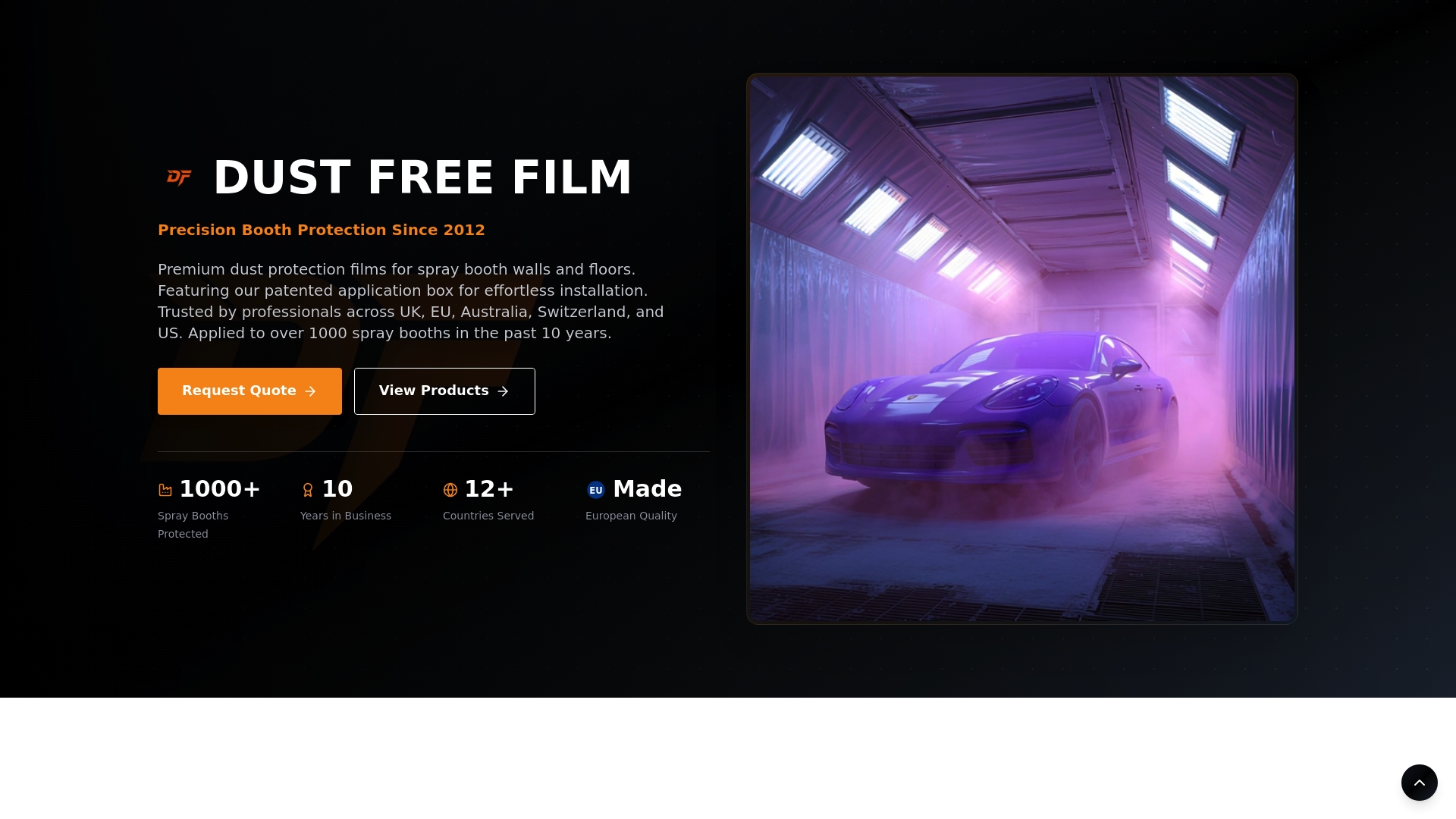
For door installations, wall protector films with tacky surfaces are commonly used for vertical particle capture, while heavy-duty floor protector films cover adjacent floor runs needing slip resistance under similar conditions. These films often pair with patented dispenser systems designed for one-person application.
Bulk buyers running multiple booths or multiple sites can request custom widths, private-label packaging, and volume pricing, with lead times scoped to order size. Shipping is handled from the Greek factory or through regional partners, depending on destination. If you’re sourcing for facilities in or supplying into Europe, Dust Free Film’s Germany page is the fastest route to a quote scoped to your region’s lead times and shipping terms. Send over your door dimensions and expected order volume, and a sales contact can turn around a formal quote within days.

Making Booth Door Film Part of Your Standard Workflow

Buying the right film is only half the job. The bigger return comes from building it into a routine your team actually follows. Run a 30 to 90 day trial on one booth first, and track three numbers: refresh time, visible booth brightness, and rework rate tied to contamination. That gives you a real baseline instead of a guess before rolling the spec out to every booth on the floor.
Train installers on the dispenser before they touch a live door. The two mistakes that show up most often, uneven pulling tension and misaligned overlap, both trace back to skipping practice runs. If your spray volume or booth temperature shifts significantly, revisit your film spec rather than assuming last year’s order still fits.
— Pavlos - Angelos Filippakis
FAQ
What Makes a Booth Door Film “the Best” for Bulk Buyers?
The best booth door film combines electrostatic particle capture with a tear-off multi-layer design and a dispenser built for one-person installation, since that combination cuts both contamination and labor time.
Is Electrostatic Film Better Than Standard Plastic Film?
Yes, for most professional booths. Electrostatic film actively attracts airborne dust rather than just blocking direct overspray, which matters most in dry, static-prone environments.
How Often Should Booth Door Film Be Replaced?
Replacement cadence depends on spray volume, but most shops schedule refreshes at shift changes rather than reactively, and tear-off layers make that scheduling far faster than remasking.
Is a Dispenser System Worth It Over Tape Installation?
A dispenser system like Dust Free Film’s patented box produces straighter lines and faster installs than tape-based masking, and it lets a single technician handle the job without help.
What Temperature Range Should Booth Door Film Handle?
Film used in booths with elevated bake cycles should be rated for sustained exposure up to roughly 80°C without curling or leaving adhesive residue behind.