
Choose a heat-resistant, multi-layer electrostatic booth film with a low-residue adhesive for downdraft spray booths. It needs to survive repeated bake cycles without off-gassing, use an anti-static treatment that keeps dust off wet paint, and peel away clean without dragging adhesive across your walls or floor grates. Everything else, from thickness to dispenser options, follows from those three priorities.
TL;DR:
- The best booth film must withstand heat ratings above 93°C with a reliable melt point of at least 120°C, especially for frequent or high-temperature bakes.
- A thick, around 220-micron film resists punctures, tears, and repeated overspray loads, ensuring durability during multiple cycles.
- Anti-static treatment significantly reduces airborne dust settling on wet paint, which improves first-pass finish quality, especially in high-spec environments.
- Low-residue adhesives are essential to prevent corrosion on galvanized surfaces and to make peel-off cleaning easier without leaving harmful residues.
- Using a dispenser system and testing film through a full bake cycle beforehand can optimize application speed, airflow preservation, and overall long-term costs.
Table of Contents
- What Makes the Best Downdraft Booth Film Different From Generic Masking Film?
- How Do You Choose the Right Film for Your Booth?
- Masking Film vs. Multi-Layer vs. Electrostatic vs. Dispenser Systems
- Installing and Maintaining Booth Film Without Disrupting Airflow
- Why Dust Free Film Fits Every Downdraft Booth Specification
- What Facility Managers Get Wrong About Booth Film
- Get Booth-Ready With Dust Free Film
- Sources
- FAQ
What Makes the Best Downdraft Booth Film Different From Generic Masking Film?
Generic masking film and purpose-built booth film look similar on a roll, but they behave completely differently once a booth hits bake temperature. Masking film sold for general construction or retail use typically carries no heat rating at all, which means it can soften, shrink, or release fumes during a 140°F to 160°F bake cycle. Dedicated booth films are engineered specifically to survive that environment, and the spec sheet tells you exactly how.
Heat resistance and bake-cycle compatibility top the list. Industry guidance from 3M’s paint booth protection resources points to ratings commonly exceeding 93°C (200°F), with some multi-layer films rated closer to 120°C for shops running hotter or longer cycles. If a supplier can’t hand you a melting point or a maximum continuous-exposure temperature, that’s a red flag, not a technicality.
Thickness and durability matter more than most buyers expect. Professional-grade films generally feature thickness around 220 microns, a figure echoed in Colad’s Film4Booth product specs, which also lists a 120°C melting point. Thicker film resists puncture from ladders, hoses, and rolling carts, and it holds up better under repeated overspray loading without tearing at seams.
Anti-static treatment is the spec that separates a good film from a great one. Static charge on an untreated surface acts like a magnet for airborne particles, and in a downdraft booth, where clean air is supposed to move steadily from ceiling to floor, that static pull works against you. An electrostatic-treated film reduces dust attraction to walls and light fixtures, which can meaningfully cut fine-particle contamination on fresh paint and improve first-pass finish rates.
Adhesive and residue behavior affects your long-term maintenance costs more than any other spec. A film that leaves adhesive residue on galvanized walls forces you into chemical washing, which accelerates corrosion over time. Low-residue adhesives peel clean, protecting both your walls and your labor budget.
Airflow impact is the spec most buyers overlook entirely. A tacky or heavily textured film surface can disrupt the laminar ceiling-to-floor airflow a downdraft booth depends on, creating turbulence that keeps contaminants suspended instead of pulling them down to the floor exhaust, according to 3M’s booth protection guidance. A smooth, low-tack surface keeps that airflow path clean.
Specs worth requesting from any supplier before you buy:
- Maximum continuous bake temperature and melting point
- Film thickness in microns or mils
- Anti-static treatment confirmation (not just “dust resistant” marketing language)
- Adhesive residue test results on your specific wall substrate
- Recommended replacement interval under your throughput
Pro Tip: Ask suppliers for a sample swatch and run it through one full bake cycle before committing to a bulk order. A five-minute oven test tells you more than any spec sheet.
How Do You Choose the Right Film for Your Booth?
Matching film to booth starts with three variables: your bake temperature, your daily cycle count, and what your walls and lighting are made of. A body shop running two bakes a day at 140°F has very different needs than an industrial coatings plant cycling parts through a 300°F cure oven attached to the booth. Higher heat and higher frequency both push you toward the upper end of the heat-resistance and thickness ranges.
Booth geometry matters too. Downdraft booths pull air from ceiling filters down through the floor grate, so film choices need to respect that flow path in a way crossdraft booths don’t, since crossdraft airflow moves horizontally and tolerates a wider range of wall textures without affecting particle transport.
Here’s a practical sequence for evaluating any film against your operation:
- Confirm the heat rating against your actual bake temperature, not the average bake temperature across the industry. Ask for third-party or in-house bake-cycle test data, not just a marketing claim.
- Request a residue report showing how the adhesive performs on your wall substrate after removal, especially if you have galvanized steel surfaces prone to corrosion.
- Ask about the recommended replacement interval under your specific overspray volume, since a low-throughput detail shop and a high-volume production line wear through film at very different rates.
- Check dispenser or roll-applicator availability. For any booth larger than a single bay, a dispenser system pays for itself in labor time and application consistency.
- Weigh upfront cost against total cost of ownership. A cheaper film that requires monthly chemical washing usually costs more over a year than a pricier film that holds up for a full quarter.
For low-throughput operations, a mid-spec electrostatic film reapplied every 90 days is usually plenty. For production environments running multiple bakes daily, invest in the highest heat rating you can source and pair it with a dispenser system, since manual application on a large wall surface introduces bubbles and misalignment that create their own airflow problems.
Pro Tip: Track your film replacement against visible overspray buildup rather than a fixed calendar date. Some booths need a change every six weeks, others stretch past three months, and throughput drives that number more than time does.
Masking Film vs. Multi-Layer vs. Electrostatic vs. Dispenser Systems
Four broad categories dominate the booth protection market, and each one solves a different problem.
Generic masking film is cheap and widely available, but it’s built for construction sites and general contracting, not paint booths. It carries no heat rating, no anti-static treatment, and no multi-layer construction, which means using it in a high-bake downdraft booth risks melting, off-gassing, or adhesive failure mid-cycle. It’s a poor fit for anything beyond a one-off, low-heat touch-up area.
High-temp multi-layer film solves the heat problem directly. Products in this category, like the Film4Booth line referenced in industry spec sheets, typically run around 220 microns thick with melting points near 120°C, and the multi-layer design lets you peel off a soiled outer layer without stripping the whole wall. This category is the workhorse for standard automotive and light industrial bake cycles.
Electrostatic films add the anti-static layer that multi-layer alone doesn’t guarantee. This matters most in high-spec finish work, where even fine dust settling on a fresh clear coat means a rework. If your shop measures success by first-pass finish rate, this is the category to prioritize over pure heat resistance.
Dispenser systems aren’t a film category so much as an application method, but they change the calculus for larger booths. A wall-mounted dispenser applies film in continuous, bubble-free sheets far faster than manual taping, and it reduces the installation defects that create their own turbulence and dust traps.
Best-fit guidance by profile:
- Small independent body shop, one or two bakes daily: mid-spec multi-layer electrostatic film, manually applied, replaced every 60 to 90 days.
- High-volume production shop: top-tier heat rating, electrostatic treatment, and a dispenser system to keep application speed and consistency high across large wall runs.
- Industrial coatings plant with high-temperature cure ovens: the highest available heat rating paired with thicker, multi-layer construction to survive repeated thermal cycling without residue buildup.
Anti-static formulations in commercially available booth films often come with recommended removal intervals around two to three months under light use, based on ArmorDillo’s product listing, which gives you a reasonable starting benchmark before you tune the schedule to your own overspray volume.
Installing and Maintaining Booth Film Without Disrupting Airflow
Application quality determines whether your film actually protects airflow or works against it. Start with the environment: apply film when booth temperature and humidity sit within the manufacturer’s recommended range, since cold surfaces cause poor adhesive tack and humid conditions trap moisture under the film, leading to bubbling and premature peeling.
Surface prep matters just as much as timing. Wipe down walls and floor grates to remove loose dust before applying a new layer, since trapping debris under the film creates bumps that can catch airflow and generate localized turbulence right where your downdraft system needs the smoothest possible surface.
Follow this sequence for a clean install:
-
Clear the booth of loose overspray and dust with a dry wipe or tack cloth before unrolling any film.
-
Align the first sheet with a corner or fixed reference point, such as a floor grate edge or light fixture frame, to keep subsequent sheets square.
-
Use a dispenser or roller tool to apply steady, even pressure, working outward from the center of each sheet to push air bubbles toward the edges.
-
Mask light fixtures and windows with a transparent, low-tack layer rather than the same opaque wall film, since Film4Booth’s application notes point out that the wrong film over lighting can reduce lumen output and color rendering, which throws off finish inspection.
-
Schedule replacement around throughput, not the calendar. A booth running heavy overspray volume needs a fresher layer more often than a detail shop doing light touch-up work.
When it’s time to remove a layer, peel slowly at a consistent angle rather than yanking it, which tears the adhesive and leaves residue behind. If a film does leave residue, address it immediately with an appropriate solvent rather than letting it sit, since dried residue on galvanized surfaces accelerates corrosion and eventually forces a full chemical wash you could have avoided.
Pro Tip: Keep a spare roll on hand at all times. Running out mid-shift and reverting to whatever masking material is in the supply closet is how a heat-rated booth ends up with a batch of melted plastic on the wall.
One common mistake: layering new film directly over heavily soiled old film instead of removing it first. That buildup adds thickness unevenly across the wall, which can throw off airflow patterns near vents and grates. Another: skipping the transparent layer over lights to save time, which then requires reworking a batch of parts because the finish inspector couldn’t see true color under dimmed fixtures. A floor protection film resource covers floor-specific installation nuances in more depth if your grates and pit design need special handling.
Why Dust Free Film Fits Every Downdraft Booth Specification
Dust Free Film builds its multi-layer electrostatic booth films specifically around the specs that matter for downdraft environments: heat resistance rated for standard bake cycles, an anti-static surface treatment that keeps particles off fresh paint, and a low-residue adhesive designed to peel clean off galvanized walls and floor surfaces. The company has manufactured to European standards since 2012, with a patented dispenser system built for fast, bubble-free application across large booth walls without the alignment headaches of manual taping.
| Buyer priority | How Dust Free Film addresses it |
|---|---|
| Bake-cycle heat resistance | Multi-layer film rated for standard automotive and industrial bake temperatures |
| Anti-static performance | Electrostatic treatment reduces particle attraction on walls and floors |
| Clean removal | Low-residue adhesive designed to protect galvanized and painted surfaces |
| Application speed | Patented dispenser system for tape-free, consistent installation |
| Scale and customization | Bulk ordering and custom configurations for multi-bay or multi-site operations |
Shops that switch to a purpose-built film like this typically see fewer rework cycles from airborne contamination, less time spent on chemical wall washing, and a longer effective life for booth surfaces and lighting components. For a production facility running multiple bakes a day, that adds up to real labor savings over a single quarter, not just a marginal improvement.
- Request a sample roll to test through one full bake cycle before committing to bulk volume.
- Ask about dispenser compatibility if your booth walls exceed a single manual roll’s practical coverage.
- Compare your current replacement interval against the anti-static benchmark ranges common across the industry to see whether you’re changing film too often or not often enough.
What Facility Managers Get Wrong About Booth Film
Most shops treat booth film as a commodity purchase, something you buy on price and reorder without much thought. That’s backward. The film touching your walls and floor grates directly shapes airflow behavior in a system engineered around laminar flow, and a bad choice there undermines the entire downdraft design your booth was built around.
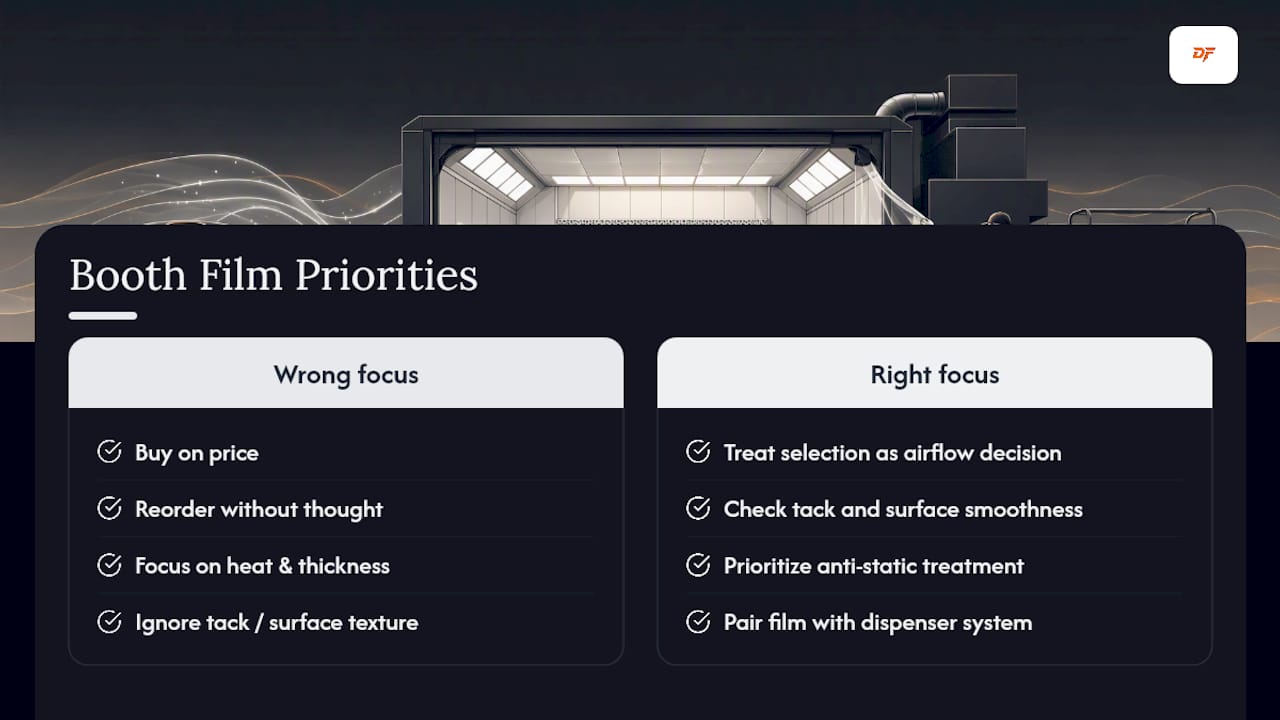
The overlooked variable is tack. Buyers fixate on heat rating and thickness, both real specs worth checking, but almost nobody asks how a film’s surface texture interacts with airflow until they’re already dealing with inconsistent finish quality. A film that’s technically heat-rated but slightly tacky can still create drag that keeps fine particles suspended longer than they should be.
The fix isn’t complicated: prioritize anti-static treatment and surface smoothness as highly as heat resistance, and pair that with a dispenser system once your booth size makes manual application inconsistent. Facility managers who treat film selection as an airflow decision, not just a durability decision, see the finish-quality payoff first.
— Pavlos Filippakis
Get Booth-Ready With Dust Free Film
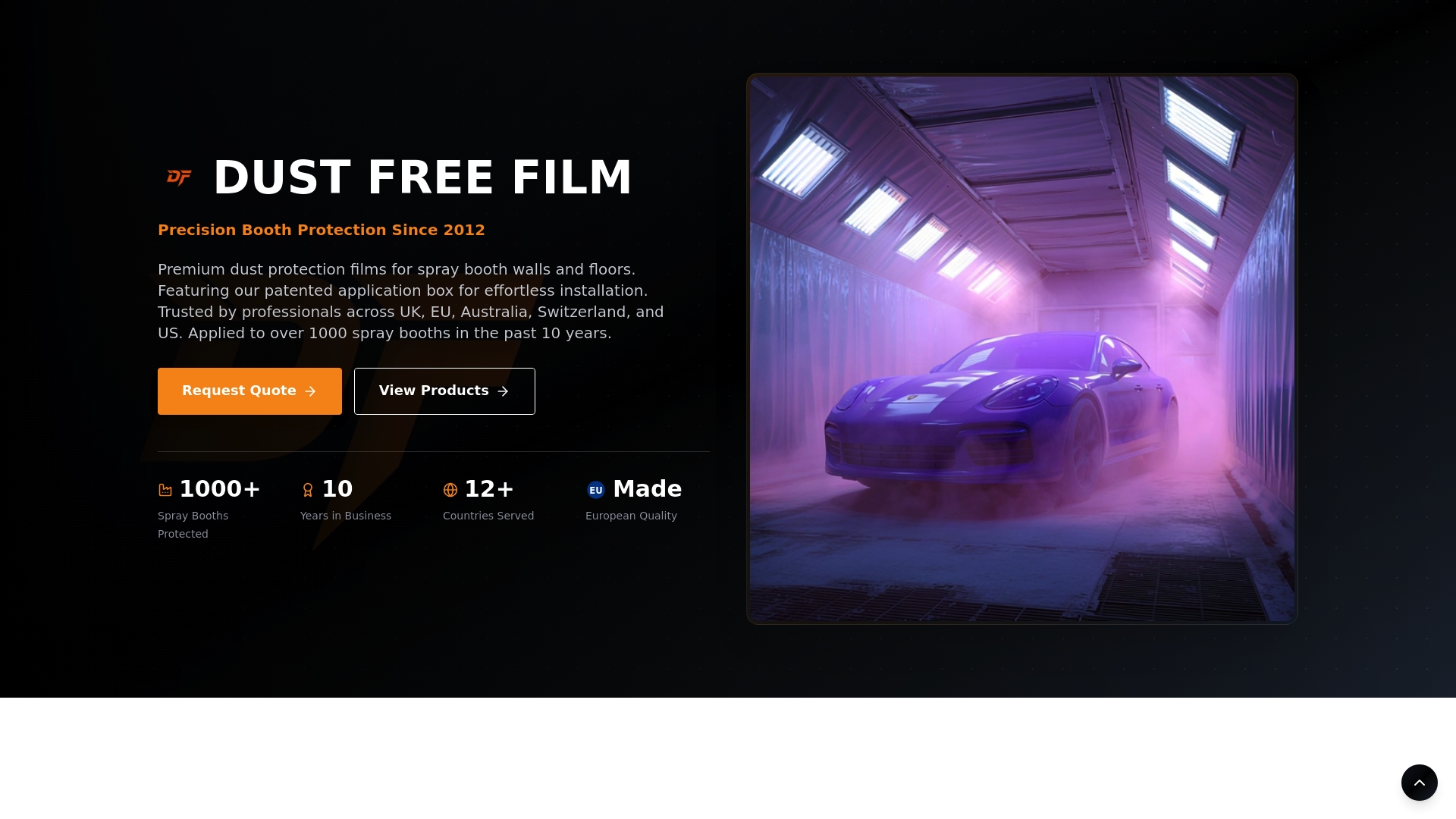
You’ve seen what separates a booth film that actually performs from one that just looks the part on a spec sheet. Dust Free Film builds exactly that: multi-layer electrostatic protection with heat resistance for standard bake cycles, a low-residue adhesive that won’t corrode your galvanized walls, and a patented dispenser system that turns a multi-hour manual taping job into a fast, bubble-free install.
For shops that also want a contractor’s view on how film compares to permanent coating systems for asset protection, the protective paint systems breakdown from Southern Sandblasting & Painting is a useful companion read. But for the day-to-day reality of a working downdraft booth, film remains the faster, lower-cost, and easier-to-replace option, and it’s what Dust Free Film has specialized in since 2012, with European manufacturing standards and bulk-order flexibility built for shops of any size.
Request a sample roll or ask for a bulk quote through the Dust Free Film product catalog and run it through your next bake cycle to see the difference for yourself.
Sources
- Paint Booth Protection — 3M
- Colad Film4Booth protective film product page — Shop Collision
- ArmorDillo clear self-adhesive paint booth protective film — Amazon listing
FAQ
Which Downdraft Paint Booth Is Considered the Best?
There’s no single “best” downdraft booth model since the right choice depends on your bay size, throughput, and bake temperature requirements, but any downdraft booth performs best when paired with film that preserves its ceiling-to-floor laminar airflow rather than disrupting it with tacky or textured surfaces.
What Is the Best Air Filtration System for a Paint Booth?
The best filtration setup pairs intake filters rated for your booth’s airflow volume with floor-level exhaust filtration, and protecting walls and grates with electrostatic film reduces the particle load those filters have to catch in the first place.
How Many CFM Does a Paint Booth Need?
Required airflow (measured in cubic feet per minute) varies by booth size and application, and it’s determined by your booth manufacturer’s engineering specs rather than a universal number, so check your unit’s documentation before making equipment changes.
How Do You Build a Downdraft Paint Booth?
Building a downdraft booth involves installing ceiling-mounted intake filtration, floor-level exhaust grates, and wall paneling designed for airtight sealing, and a full setup guide covering these steps is available in Dust Free Film’s spray booth setup resource.
What Makes a Film the Best Downdraft Booth Film for High-Volume Shops?
For high-volume shops, the best downdraft booth film combines a heat rating that survives repeated bakes, electrostatic anti-static treatment, and dispenser compatibility, since manual application at scale introduces bubbles and misalignment that hurt both airflow and finish quality.