

TL;DR:
- Effective spray booth protection combines continuous ventilation monitoring, semi-annual fire suppression inspections, and strict electrical safety compliance. Regular logging of airflow, filter status, and system checks prevents system drift, reducing fire and contamination risks. Protective films and operator training further enhance maintenance efficiency and safety standards.
Spray booth protection is defined as the full set of safety, maintenance, and compliance measures that keep spray booths operating without fire risk, contamination, or regulatory violation. Facility managers and contractors who apply these measures consistently reduce equipment downtime, protect workers, and produce finishes that meet quality standards. The core framework rests on three pillars: ventilation compliance under OSHA 29 CFR 1910.107, fire suppression readiness under NFPA 33, and structured preventive maintenance. Get all three right and the best practices for booth protection become a repeatable system rather than a reactive scramble.
What ventilation requirements and airflow monitoring are essential for booth safety?
Ventilation is the primary control for vapor and exposure risk in any spray booth environment. OSHA 29 CFR 1910.107 mandates a minimum average face velocity of 100 feet per minute (fpm) for booths using conventional spray guns. That number is not a suggestion. It is the threshold below which flammable vapor concentrations can reach ignition levels, putting workers and the facility at direct risk.
Monitoring that velocity requires more than a one-time measurement at installation. Magnehelic gauges or equivalent differential pressure instruments give you a real-time read on airflow across the booth face. Read them daily. A drop in pressure differential signals filter loading, fan wear, or duct obstruction before any of those problems become a safety event.
Filter loading is the most common cause of airflow degradation. When filters load and reduce exhaust, the booth loses negative pressure, which allows unfiltered air to infiltrate the workspace and contaminate fresh paint surfaces. The fix is scheduled filter replacement tied to pressure readings, not to a calendar date alone. Pressure drop data tells you when a filter is actually spent.
Makeup air balancing is the other side of the equation. Exhaust and supply air must stay in balance to maintain the slight negative pressure that keeps overspray contained inside the booth. If supply air exceeds exhaust, the booth goes positive and overspray migrates outward. If exhaust dominates too heavily, you create drafts that disturb wet coatings. Both scenarios compromise finish quality and safety simultaneously.
- Verify face velocity with a calibrated anemometer at least quarterly, or after any filter change or fan service.
- Log Magnehelic gauge readings at the start of each shift and flag any reading outside the design range.
- Replace intake and exhaust filters based on pressure differential thresholds, not fixed intervals.
- Inspect ductwork and fan blades for overspray buildup that restricts airflow over time.
Pro Tip: Mark the acceptable pressure range directly on the Magnehelic gauge face with a grease pencil. Operators can confirm compliance at a glance without referencing a separate document.
How to maintain and inspect fire suppression systems and interlocks
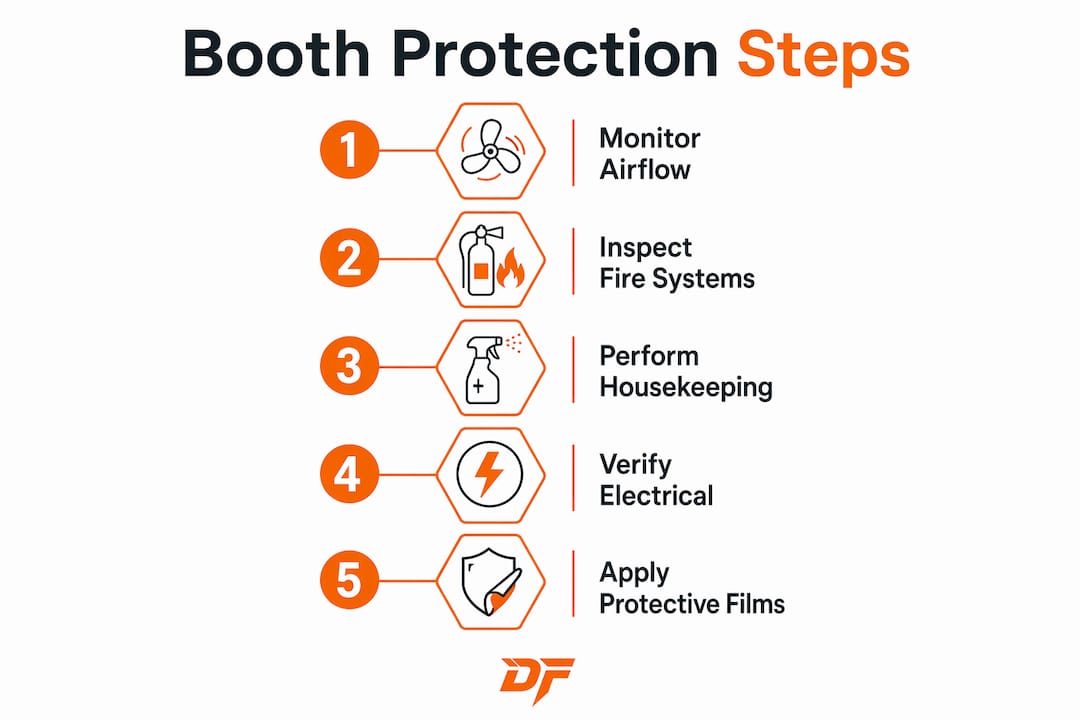
Fire suppression systems in spray booths are life-safety equipment, and their maintenance schedule is not optional. NFPA 33 requires at least semi-annual professional inspections covering detectors, suppression agent supply, nozzle condition, and full interlock testing. Skipping a cycle is a compliance violation and an insurance liability.
Between those professional service visits, monthly visual checks are your first line of defense. Suppression nozzles are precision hardware. Overspray accumulates on them during normal booth operation, and that buildup blocks the agent distribution pattern. A clogged nozzle does not suppress a fire effectively. Monthly visual inspections catch this degradation before it becomes a failure during an actual fire event.
The interlock system is equally critical. When a suppression system activates, it must automatically shut down exhaust fans, supply fans, and HVAC dampers. Bypassing these interlocks is one of the most dangerous oversights in booth management. An active airstream during a fire event feeds oxygen to the fire and carries flames through ductwork into adjacent spaces.
Follow this sequence for your semi-annual suppression inspection:
- Schedule a certified fire suppression technician for the full system service.
- Verify agent cylinder pressure and weight against manufacturer specifications.
- Test all detection heads for sensitivity and proper response.
- Confirm interlock function by simulating activation and observing fan and damper shutdown.
- Inspect every nozzle for overspray buildup and replace any that show blockage.
- Review and update the inspection log with technician sign-off and date.
For monthly checks between professional visits:
- Visually inspect all accessible suppression nozzles for paint accumulation.
- Confirm that interlock panel indicators show no fault conditions.
- Check that suppression agent cylinders remain within the pressure range marked on the gauge.
Pro Tip: Photograph nozzle condition during each monthly check and store images in a dated folder. If a nozzle failure ever leads to a claim, that photo record is your strongest evidence of due diligence.
What housekeeping and preventive maintenance routines optimize booth protection?
Structured maintenance cadence is what separates booths that drift out of compliance from those that stay consistently safe and productive. Documented preventive checks covering airflow, filter status, housekeeping, and fire protection readiness prevent the system drift that causes most booth failures. The cadence breaks down across four time horizons.
| Frequency | Key Tasks |
|---|---|
| Daily | Check Magnehelic gauge readings, inspect booth interior for overspray accumulation, remove waste materials, verify lighting function |
| Weekly | Inspect filter door seals for gaps, check manometer readings against baseline, clean booth walls and floor of overspray deposits |
| Monthly | Replace filters based on pressure data, inspect suppression nozzles visually, verify interlock indicators, review maintenance log for trends |
| Quarterly | Calibrate airflow measurements with anemometer, inspect fan blades and motor mounts, check ductwork for buildup, audit full compliance documentation |
Overspray accumulation on walls, floors, and ductwork is not just a housekeeping issue. Paint buildup blocks fire detection devices and suppression hardware, which directly increases fire risk. NFPA 13 requires approved coverings on sprinkler heads in spray booths and mandates regular cleaning. Protective films on booth walls and floors reduce the labor required for each cleaning cycle and extend the interval between deep cleans.
Flammable material storage inside or adjacent to the booth requires strict controls. Keep only the quantity of coating material needed for the current job inside the booth. Store bulk quantities in an approved flammable storage cabinet outside the spray area. Rags, filters, and other solvent-saturated waste must go into self-closing metal waste containers and be removed from the facility daily.
Maintenance logs are the operational backbone of any booth protection program. Comprehensive documentation of filter changes, airflow measurements, and suppression inspections builds the strongest compliance and insurance defense available to a facility manager. A log that shows consistent, dated entries demonstrates a culture of safety. A log with gaps demonstrates the opposite.
What equipment and material practices safeguard booth integrity?
Electrical classification is non-negotiable in spray booth environments. All booth electrical devices must carry a hazardous location rating, specifically Class I, Division 1 or Division 2 per the National Electrical Code (NEC). This covers lighting fixtures, switches, motors, and any portable equipment brought into the booth. Standard extension cords and non-rated drop lights are prohibited. One non-rated device is enough to ignite solvent vapors.
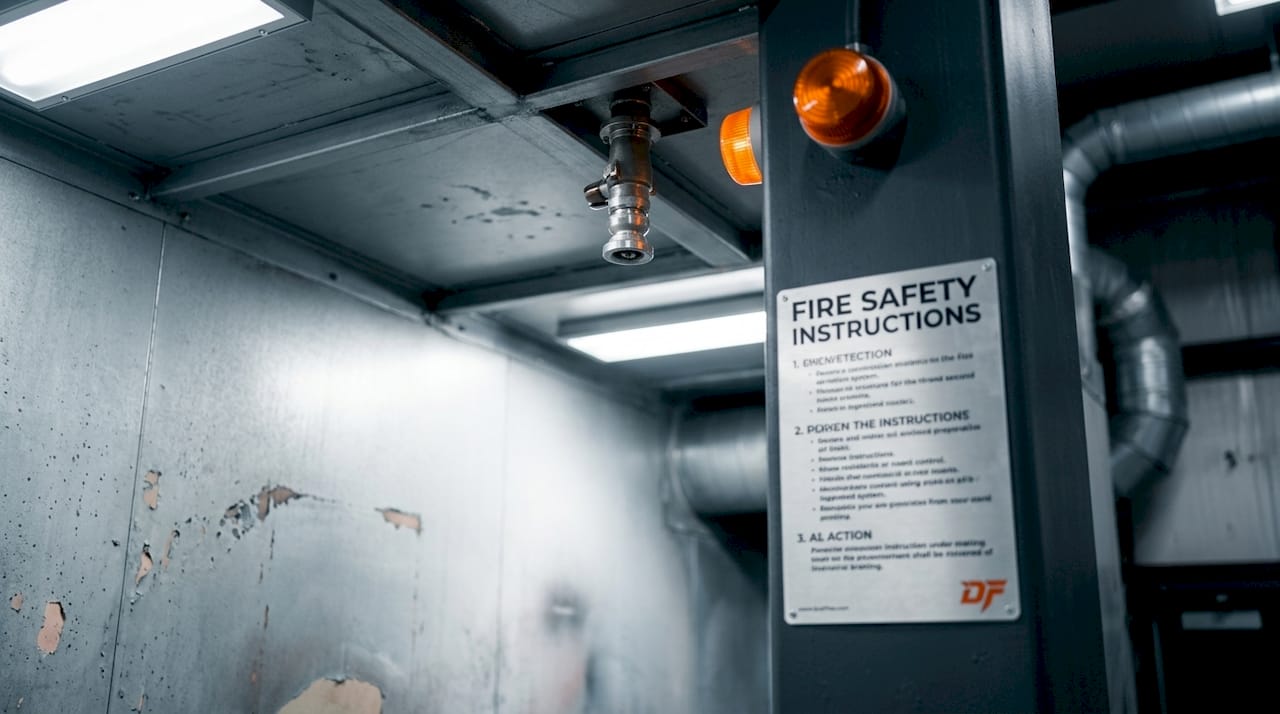
Lighting inspection belongs on your weekly checklist. Explosion-proof fixtures accumulate overspray on their lenses, which reduces light output and creates heat concentration points. Clean fixture lenses regularly and replace any fixture showing cracked seals or damaged housings immediately. A compromised housing on a rated fixture is no longer a rated fixture.
Protective films on booth walls and floors address two problems at once. They reduce overspray adhesion to booth surfaces, which cuts cleaning time significantly. They also protect the underlying booth panels from solvent attack and abrasion, extending the service life of the booth structure itself. Multi-layer electrostatic films, such as those manufactured by Dustfreefilm, allow operators to peel away a contaminated layer and expose a fresh surface without stopping production for a full cleaning cycle.
| Protection Method | Primary Benefit | Maintenance Impact |
|---|---|---|
| Explosion-proof lighting | Eliminates ignition source | Weekly lens cleaning required |
| Multi-layer wall films | Reduces overspray adhesion | Peel-and-replace replaces scrubbing |
| Approved sprinkler coverings | Prevents nozzle clogging | Replaced per NFPA 13 guidance |
| Flammable storage cabinets | Limits fuel load inside booth | Daily waste removal required |
Sprinkler head coverings deserve specific attention. NFPA 13 permits approved thin coverings over sprinkler heads in spray booths to prevent paint accumulation, but those coverings must be replaced on a schedule and must not impede activation. Using unapproved materials as coverings, such as plastic bags or tape, is a code violation that voids the protection the sprinkler provides. Source only coverings listed for use with your specific sprinkler model. You can find a curated list of spray booth safety products that meet current standards for 2026.
Key takeaways
Effective spray booth protection requires documented ventilation monitoring, semi-annual fire suppression inspections, structured maintenance cadence, and explosion-proof electrical compliance working together as a single integrated system.
| Point | Details |
|---|---|
| Ventilation is the primary control | Maintain minimum 100 fpm face velocity and monitor pressure differential daily to prevent vapor buildup. |
| Fire suppression needs monthly attention | Visually inspect suppression nozzles every month and schedule certified semi-annual service per NFPA 33. |
| Interlocks must never be bypassed | Fan and damper shutdown on suppression activation is mandatory. Bypassing interlocks turns a fire event into a catastrophe. |
| Documentation builds compliance defense | Dated logs of filter changes, airflow readings, and inspections are your strongest regulatory and insurance protection. |
| Protective films reduce maintenance burden | Multi-layer wall and floor films cut cleaning labor and protect booth surfaces from long-term solvent damage. |
What I’ve learned after years of watching booths fail
The most common booth protection failure I see is not a missing fire extinguisher or a broken gauge. It is system drift that nobody noticed because nobody was measuring. A booth that passed its last inspection can be out of compliance within 90 days if filter loading goes untracked and airflow readings are not logged. The booth looks the same. It sounds the same. But the face velocity has dropped below 100 fpm and the suppression nozzles have a thin coat of paint on them that nobody has checked since the last service visit.
The operators who run the tightest booths treat ventilation data the way a pilot treats instrument readings. They do not assume the system is working because nothing has gone wrong yet. They verify it every shift, log the numbers, and act on deviations immediately. That habit is what separates a booth that stays compliant from one that generates an OSHA citation or, worse, a fire investigation report.
I also think the industry underestimates how much protective films change the maintenance equation. When you can peel a contaminated layer off a booth wall in seconds rather than scrubbing for 20 minutes, operators actually do it. The cleaning happens on schedule because the barrier to doing it is low. That consistency is what keeps overspray from reaching suppression nozzles, sprinkler heads, and electrical fixtures in the first place. Prevention at the surface level is always cheaper than remediation after the fact. If you want to see how booth protection systems integrate surface protection with broader safety practices, the connection becomes obvious quickly.
The last thing I would emphasize is operator training. A maintenance log is only as good as the person filling it out. Operators need to understand why each check matters, not just what to check. When a technician knows that a low Magnehelic reading means vapor risk, they treat that reading with urgency. When they are just ticking boxes, they miss the pattern.
— Dust
Protect your booth surfaces with Dustfreefilm
Dustfreefilm has manufactured premium protective films for spray booths since 2012, and the difference between a booth running multi-layer wall and floor protection versus one without it shows up directly in cleaning time and surface longevity.
Dustfreefilm’s multi-layer electrostatic films install quickly without bubbles, resist heat, and stay static-free throughout the spray cycle. When a layer accumulates overspray, you peel it away and the next clean layer is ready immediately. No scrubbing, no solvent wipe-down, no production stop. For auto body shops, industrial painting facilities, and manufacturing plants that need reliable booth wall and floor protection, Dustfreefilm offers custom configurations and bulk purchasing options. Request a quote directly at dustfreefilm.com/request-quote and get a solution sized to your operation.
FAQ
What is the minimum airflow required in a spray booth?
OSHA 29 CFR 1910.107 sets the minimum average face velocity at 100 fpm for spray booths using conventional spray guns. This threshold prevents flammable vapor concentrations from reaching ignition levels during normal operation.
How often should fire suppression systems be inspected?
NFPA 33 requires certified professional inspections at least twice per year, covering detectors, agent supply, nozzles, and interlock function. Monthly visual checks of nozzle condition are also required between those service visits.
Why do suppression interlocks matter for booth safety?
Interlocks automatically shut down exhaust and supply fans when suppression activates, cutting the airstream that would otherwise feed a fire and carry flames through ductwork. Bypassing or disabling interlocks significantly worsens fire outcomes.
What electrical rating is required for spray booth equipment?
All electrical devices inside a spray booth must be rated for Class I, Division 1 or Division 2 hazardous locations per the NEC. Standard extension cords, unrated lighting, and non-classified motors are prohibited and represent direct ignition risks.
How do protective films support a booth maintenance program?
Multi-layer wall and floor films reduce overspray adhesion to booth surfaces, cutting cleaning labor and protecting panels from solvent damage. Peeling away a contaminated layer takes seconds, which means operators maintain cleanliness on schedule rather than deferring it.