

TL;DR:
- Maintaining booth cleanliness is essential because it directly impacts paint quality, safety, and operational costs. Regular cleaning, filter management, and protective films help prevent contamination, fire hazards, and energy waste. Modular booths offer a cost-effective and flexible solution for achieving and sustaining high air purity standards.
Booth cleanliness is defined as the systematic control of airborne particles, chemical residues, and surface contaminants inside spray booths to protect worker safety and paint finish quality. The importance of booth cleanliness goes far beyond appearance. Contaminated booths drive up rework costs, expose technicians to volatile organic compounds (VOCs) and isocyanates, and create fire hazards from dry overspray buildup. Standards from OSHA and NFPA 33 set the compliance floor, while data from USI Italia shows that finish quality depends 70% on air purity inside the booth. For facility managers running industrial painting operations, cleanliness is not a housekeeping task. It is a core production variable.
Why booth cleanliness matters for paint quality and cost
Paint defects trace back to one root cause more than any other: contaminated air. Finish quality relies 70% on air purity, which means a dirty booth is statistically the biggest threat to a first-pass yield. That figure comes from USI Italia’s operational data and it reframes every cleaning decision as a quality control decision.
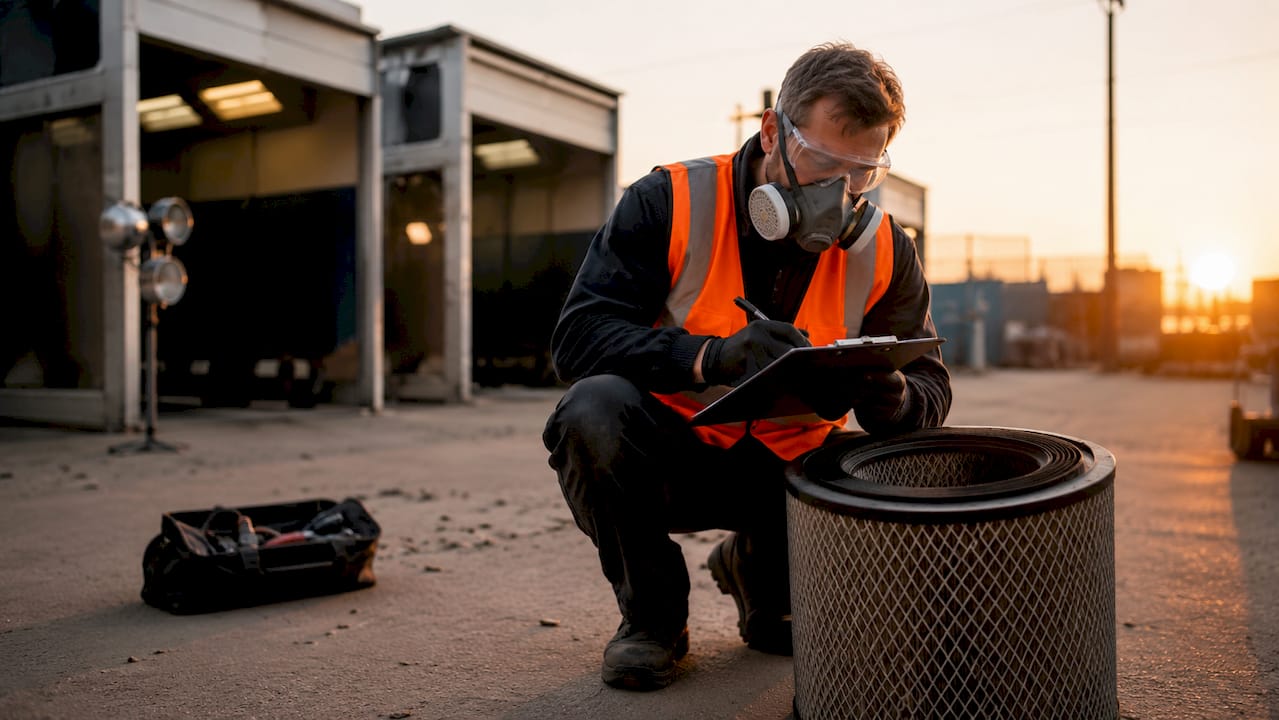
Clogged intake and exhaust filters are the most common source of air contamination in active booths. When filters load up with overspray and particulate, airflow drops, pressure balance shifts, and particles recirculate onto wet paint surfaces. The result is fish-eyes, inclusions, and texture defects that require sanding, repriming, and recoating. Each rework cycle adds labor, materials, and cycle time to a job that should have been done once.
The energy cost angle is equally significant. Clogged filters expose workers to harmful VOCs and isocyanates while forcing motors to work harder to maintain airflow. That extra motor load translates directly into higher electricity bills. Facilities that track pressure differential across filters consistently find that energy consumption climbs well before a filter looks visually dirty.
Pro Tip: Install a digital pressure differential gauge across your intake and exhaust filter banks. When readings approach the manufacturer’s limit, you have roughly one week to act before electricity costs spike and motor strain becomes a real risk. Do not wait for a visual inspection to trigger a filter change.
What safety risks come from poor booth hygiene?
Dry overspray accumulation is a fire hazard, not just a cleanliness problem. Overspray that builds up in ducts, on booth walls, and around exhaust stacks becomes highly flammable. Regular duct cleaning prevents fire hazards caused by accumulated dry overspray and is a standard requirement in fire marshal inspections. Facilities that skip periodic deep cleaning of ductwork put themselves at risk of both catastrophic fire and regulatory shutdown.
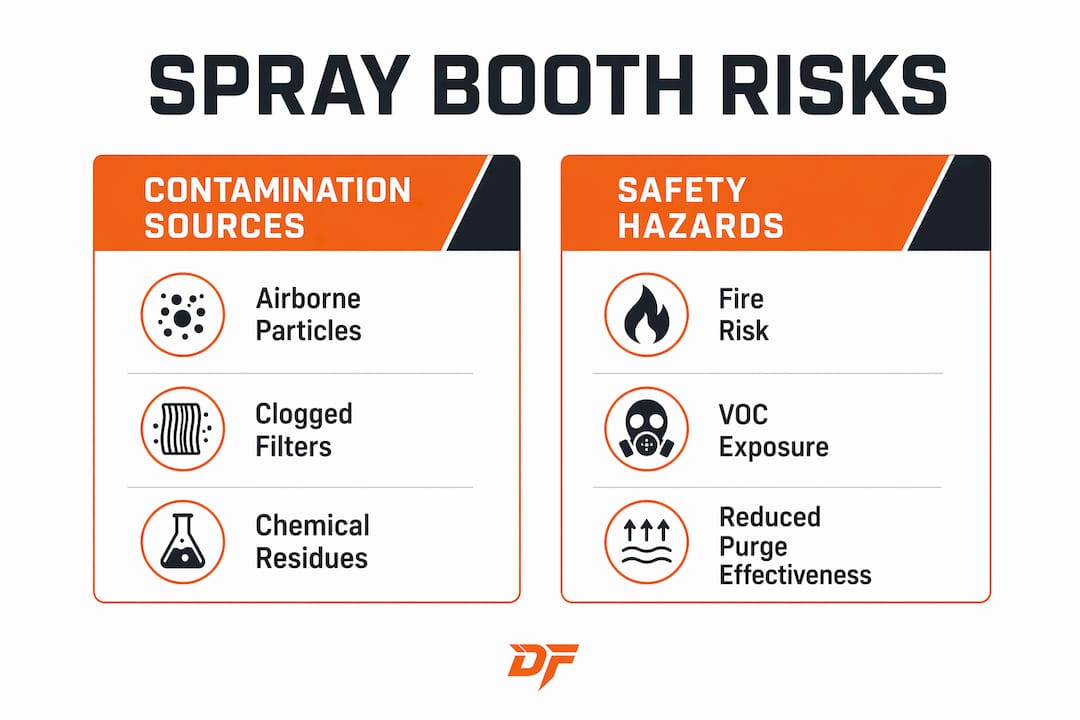
Toxic fume clearance is the second major safety concern. Manufacturers of coatings specify minimum purge times after application before a technician can safely re-enter the booth. Ignoring those clearance times, even by a few minutes, exposes workers to isocyanate concentrations that cause occupational asthma and long-term lung damage. OSHA 29 CFR 1910.94 and NFPA 33 both address ventilation requirements and purge cycles for spray finishing operations.
The following practices form the baseline for safety compliance in any industrial spray booth:
- Inspect and clean exhaust ducts on a scheduled basis, not just when a fire marshal visit is pending.
- Log purge times after every coating application and verify airflow rates match the coating manufacturer’s specifications.
- Use non-sparking tools for any cleaning task inside the booth where residual solvent vapors may be present.
- Replace exhaust filters before they reach maximum loading, not after. A loaded filter reduces purge effectiveness.
- Document all cleaning activities with dates, technician names, and filter readings to support OSHA and NFPA 33 compliance audits.
Pro Tip: Post the coating manufacturer’s purge time requirements inside the booth at eye level. When the information is visible at the point of action, compliance rates improve without additional supervision.
Modular clean booths vs. traditional cleanrooms: which is better?
Facility managers evaluating booth upgrades face a direct choice between modular clean booths and traditional hardwall cleanrooms. The cost difference is substantial. Modular clean booths reduce total cost of ownership by 30–70% by localizing air purification and lowering both capital expenditure and ongoing energy expenses. That range reflects real operational data, not marketing estimates.
The performance case for modular booths is also strong. Modular clean booths use ceiling-mounted Fan Filter Units for efficient laminar flow, supporting ISO Class 5–7 cleanliness standards with simpler maintenance than traditional cleanrooms. Laminar flow pushes particles downward and out of the work zone, which is exactly what industrial painting requires.
| Feature | Modular clean booth | Traditional cleanroom |
|---|---|---|
| Total cost of ownership | 30–70% lower | High CAPEX and OPEX |
| Installation time | Days to weeks | Weeks to months |
| Air cleanliness standard | ISO Class 5–7 | ISO Class 1–8 |
| Energy consumption | Localized, lower | Whole-room, higher |
| Flexibility | Reconfigurable | Fixed construction |
| Maintenance complexity | Low | High |
The flexibility advantage matters in industrial settings where production lines change. A modular booth can be relocated or reconfigured without construction permits or structural modifications. Traditional cleanrooms require demolition and rebuild when layouts shift. For facilities that anticipate growth or process changes, modular systems carry a strategic advantage that the cost comparison alone does not fully capture. Pairing modular booth design with plastic pipe systems for manufacturing can further reduce infrastructure costs during installation or expansion.
How to maintain booth hygiene: daily and periodic practices
Consistent cleaning routines are what separate facilities with low defect rates from those that fight contamination problems every week. Daily cleaning tasks including surface wipe-downs and filter inspections maintain booth hygiene and extend component lifespans. The key is building cleaning into the production schedule, not treating it as an after-thought.
Follow this numbered maintenance sequence to cover both daily and periodic tasks:
- Wipe all interior wall surfaces with a tack cloth or lint-free microfiber cloth before each shift. Microfiber captures particles rather than redistributing them, which is why it outperforms standard shop rags for this task.
- Inspect intake and exhaust filters visually at the start of each shift. Check pressure differential readings against the baseline established at installation. Log the reading.
- Sweep and vacuum booth floors using a vacuum with a HEPA filter. Standard shop vacuums recirculate fine particles back into the air. HEPA filtration captures particles down to 0.3 microns.
- Clean lighting fixtures and door seals weekly. Overspray accumulates on light covers and reduces illumination, which affects color matching accuracy. Door seals collect grime that breaks the booth’s pressure boundary.
- Deep clean exhaust ducts and plenums on a monthly or quarterly schedule depending on production volume. Use non-sparking tools and follow lockout/tagout procedures before entering ductwork.
- Clean delicate equipment components such as sensors and control panels with isopropyl alcohol on a lint-free cloth. This approach, proven effective for maintaining optical and electronic components, prevents gradual degradation of coatings and contact surfaces.
- Avoid soaking any fabric panels or acoustic materials inside the booth. Light vacuuming with brush tools prevents mold and material damage that soaking causes. Test vacuum suction on a small area before cleaning the full panel.
Pro Tip: Assign a dedicated cleaning log to each booth, not to a shift or a team. When the log travels with the booth, accountability is clear and inspection history is always available at the point of use.
Monitoring filter performance with pressure differential software removes the guesswork from replacement scheduling. Operators have roughly one week to act once filter pressure differentials reach their limits before electricity costs spike and motors begin to strain. Digital monitoring converts that one-week window from a crisis into a planned maintenance event. For more detail on controlling airborne contamination, Dustfreefilm’s guide on spray booth air quality covers the latest techniques for 2026.
Key Takeaways
Booth cleanliness is a production variable, not a housekeeping task. It directly controls paint finish quality, worker safety, energy costs, and regulatory compliance in industrial spray operations.
| Point | Details |
|---|---|
| Air purity drives finish quality | Finish quality depends 70% on air purity, making filter and surface maintenance a quality control priority. |
| Clogged filters cost money and health | Loaded filters increase energy consumption and expose workers to VOCs and isocyanates. |
| Safety compliance requires scheduled cleaning | OSHA and NFPA 33 require documented ventilation and purge practices; duct cleaning prevents fire hazards. |
| Modular booths cut total cost of ownership | Modular clean booths reduce ownership costs by 30–70% compared to traditional cleanrooms. |
| Daily routines prevent costly rework | Tack cloth wipe-downs, HEPA vacuuming, and pressure differential logging stop contamination before it reaches wet paint. |
Why I stopped treating booth cleaning as a maintenance line item
Most facilities I have worked with treat booth cleaning as a cost to minimize. The logic seems sound: cleaning takes time, time costs money, so do the minimum required. That logic is wrong, and the financials prove it.
Every rework cycle in a spray booth costs more than the cleaning that would have prevented it. Sanding, repriming, and recoating a single panel adds labor, materials, and booth time that a tack cloth wipe-down would have avoided. When you multiply that across a week of production, the math shifts fast.
The shift I have seen work in real facilities is treating the booth cleaning log the same way you treat a machine maintenance log. When a CNC machine gets its scheduled service, no one debates whether it is worth the time. The booth deserves the same discipline. Digital pressure differential monitoring is the tool that makes this shift practical. It removes the subjective judgment from filter replacement and replaces it with a data trigger. That one change alone has helped facilities I have observed cut unplanned downtime and reduce energy waste without adding headcount.
The other thing I would push back on is the idea that protective films and surface barriers are an added expense. They are the opposite. When booth walls and floors are protected with multi-layer films, cleaning cycles get shorter, surfaces stay in better condition longer, and the risk of contamination from wall-shed particles drops significantly. Dustfreefilm’s contamination prevention guide lays out exactly how that works in practice. Proactive protection is not a luxury for high-volume shops. It is the baseline for any facility that takes first-pass yield seriously.
— Dust
Protect your booth surfaces with Dustfreefilm
Keeping a spray booth clean starts with protecting the surfaces that collect overspray in the first place. Dustfreefilm manufactures multi-layer electrostatic protective films for booth walls and floors that trap overspray before it bonds to surfaces, cutting cleaning time and extending booth life.

The films are heat-resistant, static-free, and designed for high-traffic industrial environments. Dustfreefilm’s patented dispenser system allows quick, bubble-free installation, so your booth is back in production fast. Facilities using Dustfreefilm report fewer contamination incidents and shorter cleaning cycles between jobs. Explore the full range of spray booth protective films or visit the products page to find the right configuration for your operation.
FAQ
Why does booth cleanliness affect paint finish quality?
Finish quality depends 70% on air purity inside the booth. Contaminated air introduces particles into wet paint, causing defects that require costly rework.
How often should spray booth filters be replaced?
Replace filters based on pressure differential readings, not visual inspection alone. Once readings approach the manufacturer’s limit, facilities have roughly one week to act before motor strain and energy costs increase.
What are the main safety risks of a dirty spray booth?
Dry overspray accumulation in ducts creates a fire hazard, and clogged filters reduce purge effectiveness, exposing workers to VOCs and isocyanates. OSHA 29 CFR 1910.94 and NFPA 33 set the compliance requirements for ventilation and purge cycles.
What is the best daily cleaning routine for an industrial spray booth?
Wipe interior surfaces with a tack cloth or microfiber cloth, inspect and log filter pressure differentials, and vacuum floors with a HEPA-filtered vacuum before each shift. These daily surface cleaning tasks prevent contamination buildup and extend component life.
Are modular clean booths worth the investment for industrial painting?
Modular clean booths reduce total cost of ownership by 30–70% compared to traditional cleanrooms and support ISO Class 5–7 air cleanliness with lower energy use and simpler maintenance. For most industrial painting facilities, the cost and flexibility advantages make modular systems the practical choice.