

TL;DR:
- Dust contamination significantly affects the quality and cost efficiency of industrial spray booths. Implementing proper airflow configurations, regular monitoring, and protective measures like films are essential for effective dust control. Data-driven maintenance and external source management are crucial to maintaining consistent, high-quality finishes.
Dust contamination is one of the costliest quality failures in industrial spray booth operations. A single rework cycle from a dust-embedded finish can eat hours of labor and hundreds of dollars in materials. This guide to booth dust control gives you a structured approach, from booth design and filtration to cleaning workflows and real-time monitoring, so you stop reacting to dust problems and start preventing them. Whether you manage an automotive refinishing line or a high-volume industrial coating facility, what follows is a practical framework built for the realities of 2026 operations.
Table of Contents
- Key takeaways
- Your guide to booth dust control setup
- Dust control workflow for paint booths
- Operational best practices for dust reduction
- Verifying your dust control effectiveness
- What I’ve learned running dust control programs
- Protect your booth surfaces with Dustfreefilm
- FAQ
Key takeaways
| Point | Details |
|---|---|
| Downdraft airflow wins | Downdraft configurations pull dust away from the workpiece vertically, producing cleaner finishes. |
| Clean by behavior, not calendar | Schedule cleaning based on dust accumulation patterns in critical zones, not arbitrary dates. |
| Manage outside the booth too | Dust control fails when prep stations and sanding areas outside the booth are ignored. |
| Track pressure drops actively | Rising differential pressure is an early warning of filter loading before defects appear. |
| Protective films reduce cleaning time | Wall and floor protection films prevent surface buildup and make booth maintenance significantly faster. |
Your guide to booth dust control setup
Before you can control dust, you need a booth environment designed to resist it. The physical setup determines how hard every other strategy has to work.
Airflow configuration matters more than most realize
Downdraft airflow is the gold standard for industrial spray booths. It moves air from ceiling to floor, carrying airborne particles away from the painted surface before they can settle. Cross-draft systems push air horizontally, which works in lower-volume settings but creates more contamination risk near workers and workpieces. Semi-downdraft and side-draft configurations fall in between. Know what you have, because every other dust control decision you make should match your airflow type.
Your target air velocity at operator level is 100 to 120 feet per minute. Airflow within that range moves particles efficiently without creating the turbulence that kicks dust back into suspension. Too slow and dust settles on surfaces. Too fast and you generate new contamination.
Filtration, sealing, and environmental controls
The table below summarizes the key setup elements and their function in a dust control system.
| Setup element | Function | Recommended specification |
|---|---|---|
| Intake filters | Block incoming particulates | MERV 15 or higher for industrial use |
| Exhaust filters | Maintain pressure balance and fire safety | Inspect weekly; replace on pressure signal |
| Booth sealing | Prevent unfiltered air infiltration | Check door seals and curtains quarterly |
| Humidity control | Reduce static and particle adhesion | Maintain 50 to 60% relative humidity |
| Pressure monitoring | Detect filter loading early | Digital manometers with alarm thresholds |
Humidity control is consistently underrated. Keeping relative humidity between 50 and 60% reduces static electricity, which prevents dust from clinging to freshly sprayed surfaces and filtration media. It is a low-cost measure with measurable impact on finish quality.
Key physical prerequisites to verify before starting operations:
- Door seals and gaskets are intact and free of gaps
- Booth curtains overlap correctly with no open edges
- Intake and exhaust filter banks are seated flush with no bypass gaps
- Pressure gauges are calibrated and baseline readings are logged
- Humidity levels are monitored continuously, not spot-checked
Dust control workflow for paint booths
A structured cleaning workflow is the backbone of consistent finish quality. The mistake most facilities make is treating cleaning as a single activity. It is actually three separate disciplines with different frequencies and tools.
Daily cleaning protocol
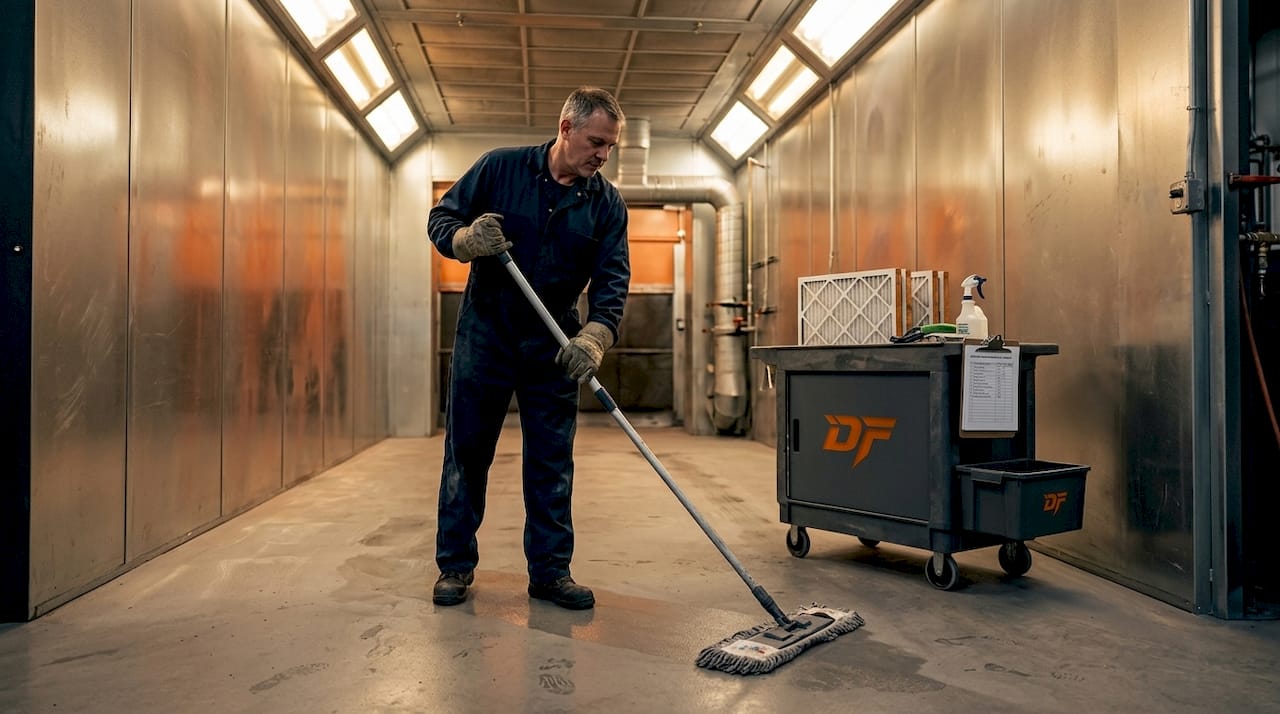
Start every shift with a focused 15-minute light clean of high-accumulation zones. Critical zones need daily care while deeper cleaning occurs less often but must be consistent to prevent dangerous buildup. Focus on:
- Wipe down intake filter frames with a damp lint-free cloth to remove surface dust before it migrates into the booth.
- Inspect and replace tacky mats at booth entry points. Tacky mats catch footwear-borne particles before they reach the spray zone.
- Check light fixture lenses and wipe clean. Dust on light covers reduces visibility and can dislodge during spraying.
- Sweep and mop booth floors with a dust-suppressing solution. Never use a dry broom, which re-suspends particles.
- Use a HEPA vacuum on booth walls from top to bottom. Always work downward to avoid recontaminating cleaned areas.
Pro Tip: Assign daily cleaning to the same person each shift. Rotating the task leads to inconsistency, and small missed areas compound quickly into real contamination events.
Weekly and biweekly deep cleaning
| Task | Frequency | Tool |
|---|---|---|
| Exhaust plenum vacuuming | Weekly | HEPA industrial vacuum |
| Exhaust filter inspection and replacement | Weekly | Pressure gauge reading triggers |
| Booth wall panel deep clean | Biweekly | Low-lint applicator with cleaning solution |
| Intake duct interior cleaning | Biweekly | Flexible hose HEPA vacuum |
| Full floor scrub and protective film refresh | Weekly | Industrial scrubber or film peel and replace |
Plenum chambers are a hidden failure point in many spray booths. Dead zones where air velocity slows allow dust to accumulate and then re-enter the airstream during high-volume spraying cycles. Specialized extraction or manual cleaning of these chambers biweekly is non-negotiable if you want consistent results.
Intake and exhaust filters have entirely different life cycles and purposes. Intake filters protect the finish; exhaust filters maintain booth pressure balance and fire safety. Managing them on the same schedule is a common and costly mistake. Replace intake filters based on visual inspection and the manufacturer schedule. Replace exhaust filters based on pressure drop readings.
Pro Tip: Never rely on a fixed calendar for filter replacement. Track differential pressure with a digital manometer and replace filters when readings climb above the manufacturer’s threshold, not because it is Monday or the end of the month.
Operational best practices for dust reduction
Controlling what enters the booth is just as critical as cleaning what is already inside it. Dust control is about total booth management, and a significant portion of contamination originates outside the spray zone.
Controlling dust at the source
Sanding and prep work generate enormous quantities of fine particulate. If your prep stations are adjacent to or connected with your spray booth, that dust will find its way in. Install dedicated dust collectors with HEPA filtration at every sanding station. Position them to create negative pressure at the work surface, pulling particles away from the worker and away from booth entry points.
Worker garments are another underestimated source. Lint from standard shop wear is one of the most common contaminants found in defect analysis. Require lint-free coveralls inside the spray booth and store them sealed when not in use. Establish a gowning protocol at the booth entrance, not in the prep area.
Key operational controls to implement:
- Use tacky mats at every booth entry point and replace them when the surface is visibly saturated
- Apply anti-static spray to booth walls and floors weekly to reduce particle adhesion
- Use protective film on booth walls and floors to create cleanable, replaceable surfaces
- Sequence your operations so that sanding and prep always occur before masking and before the booth is prepared for spraying
- Never open booth doors during active spraying cycles
Technological aids that deliver real results
Automated airflow systems and industrial HVLS fans keep particles suspended and moving toward exhaust filtration rather than settling on surfaces or workpieces. These systems reduce manual intervention and maintain consistent airflow velocity across the booth floor area.
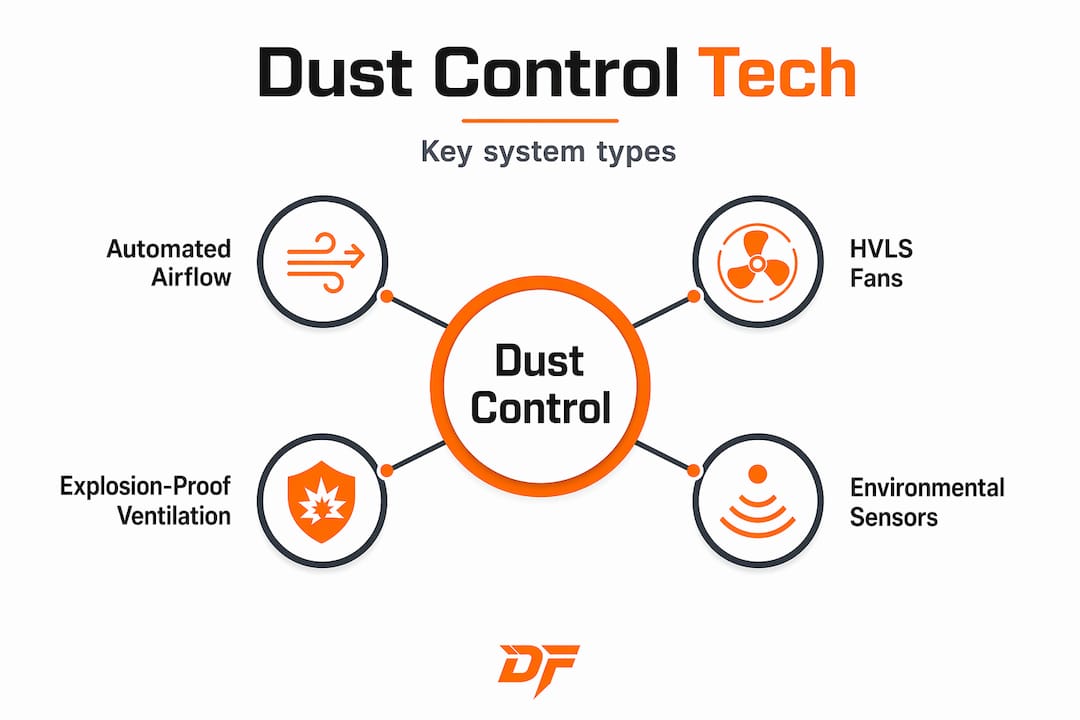
For safety compliance, particularly in wood finishing and coating facilities, explosion-proof ventilation with integrated spark detection and explosion venting is required under NFPA 664 and ATEX standards. Combustible dust is a regulatory and physical reality. Your spray booth safety practices must address this explicitly in your facility’s safety plan.
Pro Tip: Treat your dust control workflow as a living document. Review it quarterly and update it when you change materials, add new equipment, or modify booth configuration. What worked for one coating system may not work for another.
Verifying your dust control effectiveness
Implementing a system without measuring it is guesswork. Consistent verification is what separates facilities that manage dust from those that react to it.
Monitoring metrics that actually matter
Differential pressure tracking is your most reliable performance indicator. When pressure drop across a filter bank rises, airflow is being restricted. Rising differential pressure is an early warning sign of filter loading. It tells you to act before defects start appearing in your finishes, not after.
Beyond pressure monitoring, establish these verification practices:
- Log airflow velocity readings at operator level weekly using a calibrated anemometer
- Use smoke pencils or airflow visualization tools monthly to check for dead zones or turbulent areas
- Collect employee feedback after each shift on visible dust levels and spray quality; operators notice problems before instruments do
- Review finish defect logs weekly and correlate dust-related defects to cleaning and filter records
- Inspect booth seals, door gaskets, and filter seating monthly for wear and gaps
Common signs that your dust control system is underperforming include fish-eye defects in finished surfaces, visible dust trails in spray booth lighting, rapid filter loading faster than the manufacturer’s baseline, and condensation on walls suggesting humidity imbalance.
IoT-based environmental sensors are increasingly common in high-volume facilities. These devices monitor particulate count, humidity, temperature, and airflow velocity in real time, sending alerts when readings drift outside acceptable ranges. The shift from reactive cleaning to performance-driven operational discipline is where the industry is heading, and sensor-based monitoring is the mechanism that makes it possible.
What I’ve learned running dust control programs
In my experience, the facilities that struggle most with dust control are not the ones with the worst equipment. They are the ones that treat cleaning as maintenance instead of treating it as quality assurance.
I’ve seen shops invest in premium filtration and then sabotage the results by skipping plenum cleaning for three months. The plenum fills up, particles re-enter the airstream, and suddenly they are dealing with finish defects that look like an equipment failure. It is not. It is a process failure, and it is entirely preventable.
The other lesson that rarely makes it into standard training is this: most dust problems start outside the booth. The prep area, the sanding bay, the transition zone between them. The contamination from external sanding stations migrating into a spray booth is one of the most common and least-addressed causes of finish defects I have encountered.
My strongest advice is to build your governance around observed behavior, not fixed schedules. If a zone is accumulating dust faster than expected, clean it more often. If pressure drops stay flat for longer, your filters may be performing beyond their rated life. Let the data drive the schedule. That mindset shift, from calendar-based to performance-based, is where real control begins.
— Dust
Protect your booth surfaces with Dustfreefilm

One of the most practical upgrades any spray booth facility can make is adding protective film to walls and floors. Dustfreefilm’s wall and floor protector films are engineered specifically for industrial spray booth environments. They create a cleanable, replaceable surface layer that captures dust and overspray before it bonds to booth structures. Instead of scrubbing walls and floors during every deep clean, you peel and replace. The films are heat-resistant, static-free, and built for high-traffic industrial use. Installation is fast using the patented dispenser system, with no bubbles and no adhesive mess. If you want a tailored solution for your booth dimensions and application volume, request a custom quote directly from the Dustfreefilm team.
FAQ
What is the most effective airflow type for dust control in spray booths?
Downdraft airflow is the most effective configuration because it pulls particles vertically downward and away from the workpiece, significantly reducing surface contamination during spraying.
How often should spray booth filters be replaced?
Replace intake filters according to the manufacturer’s schedule and visual inspection. Replace exhaust filters based on differential pressure readings rather than fixed dates, since pressure rise signals filter loading before quality defects appear.
What humidity level reduces dust contamination in spray booths?
Maintaining relative humidity between 50 and 60% reduces static electricity buildup, which prevents dust particles from clinging to painted surfaces and filtration media.
What are the most common signs of dust control failure in a paint booth?
Fish-eye defects in finished surfaces, visible dust settling in booth lighting, faster-than-expected filter loading, and employee-reported increases in airborne particles during spraying are the most reliable early indicators.
How do protective films help with booth dust control?
Protective wall and floor films create a replaceable surface layer that traps dust and overspray, eliminating the need for intensive scrubbing and reducing the time spent on deep cleaning cycles.