
A booth film dispenser will typically pay back within 4–10 months for spray booth operations running at moderate-to-high throughput. The single biggest variable is how many booth changes you perform per day. At two or more changes daily, the labor and rework savings compound fast. At one change or fewer, payback stretches but still lands well inside 18 months for most Greek facilities.
Three conditions shift that range significantly:
- Throughput: More daily booth changes mean faster payback. Low-volume shops (one change/day) see slower returns; high-volume operations (three-plus changes/day) can hit break-even in under six months.
- Labor and rework costs: If your technicians currently spend 30–45 minutes on manual taping and cleanup per changeover, a dispenser system cuts that sharply. The higher your labor rate, the faster the math works.
- Consumable pricing and waste: Bulk film purchasing at factory-direct rates drives down cost per change. Facilities buying in smaller quantities leave margin on the table.
Pro Tip: Before requesting a quote, log your current changeover time and reject rate for two weeks. That baseline is the single most persuasive number you can bring to a procurement conversation.
Key Takeaways
A booth film dispenser pays back fastest when baseline labor and rework costs are documented before purchase, and when consumables are sourced at bulk factory-direct pricing.
| Point | Details |
|---|---|
| Payback range | Most Greek spray booth operations hit break-even in 3–10 months depending on daily changeover volume. |
| Critical cost inputs | Include CapEx, film consumables, maintenance, and any customs duties in your total cost of ownership. |
| Savings to count | Labor per changeover, rework rate reduction, and faster booth cycle time are the three highest-value savings lines. |
| Measurement window | Log daily metrics for the first 90 days; compare against your pre-install baseline to validate realized payback. |
| Dustfreefilm | Patented dispenser system, European manufacturing standards, and bulk-order pricing support faster payback for Greek facilities. |
Table of Contents
- Why a dispenser-based system changes your booth’s cost structure
- What goes into a defensible ROI model for your facility
- Illustrative ROI scenarios for Greek spray booth operations
- Buying, lead times, and installation: what to expect in Greece
- How to measure ROI in the first 3–12 months
- What proof to ask for before buying
- Dustfreefilm cuts your payback timeline from day one
- A facilities manager’s perspective on approving dispenser capex
- Sources
Why a dispenser-based system changes your booth’s cost structure
The savings from a booth film dispenser do not come from one big line item. They stack across three channels simultaneously.
Labor savings are immediate. Manual taping is slow, inconsistent, and ties up a skilled technician. A patented dispenser system cuts changeover time to a fraction of the manual process. Across a five-day week with two changes per day, that adds up to several hours of recovered labor monthly.
Reject and rework rates drop. Dust contamination during film changes is a leading cause of finish defects. Automated, precise film application eliminates the airborne particle exposure that manual handling introduces, producing cleaner surfaces and fewer rejects. Protective film quality directly affects your defect rate, and defects are expensive: a single rework job in an automotive refinishing booth can cost more than an entire week of consumables.
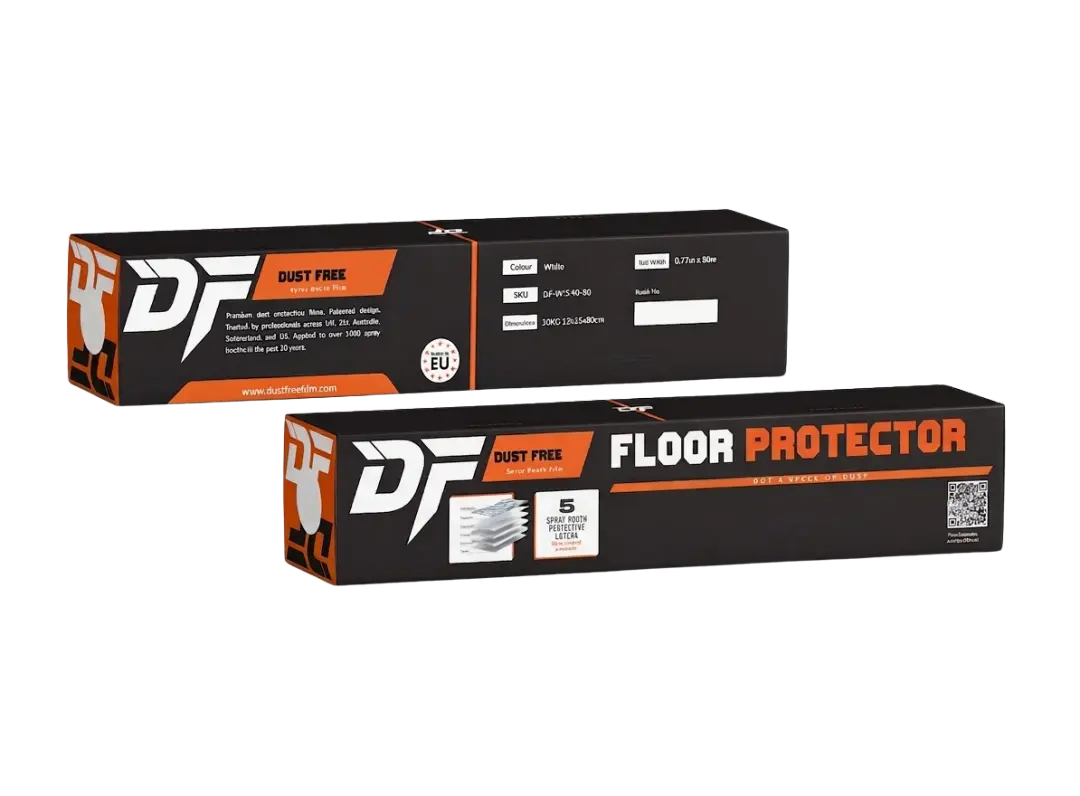
Operational predictability improves. A dispenser system standardizes consumable usage, which makes inventory planning straightforward. You stop ordering reactively and start scheduling proactively. That stability reduces overtime and prevents the revenue loss that comes from unplanned booth downtime.
High-capacity dispenser designs also reduce restocking frequency, which means fewer labor interruptions during peak production hours. Operators who add cloud monitoring or remote alerts catch maintenance issues before they become downtime events, a practice that consistently proves cheaper than reactive repair.
Pro Tip: Track booth uptime as a percentage from day one.
What goes into a defensible ROI model for your facility
Getting the math right means including the right costs and the right savings. Leaving out either side produces a number that finance will reject.
Capital expenditure (CapEx) to include:
- Dispenser hardware purchase price
- Initial film inventory (first 60–90 days of stock)
- Electrical or mounting site works
- Shipping and any Greek customs duties
Operating expenditure (OpEx) to include:
- Film roll consumables (monthly)
- Routine maintenance and spare parts
- Any software or remote monitoring fees
Savings to count:
- Labor minutes saved per changeover, multiplied by your hourly labor rate
- Reduction in rework/reject rate, valued at average rework cost per job
- Faster booth cycle time, converted to additional throughput capacity
- Reduced cleaning materials and surface prep consumables
What to exclude or treat cautiously: Marketing visibility uplift should be modeled separately. One-off installation grants are real but non-recurring. Hypothetical revenue from capacity you do not yet have customers to fill belongs in a sensitivity column, not your base case.
Simple payback formula:
ROI formula:
ROI calculators for automated dispensers typically model factory film cost per unit as low as €0.25 at factory-direct pricing, with industry averages of 250–400 film changes per month per unit. Plug your actual Greek numbers into those cells first.
Illustrative ROI scenarios for Greek spray booth operations
These three scenarios use realistic assumptions for Greek automotive and industrial facilities. Replace the inputs with your actual figures.
Labor rate assumed at €18/hour. Film costs reflect bulk purchasing. CapEx includes hardware and installation.
Turnkey automated dispenser setups in comparable industries commonly cost €7,000–€11,000 for full kiosk configurations, with payback after 600–650 service cycles in strong-traffic locations. Spray booth dispensers operate at lower price points with a narrower but more predictable customer base.
How to adapt these scenarios:
- Replace the labor rate with your actual Greek payroll cost per hour.
- Swap the film cost with your current or quoted bulk price per roll.
- Model rent as a fixed monthly cost if you lease booth space, or as a percentage of throughput value if you operate on a revenue-share arrangement.
- Run a sensitivity test: what happens to payback if your changeover rate drops 20%? If film costs rise 15%?
Conservative conversion modeling recommends starting at the low end of your throughput estimate for new installations, then adjusting upward after a 90-day measurement window. That approach produces a procurement case finance will not easily challenge.
Buying, lead times, and installation: what to expect in Greece
Greek procurement for industrial equipment moves at its own pace. Plan for it rather than against it.
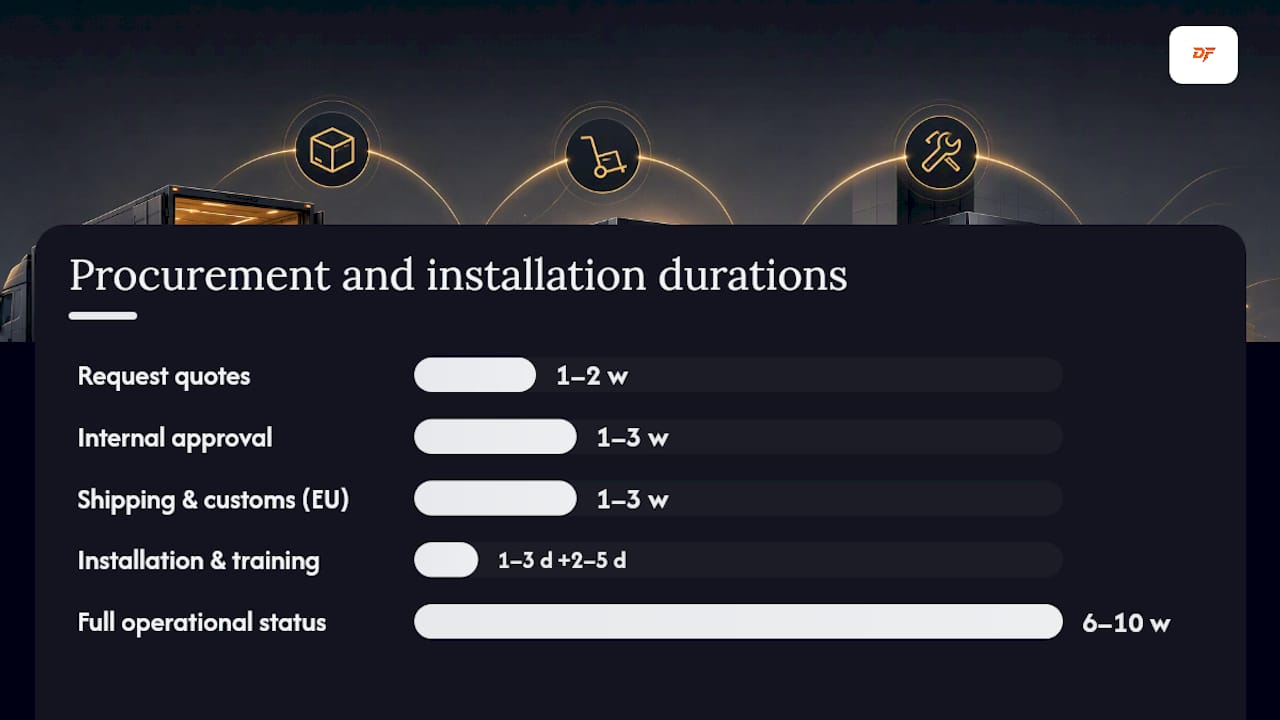
Typical timeline from decision to operational status:
- Request quotes and technical datasheets: 1–2 weeks
- Internal approval and purchase order: 1–3 weeks (longer for public-sector or multi-site operations)
- Shipping and customs clearance in Greece: 1–3 weeks for EU-manufactured goods; longer for non-EU origin
- On-site installation and electrical/mounting works: 1–3 days
- Staff training and trial runs: 2–5 days
- Full operational status: typically 6–10 weeks from decision
Installation checklist:
- Confirm power supply and mounting surface compatibility before delivery
- Verify booth dimensions against dispenser specifications
- Schedule staff training during a low-throughput period, not peak production
- Run at least three full trial changeovers before going live
- Document baseline metrics during the trial period
Questions to ask vendors before signing:
- What European manufacturing standard does the product comply with, and can you provide documentation?
- What is the patent number for the dispenser system?
- What is the warranty period and spare-part lead time to Greece?
- Do you offer bulk-order pricing and custom film configurations?
- What is your uptime SLA and escalation process?
Financing options in Greece: Equipment leasing through Greek commercial banks (Eurobank, Alpha Bank, Piraeus Bank) is common for capital equipment under €10,000. Leasing preserves working capital and converts CapEx to a predictable monthly OpEx line, which can simplify budget approval. For larger multi-booth installations, ask vendors directly about deferred payment or staged delivery arrangements. Advanced industrial equipment procurement increasingly uses leasing structures precisely because it aligns payment timing with the savings the equipment generates.
How to measure ROI in the first 3–12 months
Primary metrics to track:
- Booth changes per day (actual vs. baseline)
- Booth uptime percentage
- Reject and rework rate (jobs requiring correction ÷ total jobs)
- Labor hours per changeover
- Monthly consumable spend
- Net incremental profit (revenue or cost avoidance minus all OpEx)
Measurement cadence: Log daily for the first three months. Move to weekly summaries in months 3–6. Monthly reporting suffices from month six onward, once patterns are stable.
Reporting template (baseline vs. post-install):
Cross-check labor savings against payroll or timesheet records. Use automated uptime logs where available. Run random spot checks on film application quality to catch degradation before it affects your reject rate. Maintaining booth wall protection consistently is what keeps the savings assumptions in your model from eroding over time.
Automated dispenser systems with remote monitoring capabilities allow proactive maintenance scheduling, which vendors consistently cite as a key factor in sustaining stable margins through busy production periods.
What proof to ask for before buying
Procurement risk in this category is real. The right documents cut it significantly.
Document checklist:
- Technical datasheet with film specifications (thickness, heat resistance, static dissipation)
- Durability and test reports (independent or in-house, dated)
- CE marking documentation and European manufacturing evidence
- Patent number(s) for the dispenser system
- Warranty terms in writing, including parts and labor scope
- Uptime SLA with defined response times for Greece
Commercial proof to request:
- Case studies from facilities of similar size and throughput
- Installation references you can contact directly
- Spare-part lead time commitment for the Greek market
Key technical features to verify in the datasheet include heat resistance rating, electrostatic properties, and compatibility with your booth’s existing surface materials.
Dustfreefilm cuts your payback timeline from day one
Faster changeovers, fewer rejects, and predictable consumable costs: that is the concrete difference Dustfreefilm’s patented dispenser system delivers for Greek spray booth operations. The multi-layer electrostatic films are manufactured to European standards, heat-resistant, and static-free, which means the quality assumptions in your ROI model hold up in real production conditions, not just on paper.
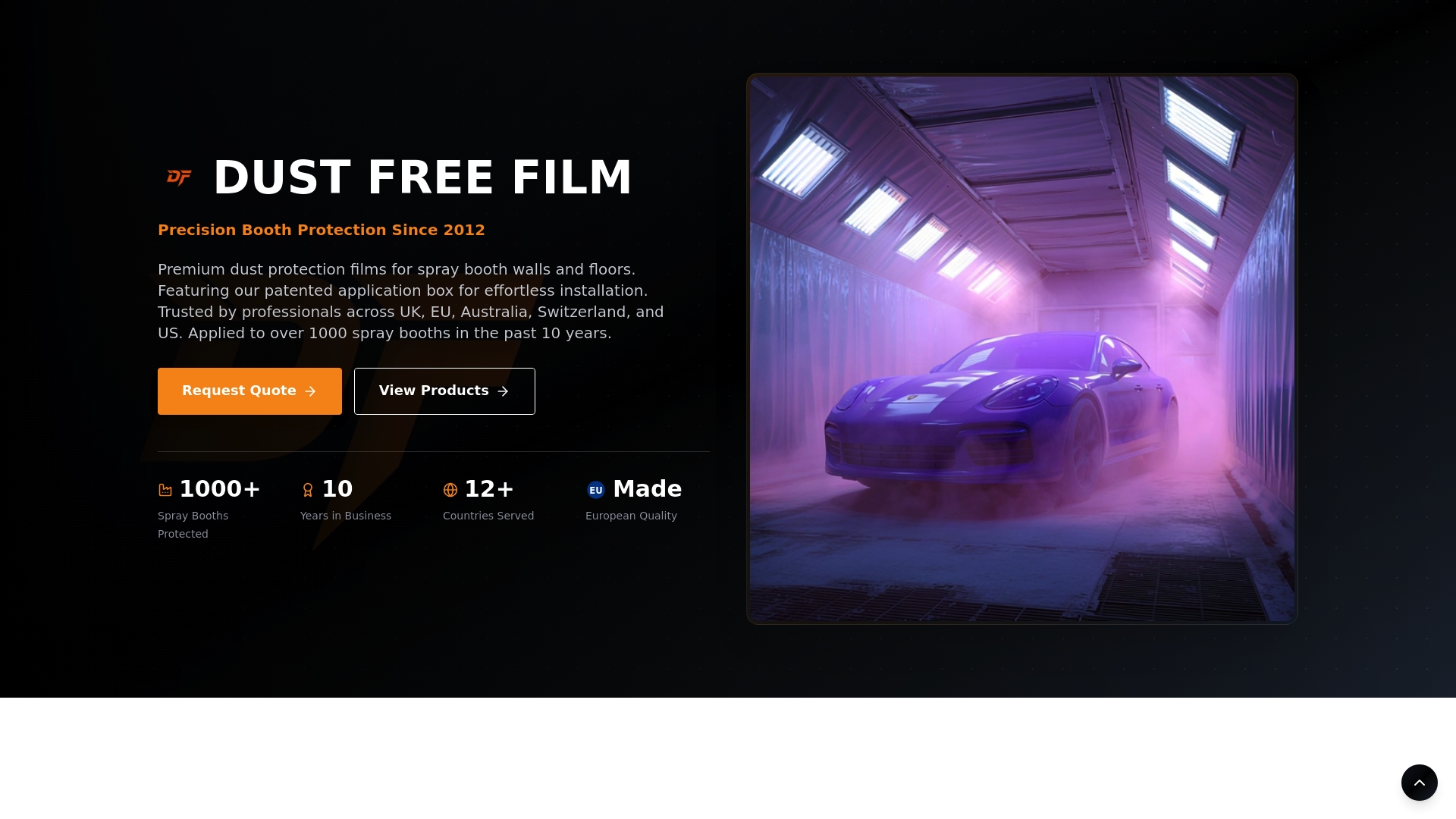
Bulk-order flexibility and custom film configurations mean your consumable cost per change stays low as volume grows. The patented application box eliminates tape and reduces changeover time to minutes. Dustfreefilm has been supplying facilities across Europe since 2012, with technical datasheets, durability reports, and patent documentation available on request.
Contact Dustfreefilm for a tailored ROI quote specific to your Greek facility’s throughput and booth configuration. Bring your baseline changeover time and current reject rate, and the team will model your actual payback period, not a generic estimate.
A facilities manager’s perspective on approving dispenser capex
The ROI math on booth film dispensers is genuinely straightforward once you have clean baseline data. What makes the approval conversation harder is not the numbers; it is the absence of them. Finance teams reject capex requests that rely on estimates. They approve ones backed by two weeks of logged changeover times and a documented rework rate.
Five talking points that move approval forward:
- Payback is bounded. Even the low-throughput scenario hits break-even inside 12 months.
- Savings are auditable. Labor hours and rework costs appear in existing payroll and job records.
- Quality risk is reduced. Fewer rejects protect customer relationships, not just the cost line.
- Uptime is guaranteed by design. Patented dispenser systems with documented SLAs are not a promise; they are a contractual commitment.
- Scalability is built in. Bulk-order and custom-configuration options mean the unit economics improve as you add booths.
Package the ROI argument for finance as payback months first, sensitivity table second.
Sources
- Screen Protector Vending Machine Cost and ROI 2026 Guide
- The F5 self-service phone film application machine — your 24/7 passive income engine
- Photo Booth ROI Calculator India | Know Your Payback Period
During procurement, request vendor technical datasheets, durability test reports, and CE/European manufacturing evidence as a minimum. Do not approve capex without them.