

TL;DR:
- Choosing the wrong booth protection can risk operator safety, violate regulations, and lead to costly rework cycles.
- Selecting the appropriate system depends on hazard levels, airflow, containment needs, and regulatory compliance specific to the operation.
Choosing the wrong booth protection for your spray environment does not just cost you a bad paint job. It can put operators at risk, trigger OSHA violations, and create rework cycles that eat profit. The range of examples of booth protection solutions available today is wide enough to cover everything from a single-bay auto body shop to a pharmaceutical coating line, and that range is exactly what makes the decision hard. This guide cuts through the confusion, explains the real differences between the most common configurations, and gives you a clear framework for matching the right solution to your specific operation.
Table of Contents
- How to evaluate booth protection solutions: key criteria
- Downflow booths: balanced dust containment with operator access
- Isolator booths: sealed containment for high-potency and sterile environments
- Side-downdraft spray booths: efficient overspray capture without a pit
- Test enclosures: interlocked safety for hazardous operations
- Regulatory compliance: OSHA’s critical spray booth protection requirements
- Comparing booth protection solutions: pros, cons, and applications
- What the industry gets wrong about booth protection
- Keep your booth surfaces as clean as your airflow
- Frequently asked questions
Key Takeaways
| Point | Details |
|---|---|
| Match protection to material hazard | Choose booth protection based on your material’s potency and containment needs rather than just dust presence. |
| Airflow and filtration matter most | Continuous directed airflow and proper filtration are essential to effectively contain dust and overspray. |
| OSHA compliance is critical | Ensure spray booths meet OSHA ventilation, electrical, and fire suppression requirements for safety and legality. |
| Maintenance preserves protection | Regular filter monitoring and cleaning prevent degradation of booth performance and operator exposure. |
| No one-size-fits-all solution | Selecting between downflow booths, isolators, side-downdraft booths, and test enclosures depends on specific operational and safety criteria. |
How to evaluate booth protection solutions: key criteria
Before you choose a booth type, you need an honest assessment of what you are actually protecting against. Dust containment is not a one-size-fits-all problem. A shop spraying waterborne basecoat has different risks than a facility handling cytotoxic powders, and treating them the same way is where most facilities go wrong.
A key nuance in containment design is the distinction between operator protection versus sealed environments built for potent materials. Understanding which category your operation falls into shapes every other decision you make. Your booth protection system type should follow from your hazard profile, not from what your neighbor shop is using.
Use this checklist before evaluating any solution:
- Containment level needed: Open-face booths work for low to medium hazard materials. Sealed systems are required when exposure limits are extremely tight.
- Material hazard profile: Look at your occupational exposure limit (OEL), the threshold for how much airborne material is considered safe for workers. The lower the OEL, the more containment you need.
- Airflow direction and filtration efficiency: Downward airflow moves contaminants away from the operator’s breathing zone. Lateral or inadequate airflow pushes them toward it.
- Regulatory requirements: OSHA ventilation minimums, NFPA fire suppression standards, and local codes are non-negotiable baselines, not optional upgrades.
- Workflow realities: A containment system that slows your throughput by 40 percent is not sustainable, regardless of how effective it is at filtering particles.
Now that you understand what criteria matter, let’s explore specific booth protection solution examples.
Downflow booths: balanced dust containment with operator access
Downflow booths are the workhorse of industrial spray environments. They are walk-in style enclosures where filtered air supplied from the ceiling moves downward, pulling dust and airborne particles away from the operator and into HEPA filtration at floor level. The airflow direction is what makes them effective. Contaminated air never rises past the breathing zone.
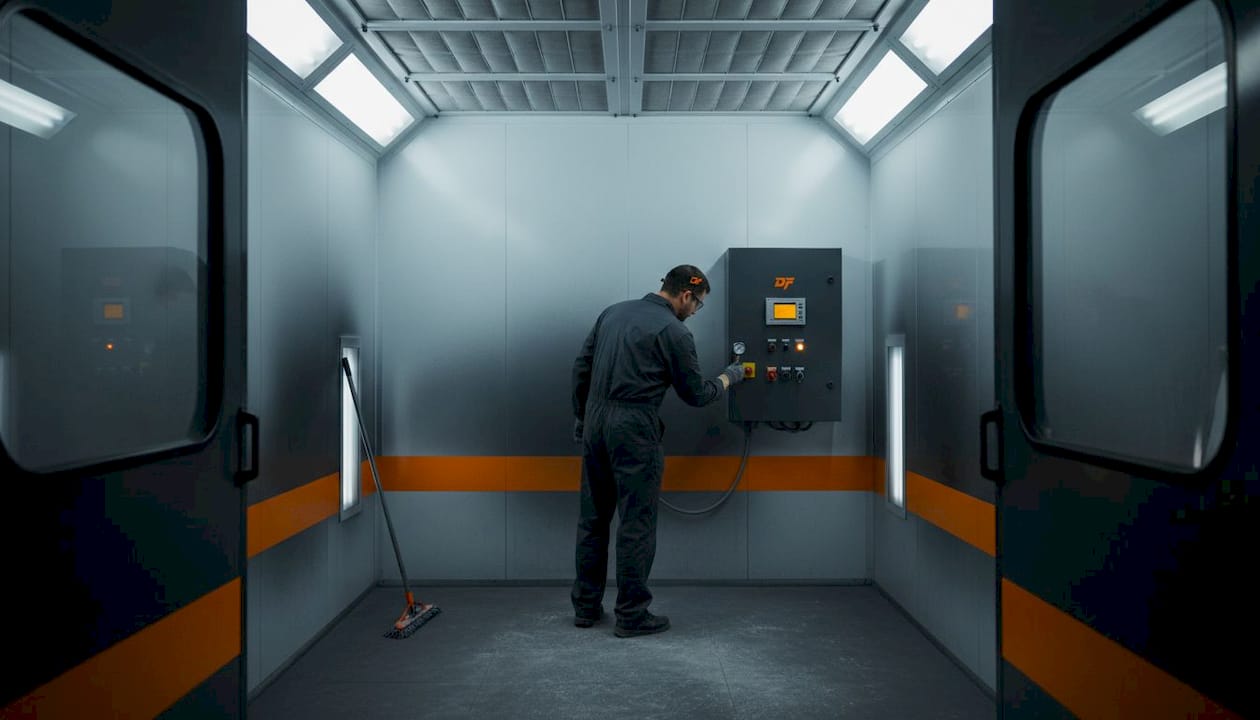
This design handles medium-potency materials well, including most automotive refinishing products, powder coatings, and industrial paints. Operators can move freely, handle parts manually, and use standard spray equipment without the physical restrictions that come with sealed alternatives. The cost is significantly lower than isolator systems, and installation is straightforward for most facilities.
Key benefits of downflow booths:
- HEPA filtration removes particles down to 0.3 microns with 99.97 percent efficiency
- Open access allows natural body movement and equipment flexibility
- Lower capital cost compared to full isolator systems
- Adaptable configurations accommodate a range of part sizes and spray processes
- Good types of spray booth protection fit for general industrial coating operations
Pro Tip: Even in a well-designed downflow booth, the wall surfaces collect overspray and contaminated residue over time. Adding a multi-layer protective film to booth walls and floors creates a surface barrier that you can peel and replace in minutes rather than scrubbing and repainting. It also reduces particulate shedding from degraded wall surfaces back into your clean airflow.
Having covered downflow booths, let’s contrast them with fully sealed isolator booths.
Isolator booths: sealed containment for high-potency and sterile environments
Isolator booths operate on a fundamentally different principle. Instead of moving air around an open operator, they separate the operator from the product entirely. The enclosure is rigid-walled and sealed, with glove ports allowing hands-in access without breaking containment. Nothing gets out unless you deliberately open the system.
These units provide ISO 5 or Class 100 clean air conditions with precisely controlled pressure differentials. Negative pressure protects the operator from toxic materials. Positive pressure protects sterile products from environmental contamination. The same housing serves both functions depending on how the pressure is configured.
Isolator booths are common in pharmaceutical manufacturing, cytotoxic drug compounding, and any process where OELs are measured in nanograms per cubic meter rather than milligrams. The cost is substantial, and the workflow is slower, but when the alternative is operator exposure to ultra-potent materials, there is no practical substitute. Their isolator booth features reflect engineering priorities that most auto body shops will never need but industrial coatings operations handling specialty chemicals absolutely will.
Key features of isolator booths:
- Full enclosure with rigid walls and sealed transfer ports
- Glove port interfaces allow manipulation without direct exposure
- Pressure-controlled environment switchable between negative and positive
- ISO 5 clean air classification for the most demanding sterile requirements
- Meets the strictest OEL targets where downflow designs fall short
Pro Tip: If you are weighing an isolator against a high-grade downflow booth for a borderline application, request containment performance testing data from the manufacturer. The OEL your material requires should dictate the test standard, not the vendor’s marketing claims.
Next, we turn to a specific alternative design optimized for overspray capture: the side-downdraft booth.
Side-downdraft spray booths: efficient overspray capture without a pit
Side-downdraft booths solve a practical installation problem. Traditional downdraft designs route exhausted air through a floor pit and then out through an underground duct. That pit costs money, complicates flooring, and creates a maintenance headache. Side-downdraft configurations direct air from the ceiling downward to low-level side plenums, capturing overspray through dry paper or fiber filters mounted along the lower side walls. No pit required.
This setup is especially practical for automotive shops that are retrofitting an existing building or working with limited concrete modification options. Overspray is pulled laterally and downward, away from the vehicle surface and the operator. Dry filters trap the particles, and a differential manometer measures the pressure difference across the filter media to tell you when loading is approaching replacement threshold. That instrumentation matters. Waiting until you can visually identify a clogged filter means you have already been running with degraded performance.
Key features of side-downdraft booths:
- No floor pit simplifies installation and reduces construction cost
- Paper or fiber dry filters capture overspray particles effectively
- Differential manometer tracks filter loading in real time for proactive maintenance
- Side low-level plenums draw contaminated air away from the work surface
- Good spray booth airflow setup for shops prioritizing finish quality without complex infrastructure
Besides dust and overspray containment, some booths focus on protecting operators during testing, as we discuss next.
Test enclosures: interlocked safety for hazardous operations
Test enclosures are a different category entirely. They are not spray booths in the traditional sense. They are engineered enclosures designed to protect operators who are running electrical tests, functional checks, or other hazardous evaluations on completed assemblies or components. The safety doors on these units are monitored by dual-circuit switches that halt the test sequence and cut power the moment a door is opened. There is no relying on the operator to remember to shut things down. The interlock does it automatically.
ESD-resistant (electrostatic discharge-resistant) materials are available for facilities testing sensitive electronic components. These prevent the enclosure itself from generating a static charge that could damage the product or create a spark hazard in certain environments. Industries that use test enclosures range from automotive electrical systems to aerospace components to industrial control systems.
Key features of test enclosures:
- Interlocked safety doors stop tests and cut power automatically on opening
- Dual-circuit switches meet regulatory requirements for hazardous equipment operation
- ESD-resistant materials protect sensitive components from static damage
- Modular configurations accommodate test objects of varying sizes
- Used in industries where spray booth safety solutions intersect with electrical and mechanical hazard management
Finally, let’s review important regulatory-driven protections required for all spray booths.
Regulatory compliance: OSHA’s critical spray booth protection requirements
OSHA does not treat spray booths as optional compliance territory. Spray booths require at least 100 feet per minute of airflow across the open face and are classified as Class I, Division 1 hazardous locations. That classification means every light fixture, fan motor, switch, and electrical component inside the booth must be rated for explosive atmosphere service. Standard commercial electrical components are not acceptable.
The five OSHA requirements that most facilities overlook:
- Minimum 100 fpm face velocity maintained consistently across the entire open face, not just at the center
- Explosion-proof electrical fixtures installed throughout the booth interior and nearby areas
- Automatic fire suppression systems installed and maintained per NFPA 33 standards
- Documented inspection records for fire, ventilation, and filtration equipment
- Appropriate PPE provided for every operator, including chemical-resistant gloves, splash eyewear, and hearing protection where noise exposure exceeds limits
Facilities that treat OSHA spray booth standards as a checklist rather than an operational baseline are the ones that end up with citations, shutdowns, or worse. Improving spray booth airflow is not just a quality initiative — it is a compliance requirement.
With these regulations in mind, let’s compare these booth protection solutions to help you decide the best fit for your facility.
Comparing booth protection solutions: pros, cons, and applications
The choice between containment technologies ultimately comes down to four variables: containment level required, operator access needs, OEL targets for the materials involved, and process sterility requirements. Here is how the main options stack up:
| Solution | Containment level | Operator access | Ideal application | Key limitation |
|---|---|---|---|---|
| Downflow booth | Medium | Open, flexible | Automotive refinishing, powder coating | Not suitable for ultra-potent materials |
| Isolator booth | Very high | Restricted (glove ports) | Pharmaceutical, cytotoxic handling | High cost, slower workflow |
| Side-downdraft booth | Medium | Open, flexible | Auto shops, retrofit installations | Lower efficiency than full downdraft pits |
| Test enclosure | Specialized | Interlocked access | Electrical/component testing | Not a spray containment solution |
A few decision points worth calling out:
- If your materials are standard automotive paints or industrial coatings, a downflow or side-downdraft booth is the right starting point.
- If you handle specialty chemicals with low OELs, isolator technology is likely required regardless of cost.
- If your facility runs both spray and electrical testing operations, you may need separate booth types for each function.
- In all cases, internal booth surface protection adds a layer of contamination control that airflow alone cannot provide. Surfaces accumulate residue. That residue becomes a secondary contamination source.
Pro Tip: Compare solutions using your spray booth protection product comparison criteria before requesting quotes. Vendors will tailor their pitch to your stated priorities. If you haven’t defined those priorities clearly, you will end up buying what they want to sell rather than what you actually need.
Based on these characteristics, consider your operational context to find the optimal booth protection solution.
What the industry gets wrong about booth protection
Here is the uncomfortable reality: most facilities invest heavily in the enclosure and almost nothing in the surfaces inside it. A downdraft booth with degraded, paint-saturated walls is not a clean environment. The airflow moves particles into the filters, yes, but it also moves particles off contaminated surfaces back into your spray zone. The walls are part of the containment system, and they are almost universally treated as afterthoughts.
We have seen it repeatedly. A shop installs a well-engineered downflow booth, follows OSHA ventilation requirements, uses quality filters, and still gets dust inclusions in finished paint. The culprit is almost always the wall and floor surfaces. Old overspray buildup becomes friable over time, meaning it breaks into fine particles that re-enter the airflow. The cleaner you keep those surfaces, the more your filtration investment actually pays off.
The best practices for booth safety go beyond airflow and filtration. They include surface management as a first-class priority. Multi-layer protective films on walls and floors address this directly: you apply the film, spray, peel the contaminated layer off, and the surface beneath is clean and protected again. No scrubbing, no downtime, no re-contaminating the booth with cleaning chemicals that introduce their own residues.
Effective booth shielding is not just a barrier between the operator and the air. It is a complete surface-to-ceiling system designed to keep every square foot of the booth interior as clean as the day it was installed.
Keep your booth surfaces as clean as your airflow
Every solution covered in this article addresses one side of the dust problem: how air moves through the booth. Dust Free Film addresses the other side: what happens to your booth surfaces over time. Our multi-layer electrostatic protective films are engineered specifically for spray booth wall and floor protection in automotive refinishing and industrial painting environments. They install quickly using our patented dispenser system, adhere without bubbles, and peel cleanly when the layer is spent, leaving a fresh, static-free surface ready for the next job. If you are serious about dust-free finishes, visit dustfreefilm.com to see our full range of booth wall and floor protection products built for exactly your operation.
Frequently asked questions
What is the main difference between a downflow booth and an isolator booth?
Downflow booths are open workspaces with filtered air moving downward to protect operators, while isolators are fully sealed enclosures with glove ports designed for handling highly potent or sterile materials with zero operator exposure.
How does OSHA regulate ventilation in spray booths?
OSHA requires at least 100 feet per minute of airflow across the booth face and classifies booth interiors as Class I, Division 1 hazardous locations, requiring all electrical equipment inside to be rated for explosive atmospheres.
What maintenance practices help keep side-downdraft booths effective?
Monitoring filter loading through a differential manometer and replacing filters before they reach full saturation are the most critical steps. Side-downdraft booths include instrumentation specifically to track filter condition before performance visibly degrades.
How do test enclosures protect operators during hazardous testing?
Test booths use dual-circuit safety switches and interlocks that immediately halt testing sequences and cut electrical power if a door is opened, eliminating accidental contact with energized or hazardous components.
Are isolators necessary for all spray booth operations?
No. Isolators are required primarily for ultra-potent materials or aseptic processes where OELs are extremely tight. Most automotive refinishing and general industrial coating operations are well-served by downflow or side-downdraft designs at significantly lower cost.