
A booth wall panel specification is the complete set of minimum technical, safety, installation, and verification requirements for protective wall films or panels used inside spray booths. It tells vendors exactly what you will accept and gives your procurement team measurable acceptance criteria they can enforce.
Every compliant specification must cover these mandatory fields:
- Material type and construction (e.g., multi-layer electrostatic film vs. single-layer adhesive film)
- Nominal thickness and layer count with units in µm or mm
- Fire rating or flammability class with reference to the applicable ASTM or NFPA test method
- Maximum continuous bake temperature in °C or °F
- Solvent and chemical resistance with test method cited
- Peel adhesion rating in N/cm, tested per a named ASTM or ISO method
- Electrostatic/static charge behavior and safe discharge level
- Airflow and permeability impact (no measurable restriction to laminar flow)
- Roll dimensions and wall coverage per unit
- Installation method (dispenser-fed, tape-free, or adhesive-backed)
- Replacement schedule (by cycle count or visible overspray threshold)
- Required third-party test reports for flammability, static, and chemical resistance
US regulatory context matters here. NFPA standards govern combustible materials inside spray booths, OSHA’s ventilation requirements apply to the booth environment, and ASTM test methods provide the measurement language. Dustfreefilm’s multi-layer electrostatic films are one example of a product designed to satisfy these fields out of the box, with protective films that reduce downtime significantly compared to unprotected booth walls.
Table of Contents
- What technical fields does a booth wall panel specification require?
- How do you read a vendor datasheet and turn it into spec language?
- What US regulations apply to spray booth wall panel materials?
- How should you install and inspect booth wall protection film?
- How do you choose the right booth wall film and evaluate vendors?
- Why multi-layer electrostatic films are the practical spec-ready choice
- Key Takeaways
- The spec is only as good as the failure modes you’ve already seen
- Dustfreefilm: spec-ready booth wall protection with samples available
- Useful sources and standards for your specification
What technical fields does a booth wall panel specification require?
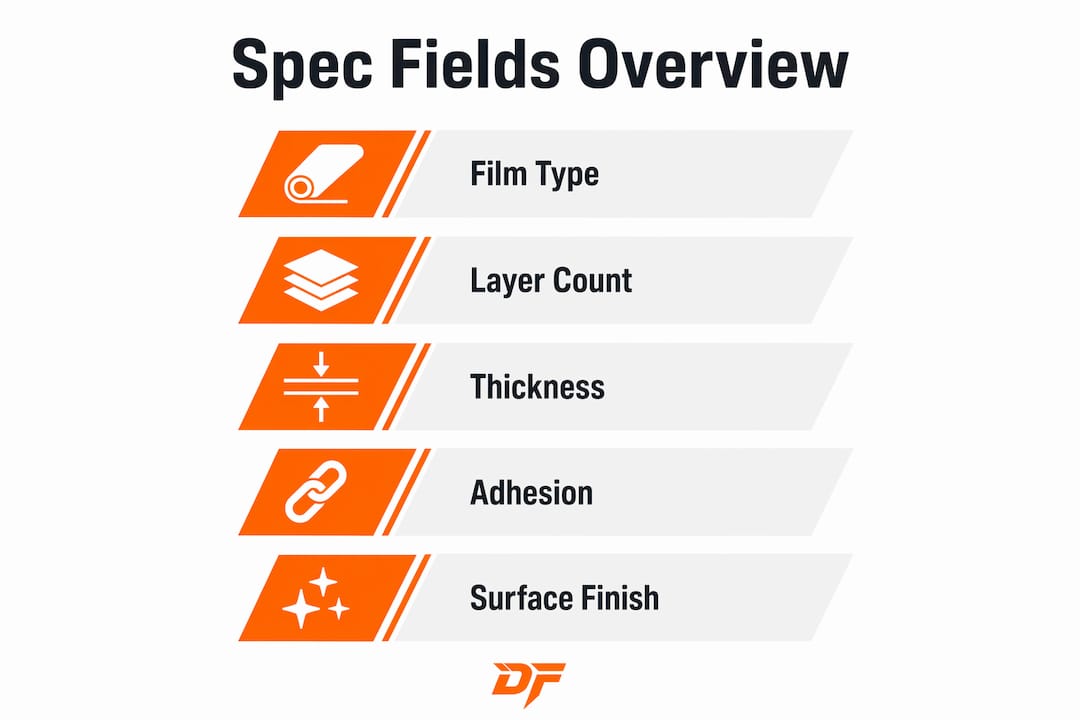
A procurement-ready spec needs more than a product name. Each field below should appear with a minimum acceptable value and a named test method so vendor quotes are directly comparable.

| Spec Field | Unit | Minimum-Spec Language Example |
|---|---|---|
| Film type | — | Multi-layer peelable electrostatic film |
| Total nominal thickness | µm | ≥ XX µm total; state per-layer thickness |
| Number of removable layers | count | ≥ 5 peelable layers |
| Peel adhesion | N/cm | ≥ Y N/cm per ASTM D3330 |
| Max continuous bake temp | °C / °F | ≥ 80°C (176°F) continuous; state peak |
| Flammability class | — | Pass per ASTM E84 or NFPA-cited method |
| Static charge behavior | — | Electrostatic attraction confirmed; safe discharge per test report |
| Solvent resistance | — | No delamination after solvent rub per datasheet method |
| Roll width × length | mm × m | State coverage per roll in m² or ft² |
| Dispenser compatibility | — | Compatible with manufacturer dispenser box |
| Shelf life | months | State storage temp range and shelf life |
Beyond the table, a few fields deserve extra attention. Peel adhesion is the one vendors most often describe vaguely. Require the test method by name. “Good adhesion” in marketing copy is not a spec. Similarly, flammability class must reference a specific ASTM or NFPA test, not a general claim of “fire-safe.” For electrostatic film behavior specifically, ask for a dielectric or static-charge test report that confirms safe levels inside an active booth.
Surface finish matters for quality control. A bright white film surface helps technicians spot dust nibs and surface defects before clear coat. Statically charged layered films can improve QA by providing a bright white, low-dust surface that highlights defects while simplifying refresh cycles through removable layers. Specify “white opaque surface finish” if your QA process depends on it.
How do you read a vendor datasheet and turn it into spec language?
Start with the headline claims, then go straight to the test data section. If a datasheet lists a claim without a test method or numeric value, that claim cannot become a contract requirement.
| Vendor Claim | What to Ask For | Contract Wording |
|---|---|---|
| “Heat resistant” | Max continuous bake temp in °C + test method | “Max continuous bake temp: ≥ 80°C per [method]” |
| “Strong adhesion” | Peel force in N/cm + ASTM/ISO method | “Peel adhesion ≥ Y N/cm per ASTM D3330” |
| “Fire safe” | Flammability test report (ASTM E84 or equivalent) | “Pass ASTM E84 Class A or equivalent; report required” |
| “Static-free surface” | Dielectric/static test report | “Electrostatic charge within safe range; third-party report required” |
| “Solvent resistant” | Solvent rub or immersion test result | “No delamination after solvent rub per datasheet method” |
Follow these steps to convert a datasheet into procurement language:
- Record every numeric value and its unit from the datasheet. Discard any claim with no number or test method.
- Confirm whether the values come from internal testing or a third-party lab. Request the lab report.
- Require peel adhesion and flammability test reports as non-negotiable attachments to the quote.
- Request dispenser compatibility documentation and, where possible, an on-site demo with a test strip.
- Write each accepted value as a minimum threshold in your spec: “≥ value [unit] per [test method].”
Sample spec text you can paste directly into a purchase order:
- “Nominal total film thickness: ≥ 100 µm; minimum 5 peelable layers; peel adhesion ≥ 2.0 N/cm per ASTM D3330.”
- “Maximum continuous bake temperature: ≥ 80°C (176°F); third-party test report required.”
- “Flammability: pass ASTM E84 Class A or equivalent NFPA-cited method; lab report to accompany delivery.”
What US regulations apply to spray booth wall panel materials?
NFPA and OSHA set the compliance floor. Any material installed inside an active spray booth must not introduce an ignition source, release ignitable volatiles, or restrict the ventilation airflow the booth was designed to maintain. Your spec should reference both frameworks explicitly.
Key regulatory requirements to include:
- NFPA compliance: Require that all films and adhesives meet NFPA standards for combustible materials inside spray finishing areas. Request a third-party flammability test report tied to a named ASTM or NFPA test method.
- OSHA ventilation: Specify that installed panels must not measurably reduce the booth’s designed airflow velocity. Include an airflow smoke test as an acceptance criterion post-installation.
- Static control: Require electrostatic charge levels within safe limits for a solvent-vapor environment. A dielectric test report from a third-party lab satisfies this.
- Chemical compatibility: Prohibit materials that release ignitable or toxic volatiles when exposed to spray solvents or bake-cycle temperatures.
- Waste disposal: Require disposal instructions that comply with local and federal hazardous-waste rules, particularly for solvent-saturated film.
Require third-party flammability and static-charge test reports as mandatory delivery attachments. A vendor’s self-certification is not a substitute for lab-verified data when NFPA and OSHA compliance is at stake inside an active spray booth.
Industrial spray booth maintenance guidance confirms that high-quality electrostatic films, used per manufacturer instructions, do not pose a fire risk and can significantly cut deep-cleaning downtime. That dual benefit, safety plus ROI, is the core argument for specifying certified films over unprotected walls.
How should you install and inspect booth wall protection film?
Follow the manufacturer’s installation SOP precisely. The single most common installation failure is applying film to cold metal panels, which prevents proper adhesion and causes lifting within days.
- Surface prep: Remove all release agents, silicone residue, and loose contamination from booth walls.
- Temperature check: Confirm panels have reached a stable surface temperature of 18–20°C (64–68°F) before application. Apply a small test strip and verify adhesion before committing to a full wall.
- Dispenser alignment: Mount the dispenser box at the top of the panel. Feed the film and peel the backing halfway before pressing to the wall.
- Application: Use a spreader from the center outward to eliminate air pockets. Overlap adjacent strips slightly at the edges.
- Trimming: Use the dispenser’s cutting bar to trim cleanly at panel edges and corners.
- Edge sealing: Confirm all edges are pressed flat with no lifted corners.
- Removal: Pull layers from the bottom up at a low angle to avoid tearing and to prevent adhesive transfer to the panel.
- Disposal: Bag removed layers per your facility’s solvent-waste protocol.
Pro Tip: Condition booth panels to 18–20°C (64–68°F) before application, per manufacturer SOP guidance. Cold metal causes adhesive failure within the first few bake cycles, and no amount of smoothing during installation compensates for it.
Post-installation acceptance tests:
| Test | Pass Criterion | Fail Action |
|---|---|---|
| Visual adhesion check | No lifted edges or bubbles | Re-apply affected section |
| Seam/overlap integrity | Overlaps flat, no gaps | Re-smooth or re-trim |
| Airflow smoke test | No visible disruption to laminar flow | Investigate panel fit and trim |
| Lighting/visibility check | White surface visible, no shadowing | Confirm correct film side facing outward |
One technical datasheet for a 5-layer spray booth wall protector recommends removing layers prior to 150 bake cycles or when heavily coated. In practice, experienced operators replace based on visible overspray build-up rather than strict cycle counts, because throughput varies and adhesive curing to the panel is the real risk to avoid.
How do you choose the right booth wall film and evaluate vendors?
Choose materials that satisfy your minimum spec fields first, then compare lifecycle costs. A lower unit price that requires more frequent replacement or leaves adhesive residue on panels often costs more over a quarter than a premium film with a longer service interval.
Procurement checklist:
- Third-party flammability and static test reports included with quote
- On-site sample installation and acceptance test offered
- Dispenser system compatibility confirmed
- Installation labor estimate provided (or self-install SOP supplied)
- Recommended replacement schedule stated for your throughput
- Disposal and recyclability instructions included
- Warranty terms on peelable layers documented
- Bulk pricing and lead times confirmed for your order volume
For selecting protective films that fit your booth type and paint system, also verify compatibility with waterborne and solvent-borne coatings, since some adhesive formulations react differently to each.
Vendor questions to ask before committing:
- Can you provide third-party lab reports for flammability (ASTM E84 or equivalent) and static charge?
- What is the recommended replacement schedule at our estimated throughput (state your weekly bake cycles)?
- Does your dispenser system require any booth modification, and is training included?
- What warranty applies to peelable-layer integrity across bake cycles?
- Can you provide references from similar automotive or industrial spray booth environments in the US?
Lifecycle cost factors to model: unit film cost per m², estimated labor for installation and removal per cycle, disposal fees for solvent-saturated film, and the avoided cost of deep cleaning. Best practices for industrial painting consistently show that protective film programs reduce cleaning labor costs enough to justify premium film pricing within a single quarter at moderate throughput.
Why multi-layer electrostatic films are the practical spec-ready choice
Multi-layer electrostatic films satisfy the core procurement requirements in a single product: peelable protection, static attraction of airborne overspray, fast refresh cycles, and compatibility with bake cycles when rated to the appropriate temperature. They also eliminate the need for tape, which removes one potential contamination source from the booth.
Key product features to include in your spec language when evaluating this film type:
- Multi-layer removable construction (minimum 5 peelable layers per roll)
- Electrostatic charge behavior confirmed by third-party test report
- Heat-resistant top layers rated for bake-cycle temperatures
- Patented dispenser system for tape-free, bubble-free installation
- White opaque surface finish for defect visibility during QA
- Datasheet and sample availability for pre-purchase acceptance testing
Dustfreefilm’s multi-layer electrostatic booth wall films are built to these requirements, with a patented dispenser system that makes installation fast enough to schedule during shift changes rather than planned downtime. The protective film applications across automotive and industrial settings demonstrate consistent performance in high-throughput environments.
Pro Tip: Include an on-site sample installation and a 30-minute acceptance test (airflow smoke test, adhesion check, and visual inspection) as a line item in your purchase order. Any vendor confident in their product will agree to it, and it eliminates specification disputes before the first full order ships.
Key Takeaways
A complete booth wall panel specification must include measurable values and named test methods for every field, with third-party lab reports as non-negotiable delivery attachments.
| Point | Details |
|---|---|
| Mandatory spec fields | Always include material type, layer count, thickness (µm), max bake temp, peel adhesion (N/cm), and flammability class. |
| Third-party test reports | Require lab-verified flammability (ASTM E84) and static-charge reports; vendor self-certification is not sufficient. |
| Installation temperature | Panels must reach 18–20°C (64–68°F) before film application to ensure long-term adhesion. |
| Replacement schedule | Replace layers based on visible overspray build-up or as recommended by experience to prevent adhesive curing. |
| Dustfreefilm | Dustfreefilm’s multi-layer electrostatic films with patented dispenser systems directly satisfy the spec fields above and are available with datasheets and on-site samples for acceptance testing. |
The spec is only as good as the failure modes you’ve already seen
Most booth wall film failures trace back to three decisions made before the first roll is even opened: skipping surface prep, applying to cold panels, and waiting too long between layer removals. The spec checklist in this article addresses all three, but the real test is whether your facility actually enforces it at installation time.
Replacement scheduling is where operators consistently underestimate the risk. A film that looks acceptable at 160 bake cycles may have adhesive that has already begun to bond permanently to the panel. Peeling it then costs far more in labor and panel prep than two earlier layer removals would have. Build the replacement trigger into your maintenance calendar, not just your spec document.
The other underrated benefit of a proper specification is what it does to vendor conversations. When you arrive with a document that asks for peel adhesion in N/cm and a named ASTM test method, vendors who cannot supply that data self-select out of the process. That alone saves procurement time and reduces the risk of a non-compliant product reaching your booth.
Dustfreefilm: spec-ready booth wall protection with samples available
Dustfreefilm manufactures multi-layer electrostatic booth wall protection films that map directly to the specification fields covered in this article. Each product includes heat-resistant peelable layers, a patented tape-free dispenser system, and white opaque surface finish for QA visibility, with bulk pricing and custom configurations available for high-throughput facilities.
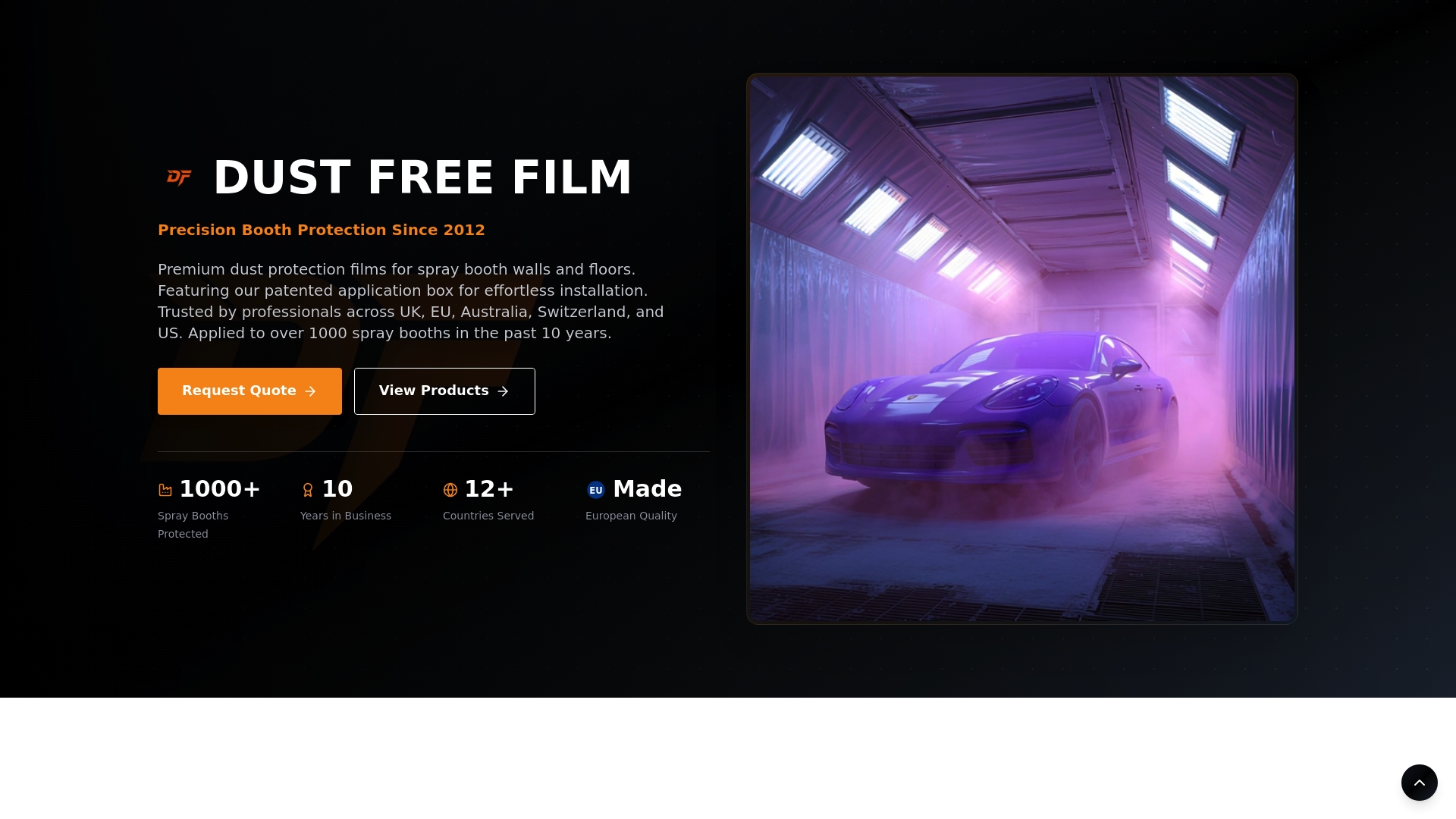
The films are available with full technical datasheets and on-site sample kits so your team can run the acceptance tests described above before committing to a full order. That means you can verify peel adhesion, confirm airflow integrity, and check dispenser compatibility against your booth dimensions before the purchase order is signed.
Request a datasheet, sample kit, or bulk quote directly at dustfreefilm.com. If your facility runs multiple booths or operates across shifts, ask about dedicated distributor and wholesale arrangements.
Useful sources and standards for your specification
Use these references when writing contract language, requesting third-party evidence, or building an RFP appendix.
| Source | Type | Use In Spec |
|---|---|---|
| ASTM D3330 | Test standard | Peel adhesion measurement method |
| ASTM E84 | Test standard | Surface burning characteristics / flammability class |
| NFPA (spray finishing standards) | Regulatory | Combustible materials and ignition-source requirements |
| OSHA 29 CFR 1910.94 | Regulatory | Spray booth ventilation requirements |
| Manufacturer installation SOP | Technical document | Temperature conditioning and application procedure |
| Third-party flammability lab report | Test evidence | Delivery attachment requirement |
| Third-party static/dielectric report | Test evidence | Delivery attachment requirement |
Key references to cite in your RFP or purchase order:
- Multi-layer booth protection installation SOP for temperature conditioning and application procedure
- 5-layer spray booth wall protector technical datasheet for layer count, static behavior, and replacement cycle guidance
- Industrial spray booth maintenance ROI guidance for lifecycle cost justification
- Protective paint systems and material compatibility for material selection and disposal guidance
- ASTM D3330, ASTM E84, NFPA spray finishing standards, and OSHA 29 CFR 1910.94 as primary regulatory citations