

TL;DR:
- Selecting the appropriate dust protection film based on static, surface type, and application needs improves finish quality.
- Combining multiple film types and scheduling regular replacements minimizes contamination and rework costs.
- Investing in tailored dust control solutions enhances booth efficiency and reduces defect rates over time.
Dust is the enemy of a perfect finish. One airborne particle landing on fresh paint means rework, wasted materials, and a frustrated customer. For managers running automotive refinishing shops or industrial painting facilities, that scenario plays out more often than it should, usually because the wrong dust protection film is in place. Not all films are built the same, and picking the wrong type can cost you far more than the film itself. This guide breaks down every major category of dust protection film for spray booths, so you can make a smarter, more informed call for your operation.
Table of Contents
- What to look for when choosing dust protection films
- Electrostatic dust protection films
- Peelable and self-adhesive protective films
- Spray-on peelable coatings and booth wraps
- A smarter approach: Integrating dust protection film choices
- Find the best dust protection film for your spray booth
- Frequently asked questions
Key Takeaways
| Point | Details |
|---|---|
| Match film to risk | Choose films specialized for static, high traffic, or complex booth layouts. |
| Efficiency boosts quality | Properly selected dust protection films help reduce defects and maintenance downtime. |
| Replacement is key | Sticking to replacement schedules maximizes the benefit from any protection film. |
| Mix for best results | A combination of film types often yields superior dust control. |
What to look for when choosing dust protection films
Before you compare products, you need a clear checklist of what actually matters in your specific booth environment. Not every shop has the same workflow, surface layout, or contamination risk, so your film selection should reflect your reality.
Here are the core criteria to evaluate:
- Dust resistance and static management: A film that does not control static charge will attract dust like a magnet, undermining the whole point of protection.
- Surface compatibility: Floors, walls, curved corners, and ventilation panels each demand different adhesion levels and flexibility. The main types of dust protection films include electrostatic films (conductive, dissipative, anti-static), multi-layer peelable films, self-adhesive single-layer films, and spray-on peelable coatings, and each category handles surface types differently.
- Ease of application and replacement: A film that takes 45 minutes to apply per panel will slow your throughput. Look for dispenser systems and peel-and-stick formats that your crew can manage quickly between jobs.
- Maintenance and replacement intervals: Some films last 60 to 90 days; others need changing weekly in high-volume environments. Factor replacement frequency into your total cost calculation.
- Safety features: Non-slip textures for floors and heat-resistant film properties for areas near lamps or curing systems are non-negotiable in active booths.
- Cost-efficiency: The real cost is not the film price. It is what you spend on rework, polishing, and downtime when the film underperforms. Cheaper films often cost more in the long run.
You also want to check film durability data before committing to a product at scale. A film that degrades under heat or heavy foot traffic will contaminate your booth, not protect it.
Pro Tip: Prioritize films that carry certifications or meet recognized industry standards for static control and chemical resistance. In demanding environments, an uncertified film is a liability, not a savings.
With these crucial criteria in mind, let’s break down each major category of dust protection film for spray booths.
Electrostatic dust protection films
Electrostatic dust protection films are especially critical for environments where static is the main culprit. Here’s why they matter.
Static electricity is a silent contaminant. When booth surfaces carry a static charge, they actively pull airborne dust toward freshly painted panels. Electrostatic films are engineered to eliminate or manage that charge before it creates a problem.
There are three types, and each serves a different purpose:
- Conductive films: These provide immediate grounding and are used where static discharge must happen fast, such as in semiconductor manufacturing.
- Dissipative films: These allow charge to bleed off gradually, which makes them the ideal choice for spray booths. They prevent sudden discharges that could disturb wet coatings.
- Anti-static films: These prevent static charges from forming in the first place, making them useful as an added layer of protection in combination setups.
The performance payoff is real. Shops using proper dust prevention technology report up to 25% fewer coating defects. That translates directly into less rework, fewer warranty claims, and better throughput per shift.
Benefits of electrostatic films in spray booths:
- Dramatically reduced dust attraction on booth walls and ceilings
- Cleaner finishes with fewer fish-eye defects and inclusions
- Lower material waste from rework and polishing
- Faster color-change cycles when dissipative films are in place
- Reduced maintenance frequency compared to untreated booth surfaces
For shops doing frequent color changes or working with metallic and pearl finishes, the case for dissipative films is especially strong. Even minor static buildup can create visible texture problems in those high-detail applications. Explore the in-depth electrostatic film guide to see how these products perform across different booth configurations.
The key is matching the film type to your booth’s actual static and dust profile. A shop running one to two jobs per day in a low-humidity environment has different needs than a high-volume facility cycling through dozens of panels. You can also review options to optimize dust control based on your specific workflow before committing to a product line.
Peelable and self-adhesive protective films
Beyond static control, film format and maintenance features are key. Let’s compare peelable and self-adhesive film types.
Not every contamination problem is about static. Sometimes the challenge is simply keeping booth surfaces clean and easy to reset between jobs. That is where film format becomes the deciding factor.
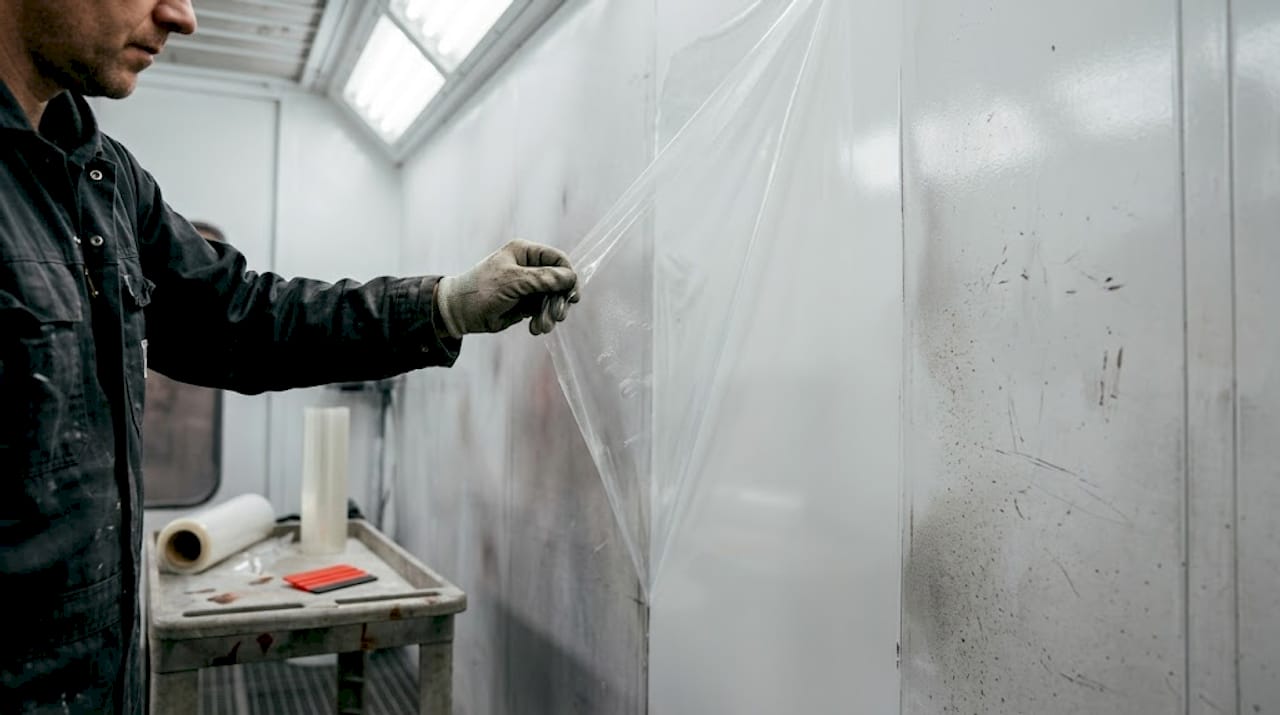
Multi-layer peelable films are built for high-volume operations. Each layer is applied on top of the previous one, and when the top layer becomes contaminated, you simply peel it off to reveal a fresh surface beneath. High-volume operations benefit most from multi-layer formats because the quick-peel approach eliminates the time spent removing and re-applying full film sheets between jobs.
Self-adhesive single-layer films are a better fit for smaller shops or lower-traffic areas. They are simpler to install and more cost-effective up front, though they require a full replacement cycle each time. Single-layer protective films for floors and walls prevent overspray and dust damage, offer non-slip surfaces, resist heat up to 200°F, and should be replaced every 60 to 90 days.
| Feature | Multi-layer peelable | Self-adhesive single-layer |
|---|---|---|
| Reset speed | Very fast (peel top layer) | Moderate (full replacement) |
| Best for | High-volume, frequent cycles | Smaller shops, lower traffic |
| Upfront cost | Higher | Lower |
| Long-term efficiency | Higher | Moderate |
| Installation complexity | Moderate | Low |
Pros and cons at a glance:
- Multi-layer peelable: Fast reset, durable, ideal for busy booths; higher initial investment
- Self-adhesive single-layer: Easy install, budget-friendly; requires more frequent full change-outs
For floor film recommendations by booth type, it helps to review options specifically rated for foot traffic, rolling equipment, and chemical exposure. You can also look at film applications in spray booths to see how each format performs in real shop conditions.
Pro Tip: During peak production seasons, rotate peel layers on a set schedule rather than waiting until visible contamination appears. Proactive rotation keeps your booth cleaner and prevents gradual buildup that you might not notice until it shows up in your finish.
Spray-on peelable coatings and booth wraps
In cases where standard films aren’t practical, spray-on coatings and booth wraps step in. Here’s how each alternative works.
Some booth areas simply cannot be protected with sheet films. Vents, corners, structural supports, and irregular panel seams are difficult to cover cleanly with rolls of film. That is where spray-on peelable coatings and booth wraps offer real value.
Spray-on peelable coatings are liquid-applied products that cure into a flexible, protective film directly on the surface. Spray-on films are ideal for irregular surfaces where traditional films won’t adhere properly. You spray them into corners, around fittings, and over uneven surfaces, then peel the cured film off when it is time for a reset.
Booth wraps are pre-made plastic or fabric panels that cover large booth surfaces quickly. Protective booth wraps are easier to remove than spray coatings but take longer to install, making them a better fit for planned changeovers rather than rapid turnarounds.
| Factor | Spray-on coating | Booth wrap |
|---|---|---|
| Application time | Moderate | Longer |
| Removal ease | Easy (peel after cure) | Very easy |
| Surface coverage | Irregular surfaces | Flat/large surfaces |
| Best use case | Vents, corners, fittings | Full booth changeovers |
When to choose spray-on vs. booth wrap:
- Use spray-on for vents, corners, and any area with complex geometry
- Use booth wraps for planned maintenance cycles or large-scale reconfigurations
- Combine both when your booth has a mix of flat walls and complex structural elements
For examples of how both formats are deployed in real facilities, the real-world applications resource covers a range of shop layouts and use cases.
Pro Tip: Keep a supply of spray-on coating on hand specifically for hard-to-reach zones. Even if your primary protection system uses sheet films, those corner and vent areas are contamination entry points that need coverage too.
A smarter approach: Integrating dust protection film choices
After reviewing all the main options, one thing becomes clear: the shops that get the best results are not the ones using a single film type everywhere. They are the ones that treat film selection like a system, not a product purchase.
The one-size-fits-all mindset is one of the most common and costly mistakes in spray booth management. Your floor takes impact and chemical exposure. Your walls face overspray and static. Your corners and vents trap contamination that standard films miss. Each zone has a different threat profile, and it deserves a film matched to that threat.
The other thing most managers overlook is the maintenance schedule. Films do not fail overnight. They degrade gradually, and that gradual contamination creeps into your finishes before you notice it. Building a firm rotation schedule, not just reacting when something looks dirty, is what separates a well-run booth from one that consistently battles defect rates.
It is also worth reassessing your film strategy after any major workflow change, such as adding a new product line, increasing shift volume, or reconfiguring the booth layout. What worked before may not be the best fit after. Reviewing advanced dust control strategies periodically keeps your protection approach current with your actual operation.
Investing in a smart combination of film types costs less over time than absorbing repeated rework and polishing labor. The math always favors prevention.
Find the best dust protection film for your spray booth
Ready to upgrade your spray booth’s dust defense? Here’s how to get started.
Choosing the right film is only the first step. Putting it into practice across your booth, on the right surfaces, with the right replacement schedule, is where the real improvement happens.
At Dust Free Film, we have been manufacturing premium spray booth protection solutions since 2012, built to European quality standards and proven in high-volume automotive and industrial environments. Whether you need dissipative electrostatic films for static-prone booths, multi-layer peelable systems for fast-paced production floors, or specialty films for complex surfaces, we have options designed for your specific setup. Browse our full range of shop protection films or connect with our team directly to request a quote for your next booth upgrade.
Frequently asked questions
How often should dust protection films be replaced in spray booths?
Most films should be replaced every 60 to 90 days for optimal performance, though high-volume shops may need more frequent changes based on contamination levels.
What’s the main advantage of electrostatic dissipative films?
They control static charges gradually, which prevents dust from being attracted to booth surfaces and reduces defects in the finished coating.
Can spray-on peelable films be used on all booth surfaces?
They are specifically designed for irregular or complex surfaces where standard sheet films cannot adhere properly, such as vents, corners, and structural fittings.
Are protective booth wraps reusable?
Most booth wraps are single-use and should be replaced after major booth maintenance or when contamination levels affect their protective performance.