

TL;DR:
- Dust in coating facilities poses long-term health, fire, and quality risks that regular cleaning cannot eliminate. Implementing a system-wide approach involving airflow management, zone separation, source capture, and continuous monitoring is essential for effective dust control. Using protective films, advanced airflow technologies, and strict maintenance schedules significantly enhances coating quality and operational safety.
Dust is the silent saboteur in automotive and industrial spray painting operations. Coatings application dust risks go far beyond a dirty floor or a speck in your clearcoat. We’re talking about health hazards that build invisibly over years, fire conditions that can ignite without warning, and coating defects that cost your facility real money on rework. The frustrating part? Most operators already clean regularly and still deal with contamination. That’s because cleaning alone isn’t a dust control strategy. This guide covers the full picture: sources, hazards, control methods, and what a properly integrated approach actually looks like.
Table of Contents
- Understanding dust risks in coatings application
- Core principles of dust control in spray painting environments
- How airborne dust impacts paint quality and workflow efficiency
- Advanced methods to reduce airborne contamination and overspray
- Best practices for maintaining a dust-controlled spray painting facility
- Why a systems approach to dust control beats quick fixes
- Enhance your dust control with Dust Free Film solutions
- Frequently asked questions
Understanding dust risks in coatings application
Coatings application dust risks fall into three distinct categories, and most facilities underestimate at least one of them.
Health hazards are the most persistent. Coating dust frequently contains heavy metals like chromium and lead from pigments, along with fine silica particles from fillers and substrates. These aren’t just nuisances. Powder coating dust creates significant respiratory risks when inhaled, including occupational asthma, silicosis, and long-term lung disease. Workers exposed daily without adequate protection are accumulating damage that may not show up clinically for a decade.
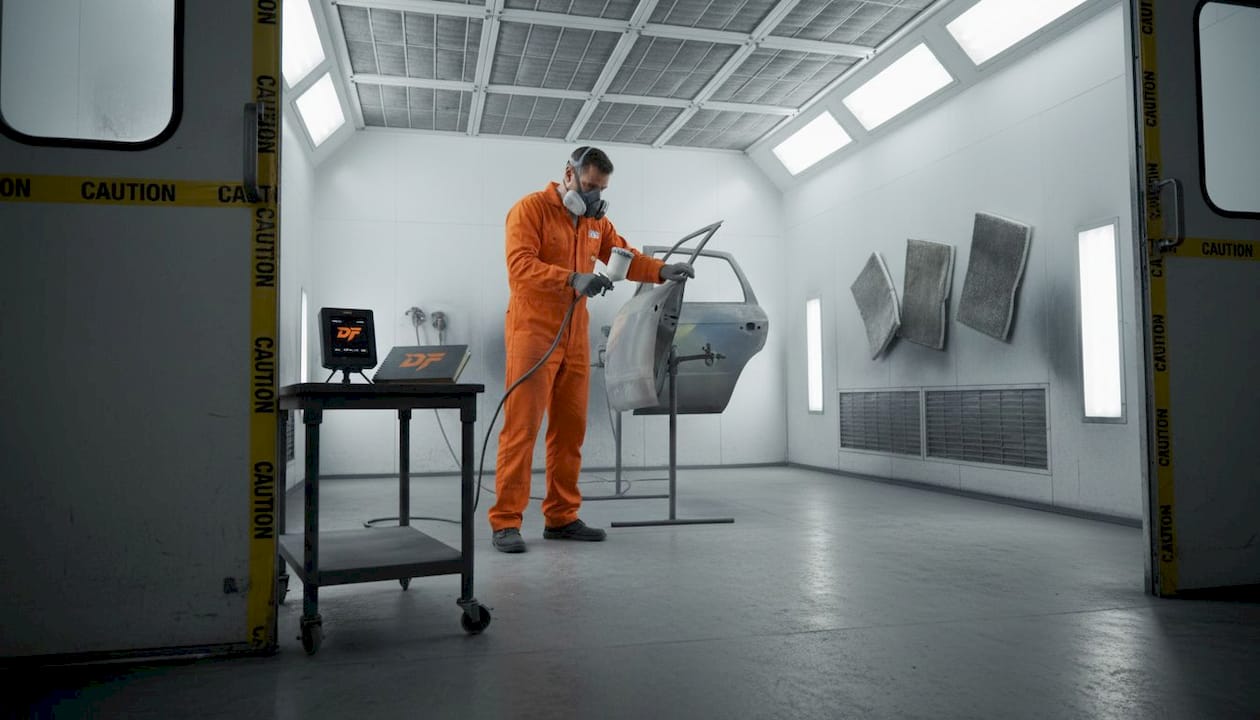
Fire and explosion hazards are often overlooked in liquid coating environments because people associate explosions with powder coating. But fine powder particles suspended in air at concentrations above their lower explosive limit can detonate from a single spark. Even in spray applications, flammable solvent vapor combined with dust creates compounding risk. Standard fire suppression equipment may not be rated for dust explosions, which is a critical distinction.
Coating quality degradation is where dust exposure in coatings hits your bottom line directly. Airborne particles that settle on wet or uncured surfaces cause defects that are often invisible until final inspection. These include:
- Bumps and nibs from dust particles embedded in clearcoat
- Pinholes from contamination under paint layers
- Orange peel amplification from surface disruption
- Adhesion failures in areas with heavy particulate contamination
Proper respiratory protection and paint booth safety go hand in hand. Ventilation is not optional. It’s the backbone of every other control measure you implement.
“Treating dust as a housekeeping issue rather than a process hazard is the most common mistake in coating operations. The consequences range from rejected parts to respiratory claims.”
Core principles of dust control in spray painting environments
Effective dust control in coating environments is a workflow and airflow problem, not an equipment problem. You can install the best filter system on the market and still have contamination issues if your workflow moves dust-laden parts through clean zones or if your airflow creates turbulence that lifts settled particles back into suspension.
Here are the foundational principles every facility should have in place:
- Zone separation: Define pre-prep, surface prep, coating, and curing zones with clear physical boundaries. Air should flow from cleaner zones toward dirtier ones, not the reverse.
- Negative pressure rooms: Coating areas should be maintained at a slightly lower pressure than adjacent spaces. This prevents dust-laden air from migrating outward when doors open.
- Source capture: Spray booths and downdraft tables capture overspray and dust at the point of generation before it reaches the broader facility. They are the single most effective control for coatings application airborne particles.
- Correct vacuum technique: Never sweep or blow dust with compressed air. Both re-aerosolize settled particles. Use M-Class vacuum filtration at minimum; H-Class or H14 filtration for fine respirable dust from powder coating or abrasive blasting operations.
- Particulate monitoring: Deploy PM2.5 and PM10 monitors to validate that your controls are actually working, not just functioning. A filter in good condition doesn’t guarantee air quality if airflow bypass is occurring.
These principles work together as a system. Skipping any one of them creates a weak point that undermines the rest.
Pro Tip: Don’t evaluate your dust control system under static conditions. Run PM2.5 monitoring while your spray booth operates at full production load, with doors cycling and workers moving through the space. That’s when real contamination events happen.
For more detail on applying these principles, dust control quality solutions and a spray booth maintenance workflow provide practical implementation steps.
How airborne dust impacts paint quality and workflow efficiency
Even when your booth filters are functioning and your ventilation is running, preventing dust in coatings is a multi-stage problem. Parts don’t stay clean between operations. Dust settles during transport. Parts pick up contamination from fixtures and carts. Multiple dust removal steps at different production stages are what actually prevent defects, not a single wipe-down before spraying.
Here’s how a complete dust removal sequence should look on a production line:
- Pre-cleaning: Remove bulk contamination before any surface prep begins. This includes chemical washing or pressure washing to strip oils and loose particles.
- Post-prep dust removal: After sanding or blasting, vacuum the part thoroughly with H-Class rated equipment before it moves to the spray zone.
- Pre-spray tack wipe: Use a tack cloth or ionized air blow-off immediately before coating to capture any residual particles on the surface.
- Spray zone air filtration: Maintain continuous filtered airflow through the booth during application. Downdraft configurations outperform crossdraft for surface cleanliness.
- Curing zone control: Filter curing oven inputs. Unfiltered heat cycles introduce new contamination on uncured surfaces.
The defect types you see are diagnostic. Here’s how to read them:
| Defect type | Primary cause | Prevention measure |
|---|---|---|
| Nibs and bumps | Dust settled in wet clearcoat | Tack wipe, filtered airflow in booth |
| Pinholes | Contamination under base layers | Multi-stage cleaning before coating |
| Adhesion failure | Surface contamination before primer | Chemical cleaning and surface prep protocol |
| Cratering | Oil or silicone contamination | Separate storage, clean PPE policy |
| Orange peel amplification | Surface disruption from particles | Ionized air blow-off, downdraft booth |
For a detailed look at how booth configuration affects these outcomes, the spray booth setup guide covers layout decisions that directly impact defect rates. If you’re already seeing contamination issues, reducing dust in spray booths and industrial painting dust prevention address root-cause diagnosis.
Advanced methods to reduce airborne contamination and overspray
Beyond the fundamentals, engineering controls that contain contamination at the source represent the next level of coatings application hazard reduction.
Air-curtain spray hoods are one of the more significant recent advances. Rather than relying only on exhaust to pull overspray away from the work zone, these systems use a directed airflow barrier around the spray area. Air-curtain spray hoods reduce overspray particle escape and improve coating material deposition on the target surface, which cuts both material waste and airborne contamination simultaneously.
The geometry of that airflow matters more than most operators realize. Blowing angle and exhaust rate interact to determine what percentage of overspray is captured versus what escapes into the booth environment. The following comparison illustrates how configuration choices affect performance:
| Configuration | Overspray capture rate | Wall deposition | Environmental emission |
|---|---|---|---|
| No air curtain (baseline) | Low (approx. 45%) | High | High |
| Air curtain, low angle (15°) | Moderate (approx. 62%) | Moderate | Moderate |
| Air curtain, optimized angle (30°) | High (approx. 78%) | Low | Low |
| Air curtain + balanced exhaust | Highest (approx. 85%+) | Minimal | Minimal |
These numbers aren’t hypothetical. They reflect the kind of performance gains that justify capital investment in hood technology when you factor in material savings and reduced cleaning labor over a year.
Pro Tip: When evaluating spray hood or booth designs, ask vendors for data on wall deposition rates, not just filter capture efficiency. Paint buildup on booth walls and floors is a leading source of secondary dust contamination.
For booth-level application of these concepts, dust-free finishes in spray booths covers the practical translation from engineering design to daily operation.
Best practices for maintaining a dust-controlled spray painting facility
A system that isn’t maintained degrades predictably. Consistent maintenance of booth conditions, filters, and housekeeping practices is what separates facilities with reliable coating quality from those that chase contamination problems reactively.
Here’s what a working maintenance program actually covers:
- Vacuum all surfaces, including forgotten ones: Ledges, lighting fixtures, cable trays, door frames, and booth panel joints accumulate dust that re-aerosolizes during high-production activity. A booth that looks clean at eye level can be a significant contamination source above your sight line.
- Maintain and verify pressure differentials: Use a manometer to confirm that coating rooms remain at negative pressure relative to adjacent areas. A door seal failure or blocked exhaust port can reverse this relationship without triggering any obvious alarm.
- Perform regular smoke tests: Smoke pencils or generators reveal actual airflow patterns inside the booth. These tests should be run during operating conditions, not during shutdowns.
- Filter replacement on schedule, not on visual inspection: Filters that look usable can be bypassing at the seal. Replace on the manufacturer’s schedule and inspect gaskets and housing integrity at every change.
- Enforce entry controls: Every worker who enters a spray zone carries contamination on their clothing and footwear. Sticky mats, tack curtains, and mandatory coverall policies make a measurable difference.
- Document everything: Track filter change dates, pressure differential readings, and defect rates by week. Patterns in that data will tell you where your system is degrading before it becomes a quality or safety event.
For a complete maintenance schedule framework, the spray booth maintenance workflow and dust-free painting best practices are worth reviewing with your team.
Pro Tip: Track airflow metrics under operational load, not just static conditions. Airflow patterns change when booth doors cycle, workers move through the space, and exhaust filters approach their service limit. Static measurements give you a false baseline.
Why a systems approach to dust control beats quick fixes
Here’s an uncomfortable truth about minimizing dust in application environments: the facilities with the worst contamination problems usually have decent equipment. New filters, upgraded booths, quality spray guns. What they’re missing is alignment between their hardware and their actual workflow.
A systems approach to dust control means that every element of your operation is considered together: airflow design, workflow sequence, cleaning methods, maintenance schedules, and how your workers interact with the environment. When these elements conflict, contamination follows.
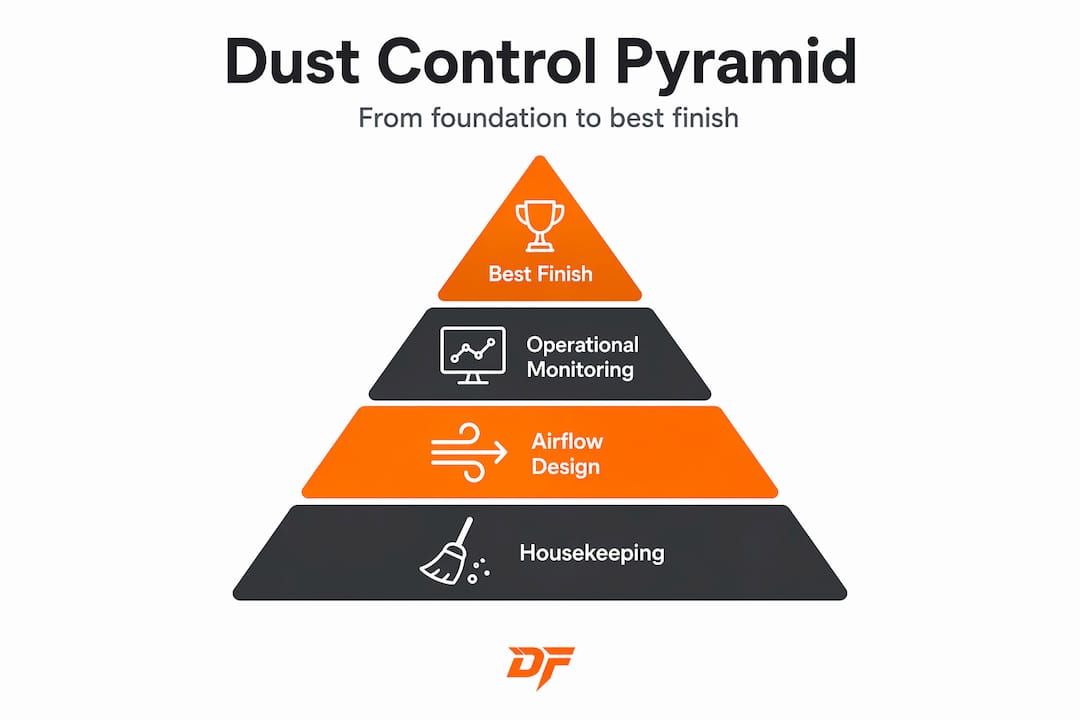
The most common breakdown we see isn’t in the equipment. It’s re-aerosolization from inadequate housekeeping. A facility invests in a downdraft booth but sweeps the prep area every morning. The suspension event from that sweep moves through the facility for hours. The booth captures what enters it, but the damage is already done on parts prepped before spraying.
The second most common failure is treating coating application safety as a compliance exercise rather than an operational priority. If your workers see PPE as an inconvenience and your maintenance logs as paperwork, you don’t have a dust control culture, and culture is what sustains performance between audits.
The right approach to effective dust management involves putting particulate monitors in the hands of the people doing the work, not just the safety manager. When operators can see that a specific cleaning action or workflow change drops PM readings by 40%, they own the outcome. That’s more durable than any policy document.
Protective measures for coatings aren’t a checklist. They’re a feedback loop between your process, your environment, and your people. Build the loop, and the results take care of themselves.
Enhance your dust control with Dust Free Film solutions
If you’ve put the right airflow controls and maintenance practices in place, the next question is what happens to your booth walls and floors between cleaning cycles.

Dust Free Film spray booth protection provides multi-layer electrostatic films that line booth walls and floors, preventing paint overspray and dust from bonding to booth surfaces. When contamination builds up on the film rather than your booth structure, changeovers take minutes instead of hours. The films are heat-resistant, static-free, and built for the demanding conditions of automotive refinishing and industrial coating operations. They don’t replace your airflow and filtration system, they protect the surfaces your system can’t clean automatically. If you’re ready to see what that means for your facility’s cleaning cycles and coating quality, request a Dust Free Film quote and get specifications matched to your booth configuration.
Frequently asked questions
What are the main health risks from dust during coatings application?
Coating dust frequently contains toxic substances including heavy metals and silica, which cause respiratory disease, occupational asthma, and long-term lung damage when inhaled repeatedly without protection.
How can I verify if my spray booth is effectively capturing dust?
Use PM2.5 and PM10 monitors during operational conditions and perform smoke tests to confirm airflow direction and confirm that negative pressure is maintained throughout the coating cycle.
Why is multiple dust removal necessary in painting operations?
Dust settles on parts during transport and handling between process stages, meaning a single pre-spray wipe leaves contamination introduced after that point, which is why cleaning at each transition reduces defect rates significantly.
What filtration levels are recommended for vacuuming coating dust?
M-Class filtration is the minimum acceptable standard for coating dust, while H-Class or H14 filtration is required for fine respirable particles generated during powder coating or abrasive surface preparation.
How do air-curtain spray hoods help control overspray?
Air-curtain spray hoods create a directed airflow boundary around the spray zone that redirects escaping particles back toward the target surface, improving material transfer efficiency while simultaneously reducing airborne contamination in the booth environment.