

Dust contamination in spray booths creates more than cosmetic flaws. Rework due to dust contamination can increase painting costs by up to 30%, draining profits and extending timelines. Yet many operators believe filtration alone solves dust problems. The truth demands integrated solutions combining filtration, airflow management, surface protection, and rigorous maintenance. This article explores proven dust control strategies that deliver superior paint finishes while cutting operational costs.
Table of Contents
- Understanding Dust: Sources, Types, And Contamination Mechanisms
- Core Dust Control Technologies: Filtration, Airflow, And Booth Design
- Innovations In Dust Control: Protective Films And Materials
- Best Practices: Maintenance, Environment, And Worker Safety
- Common Misconceptions About Dust Control In Painting
- Conclusion: Integrating Dust Control For Optimal Paint Finish And Efficiency
- Explore Dust Free Film Solutions For Spray Booth Protection
Key takeaways
| Point | Details |
|---|---|
| Cost impact | Dust contamination increases painting costs up to 30% through rework and defects. |
| Integrated approach | Effective dust control combines HEPA filtration, airflow management, and surface protection. |
| Filtration power | HEPA filters remove 99.97% of harmful airborne particles 0.3 microns or larger. |
| Film protection | Static-free dust control films reduce particulate deposition by up to 80%. |
| Maintenance priority | Regular filter replacement and environmental controls sustain dust-free conditions. |
Understanding dust: sources, types, and contamination mechanisms
Dust doesn’t materialize from nowhere. Every spray booth faces contamination from predictable sources that operators must recognize and control.
Dust includes airborne particles from sanding, worker clothing fibers, and paint overspray, all critical sources that contribute to paint defects if uncontrolled. Sanding operations release abrasive particles that settle on surfaces waiting for paint. Operator movements shed clothing fibers that float through booth air currents. Paint overspray creates microscopic droplets that dry into dust particles. External air infiltration introduces environmental contaminants through gaps and seams.
Particle size determines contamination severity. Fine particles under 0.3 microns penetrate paint films and create surface roughness that destroys gloss. Medium particles between 0.3 and 10 microns cause visible imperfections requiring spot repair. Larger particles over 10 microns settle quickly but create texture defects if they land on wet paint.
Airflow patterns control how dust moves through booths. Turbulent airflow increases dust recirculation and deposition on painted surfaces, while laminar flow sweeps particles toward exhaust filters. Understanding spray booth contamination impact on paint quality helps operators design effective control strategies.
Primary dust sources requiring control:
- Sanding and surface preparation releasing abrasive particles
- Operator clothing, skin cells, and hair fibers entering booth air
- Paint overspray particles drying into airborne contaminants
- External air infiltration through gaps, doors, and ventilation
- Equipment surfaces accumulating dust that re-enters air streams
Core dust control technologies: filtration, airflow, and booth design
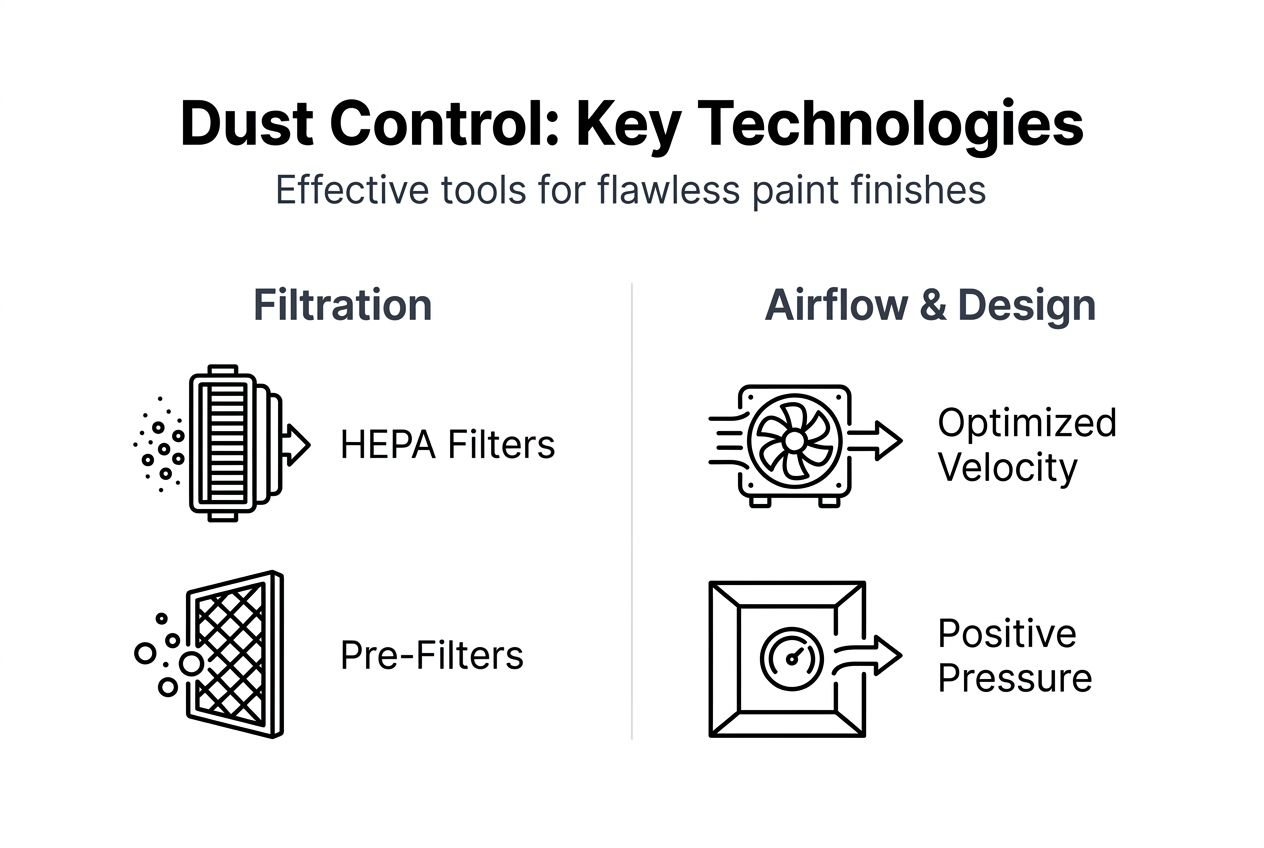
Three interconnected technologies form the foundation of effective dust control in professional spray booths.
HEPA filters capture 99.97% of particles 0.3 microns or larger, essential for maintaining clean air in paint booths. These filters use dense fiber networks that trap particles through mechanical and electrostatic mechanisms. Intake filters clean incoming air before it enters the booth. Exhaust filters prevent contaminated air from recirculating into the workspace. Filter efficiency determines how many contamination cycles air must pass through before reaching acceptable cleanliness.
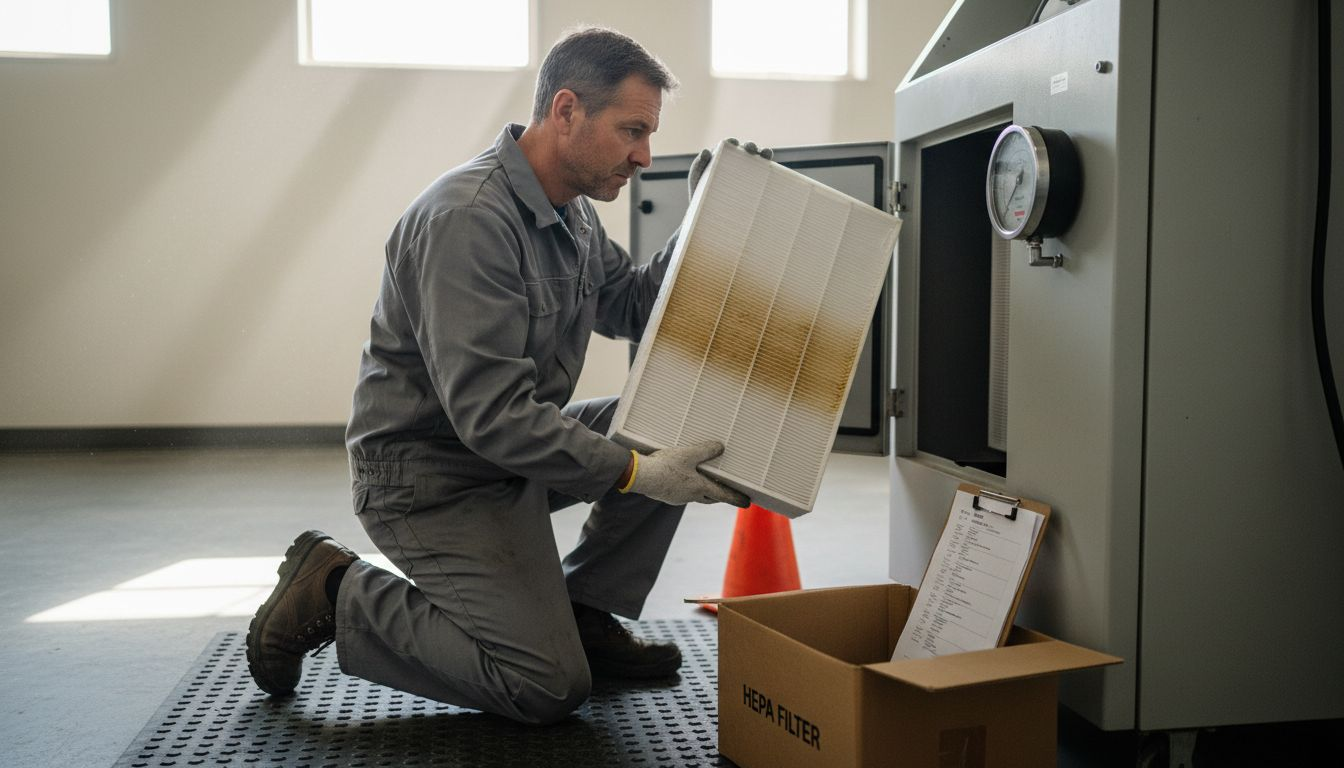
Airflow velocity optimization prevents particle settling. Maintaining airflow velocity between 100 and 120 feet per minute optimizes particle removal without creating excessive turbulence. Velocities below 100 feet per minute allow particles to settle on surfaces before filters capture them. Velocities above 120 feet per minute create turbulent eddies that recirculate contaminants.
Positive pressure booth design prevents entry of external dust contamination. Supply fans push more air into the booth than exhaust fans remove, creating slight overpressure. This pressure gradient forces air outward through any gaps, preventing unfiltered external air from entering. Turbulent or poorly balanced airflow increases the risk of dust particle recirculation and settling on painted surfaces, causing defects.
| Technology | Function | Performance Metric |
|---|---|---|
| HEPA filtration | Removes particles ≥0.3 microns | 99.97% capture efficiency |
| Airflow velocity | Transports particles to filters | 100-120 ft/min optimal range |
| Positive pressure | Prevents external contamination | 0.02-0.05 inch water column |
| Filter staging | Multi-stage particle capture | 95% pre-filter + HEPA final |
Effective booth design integrates these technologies. Supply plenums distribute filtered air evenly across booth ceilings. Exhaust pits or wall systems capture contaminated air at floor level. The relationship between air quality in spray booths impact on finish quality demonstrates why balanced systems outperform single-technology approaches.
Critical airflow considerations:
- Laminar downward flow sweeps particles toward exhaust filters efficiently
- Cross-draft patterns increase particle residence time and settling risk
- Dead zones create stagnant air pockets where contamination accumulates
- Supply and exhaust balance maintains optimal pressure gradients
Pro Tip: Monitor pressure differential across filters weekly using a manometer. Replace filters when differential exceeds manufacturer specifications, typically around 1 inch water column, to maintain optimal airflow and particle capture.
Innovations in dust control: protective films and materials
Surface protection innovations complement filtration and airflow systems by preventing dust accumulation on booth surfaces.
Multi-layer electrostatic films are static-free and reduce dust adherence through specialized surface treatments. Static-free protective films reduce dust adherence and facilitate quick installation, creating smooth surfaces that resist particle attachment. These films feature multiple layers providing tear resistance and durability under industrial conditions. Heat-resistant formulations withstand elevated booth temperatures during baking cycles without degrading or releasing contaminants.
Installation efficiency supports operational continuity. Protective films enable rapid, bubble-free installation supporting operational efficiency through patented dispenser systems. Operators apply films in minutes rather than hours, minimizing booth downtime during preparation. Adhesive systems bond firmly without leaving residue when removed, simplifying cleanup between jobs.
Integrated performance multiplies effectiveness. Combined with booth pressure controls, films decrease particulate deposition by 60-80% on protected surfaces. Films create barriers preventing dust from embedding in porous booth materials. Smooth film surfaces simplify cleaning between painting cycles. Understanding protective films ensuring dust-free finishes helps operators maximize return on investment.
Key film features driving dust control:
- Anti-static surface treatments eliminating electrostatic particle attraction
- Multi-layer construction providing mechanical strength and longevity
- Heat resistance maintaining integrity during elevated-temperature curing
- Quick-change systems reducing booth downtime during maintenance cycles
- Smooth surfaces minimizing particle adhesion and simplifying cleaning
Pro Tip: Replace booth films after every 5 to 10 painting cycles depending on contamination levels. Fresh films maintain optimal dust resistance and prevent accumulated particles from becoming airborne during subsequent jobs.
Film applications extend beyond walls. Floor protection prevents ground-level dust from becoming airborne through foot traffic. Equipment covers shield pumps, hoses, and tool storage from contamination. Door films reduce particle transfer when operators enter and exit booths. The role of dust protection film for clean booths continues expanding as operators recognize comprehensive protection benefits.
Best practices: maintenance, environment, and worker safety
Sustaining dust control effectiveness requires systematic maintenance protocols and environmental management.
Filter maintenance determines long-term system performance. Replace filters before suction pressure drops below 60% of rated capacity to maintain filtration stability. Pressure gauges monitor differential pressure across filter banks, indicating when replacement becomes necessary. Intake filters typically require monthly replacement in high-use facilities. Exhaust filters last longer but need quarterly inspection. Keeping spare filters in inventory prevents operational delays when replacement becomes urgent.
Humidity control reduces static electricity and particle suspension. Maintaining humidity levels between 40-60% reduces static-related dust attraction by up to 40%. Dry conditions below 40% humidity increase electrostatic charging that attracts particles to surfaces. Excessive humidity above 60% can affect paint curing and create other quality issues. Simple humidifiers or dehumidifiers integrated with booth HVAC systems maintain optimal ranges.
Cleaning protocols prevent contamination buildup:
- Conduct daily visual inspections identifying dust accumulation areas requiring attention.
- Use HEPA-filtered vacuums for surface cleaning rather than compressed air that redistributes particles.
- Wipe booth surfaces with tack cloths before each painting cycle removing settled dust.
- Clean light fixtures and ventilation grilles monthly preventing contamination from overhead sources.
- Seal booth seams and door gaps annually using appropriate caulking and weatherstripping materials.
Worker safety extends beyond paint finish quality. Respirators and local exhaust ventilation cut worker particulate exposure by 85% compared to unprotected environments. Supplied air respirators provide the highest protection for sustained booth operations. Personal protective equipment including coveralls, gloves, and hair covers prevents operators from introducing contamination. The comprehensive paint booth cleaning guide details protocols protecting both workers and paint quality.
Environmental controls supporting dust reduction:
- Dedicated booth entry airlocks preventing external contamination infiltration
- Sticky mats at booth entrances removing particles from shoe soles
- Climate control maintaining stable temperature reducing condensation and particle settling
- Lighting systems using sealed fixtures preventing dust accumulation on bulbs
Pro Tip: Create a maintenance log tracking filter changes, cleaning cycles, and pressure readings. Documentation reveals patterns helping predict failures before they compromise paint quality or worker safety.
Long-term effectiveness requires operator training. Workers must understand how their actions affect dust levels. Proper sanding techniques, clothing choices, and movement patterns all influence contamination. Regular refresher training keeps dust control practices front of mind. Resources like the automotive spray booth maintenance guide provide ongoing education supporting operational excellence.
Common misconceptions about dust control in painting
Several persistent myths undermine effective dust management in spray booth operations.
Filtration alone provides insufficient protection. Operators believing HEPA filters solve all dust problems neglect airflow patterns, surface protection, and maintenance requirements. Filters capture airborne particles but cannot prevent dust from settling on surfaces between filter passes. Integrated control systems combining multiple technologies deliver superior results compared to single-solution approaches.
Airflow velocity misconceptions compromise performance. Some operators maximize fan speeds believing faster always means cleaner. Incorrect airflow velocity outside the 100 to 120 feet per minute range reduces dust capture effectiveness. Excessive velocity creates turbulent mixing that keeps particles suspended longer. Insufficient velocity allows premature settling before filtration occurs.
Film functionality often gets dismissed. Dust control films are functional components, not merely cosmetic improvements to booth appearance. Films actively prevent particle adhesion, simplify cleaning, and reduce contamination cycles. Operators viewing films as optional accessories miss significant performance benefits.
Maintenance neglect accelerates performance degradation. Postponing filter changes or cleaning cycles to save time actually increases costs through higher defect rates. Filters operating beyond rated capacity allow particle breakthrough. Accumulated booth contamination becomes airborne during subsequent operations. Understanding dust-free booths impact on paint defects clarifies maintenance value.
Common misconceptions preventing optimal dust control:
- Belief that expensive HEPA systems eliminate all other dust control needs
- Assumption that visible cleanliness indicates acceptable contamination levels
- Thinking dust control investments cost more than defect rework expenses
- Expecting instant results without allowing integrated systems time to stabilize
- Ignoring environmental factors like humidity affecting particle behavior
Cost concerns often prevent adoption. Operators believing dust control systems represent unaffordable expenses ignore substantial savings from reduced rework, faster cycle times, and improved customer satisfaction. Initial investment in quality filtration, protective films, and maintenance programs pays back through lower total operating costs. Defect reduction alone typically justifies dust control expenditures within months.
Conclusion: integrating dust control for optimal paint finish and efficiency
Comprehensive dust control strategies transform spray booth operations by reducing defects, cutting costs, and protecting workers.
Advanced dust control approaches combining HEPA filtration, optimized airflow, protective surface films, and rigorous maintenance deliver measurably superior paint quality. Operators implementing integrated systems report defect reductions exceeding 90% compared to minimal-control baselines. Rework costs drop proportionally as first-time quality improves. Cycle times decrease when painters spend less time correcting contamination-related flaws.
Protective films complement filtration and airflow technologies creating cleaner booth environments. Films prevent dust accumulation on walls and floors that would otherwise become airborne during operations. Static-free surfaces resist particle adhesion better than untreated booth materials. Quick installation and removal support efficient maintenance cycles.
Ongoing monitoring and maintenance ensure long-term dust control efficacy. Pressure differential tracking, humidity management, and scheduled cleaning prevent gradual performance degradation. Documentation helps identify trends and predict maintenance needs before quality suffers.
Holistic approaches maximize finish quality, efficiency, and worker safety simultaneously. Dust control investments pay dividends across multiple operational dimensions. Facilities adopting comprehensive strategies gain competitive advantages through superior quality, faster turnaround, and enhanced reputation. Understanding dust-free booths cutting paint defects in 2026 demonstrates the measurable value of integrated dust management.
“Dust control represents the difference between acceptable paint quality and exceptional finishes that build customer loyalty and drive repeat business. Operators investing in comprehensive contamination management systems consistently outperform competitors relying on minimal filtration alone.”
Explore dust free film solutions for spray booth protection
Effective dust control requires more than filtration and airflow management. Surface protection plays a critical role in maintaining booth cleanliness between painting cycles.
Dust Free Film manufactures static-free, durable protective films specifically engineered for spray booth walls and floors. Their multi-layer films reduce dust adherence through specialized surface treatments while withstanding heat and physical wear in demanding industrial environments. The patented dispenser system enables rapid, bubble-free installation that minimizes booth downtime during maintenance cycles.
Integrating protective films with booth pressure controls and HEPA filtration creates comprehensive contamination barriers. Films prevent dust from embedding in porous booth surfaces where it would become airborne during subsequent jobs. Smooth film surfaces simplify cleaning protocols and reduce particle generation compared to textured booth materials.
Operators seeking proven dust free film for spray booth protection benefit from European manufacturing standards ensuring consistent quality and performance. Custom configurations accommodate diverse booth sizes and layouts. Bulk purchasing options support large facilities managing multiple booth locations. Request a dust free film quote to explore how protective films enhance your existing dust control strategy and deliver measurable improvements in paint finish quality.
FAQ
What are the main sources of dust contamination in spray booths?
Dust contamination originates from sanding operations releasing abrasive particles, operator clothing shedding fibers, paint overspray creating dried particles, and external air introducing environmental contaminants. Equipment surfaces and booth materials also accumulate dust that re-enters air streams during operations. Controlling these sources requires integrated filtration, surface protection, and procedural controls.
How does airflow velocity affect dust control in painting?
Airflow velocity between 100 and 120 feet per minute optimizes particle transport to exhaust filters while minimizing turbulent recirculation. Velocities below this range allow particles to settle on surfaces before filtration occurs. Velocities above this range create turbulent eddies that keep contaminants suspended and increase deposition on painted surfaces. Proper velocity balancing is essential for effective dust capture.
Why are dust control films important in spray booths?
Dust control films create smooth, static-free surfaces that resist particle adhesion and simplify cleaning between painting cycles. Films prevent dust from embedding in porous booth materials where it would become airborne during subsequent operations. Combined with proper booth pressure and filtration, dust protection film ensuring clean paint booths reduces particulate deposition by up to 80%, significantly improving paint finish quality and reducing defect rates.
How often should filters be replaced to maintain dust control?
Replace filters before suction pressure drops below 60% of rated capacity to sustain optimal filtration efficiency. Monitor pressure differential across filter banks weekly using manometers or installed gauges. Intake filters in high-use facilities typically require monthly replacement, while exhaust filters need quarterly inspection and replacement. The paint booth cleaning guide for dust control provides detailed maintenance schedules supporting long-term contamination management and consistent paint quality.