

The 2026 best-practice answer is a layered dust-control system that starts at the source, locks in engineered enclosures and ventilation, adds real-time particulate monitoring, and backs everything with an auditable housekeeping program that satisfies NFPA 660. Industry analysis confirms that layered strategies combining engineering controls, monitoring, and enclosure systems significantly reduce occupational dust exposure. Your immediate next step: run a 30-day pilot pairing multi-layer electrostatic booth films with PM sensors and updated housekeeping metrics before committing to a full-scale rollout.
- Deploy protective booth wall and floor films (source control first).
- Audit ventilation balance and filtration ratings.
- Install fixed PM10/PM2.5 sensors at critical zones.
- Document accumulation thresholds and inspection frequencies.
- Train every role with assigned accountability before the pilot starts.
Table of Contents
- What do effective dust prevention strategies in 2026 look like for spray booths?
- Source control: how do protective booth films reduce particulate adhesion?
- Engineering controls: which booth design changes actually reduce dust?
- Chemical stabilization vs. mechanical suppression: which fits your facility?
- What should you measure in real-time, and what triggers a response?
- Housekeeping in 2026: what does an auditable NFPA 660 program require?
- Pilot-to-scale rollout: timeline, cost drivers, and a simple ROI example
- Training modules and SOPs that make dust control stick
- Pilot example: multi-layer films in a medium automotive spray booth
- Five-step action plan you can start this week
- How automation and AI are changing predictive dust control
- Advanced materials that go beyond standard protective films
- Energy efficiency and ventilation optimization in dust prevention
- Waste management and disposal for dust and filtration media in 2026
- Key Takeaways
- The gap between compliance paperwork and what actually works on the floor
- Dustfreefilm’s multi-layer films are built for this program
- Useful sources
What do effective dust prevention strategies in 2026 look like for spray booths?
A layered control model treats each defense as a distinct line, not a backup plan. Source control stops particulates from adhering to surfaces in the first place. Enclosure and ventilation contain what escapes. Capture systems (dust collectors, local exhaust ventilation) pull airborne particles before they settle. Monitoring and automation detect exceedances and trigger responses. Documented housekeeping and training close the loop for auditors.
| Layer | Primary Control | Spray Booth Application |
|---|---|---|
| Source control | Protective films | Multi-layer electrostatic wall and floor protectors |
| Enclosure | Booth design, vestibules | Positive/negative pressure, sealed access panels |
| Capture | LEV, dust collectors | High-efficiency filtration (MERV/HEPA) |
| Monitoring | PM sensors, data logging | Fixed PM10/PM2.5 sensors, differential pressure gauges |
| Housekeeping | Documented program | Measurable thresholds, inspection schedule, corrective actions |
| Training | SOPs, role ownership | Onboarding, daily inspection, sensor response |
High-traffic automotive booths need all six layers running simultaneously. Lower-volume batch operations can often prioritize source control and housekeeping while running lighter monitoring.
Source control: how do protective booth films reduce particulate adhesion?
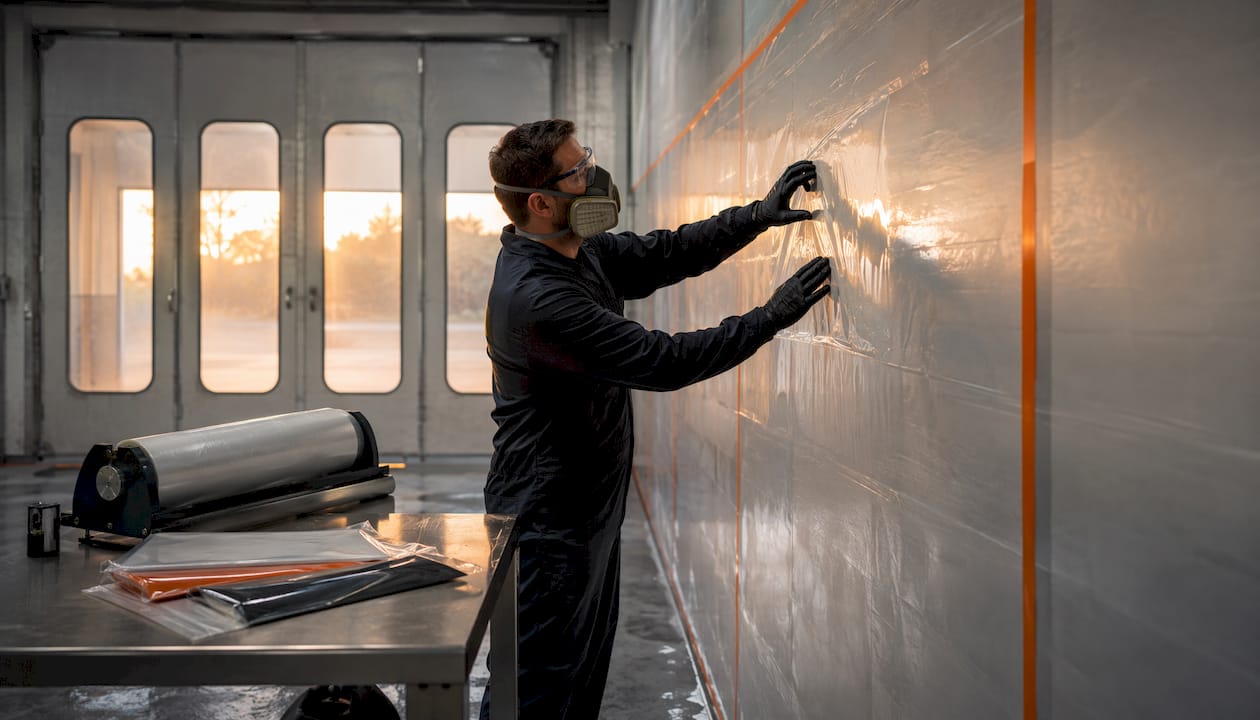
Static charge on unprotected booth walls actively attracts airborne particulates. Multi-layer electrostatic films neutralize that charge, cutting the frequency of manual wiping and the rework it causes. That is source control working at its most direct: prevent adhesion rather than clean it up afterward. Protective films for booth walls reduce re-entrainment risk and lower manual cleaning frequency, which directly improves finish quality.
Procurement checklist for booth wall and floor films:
- Multi-layer construction with electrostatic neutralizing surface
- Heat resistance rated for spray booth curing temperatures
- Static-free surface verified by the manufacturer
- Durability for high-traffic industrial use
- Patented dispenser system for fast, tape-free, bubble-free installation
- Custom sizing and bulk ordering options for large facilities
| Use Case | Film Type | Replacement Trigger |
|---|---|---|
| Continuous production | Consumable multi-layer film | Per batch or measured accumulation |
| Event/batch painting | Temporary adhesive protector | End of each paint session |
| Permanent booth walls | Long-life protective layer | Scheduled interval or visible damage |
| Floor protection | Adhesive floor protector | Per shift or accumulation threshold |
Dustfreefilm’s multi-layer electrostatic films are built specifically for automotive and industrial spray booths, with a patented dispenser system that cuts installation time and eliminates the edge-lifting that undermines protection. For booth wall film installation best practices, surface prep and dispenser alignment are the two steps most often skipped under production pressure.
Engineering controls: which booth design changes actually reduce dust?
Ventilation balance is the most underrated engineering control in spray booths. A booth running positive pressure relative to adjacent areas pushes contaminated air outward; negative pressure draws clean air in and exhausts particulates through filtration. Getting that balance wrong undermines every other control in the stack.
| Engineering Control | Function | Interaction with Films |
|---|---|---|
| Airflow balance (positive/negative pressure) | Controls dust migration direction | Correct pressure reduces film loading rate |
| Local exhaust ventilation (LEV) | Captures particulates at the source point | Reduces airborne load before it reaches walls |
| MERV/HEPA filtration | Removes fine particles from exhaust stream | Lower wall contamination extends film life |
| Vestibule / sealed access panels | Prevents cross-contamination between zones | PVC curtains for contamination control protect film edges from external particulate |
| Transfer-chute jackets | Encloses material transfer points | Reduces fugitive dust entering booth area |
Dust collection systems reduce workplace particulate but require explosion protection per NFPA guidance and regular maintenance. When LEV is well-tuned, film replacement intervals extend noticeably because the airborne load hitting booth walls drops.
Chemical stabilization vs. mechanical suppression: which fits your facility?
Operational guidance recommends chemical stabilization for permanent, high-traffic fixed surfaces and mechanical suppression for areas where traffic patterns and materials change frequently. Integrated approaches using both are most effective for medium- to large-scale facilities.
| Facility Type | Traffic Pattern | Recommended Approach |
|---|---|---|
| Fixed automotive production line | Constant, predictable | Chemical stabilization on adjacent floors |
| Batch industrial painting | Variable, intermittent | Mechanical suppression + consumable films |
| Multi-process manufacturing | Mixed | Integrated: chemical on fixed zones, mechanical on variable zones |
| Marine/large-format coating | Seasonal or project-based | Mechanical suppression, film protectors per project |
One compliance note: any chemical stabilizer applied near spray booth areas must be verified for material compatibility with coatings and reviewed in your Dust Hazard Analysis (DHA). Surface-stabilizing treatments must be matched to climate, traffic, and material properties to avoid runoff or surface incompatibility issues.
What should you measure in real-time, and what triggers a response?
Fixed PM10 and PM2.5 sensors at critical zones are the minimum for a 2026-compliant monitoring setup. Real-time PM sensors combined with automated suppression improve control precision and can automate responses when thresholds are exceeded.
Recommended metrics and threshold-action mapping:
- PM2.5 at booth interior: Elevated reading triggers LEV increase; sustained exceedance stops the batch.
- PM10 at exhaust plenum: Rising trend signals filter loading; schedule replacement before the next shift.
- Differential pressure across filters: Drop below design spec triggers immediate filter inspection.
- Air changes per hour (ACH): Log against design spec; deviation flags ventilation imbalance.
- Surface accumulation trend lines: Weekly visual inspection logged against defined thresholds.
Data logs must be retained long enough to support NFPA 660 audits. Store sensor readings, corrective actions, and inspection records in a format auditors can review on demand.
Housekeeping in 2026: what does an auditable NFPA 660 program require?
NFPA 660 is the 2026 baseline for combustible dust housekeeping expectations. Engineering controls alone no longer satisfy safety expectations; auditors will expect written, actionable housekeeping programs that reflect what actually happens on the floor. Programs must define measurable accumulation limits, inspection frequencies, assigned accountability, and verifiable corrective actions.
| Inspection Item | Frequency | Responsible Role | Accumulation Threshold | Corrective Action |
|---|---|---|---|---|
| Booth wall film condition | Per batch | Lead painter | Visible contamination or edge lift | Replace film, log replacement |
| Floor protector condition | Per shift | Maintenance tech | Visible debris accumulation | Replace or clean, log action |
| Filter differential pressure | Daily | Maintenance tech | Outside design spec | Inspect and replace filter |
| Sensor calibration check | Monthly | Safety lead | Drift beyond tolerance | Recalibrate, log result |
| DHA review | After any process change | Safety lead + ops manager | Any material/equipment change | Update DHA, retrain affected staff |
Audit checklist: Auditors will check DHA linkage to current processes, completed corrective action records, sensor data logs, and signed training records. NFPA 660 practical implications for 2026 mean recurring problem areas must be tracked and resolved with documented evidence, not just noted.
Pilot-to-scale rollout: timeline, cost drivers, and a simple ROI example
| Phase | Duration | Key Actions |
|---|---|---|
| Pilot | 30–60 days | Deploy films + sensors in one booth; baseline defect and cleaning metrics |
| Evaluation and DHA update | 30 days | Analyze pilot data; update DHA; adjust thresholds |
| Phased rollout | 90–180 days | Expand to remaining booths; train all roles |
| Full scale and maintenance | Ongoing | Quarterly audits; scheduled film and filter replacement |
Cost drivers to budget: film material per square foot, dispenser hardware, sensor network installation, filtration upgrades, installation and training labor, and waste handling for used films and filter media.
Simple ROI snapshot: A medium-sized automotive booth might reduce finish defects requiring rework after deploying multi-layer films, cutting both material waste and labor. Reduced manual cleaning frequency and longer filter change intervals add further savings. Tracking booth protection benefits against baseline metrics is the fastest way to build a procurement justification for scale-up.
Training modules and SOPs that make dust control stick
Dust control fails when it lives only in a policy document. Ownership has to reach the person standing in front of the booth.
- Onboarding module: Explain the layered control model, each role’s responsibilities, and how to read sensor alerts.
- Daily inspection module: Pre-shift film condition check, sensor status review, and filter pressure log.
- Sensor response module: What each alert level means and the exact SOP step to take (increase LEV, stop batch, replace film).
- Film installation and removal module: Dispenser alignment, overlap technique, edge sealing, and safe disposal of used film.
- Corrective-action reporting module: How to document a finding, assign a fix, and close the loop in the audit record.
Combustible dust DHAs must be revisited after any material or equipment change. Tie training completion records and SOP sign-offs directly into your NFPA 660 audit file so nothing falls through the gap between operations and compliance.
Pilot example: multi-layer films in a medium automotive spray booth
Before: Manual wall cleaning required after every 3–5 paint jobs; finish defect rate elevated by particulate re-entrainment; filter changes scheduled on a fixed calendar regardless of actual loading.
Key actions taken:
- Deployed multi-layer electrostatic wall and floor protectors across the full booth interior.
- Installed fixed PM2.5 sensors at two critical zones; logged readings per batch.
- Assigned film replacement to the lead painter at batch end; documented in the shift log.
- Tied filter replacement to differential pressure readings rather than a fixed schedule.
After: Manual cleaning interval extended significantly; finish defect rate dropped; filter changes shifted to condition-based scheduling, reducing unnecessary replacements.
Lessons learned: Edge adhesion at corners needs extra attention during installation. Dispenser training takes one session but must be hands-on. Sensor placement matters: mount at breathing-zone height, not ceiling level, for readings that reflect actual worker exposure.
Five-step action plan you can start this week
- Baseline audit (this week) — Operations lead: Walk every booth and log current film use, cleaning frequency, filter change intervals, and any open corrective actions from the last audit.
- Pilot scope and procurement (week 2–3) — Operations lead + Procurement: Select one high-traffic booth for the pilot; order multi-layer electrostatic films, dispenser hardware, and PM sensors. Review 2026 booth protection best practices before specifying.
- DHA review and housekeeping program update (30 days) — Safety lead: Confirm the DHA reflects current materials and equipment; set measurable accumulation thresholds and assign inspection ownership.
- Pilot execution and metric collection (30–60 days) — All roles: Run the pilot; log defect rates, cleaning labor hours, and filter change intervals against baseline.
- Scale decision and full rollout (90 days) — Operations lead + Safety lead: Present pilot data to procurement; expand to remaining booths; schedule quarterly audits.
Priority tags: Steps 1–2 are immediate (this week). Step 3 is short-term (30 days). Steps 4–5 are medium-term (60–90 days).
How automation and AI are changing predictive dust control
Predictive maintenance platforms now connect sensor data from PM monitors, differential pressure gauges, and airflow meters into a single dashboard. Instead of reacting to a clogged filter or a defect spike, the system flags the trend before it becomes a problem. Machine learning models trained on historical sensor logs can predict filter saturation windows and recommend film replacement intervals based on actual production volume rather than a fixed calendar.
For facility managers, the practical entry point is integrating existing PM sensors with a building management system (BMS) or a standalone industrial IoT platform. Automated alerts routed to maintenance staff via SMS or a CMMS work order system close the gap between detection and response. The auditable, sensor-driven programs that combine data-driven triggers with documented SOPs are becoming the gold standard for 2026 compliance.
Advanced materials that go beyond standard protective films
Anti-static coatings applied to permanent booth surfaces reduce the electrostatic charge that draws fine particles to walls between film changes. Nano-ceramic coatings on metal surfaces create a low-adhesion layer that makes residual particulate easier to wipe without solvents. Some facilities are evaluating hydrophobic surface treatments on booth ceilings and upper walls where film installation is impractical.
These materials work best as a complement to consumable films, not a replacement. A nano-coated wall still accumulates particulate; it just accumulates it more slowly and releases it more cleanly during housekeeping. The selection criteria mirror those for films: heat resistance, compatibility with coating chemistry, and durability under the cleaning agents used in the facility.
Energy efficiency and ventilation optimization in dust prevention
Ventilation is the largest energy consumer in most spray booths, and it is also the control most often run at fixed settings regardless of actual production load. Variable-frequency drives (VFDs) on exhaust fans allow airflow to scale with production intensity, cutting energy use during low-load periods without compromising dust control. Demand-controlled ventilation (DCV) systems use PM sensor data to modulate fan speed in real time.
The payback on VFD retrofits in industrial spray booths is typically measured in months, not years, when energy costs and reduced filter wear are both counted. Pairing VFDs with condition-based filter replacement (triggered by differential pressure rather than a fixed schedule) compounds the savings. Booth floor protection and wall films also reduce the particulate load reaching filters, which directly extends filter life and lowers the energy penalty of a partially blocked filter.
Waste management and disposal for dust and filtration media in 2026
Used booth films, spent filter media, and collected dust all carry regulatory classification risk. In the United States, paint-related particulate collected from spray booths may be classified as hazardous waste under RCRA if it contains heavy metals or regulated solvents. Characterization testing determines the correct disposal pathway before the first drum leaves the facility.
For filter media, the safest default is to treat spent filters as potentially hazardous until a waste characterization confirms otherwise. Document every disposal event: waste type, quantity, disposal contractor, and manifest number. Sustainability-focused facilities are increasingly working with certified recyclers who can process film waste and filter media separately from general industrial waste. Keeping disposal records in the same audit file as your NFPA 660 housekeeping logs simplifies both regulatory inspections and internal sustainability reporting.
Key Takeaways
A layered dust-control system that starts with source control, adds engineered enclosures and real-time monitoring, and is backed by an auditable NFPA 660 housekeeping program is the single most defensible approach for spray booth facilities in 2026.
| Point | Details |
|---|---|
| Source control is the first line | Multi-layer electrostatic films prevent particulate adhesion and reduce rework before cleaning is needed. |
| NFPA 660 requires measurable programs | Housekeeping must define accumulation thresholds, inspection frequencies, and assigned accountability. |
| Real-time monitoring closes the loop | Fixed PM10/PM2.5 sensors with threshold-action mapping turn data into audit evidence and operational triggers. |
| DHAs are living documents | Any change in paint material, booth air velocity, or filtration equipment requires an immediate DHA review. |
| Dustfreefilm for source control | Dustfreefilm’s multi-layer electrostatic films and patented dispenser system are a direct fit for the source-control layer in this program. |
The gap between compliance paperwork and what actually works on the floor
Most facilities that struggle with dust control in spray booths are not failing on engineering. Their ventilation is adequate. Their filters are rated correctly. The gap is almost always at the source-control layer and in the housekeeping program. Walls get contaminated between cleaning cycles, particulate re-entrains during the next paint job, and the defect rate climbs. The fix gets logged as a ventilation problem, more airflow gets added, energy costs rise, and the defect rate stays stubbornly high.
The reason protective films are underspecified in so many facilities is that their benefit is invisible until you measure it. A booth running multi-layer electrostatic films produces fewer defects per batch, requires less manual cleaning labor, and loads its filters more slowly. None of that shows up on a compliance checklist unless you are tracking finish defect rates and cleaning labor hours as operational KPIs alongside your PM sensor logs.
The 2026 NFPA 660 expectations are actually an opportunity here. The requirement for measurable, documented housekeeping programs forces facilities to instrument the very metrics that justify source-control investment. Run the pilot, collect the numbers, and the procurement case for scaling up writes itself.
Dustfreefilm’s multi-layer films are built for this program
Fewer rework cycles, longer filter life, and a housekeeping program that passes audit: that is what source control at the booth wall and floor level actually delivers. Dustfreefilm has been manufacturing multi-layer electrostatic dust protection films for automotive and industrial spray booths since 2012, with a patented dispenser system designed for fast, tape-free installation under production pressure.
Films are heat-resistant, static-free, and available in custom configurations and bulk orders for facilities running multiple booths or high production volumes. Whether you are specifying for a single pilot booth or a full-facility rollout, Dustfreefilm can supply the films, the dispenser hardware, and the technical specifications your procurement team needs. Request a quote or pilot sample to get started this week.
Useful sources
| Source | How it supports this article |
|---|---|
| NFPA 660 standard development | 2026 baseline for combustible dust housekeeping documentation requirements |
| Layered dust control strategies | Industry analysis supporting layered engineering + monitoring + enclosure approach |
| Chemical vs. mechanical dust control guidance | Decision logic for chemical stabilization vs. mechanical suppression |
| Combustible dust risk management | OHS guidance on DHAs, training integration, and dust collector explosion protection |
| NFPA 660 practical implications 2026 | Increased auditor scrutiny on measurable housekeeping programs |
| Real-time PM monitoring and automation | Sensor-driven deployment and automated suppression as 2026 standard |
| Dust suppression methods overview | Decision factors for suppression selection by climate, traffic, and material |
| OSHA combustible dust guidance | Source-control principle and re-entrainment risk reduction |