

TL;DR:
- Dust protection with multi-layer static-free films significantly improves spray booth throughput and finish quality. Tracking key performance indicators like rework rate and film replacement frequency helps measure and justify dust control investments.
Dust protection directly and measurably improves spray-booth throughput, finish quality, and equipment uptime. The single most effective step you can take is adopting multi-layer, static-free protective films — Dustfreefilm’s booth wall and floor protectors are the purpose-built option for this application. EPA fugitive dust guidance confirms that physical enclosure and barrier controls are among the most reliable methods for containing particulate at the source, and proper dust control measurably reduces rework, downtime, and maintenance costs across industrial operations.
Table of Contents
- How does dust contamination reduce throughput and finish quality?
- What KPIs should you track to connect dust protection to maintenance?
- What physical controls consistently reduce booth contamination?
- Step-by-step checklist for installing and replacing booth films
- How do you build a simple ROI case for dust-protection film?
- What mistakes undermine dust-protection film programs?
- Key Takeaways
- The measurement gap most facilities never close
- Dustfreefilm: purpose-built films for spray-booth efficiency
- Useful sources for compliance and deeper reading
How does dust contamination reduce throughput and finish quality?
Every dust particle that lands on a freshly sprayed surface is a rework event waiting to happen. In a busy auto body shop running multiple jobs per day, even a 5% rework rate means one job per shift gets touched twice — burning labor, paint, and booth time. Scale that across a week, and you’re looking at a meaningful throughput gap that never shows up on a dust-control budget line.
The cascade goes further than visible nibs and fisheyes:
- Rework and rejects: Particulate contamination forces sanding, recoating, or full strip-and-repaint cycles, each adding a significant amount of time per affected panel.
- Increased cycle time: Technicians spend extra time on tack-rag passes and visual inspections when booth cleanliness is unreliable.
- Equipment degradation: Poor filtration leads to energy waste, accelerated fan wear, and sensor faults that compound into unplanned downtime.
- Airflow disruption: Blinded intake filters reduce downdraft velocity, which changes how paint atomizes and settles — a subtle but consistent quality killer.
OSHA and EPA both treat airborne particulate as a compliance issue, not just a quality one. Keeping dust control in industrial safety on the same priority level as filtration maintenance protects workers and avoids regulatory exposure.
Facilities that treat filtration and dust control as strategic assets — not housekeeping — see measurable gains in production efficiency and equipment reliability. (Engineering News)
What KPIs should you track to connect dust protection to maintenance?
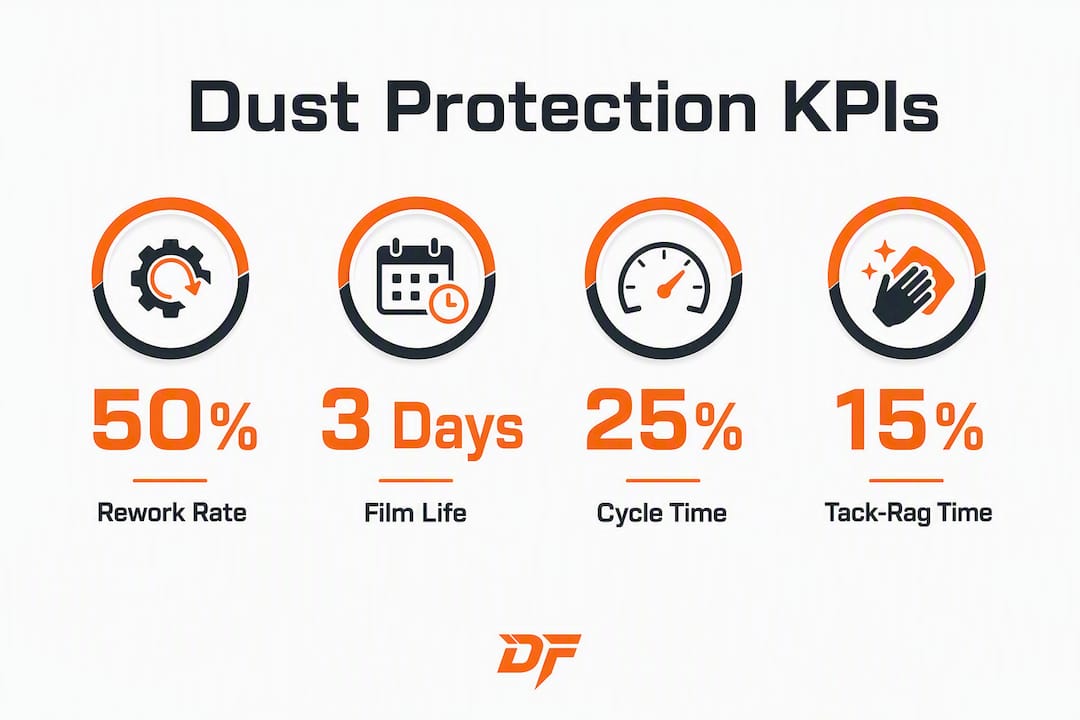
Dust protection only earns its place in a budget when you can measure what it changes. These six KPIs give you that link:
| KPI | Measurement Method | Trigger Threshold |
|---|---|---|
| Film replacement frequency | Log per booth per week | Increase of 20%+ vs. baseline |
| Rework rate | Touch-ups per shift or % of jobs | >8% of jobs per shift |
| Cycle time variance | Average booth time per job | >10% above rolling 4-week average |
| Differential pressure across filters | Magnehelic gauge reading | — |
| Particulate count (if available) | Handheld particle counter | — |
| Tack-rag time per job | Technician log | Trending upward over 2-week window |
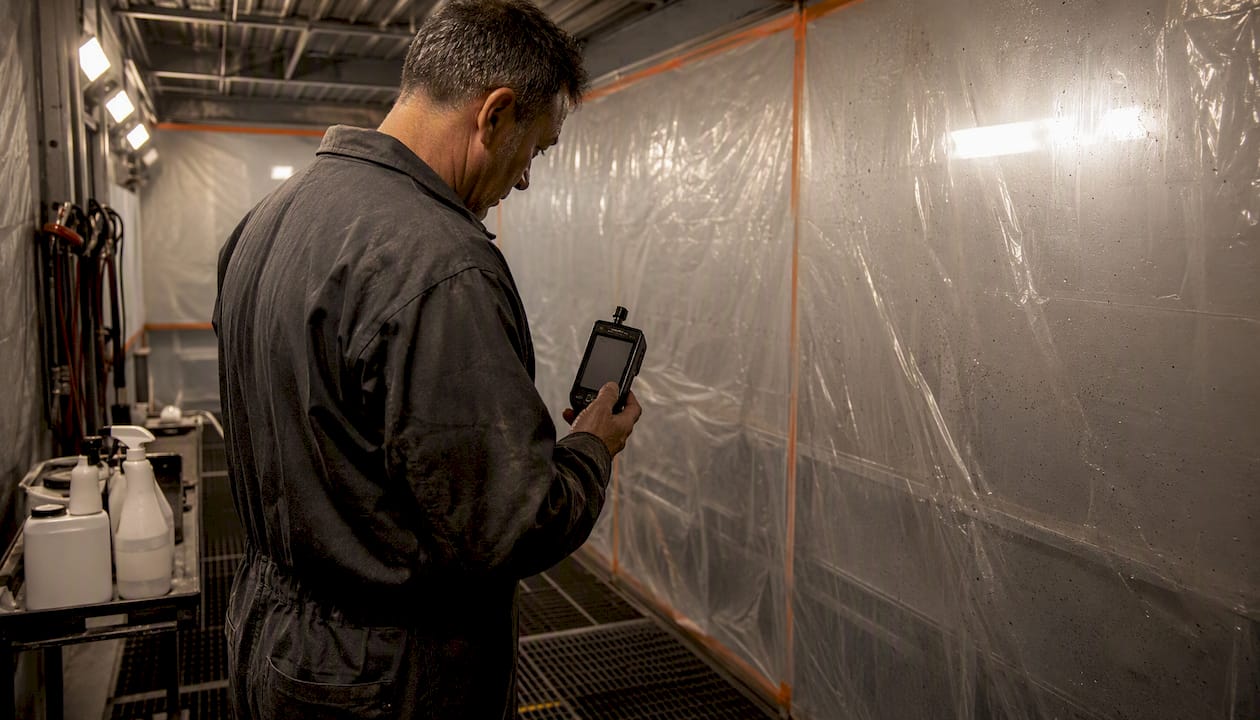
Condition-based indicators — differential pressure trends, pulse-valve efficiency, and film-replacement cadence — are reliable early-warning signals for filtration system degradation before a major failure occurs.
Booth Maintenance Log (suggested fields): Date | Booth ID | Film area replaced (sq ft) | Time to apply (min) | Observed defects (type/count) | Visual particulate rating (1–5) | Downstream action taken. Log every film swap and every rework event. Review weekly; act on any KPI that crosses its threshold two weeks in a row.
Pro Tip: Sample your particle count immediately after a film replacement and again 48 hours later. A rising count with no change in filtration status points to a hidden dust source — corners, light fixtures, or vent gaps — not a filter problem.
What physical controls consistently reduce booth contamination?
Behavior-based controls — reminders, checklists, verbal instructions — degrade over time. Physical-first controls do not. Multi-layer barrier films, adhesive floor covers, and taped seams remove human-judgment variability from the equation and create a stable foundation for consistent finish quality. A systematic review of dust control effectiveness found that implementing multiple layers of controls is strongly recommended, precisely because single-layer or behavior-only approaches leave residual exposure risk.
Film specification checklist — what to require:
- Multi-layer construction (minimum two layers for tear resistance and particle capture)
- Static-free or antistatic surface treatment to prevent re-entrainment from booth air currents
- Heat resistance rated to booth operating temperatures (typically 140–180°F for automotive cure cycles)
- Abrasion resistance sufficient for floor traffic without tearing
- Roll width and length options that match your booth dimensions without excessive seaming
- Compatibility with a dispenser system for tape-free, bubble-free application
Beyond wall and floor film, cover light fixtures, hood vents, and corners with custom-fit cut panels. Corners are a disproportionate source of rework — particulate accumulates there and gets re-entrained by downdraft airflow. Dustfreefilm’s multi-layer protection options include configurations for exactly these high-risk zones.
Pro Tip: Anti-static film combined with a properly balanced downdraft system limits re-entrainment at the source. The result is shorter tack-rag time before each coat — often the single fastest way to recover production minutes without adding headcount.
Step-by-step checklist for installing and replacing booth films
- Prep the surface. Wipe walls and floors with a tack cloth. Remove loose debris, dried overspray, and any adhesive residue from the previous film layer.
- Measure and pre-cut. Cut rolls to length before entering the booth. Pre-staging cuts outside saves 5–8 minutes per install.
- Load the dispenser. Thread the roll into the patented dispenser box. Confirm the leading edge is straight before advancing.
- Apply bubble-free. Use a two-person team: one feeds the film, one smooths from center outward. Never pull tight — let the film lay naturally to avoid stress wrinkles.
- Seal seams. Overlap adjacent panels by at least 2 inches and press seams firmly. Unsealed seams are the most common entry point for particulate.
- QA before production. Walk the booth with a flashlight at a low angle. Any bubble, lifted edge, or gap gets fixed before the first job starts.
Replacement cadence by area:
- Floor (high-traffic zone): daily or every 2–3 jobs, whichever comes first
- Walls (mid-height): weekly under normal load; after any sanding or grinding event
- Corners and light fixtures: weekly; inspect after every heavy-use shift
Pro Tip: Train technicians on a simple two-category visual standard: “good” (flat, no lifted edges, no visible contamination under the film) vs. “replace now” (any bubble larger than a quarter, any lifted seam, any visible particulate pocket). Post a laminated photo reference inside the booth door.
How do you build a simple ROI case for dust-protection film?
| ROI Input / Output | Example Value | Notes |
|---|---|---|
| Film cost per sq ft | a low cost per square foot | Varies by roll spec and order volume |
| Labor cost per install | moderate per booth | Two-person, under 20 min install |
| Replacement cadence | 5x per week (floor) | Adjusted by traffic and job type |
| Annual film + labor cost | several thousand dollars | Mid-size single booth |
| Rework rate before film | a higher percentage of jobs | Baseline for calculation |
| Rework rate after film | a lower percentage of jobs | Conservative field estimate |
| Labor + paint cost per rework | — | One panel, one technician hour |
| Annual rework savings | several thousand dollars | At 10 jobs per day |
| Estimated payback period | a few months to under a year | Depends on job volume and rework cost |
The math is straightforward. A shop running 10 jobs per day at an 8% rework rate generates roughly 200 rework events per year. Cutting that to 4% saves 100 events. At $200 average rework cost, that’s $20,000 in recovered labor and materials — against a film program costing under $6,000 annually.
Sensitivity levers to watch:
- Labor savings drive more ROI than paint savings alone — factor in technician time, not just materials.
- Faster cycle time (even 10 minutes per job) compounds quickly across high-volume operations.
- Reduced tack-rag time and fewer pre-coat inspections add production capacity without capital investment.
For a deeper look at how dust-free environments benefit manufacturing throughput, the operational math extends well beyond paint quality.
What mistakes undermine dust-protection film programs?
- Wrong film spec: Non-static film in a spray booth actively makes contamination worse — charged surfaces attract and hold airborne particles. Always specify antistatic.
- Poor dispenser choice: Manual application without a dispenser system traps air bubbles and contaminants under the film, defeating its purpose. Use a purpose-built dispenser box.
- Overreliance on housekeeping: Sweeping and wiping redistribute fine particles; they don’t eliminate them. Physical barrier film is the control; cleaning is the supplement.
- Skipping the QA walk: Installing film without a pre-production inspection leaves lifted edges and bubbles that fail mid-job. The 3-minute walk saves a 90-minute rework.
- Ignoring hidden dust sources: Corners, light fixtures, and vent gaps are the most common cause of unexplained rework. Cover them with spray booth barriers configured for those specific zones.
One environmental note: high humidity softens adhesive and reduces film adhesion; temperatures above the film’s rated threshold cause lifting at edges. Check your film’s spec sheet against booth cure temperatures and seasonal humidity ranges, and adjust replacement cadence accordingly. The NRCS CPS 373 guidance makes the same point about suppressant selection — treatment longevity and reapplication needs must match the operating environment, not just the initial specification.
Key Takeaways
Dust protection is a measurable operational lever: facilities that switch to multi-layer, static-free barrier films and track KPIs consistently cut rework rates, shorten cycle times, and recover labor costs that far exceed the film program’s annual cost.
| Point | Details |
|---|---|
| Track six core KPIs | Film replacement frequency, rework rate, cycle time, differential pressure, particulate count, and tack-rag time reveal problems early. |
| Physical controls beat behavior | Multi-layer antistatic films remove human-judgment variability and create a stable, repeatable finish environment. |
| ROI is achievable in months | A mid-size booth cutting rework from 8% to 4% can recover $20,000 annually against a film cost under $6,000. |
| Hidden sources drive rework | Corners, light fixtures, and vent gaps are the most overlooked contamination points; cover them with custom-fit film panels. |
| Dustfreefilm is the recommended option | Dustfreefilm’s multi-layer, static-free films with patented dispenser systems are purpose-built for automotive and industrial spray booths. |
The measurement gap most facilities never close
Most spray-booth operators know dust is a problem. Fewer treat it as a metric. The gap between those two positions is where rework budgets quietly disappear.
What the data actually shows is that the operational case for physical-first dust protection is not subtle. Anti-static film surfaces reduce re-entrainment and can materially shorten prep time, converting maintenance minutes into production minutes. When you start logging film replacement frequency alongside rework rate, the correlation becomes visible within weeks — not quarters. That’s the shift worth making: from “we clean the booth regularly” to “our film cadence is a leading indicator of finish quality.” One is a habit; the other is a system.
Dustfreefilm: purpose-built films for spray-booth efficiency
Fewer reworks, faster installs, and a measurable drop in tack-rag time — that’s what Dustfreefilm’s multi-layer, static-free booth films deliver in practice. The patented dispenser system cuts installation to under 20 minutes for a full booth, with no tape and no trapped bubbles. Static-free surfaces prevent re-entrainment from downdraft airflow, directly reducing pre-coat prep time. Multi-layer construction means a single peel resets the surface without a full replacement cycle, keeping high-traffic floor zones clean between jobs.
Every feature maps to a KPI: multi-layer construction lowers rework rate; static-free surface cuts tack-rag time; the dispenser system reduces install labor. Custom configurations are available for corners, light fixtures, and non-standard booth dimensions. Bulk pricing and distributor programs support high-volume operations. Request a sample or get a pilot quote at dustfreefilm.com — bring your booth dimensions and current rework rate, and the team can help you build the ROI case before you commit to a full order.
Useful sources for compliance and deeper reading
| Source | Best Used For |
|---|---|
| EPA Fugitive Dust Control Best Practices | Compliance examples, enclosure methods, and inspection techniques (Method 9) |
| Processing Magazine — Dust Control and Productivity | Productivity case studies, ROI framing, and anti-static surface performance |
| Engineering News — Hidden Cost of Poor Dust Collection | Predictive maintenance indicators, filter performance audits, and equipment-wear cost data |
| PMC Systematic Review — Dust Control Effectiveness | Evidence base for multi-layer controls and why single-layer approaches leave residual risk |
| NRCS CPS 373 — Dust Control Practice Sheet | Guidance on treatment longevity and matching control strategy to operating conditions |
| Dustfreefilm.com | Product specs, sample requests, bulk pricing, and installation guidance for spray-booth films |