

TL;DR:
- Effective dust management in industrial painting requires multiple layered solutions tailored to specific site conditions to prevent defects and operational delays. Proper surface barriers, regular monitoring, and environment-specific strategies significantly improve paint quality and reduce rework costs. Treating dust control as an ongoing operational discipline, rather than a one-time setup, is essential for maintaining consistent, high-quality finishes.
Walk into any high-volume auto body shop or industrial painting facility, and you’ll likely find contractors who believe their current dust control setup is “good enough.” Most assume that running an exhaust fan, doing occasional sweeps, or misting down surfaces before painting covers the bases. It doesn’t. The reality is that paint defect reduction depends on far more than these basic measures, and the gap between acceptable and excellent dust management is precisely where rework costs, unhappy clients, and lost productivity live.
Table of Contents
- Why dust management matters for contractors
- Core principles of effective dust management
- Evaluating dust management solutions: What works, what doesn’t
- Best practices: Achieving dust-free finishes and operational efficiency
- The real difference: Lessons contractors miss in dust management
- Next steps: Easy, proven solutions for contractors
- Frequently asked questions
Key Takeaways
| Point | Details |
|---|---|
| Dust management is essential | Uncontrolled dust reduces paint quality and operational efficiency for contractors. |
| Custom solutions outperform basics | Methods tailored to specific sites and tasks deliver better dust control than generic approaches. |
| Advanced barriers cut defects | Modern dust barriers have been shown to cut paint defects by up to 90 percent in manufacturing. |
| Water-only isn’t enough | Relying solely on water in dry or windy conditions is ineffective and can cost more in rework. |
| Continuous best practices matter | Ongoing maintenance and smart product use keep dust at bay and operations running smoothly. |
Why dust management matters for contractors
Dust is not just an annoyance on a paint job. It is a measurable threat to your bottom line, your equipment, and your compliance standing. Research confirms that dust causes significant defects in paint finishes and operational delays that compound over time. For contractors running tight schedules, a single dust-contaminated panel can mean sanding back, recoating, and losing hours or even an entire production day.
The financial toll adds up faster than most shops realize. Rework on automotive refinishing jobs typically burns through materials, labor, and booth time simultaneously. When a paint defect forces a redo, you’re not just repainting one panel; you’re also running the booth longer, consuming more product, and delaying the next job in line.
Beyond paint quality, dust compromises equipment reliability. Particles settle into spray guns, clog filters, and abrade moving components in ventilation systems. Facilities that neglect dust management often spend disproportionate amounts on equipment maintenance and replacement, costs that rarely appear in post-job reviews but quietly erode profit margins.

Regulatory compliance is another pressure point. OSHA and EPA standards for particulate control apply to industrial painting environments, and failing an inspection can result in fines or forced shutdowns. Contractors who treat dust management as a cost center rather than a risk mitigation tool often find out the hard way how expensive non-compliance can be.
Key operational risks tied to poor dust control include:
- Increased rework rates and material waste
- Premature filter replacement and gun maintenance
- Regulatory fines and inspection failures
- Customer dissatisfaction leading to lost repeat business
- Worker health issues from prolonged airborne particle exposure
“Dust contamination in a spray environment is not a cosmetic problem. It is a systemic operational failure that touches every part of your production chain, from prep to delivery.”
When you start thinking about dust this way, raising paint quality stops being about technique alone. It becomes about controlling the environment around the paint process, not just the process itself.
Core principles of effective dust management
Understanding dust management means understanding where dust actually comes from in an industrial or automotive refinishing setting. It is not just floating in from outside. In active facilities, dust is generated continuously from vehicle movement, foot traffic, prep sanding, surface grinding, air movement from HVAC systems, and even the vibration of nearby equipment. Every source needs to be addressed in your control strategy.
Here are the foundational principles every contractor and facility manager needs to internalize:
- Identify all dust generation sources before selecting any solution. Generic recommendations fail because they assume generic conditions. A body shop with heavy prep sanding traffic generates different dust profiles than a manufacturing plant coating large structural components.
- Recognize the limits of single-method suppression. Water misting works well in certain conditions, but research shows that empirical vehicle resuspension models exceed EPA AP-42 predictions, meaning dust levels from vehicle traffic in dry or windy sites are consistently higher than standard models account for. Water-only approaches simply cannot compensate for this in many real-world environments.
- Prioritize physical containment over dilution. Moving contaminated air around with fans does not eliminate dust; it redistributes it. Physical barriers that prevent dust from entering the spray environment are almost always more effective than trying to filter dust out after it has already entered the space.
- Layer your defenses. The best-performing facilities use multiple overlapping systems: booth wall and floor protection films, inlet filters, exhaust filtration, and dedicated prep zones separated from finishing zones.
- Build in monitoring and maintenance cycles. A control system that was working perfectly three months ago may be underperforming today if filters are overloaded or film layers have not been refreshed. Regular inspection schedules are not optional.
- Match your solution to your environment. High-humidity coastal shops, dry inland plants, facilities near construction activity, and high-traffic manufacturing halls all present different challenges. Your industrial dust control solutions should reflect your specific site conditions, not a catalog default.
Pro Tip: Before implementing any new dust control measure, spend one full shift documenting where visible dust settles in your facility. Floor patterns, equipment surfaces, and window sills tell you exactly where your contamination is originating and traveling, which gives you the data to target your investment accurately.
Evaluating dust management solutions: What works, what doesn’t
Not all dust management products are created equal, and the marketing around some methods overpromises significantly. Here is a side-by-side look at the most commonly used approaches in automotive and industrial painting environments.
| Solution | Effectiveness | Cost level | Best environment |
|---|---|---|---|
| Spray booth with standard filtration | Moderate | Medium | General automotive refinishing |
| Water-only suppression | Low to moderate | Low | Humid, low-wind outdoor settings |
| Temporary fabric barriers | Low | Low | Light-duty, short-term jobs |
| Multi-layer protective film (walls and floors) | High | Medium | Any enclosed spray environment |
| High-efficiency air filtration systems | High | High | Precision industrial coating |
| Combined film and filtration approach | Very high | Medium to high | High-volume or critical-finish applications |
The table tells a clear story. Water-only suppression, which many contractors rely on as a primary method, consistently underperforms in dry and windy conditions. It requires high humidity and calm airflow to be even moderately effective. In most industrial painting environments, those conditions are the exception, not the rule.
Temporary fabric barriers share a similar problem. They may stop large particles, but they fail to prevent fine particulate from migrating into the spray zone. They also degrade quickly, absorb contaminants, and can themselves become a source of contamination if not replaced frequently.
Multi-layer protective films designed specifically for spray booths address the problem differently. Rather than trying to catch or suppress dust after it is generated, these films physically isolate the booth surfaces from accumulated contamination. Because each layer can be peeled off between jobs, the booth environment resets to a clean state without requiring a full manual cleaning cycle. This is a significant time and labor advantage in high-volume operations.
When evaluating dust barrier comparisons, the key factors to weigh are:
- Particle size filtration capability (finer is better for automotive finishes)
- Installation speed and downtime impact
- Durability across temperature and humidity ranges
- Ease of replacement or refresh between jobs
- Compatibility with existing booth design and ventilation systems
Looking at barrier examples from real-world applications shows that facilities combining physical film protection with proper air filtration consistently outperform those relying on either method alone.
Pro Tip: When assessing any dust control product, ask the supplier for performance data specific to enclosed spray environments, not general industrial settings. Dust behavior in a sealed spray booth is fundamentally different from open-air or warehouse conditions, and the solution needs to match that reality.
Best practices: Achieving dust-free finishes and operational efficiency
Knowing what works is only half the equation. Executing it consistently across shifts, crews, and varying production volumes is where the difference between average and excellent operations actually lives. Here is a structured approach to implementation.
Step-by-step implementation guide:
- Conduct a baseline dust audit. Measure particulate levels at key points in your facility before any changes. This gives you a benchmark to measure improvements against.
- Install booth wall and floor protection films before the first job of the day. Films should cover all interior surfaces that could shed or trap particles, including corners and ceiling junctions where dust accumulates invisibly.
- Establish a dedicated prep zone physically separated from the finishing environment. Sanding and grinding generate the heaviest particulate loads. Keeping these operations away from the spray booth reduces the baseline contamination entering the controlled environment.
- Check and replace inlet filters on a scheduled basis, not reactively. A filter at 80% capacity is already compromising airflow dynamics and allowing finer particles through.
- Implement a peel-and-refresh protocol for film layers between each vehicle or production batch. This takes minutes and eliminates the contamination that accumulates on surfaces during a job.
- Train all staff on contamination pathways. The technician who walks through a dusty prep area and then enters the spray booth is carrying contamination on their clothing. Simple protocols like dedicated booth entry footwear make a measurable difference.
The results from facilities that have implemented structured dust management programs are significant. Sites that have adopted advanced dust barriers report major reductions in paint defects and booth downtime.
| Metric | Before structured dust control | After structured dust control |
|---|---|---|
| Paint defects per 10 jobs | 3.2 average | 0.4 average |
| Rework hours per week | 8 to 12 hours | 1 to 2 hours |
| Filter replacement frequency | Every 2 weeks | Every 4 to 6 weeks |
| Booth cleaning time per shift | 45 minutes | 10 minutes |
| Customer complaint rate | 12% | Under 2% |
Common pitfalls that prevent contractors from achieving these results include:
- Skipping the baseline audit and having no data to guide decisions
- Treating film replacement as optional rather than mandatory between jobs
- Relying on a single control method when the environment demands multiple layers
- Failing to reduce dust in spray booths through process changes, not just product additions
- Neglecting safety protocols for dust control that protect both finish quality and worker health
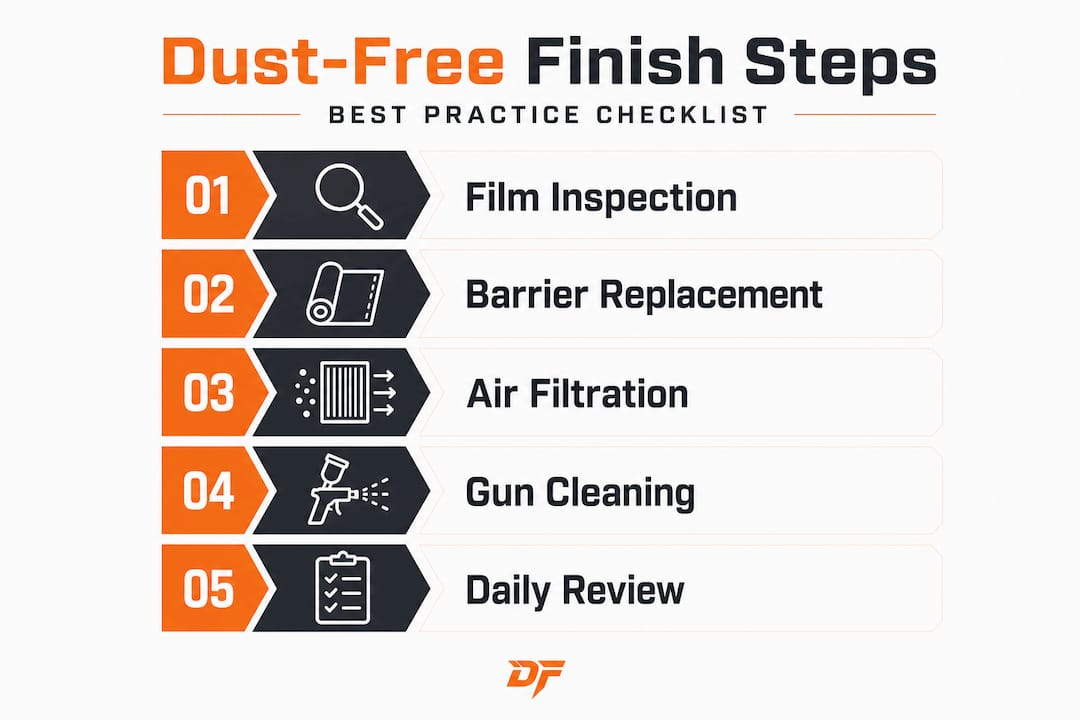
The ongoing performance checklist for any serious dust management program should include daily film inspection and replacement, weekly filter checks, monthly booth deep cleaning, and quarterly system reviews that compare defect rates to baseline.
The real difference: Lessons contractors miss in dust management
Here is something we’ve seen repeatedly across high-performing and struggling facilities alike: the shops that get dust management right are not necessarily the ones with the biggest budgets or the most sophisticated equipment. They are the ones that stopped treating dust control as a one-time purchase and started treating it as an ongoing operational discipline.
Conventional wisdom in this industry says “get a good booth and you’re set.” That assumption is expensive. A spray booth is a controlled environment, not a self-maintaining one. The moment you introduce vehicle traffic, sanding operations, or simply open the doors for entry and exit, you are reintroducing contamination. The booth itself does not eliminate dust; your active management practices do.
We’ve also seen contractors invest heavily in air filtration systems while ignoring the booth surfaces themselves. Filters catch airborne particles, but they do nothing about the dust that has already settled on walls, floors, and ledges and will become airborne again the moment airflow changes or someone walks through. Physical surface protection is not a luxury add-on; it is a foundational layer that determines whether everything else you invest in actually pays off.
The facilities that transform their results are usually the ones willing to question the methods they inherited. They look at top dust control solutions not as a catalog to pick from but as a toolkit to assemble based on their specific site conditions, production volumes, and quality standards. That mindset shift is worth more than any single product.
One more uncomfortable truth: most dust contamination issues are discovered after the fact, in the form of a rejected finish or a customer complaint. Building in proactive monitoring, the kind that catches contamination trends before they become defects, separates the contractors who consistently deliver quality from the ones who are always putting out fires.
Next steps: Easy, proven solutions for contractors
You now have a clear picture of what effective dust management actually requires. The difference between a finish that leaves a client impressed and one that goes back for rework often comes down to the barrier systems protecting your booth environment between and during jobs.

At Dust Free Film, we’ve been engineering spray booth protection specifically for contractors and facility managers since 2012. Our multi-layer electrostatic protective films are designed to install fast, peel cleanly, and maintain a contamination-free surface across even the most demanding production schedules. Whether you run a single-bay auto body shop or a multi-line industrial coating facility, we have configurations built for your environment. Ready to see what the right barrier system can do for your operation? Request a custom quote and our team will match you to the solution that fits your site.
Frequently asked questions
What is the most effective dust management method for automotive paint contractors?
A combination of physical barriers, proper ventilation, and advanced filtration delivers the best results. Sites using advanced dust barriers consistently report major reductions in paint defects and rework rates.
Does water-only suppression work for dust control in dry or windy plants?
Water-only suppression is usually insufficient in dry or windy sites because resuspension exceeds standard predictions under those conditions. Alternative or supplemental physical containment methods are needed for reliable control.
How does dust impact paint quality in manufacturing environments?
Even microscopic dust particles cause surface defects and require rework, which generates production delays. Research confirms that dust causes significant defects in industrial and automotive paint finishes that compound across a production schedule.
What are common mistakes contractors make in dust management?
Contractors most often underestimate site-specific challenges and rely on basic suppression methods while ignoring environmental variables. The research on dry and windy site challenges makes clear that one-size-fits-all approaches consistently fall short of what real production environments demand.