

TL;DR:
- Static charges on spray booth surfaces attract dust, leading to finish defects.
- Electrostatic film neutralizes static, reducing dust-related rework and improving quality.
- Combining surface film with humidity control, ionization, and grounding creates optimal static management.
Static electricity is one of the most underestimated variables in spray booth operations. Facilities routinely invest in filtration, airflow systems, and premium coatings, yet still battle dust contamination that ruins finishes at the final stage. The reason is often invisible: static charges on booth surfaces actively pull airborne particles onto freshly painted panels. Electrostatic film addresses this problem at its source, offering a surface-level solution that neutralizes static before it can attract dust. This guide breaks down what electrostatic film actually means, how it works scientifically, and how facility managers can use it to drive measurable improvements in finish quality and operational efficiency.
Table of Contents
- What is electrostatic film? Core definition and science
- Electrostatic film vs. other static control solutions
- Real-world impact and cost effectiveness of electrostatic film
- How to choose and apply electrostatic film in your spray booth
- The overlooked value of static management in operational excellence
- Upgrade your spray booth with proven dust and static control solutions
- Frequently asked questions
Key Takeaways
| Point | Details |
|---|---|
| Static management matters | Uncontrolled static charges are a hidden root cause of dust and finishing defects in spray booths. |
| Electrostatic film is highly effective | Applied film significantly reduces dust attraction and improves paint shop efficiency compared to traditional methods alone. |
| Solutions work best in combination | Pairing film with humidity control and grounding provides robust dust and static mitigation in demanding environments. |
| ROI is strong | Despite a higher upfront cost, facilities typically see fast payback from waste and labor savings. |
What is electrostatic film? Core definition and science
Electrostatic film is a surface-applied protective film engineered to dissipate or neutralize static electrical charges that accumulate on spray booth walls, floors, and fixtures. Unlike standard protective films that simply cover surfaces, electrostatic film actively manages the charge environment inside your booth. That distinction matters enormously when you’re trying to achieve a flawless finish.
The science behind it is straightforward. Static charges build up on non-conductive surfaces through friction, airflow, and contact with materials moving through the booth. These charges act like magnets for dust particles. Electrostatic film interrupts this process by incorporating conductive or dissipative polymers into its structure. ABS-antistatic materials work on a similar principle, using additives that allow charges to flow through the material rather than accumulate on its surface.
There are two main types of electrostatic film, and choosing the right one matters:
- Conductive film: Discharges static rapidly, ideal for high-static zones where charge buildup is fast and intense.
- Dissipative film: Releases charge gradually in a controlled manner, suited for standard booth environments where a slower, steadier discharge is preferred.
- Multi-layer designs: Combine protective and static-control properties in a single application, reducing installation complexity.
- Heat-resistant variants: Maintain performance under the elevated temperatures common in industrial spray booths.
Humidity plays a critical role here. In low-humidity environments, charge buildup accelerates significantly because dry air is a poor conductor. Low-humidity settings require combining electrostatic film with additional controls like humidification or ionization for full static mitigation. Film alone handles the surface; the surrounding air environment still needs attention.
| Film type | Discharge speed | Best environment | Key benefit |
|---|---|---|---|
| Conductive | Rapid | High-static zones | Immediate charge removal |
| Dissipative | Controlled | Standard booths | Gradual, stable discharge |
| Multi-layer | Variable | All booth types | Combined protection |
“Facilities that integrate electrostatic film as part of a broader static management strategy report up to 70% fewer dust-related defects in finished coatings.”
For a deeper look at how these films fit into overall booth performance, enhancing spray booth performance covers the full picture. Understanding the impact of static on dust control also gives you the context to make smarter procurement decisions.
Electrostatic film vs. other static control solutions
Electrostatic film does not operate in isolation. To get the most from it, you need to understand where it excels compared to other static and dust control strategies, and where combining approaches makes sense.
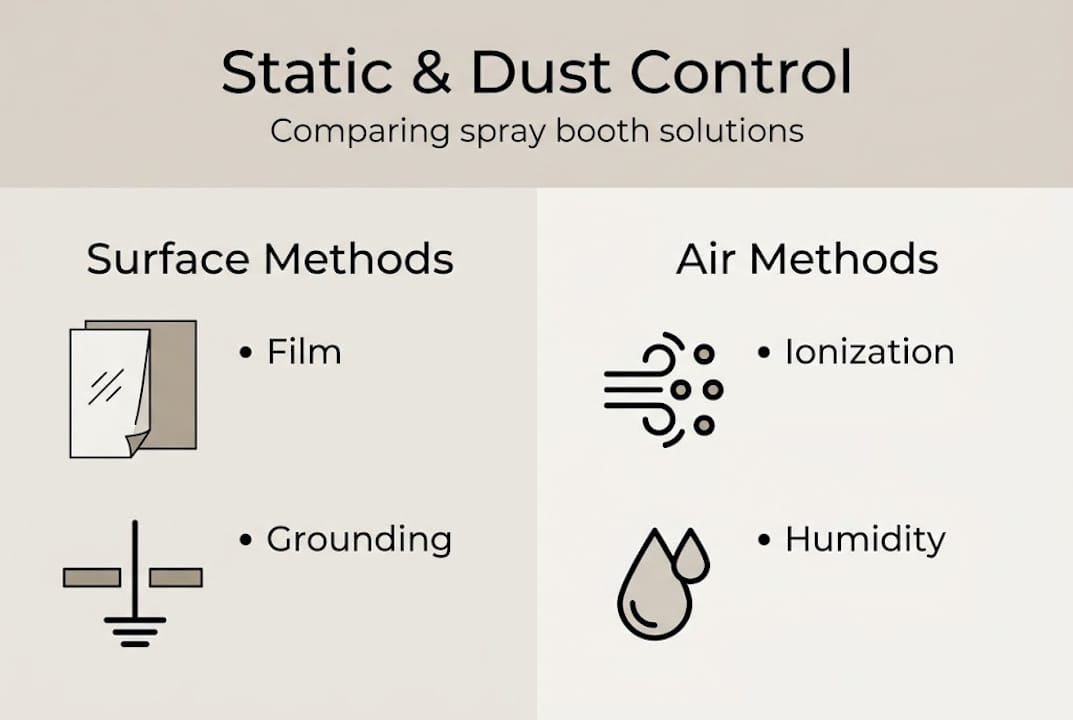
Film vs. humidification: Maintaining relative humidity between 50 and 65% reduces airborne static by improving air conductivity. However, humidity control alone does nothing for static that has already built up on booth surfaces. Electrostatic film handles that surface charge directly, making the two methods genuinely complementary rather than interchangeable.
Film vs. ionization: Ionization systems emit charged ions into the air to neutralize airborne particles in real time. This is effective for particles already suspended in the air column but does not address static on walls, floors, or fixtures. Electrostatic film provides continuous surface protection between cleaning cycles, filling the gap that ionization leaves.
Film vs. grounding: Grounding is foundational. Every booth should have proper grounding to prevent dangerous charge accumulation. But grounding addresses the structure itself, not the surfaces where dust actually lands. Electrostatic film works on top of grounding, targeting the surfaces that interact directly with your paint job.
Complementary methods for static and dust control include humidity control at 50 to 65% RH, equipment grounding, and ionization systems alongside static-dissipative films. The most effective booths use all of these in a coordinated way.
| Solution | Targets | Continuous? | Best combined with |
|---|---|---|---|
| Electrostatic film | Surface charges | Yes | Humidification, grounding |
| Humidification | Airborne static | Yes | Film, ionization |
| Ionization | Airborne particles | Yes | Film, grounding |
| Grounding | Structural charge | Yes | Film, humidification |
Here is a practical sequence for evaluating your current setup:
- Audit your booth for grounding compliance first.
- Measure average relative humidity during peak operations.
- Identify high-static surface zones using a static meter.
- Select film type based on discharge needs (conductive vs. dissipative).
- Add humidification or ionization if low humidity is a recurring issue.
Pro Tip: In booths with high airflow rates, ionization alone often struggles to keep up. Pairing it with electrostatic film on walls and floors gives you a stable baseline that airflow cannot disrupt.
For broader context on managing dust at the facility level, industrial dust control solutions and boosting spray booth results offer practical frameworks you can apply immediately.
Real-world impact and cost effectiveness of electrostatic film
The performance case for electrostatic film is built on a simple equation: fewer dust-related defects equal less rework, less wasted paint, and faster throughput. Let’s look at what facilities actually experience.
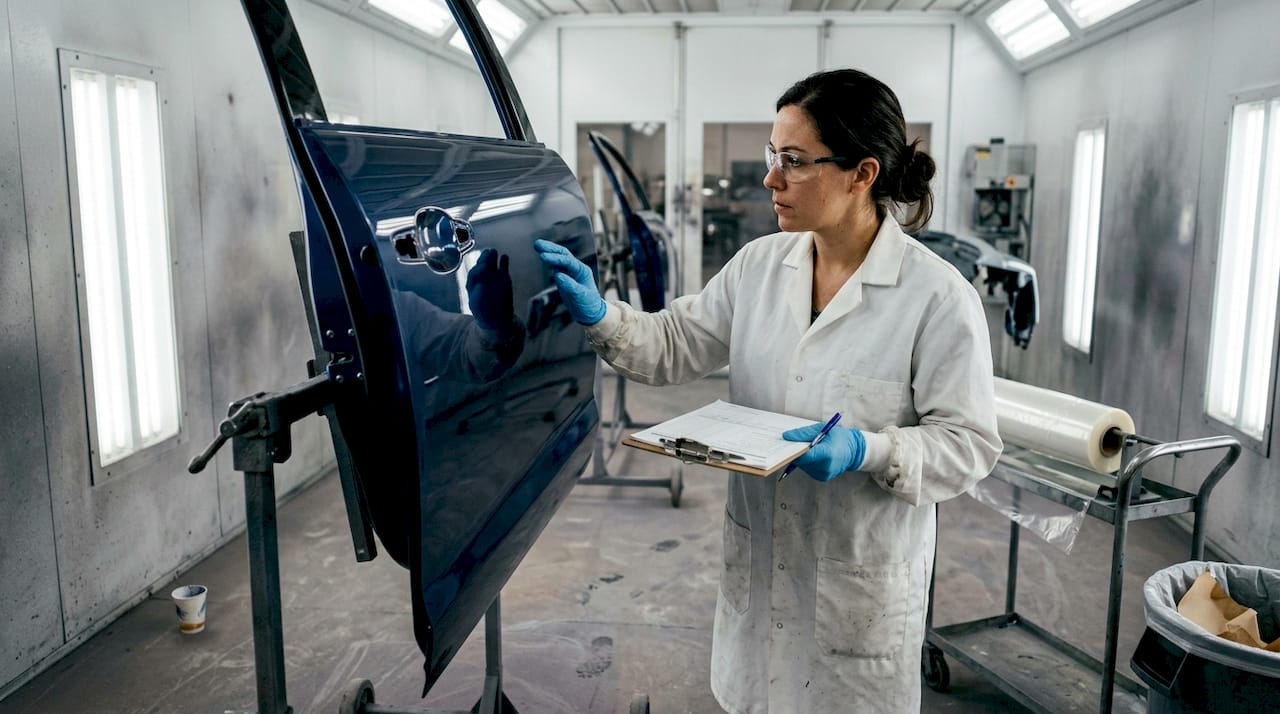
Waste reduction is the most immediate benefit. Every dust inclusion in a finish requires sanding, re-coating, or in the worst cases, full panel rework. Each rework cycle consumes paint, labor hours, and booth time. Electrostatic film reduces the frequency of these events by cutting the primary source of contamination at the surface level.
Facilities that adopt electrostatic film consistently report:
- Fewer booth cleaning cycles per shift
- More consistent finish quality across vehicle types and panel sizes
- Reduced paint consumption per job due to lower defect rates
- Shorter cycle times because rework interruptions decrease
- Improved compliance with OEM finish quality standards
The ROI calculation is straightforward. Higher initial film costs are offset by reduced paint waste, fewer reworks, and improved finish quality over time. For a mid-volume auto body shop running 20 to 30 jobs per week, even a 15% reduction in rework frequency translates to significant labor and material savings within the first quarter of use.
Stat to know: Facilities operating in low-humidity climates, where static buildup is most aggressive, typically see the fastest return on investment when they pair electrostatic film with controlled relative humidity.
Pro Tip: Track your rework rate before and after film installation for at least 30 days. That data becomes your internal business case for expanding the solution across additional booths or facilities.
For facilities focused on finish quality benchmarks, raising paint quality and achieving flawless finishes provide additional operational guidance that complements electrostatic film deployment.
How to choose and apply electrostatic film in your spray booth
Selecting the right electrostatic film is not a one-size-fits-all decision. Your booth’s humidity profile, airflow characteristics, and static zone intensity all influence which film type will perform best. Here is a practical process for getting it right.
- Assess your static environment. Use a surface static meter to identify which zones in your booth accumulate the highest charges. Walls near air intake points and floor areas under high-traffic paths are common hotspots.
- Check your humidity baseline. If your booth regularly runs below 50% RH, plan to address that alongside film selection. Dissipative films suit controlled environments; conductive films are best for rapid discharge in high-static zones.
- Match film type to zone needs. Use conductive film in your highest-static areas and dissipative film in standard zones. Some facilities use both types in different locations within the same booth.
- Prepare surfaces before application. Clean booth walls and floors thoroughly. Any residual dust, grease, or moisture between the film and surface reduces adhesion and static-control performance.
- Apply using a patented dispenser system where available. Bubble-free installation is critical because air pockets create micro-zones where static can still accumulate beneath the film.
- Monitor and evaluate periodically. Film performance can degrade with heavy use, cleaning chemical exposure, or physical damage. Schedule regular inspections and replace sections as needed.
ISO and OEM guidelines for coating environments often specify maximum allowable particle counts and surface charge levels. Aligning your film selection with these standards protects both finish quality and compliance standing.
Pro Tip: Never skip the surface prep step to save time. A film applied over a contaminated surface will underperform from day one, and you will incorrectly conclude that the film itself is the problem.
For practical examples of how facilities deploy protective film across different booth configurations, protective film applications and top floor film options give you real-world reference points.
The overlooked value of static management in operational excellence
Most facilities treat static electricity as a nuisance, something to address reactively when a bad batch of finishes forces the issue. That mindset is costing you more than you realize.
Static is not a background variable. It is an active process input that affects finish quality, paint transfer efficiency, and cleaning frequency every single shift. Facilities that recognize this and build static management into their standard operating procedures gain a measurable competitive edge. Their defect rates are lower, their throughput is higher, and their quality consistency is something their customers notice.
The real opportunity is integration. Surface film, air ionization, humidity control, and staff training are not competing solutions. They are layers of a system. When you align all of them around a shared goal of static elimination, the results compound. A facility that manages static as a key process variable, rather than an occasional annoyance, operates at a fundamentally different level than one that does not.
For a deep dive on static impact, the data reinforces what experienced facility managers already sense: static control is where operational excellence actually starts.
Upgrade your spray booth with proven dust and static control solutions
If dust contamination and static-related defects are limiting your facility’s output, the solution starts with the right protective film. At Dust Free Film, we have been helping automotive refinishing and industrial painting facilities eliminate these problems since 2012, with multi-layer electrostatic booth wall and floor protectors built to European manufacturing standards.
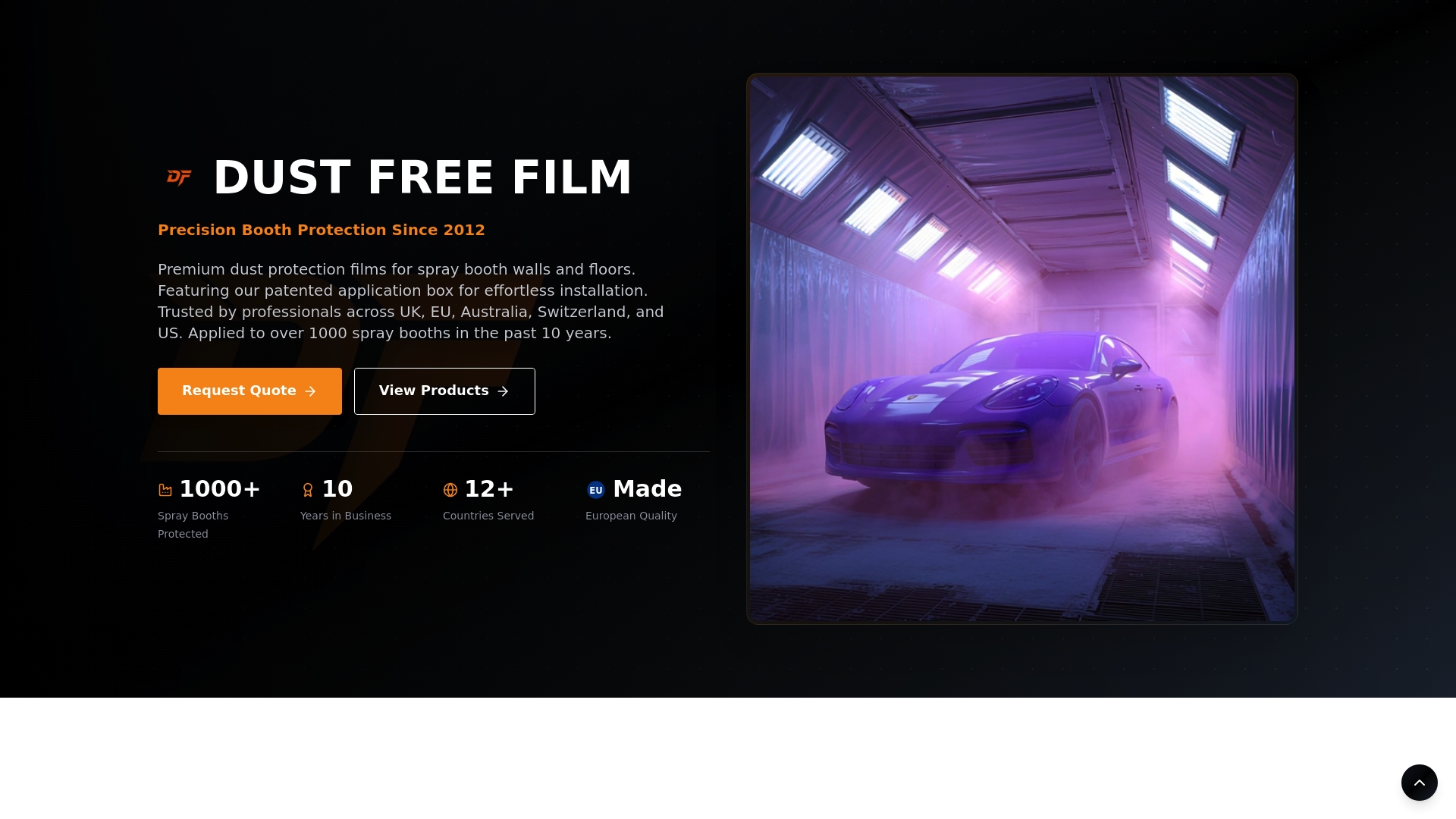
Our patented dispenser system makes installation fast and bubble-free, and our team provides technical support to help you match the right film type to your specific booth conditions. Whether you manage a single auto body shop or a network of industrial painting facilities, we offer flexible configurations and bulk purchasing options to fit your procurement needs. Request a quote today and take the first step toward consistently flawless finishes.
Frequently asked questions
What does electrostatic film do in a spray booth?
Electrostatic film neutralizes static charges on booth surfaces that would otherwise attract dust particles, directly improving paint finish quality and reducing contamination-related rework.
How does electrostatic film compare to using humidification in dust control?
Electrostatic film targets static on surfaces, while humidification at 50 to 65% RH reduces airborne charge buildup. Using both together delivers maximum dust reduction across all zones of the booth.
Does electrostatic film save money despite the initial higher cost?
Yes. Reduced paint waste and fewer rework cycles typically offset the upfront film cost within the first few months of consistent use.
Is electrostatic film difficult to install?
Most electrostatic films are designed for straightforward application, but proper surface preparation and periodic condition checks are essential for maintaining peak static-control performance.
When should I use conductive vs. dissipative film?
Conductive films excel in high-static zones needing rapid discharge, while dissipative films are the right choice for standard booth environments where gradual, controlled static release is sufficient.