

TL;DR:
- Electrostatic protection prevents damage from static discharge in industrial and automotive settings. Proper grounding, material selection, and environmental controls reduce risks like paint defects, electronics failure, and explosions.
Electrostatic protection is defined as the set of practices, materials, and devices used to prevent damage from electrostatic discharge (ESD) in industrial and automotive environments. The industry standard term is ESD control, and it covers everything from grounding straps and conductive floor coatings to anti-static booth films. For technicians working in spray booths or handling sensitive components, ESD control is not optional. A single uncontrolled discharge can ruin a paint finish, destroy a semiconductor, or ignite a combustible atmosphere. Standards like ANSI/ESD S20.20-2021 exist precisely because the consequences of ignoring static electricity are severe and expensive.
What is electrostatic protection and why does it matter?
Electrostatic protection is the discipline of controlling static charge so it never builds to a level that causes a damaging discharge. The term covers both the physical materials you use and the procedures your team follows. In automotive refinishing and industrial painting, ESD control directly affects finish quality, equipment reliability, and worker safety.
ESD causes over 30% of semiconductor failures in manufacturing. That figure means roughly one in three component failures on a production line traces back to a charge event that was preventable. Even more striking, components rated as low as 1.2V can be destroyed by a minor discharge that a technician never feels.
The importance of electrostatic protection grows in proportion to the sensitivity of what you are protecting. In a spray booth, the threat is twofold. Static attracts airborne dust and particulates to freshly painted surfaces, and in solvent-heavy environments, a spark can trigger an explosion. Both outcomes are avoidable with the right controls in place.
What causes electrostatic discharge in industrial settings?
Static charge builds through triboelectric charging, the transfer of electrons when two materials contact and then separate. Walking across a vinyl floor, pulling a protective film off a surface, or moving a cart across a spray booth all generate charge. The charge accumulates on personnel, equipment, and surfaces until it finds a path to equalize, which is the discharge event.
The key risk factors in industrial environments include:
- Material interactions: Insulative materials like plastics and dry fabrics hold charge longest and release it suddenly.
- Low humidity: Dry air removes the conductive moisture layer from surfaces, allowing charge to accumulate faster.
- Personnel movement: Static charge rebuilds on the human body within seconds of movement, making a single grounding touch insufficient.
- Ungrounded equipment: Metal carts, spray guns, and fixtures that are not bonded to earth become charge reservoirs.
- Combustible atmospheres: Solvent vapors and combustible dust lower the ignition threshold, making even a small discharge dangerous.
Environmental humidity is one of the most underrated controls. Maintaining workspace humidity between 40–60% reduces static buildup significantly because moisture conducts excess charge away before it accumulates. Spray booth operators who struggle with recurring dust contamination often find that humidity control alone produces a measurable improvement.
How to protect from static: key methods and materials
Effective ESD control combines personnel grounding, material selection, environmental management, and ionization technology. No single method works in isolation.

Personnel grounding devices
Wrist straps connected to a verified earth ground are the standard for continuous personnel grounding. The critical word is continuous. Touching a grounded surface removes charge temporarily, but static rebuilds within seconds of movement. Wrist straps maintain a constant low-resistance path to ground throughout a task.
Material selection: anti-static vs. conductive
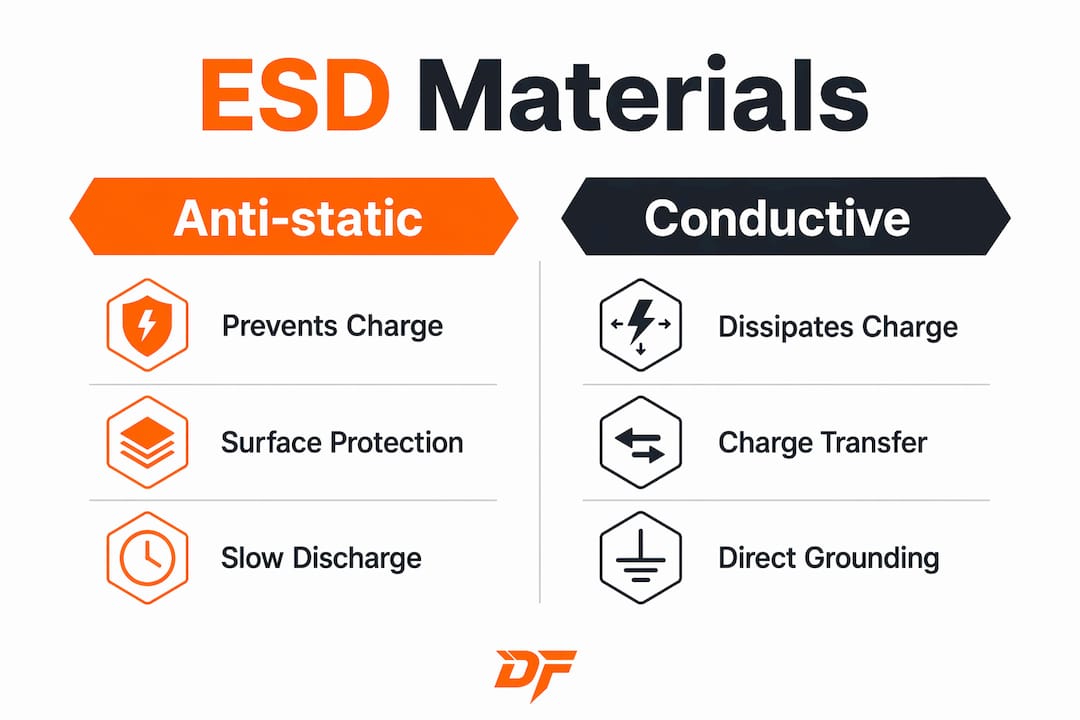
The most common mistake in ESD control is treating anti-static and conductive materials as interchangeable. They are not. Anti-static materials prevent charge generation; conductive materials move existing charge to ground. Using an anti-static mat where a conductive, grounded mat is needed leaves accumulated charge with nowhere to go.
| Property | Anti-static material | Conductive material |
|---|---|---|
| Primary function | Prevents charge from forming | Dissipates existing charge to ground |
| Typical surface resistance | 10^9 to 10^12 ohms | Below 10^5 ohms |
| Requires earth ground | No | Yes |
| Best application | Packaging, booth wall films | Floor mats, footwear, grounding straps |
| Risk if misused | Insufficient dissipation | Rapid discharge if ungrounded |
Environmental and ionization controls
Specialized conductive floor coatings and footwear maintain continuous charge dissipation across an entire facility. Ionization bars and guns neutralize static on insulative surfaces that cannot be grounded directly, such as painted panels mid-process or plastic components. Ionization is the only reliable method for those surfaces.
Pro Tip: Anti-static mats fail most often because their earth ground connection is never verified. Test the resistance path from mat surface to ground before each shift. A high-resistance or open connection means the mat is accumulating charge, not dissipating it.
How does electrostatic protection improve spray booth paint quality?
Static electricity in a spray booth acts like a magnet for contamination. Charged booth walls, floors, and protective films attract airborne dust and fiber particles. Those particles settle on wet paint and create defects that require rework or complete resprays. The connection between static electricity in spray booths and dust contamination is direct and well-documented.
The practical steps for protecting finish quality through ESD control include:
- Use static-free booth films: Booth wall and floor protectors made from anti-static or conductive materials stop the surface from attracting dust. Standard plastic films can generate significant charge when unrolled or walked on.
- Ground the vehicle being painted: The vehicle body must be bonded to earth before spraying begins. An ungrounded vehicle accumulates charge from the spray gun’s airstream and attracts overspray and dust.
- Select the right protective film: Anti-static films reduce defects by preventing the booth liner itself from becoming a contamination source. Multi-layer films with verified static-free properties outperform standard polyethylene sheeting.
- Maintain conductive flooring: Conductive floor coatings or mats dissipate charge from technicians and equipment continuously, reducing the overall static level in the booth environment.
- Control humidity: Keeping booth humidity in the 40–60% range reduces charge buildup on all surfaces simultaneously.
The electrostatic film principle applies directly here. Films that are designed to be static-free do not generate triboelectric charge during installation or use, which means they do not become dust magnets during a paint cycle.
Workplace safety: why static discharge causes explosions
Static discharge is a major explosion risk in environments with combustible dust or volatile liquids. Spray booths, solvent storage areas, and powder coating lines all qualify. The hazard is invisible, which is why it is consistently underestimated.
The safety protocol for hazardous environments follows a clear sequence:
- Identify ignition sources: Map every surface, piece of equipment, and personnel pathway where static can accumulate. Ungrounded metal containers, plastic tubing, and synthetic clothing are common sources.
- Bond and ground all conductive equipment: Every metal container, spray gun, and cart must be bonded to adjacent equipment and grounded to earth. Bonding prevents spark discharge between two objects at different potentials.
- Specify compliant PPE: Gloves and footwear must meet standards such as EN 16350 for electrostatic properties. Standard nitrile or latex gloves provide no ESD protection and can accumulate charge.
- Restrict insulative materials: Synthetic clothing, standard plastic containers, and uncoated floors are ignition risks in solvent-heavy areas. Replace them with static-dissipative alternatives.
- Inspect and test regularly: Grounding connections corrode, wrist straps degrade, and floor coatings wear. A weekly resistance test on all grounding paths catches failures before they cause incidents.
Pro Tip: Static electricity hazards often go unrecognized despite serious risk. Post a grounding checklist at every booth entry point and make it part of the pre-shift sign-off. The few seconds it takes to verify grounding is the cheapest insurance available.
Comparing ESD standards and best practices
Two standards define the framework for professional ESD control. ANSI/ESD S20.20-2021 and IEC 61000-4-2 set test protocols and immunity requirements for wrist straps, mats, protection diodes, and facility-level controls. Compliance with these standards is the baseline for any serious ESD program.
| Standard | Scope | Key requirement |
|---|---|---|
| ANSI/ESD S20.20-2021 | Facility and personnel ESD control programs | Verified grounding, documented testing, trained personnel |
| IEC 61000-4-2 | Device-level ESD immunity testing | Defines discharge levels and test methods for components |
| EN 16350 | Electrostatic properties of protective gloves | Resistance thresholds for gloves used in explosive atmospheres |
The co-design principle from IEEE Spectrum’s ESD research states that effective ESD protection requires combining device-level safeguards with environmental and procedural controls. Relying on one layer alone creates gaps. A facility that uses compliant floor coatings but skips wrist strap testing will still have failures. The standard works only when all layers are active simultaneously.
Common pitfalls include using anti-static materials where conductive materials are required, failing to verify earth ground connections, and treating ESD training as a one-time event rather than an ongoing practice.
Key takeaways
Electrostatic protection requires continuous grounding, correct material selection, and verified earth connections to prevent ESD damage, paint defects, and explosion hazards.
| Point | Details |
|---|---|
| ESD causes major failures | Over 30% of semiconductor failures in manufacturing trace back to uncontrolled static discharge. |
| Anti-static and conductive differ | Anti-static prevents charge formation; conductive materials dissipate existing charge to ground. Use each correctly. |
| Humidity controls static | Keeping workspace humidity at 40–60% reduces charge buildup on all surfaces simultaneously. |
| Booth films affect finish quality | Static-free booth wall and floor films prevent dust attraction and reduce paint defects during spraying. |
| Verify all ground connections | Unverified earth grounds on mats, straps, and equipment accumulate charge instead of dissipating it. |
What I’ve learned about ESD control that most guides miss
Most ESD guides focus on electronics assembly and treat spray booths as an afterthought. After working with automotive refinishing professionals for years, I’ve found the opposite is true. The spray booth is one of the most demanding ESD environments that exists, combining combustible solvents, sensitive paint chemistry, and high personnel movement in a confined space.
The single biggest mistake I see is intermittent grounding. Technicians touch a grounded surface before entering the booth and consider themselves protected. Static rebuilds within seconds of movement. Continuous grounding via wrist straps or conductive footwear on verified conductive flooring is the only method that actually works throughout a task.
The second mistake is material confusion. I’ve walked into facilities using anti-static booth films and assuming they provide full ESD control. Anti-static films are excellent at preventing charge generation on the film surface itself, which is exactly what you need to stop dust attraction. But they do not replace grounding for personnel or equipment. Both layers must be present.
The third insight is that ESD protection and dust control are the same problem viewed from two angles. A static-free booth is a cleaner booth. When you eliminate static charge from booth surfaces, you eliminate the mechanism that pulls dust out of the air and onto wet paint. The investment in proper ESD materials pays back in reduced rework, not just in avoided safety incidents.
— Dust
Dustfreefilm’s static-free booth protection solutions
Dustfreefilm has manufactured spray booth protection films since 2012, specifically for automotive refinishing and industrial painting environments where static control and dust contamination are daily challenges.

Dustfreefilm’s multi-layer booth wall and floor protectors are built to be static-free, preventing the films themselves from attracting dust during paint cycles. The patented dispenser system allows quick, bubble-free installation, which means less handling time and less triboelectric charge generated during setup. The films are heat-resistant and designed for high-traffic industrial use. For auto body shops and industrial spray facilities looking to reduce paint defects and meet workplace safety requirements, the full Dustfreefilm spray booth protection range covers both wall and floor applications with verified static-free performance.
FAQ
What is electrostatic protection in simple terms?
Electrostatic protection is the use of grounding devices, anti-static materials, and environmental controls to prevent static electricity from building up and discharging in ways that damage equipment or create safety hazards.
What causes electrostatic discharge in a spray booth?
ESD in a spray booth is caused by friction between materials, personnel movement, and ungrounded equipment. Low humidity accelerates charge buildup on all surfaces.
How does static electricity affect paint finish quality?
Static charge on booth walls, floors, and protective films attracts airborne dust and particles to wet paint, creating surface defects that require rework or respraying.
What is the difference between anti-static and conductive materials?
Anti-static materials prevent charge from forming on their surface. Conductive materials move existing charge to an earth ground. Both serve different roles and are not interchangeable.
Which standard governs ESD control programs in industrial facilities?
ANSI/ESD S20.20-2021 is the primary standard for facility-level ESD control programs, covering wrist straps, floor materials, personnel grounding, and documentation requirements.