

TL;DR:
- Dirty paint booths contribute to 40% of paint defects, leading to significant financial losses. Regular cleaning, proper maintenance, and static control are essential for minimizing contamination. Investing in dust-control solutions and fostering a culture of accountability improves paint quality and shop profitability.
Dirty paint booths are quietly draining your shop’s profits. Most facility managers assume a little dust is just part of the process, but the numbers tell a different story. Dirty booths contribute to 40% of dirt contamination sources, triggering rework cycles that eat into margins, delay delivery times, and frustrate customers. This guide breaks down the real financial and operational cost of neglected spray booths, shows you exactly how contamination enters your facility, and gives you a clear action plan for cleaner booths, fewer defects, and stronger business results.
Table of Contents
- Why clean booths matter: The cost of overlooking dust
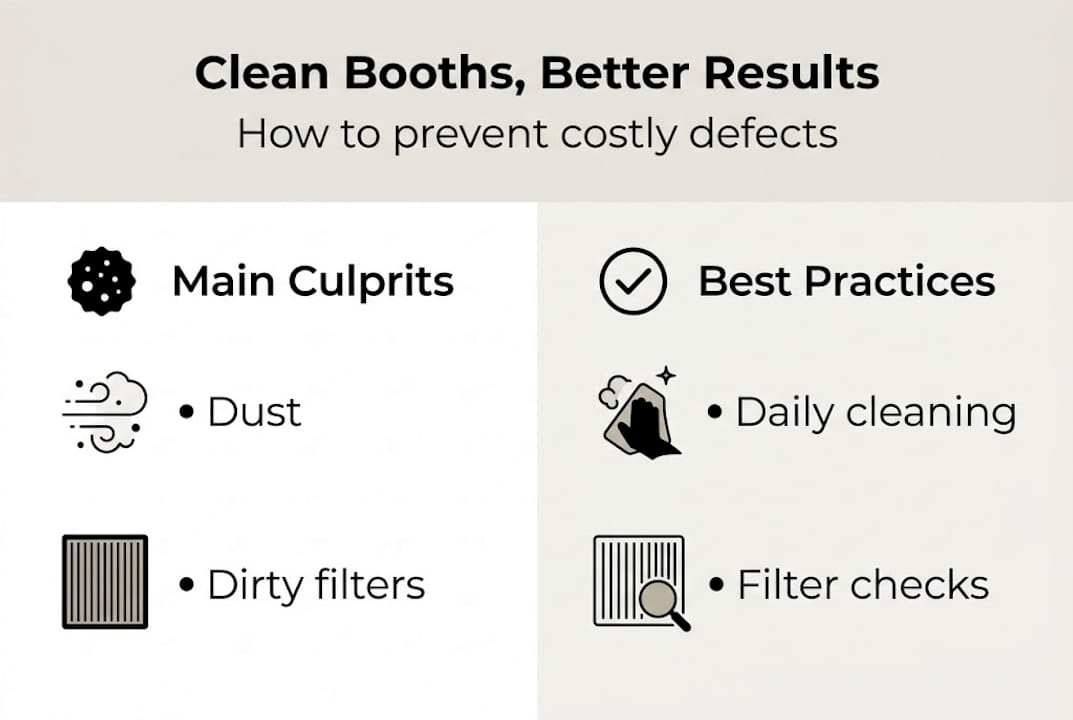
- How contamination happens: Main culprits and failure points
- Proven strategies for spotless booths and flawless paint
- Smart dust control: When are clean booths truly essential?
- A facility leader’s view: Clean booths are an investment, not a cost
- Next steps: Advanced booth solutions for your facility
- Frequently asked questions
Key Takeaways
| Point | Details |
|---|---|
| Booth cleanliness saves money | Clean paint booths significantly reduce costly rework and production loss. |
| Prevention beats correction | Routine filter changes and cleaning prevent most dust problems before they start. |
| Tech and process both matter | Combining proper technology with disciplined workflows yields the best results. |
| Static control is critical | Managing humidity and static electricity helps minimize dust in modern booths. |
Why clean booths matter: The cost of overlooking dust
Most shop owners treat booth cleaning as a routine task rather than a financial priority. That mindset is expensive. When you factor in wasted paint, labor for redos, extended job times, and customer dissatisfaction, a single contamination event can wipe out the margin on an entire job.
The scale of the problem may surprise you. According to industry data, 40% of paint defects are traced directly to dirty booths, costing large manufacturing plants between $50,000 and $150,000 every single day. For collision shops, the numbers are smaller but still striking: shops lose over $100,000 annually from dirt-related redos alone.
| Setting | Annual loss from contamination | Primary driver |
|---|---|---|
| Large auto plant | $18M–$55M+ | Defect-driven downtime |
| Mid-size paint facility | $500K–$2M | Rework and material waste |
| Collision/body shop | $100K+ | Dirt in paint, redo labor |
Beyond hard costs, there is a productivity drain that rarely shows up on a spreadsheet. Technicians spend time sanding, repainting, and re-clearing vehicles that should have been finished in one cycle. That backlog delays other jobs, compresses scheduling, and pushes overtime costs higher.
The most common contamination sources break down like this:
- Clogged or degraded intake/exhaust filters that let unfiltered air into the booth
- Inadequate surface cleaning between jobs, leaving sanding dust and debris behind
- Worn or damaged door seals that allow outside air to bypass filtration
- Residue buildup on booth walls and floors that gets disturbed by airflow during painting
- Improperly prepared vehicles entering the booth with surface contaminants
Understanding the paint booth contamination impact on finished quality is the first step toward stopping the cycle. Every dollar spent preventing contamination saves several more in rework, materials, and lost billable time.
How contamination happens: Main culprits and failure points
Even well-managed shops experience contamination because the entry points are surprisingly easy to miss. Dust does not just fall from the ceiling. It travels, settles, circulates, and gets trapped in the airstream right when fresh paint is most vulnerable.
Here is how contamination typically works its way into a booth environment:
- Airborne particles enter through degraded filters. Intake filters that are overdue for replacement allow fine particles to pass directly into the booth’s airstream.
- Residue from booth surfaces becomes airborne. Old overspray on walls, ceilings, and floors gets disturbed by high-velocity airflow during the spraying phase.
- Personnel carry in contamination. Technicians wearing clothing or footwear with loose fibers or debris introduce particles every time they enter the booth.
- Static on painted surfaces attracts dust. Freshly applied paint carries electrostatic charge that actively pulls nearby particles onto the surface before it cures.
- Adjacent shop activity creates secondary contamination. Grinding, sanding, or prep work happening nearby can push dust through any gap in the booth’s sealing.
“Top contamination sources: dirty filters, inadequate maintenance, and lack of proper cleaning are responsible for the majority of paint defects in spray booths.”
The overlooked factor here is human behavior. Shortcuts are common, especially in busy shops. A technician might skip a full wipe-down between jobs, or a filter change gets postponed because the schedule is tight. Over time, these small decisions compound into a significant contamination problem.
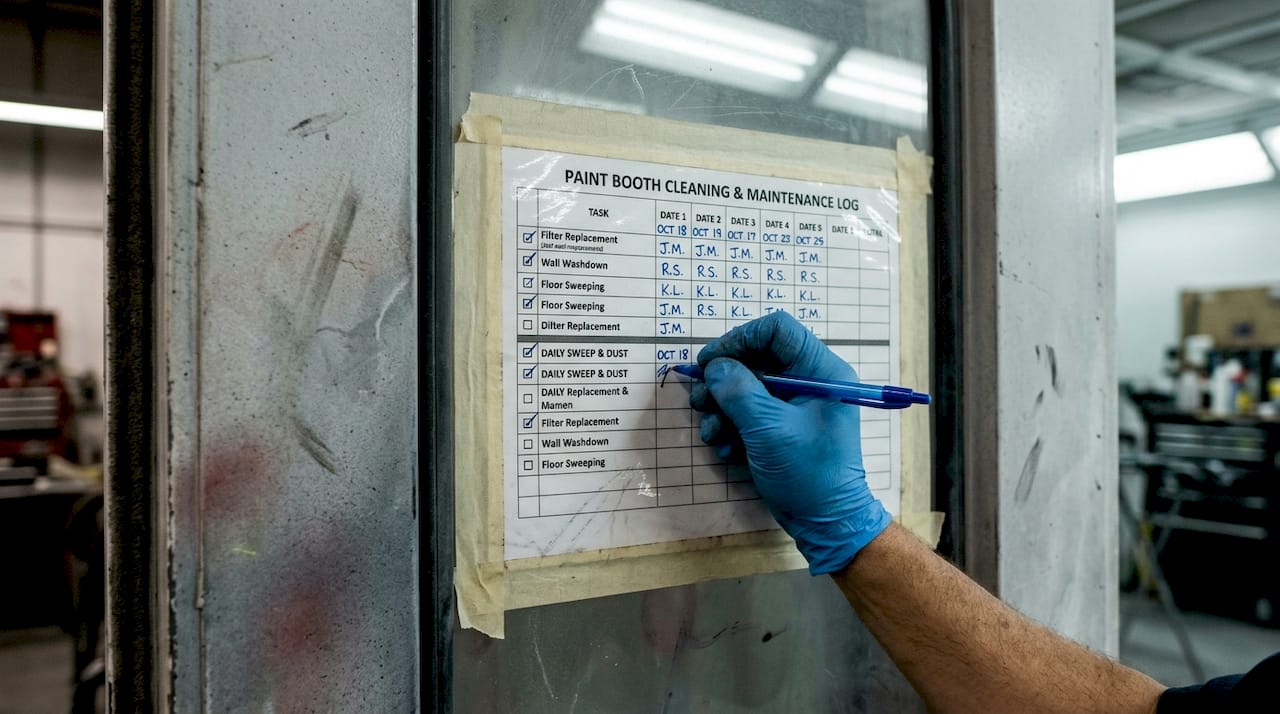
Effective paint booth contamination prevention depends on consistency, not just on having the right equipment. A well-documented cleaning log holds the team accountable across shifts and prevents the drift that happens when maintenance is treated as optional.
For a deeper look at what actually works on the floor, reviewing practical paint booth dust control methods helps managers prioritize the right interventions for their facility size and paint volume.
Pro Tip: Create a physical cleaning schedule posted inside the booth with sign-off fields for each task. When every technician initials each completed step, accountability becomes part of the culture rather than an afterthought.
Proven strategies for spotless booths and flawless paint
Knowing where contamination comes from is only half the battle. The real question is what you do about it systematically. The best facilities combine technology, workflow discipline, and protective materials to stay consistently clean.
| Method | Cost level | Effectiveness | Best for |
|---|---|---|---|
| Manual cleaning only | Low | Moderate | Small shops, low volume |
| Protective prep films | Low to medium | High | Any shop size |
| Full booth automation | High | Very high | High-volume facilities |
Protective films for booth walls and floors are one of the most cost-effective upgrades available. They capture overspray and surface debris before it can become airborne again, and multi-layer systems let you peel and refresh the surface without scrubbing. Reviewing a detailed booth maintenance guide can help you build the right maintenance cycle for your volume.
For daily, weekly, and monthly tasks, a structured approach prevents the gaps that lead to contamination events:
- Daily: Wipe down all surfaces with a tack cloth, inspect door seals, check filter pressure differential
- Weekly: Full floor and wall inspection, clean light fixtures, check airflow balance and intake velocity
- Monthly: Replace or deep-clean filters based on usage, inspect all seals and gaskets, test booth pressure and airflow patterns
Static electricity is a major but underappreciated contributor to dust attraction on freshly painted surfaces. Ionization and grounding significantly reduce paint defects by neutralizing the charge that pulls dust particles onto wet paint. Humidity control plays a supporting role, keeping static buildup lower during dry seasons.
Pro Tip: Invest in a handheld ionization bar and use it on vehicle surfaces immediately before spraying. This takes under two minutes and can cut particle attraction by a measurable margin on high-gloss jobs.
Building a dust-free booth workflow with documented steps for each phase, from vehicle entry to flash cure, removes the variability that leads to inconsistent results across different technicians.
Smart dust control: When are clean booths truly essential?
Not every facility has the same needs. Some shop owners, particularly those running lower-volume operations, question whether the full investment in dedicated dust-control infrastructure is always necessary. It is a fair debate worth addressing honestly.
The reality is nuanced. Some small shops can succeed with excellent prep practices and HVLP (high-volume, low-pressure) spray equipment without a full enclosed booth, but this approach has real limits. The scenarios where skipping a controlled booth environment creates significant risk include:
- Color match jobs where even a single particle under clear coat is visible and unacceptable
- High-value vehicles where a redo could eliminate all profit and damage reputation
- Regulatory compliance work where documented air quality and emissions controls are required
- Metallic and pearl finishes that are extremely sensitive to any mid-application contamination
- High-volume operations where one contamination event triggers a backlog affecting multiple customers
“Facilities that invest in dedicated dust-control environments see more consistent outcomes, fewer rework cycles, and stronger customer retention than shops relying on prep alone.”
For smaller operations, the decision framework is straightforward. If you regularly handle high-end paint jobs, color-critical repairs, or work on vehicles where the customer expects a factory-level finish, the cost of a controlled booth environment pays for itself in avoided redos. If you primarily handle basic fleet work or industrial applications where cosmetic perfection is secondary, a simplified approach with strong prep discipline may be sufficient.
Managing static electricity in booths is one area where even simplified setups benefit from targeted investment. Static control tools are affordable and portable, making them practical for shops at every scale. The data on dust-free booths impact on defect rates makes a compelling case for any facility that competes on quality.
A facility leader’s view: Clean booths are an investment, not a cost
After years of working with auto body shops and industrial painting facilities, one pattern stands out clearly: the shops that treat booth cleanliness as a line-item cost to minimize are the same shops that consistently struggle with margin and customer retention.
The counterintuitive truth is that clean booths generate revenue. Every redo you avoid is a job you can deliver on time and at full margin. Every customer who receives a flawless finish comes back and refers others. The math is straightforward once you start tracking it.
Most facility managers never quantify their rework costs with precision. They absorb the losses as part of doing business without connecting them directly to booth condition. When you start logging rework events, tracking their cause, and calculating the true cost per incident, the case for booth investment becomes impossible to ignore.
A culture of accountability, where every team member takes ownership of booth condition, outperforms any checklist. Checklists get skipped. Culture does not. When your team understands that a clean booth directly connects to their productivity and the shop’s ability to take on more work, behavior shifts. The investment in tools like boost paint quality resources pays dividends that show up in fewer redos and faster cycle times.
Pro Tip: Start tracking your rework events in a simple spreadsheet for 90 days. Log the cause, the time spent, and the materials used. The total will almost certainly justify your next booth improvement.
Next steps: Advanced booth solutions for your facility
You now have a clear picture of what clean booths are worth and what it takes to maintain them consistently. The next step is matching your facility’s specific challenges with solutions designed for professional-grade results.

At Dust Free Film, we have built our product line around the real problems that facility managers face every day: overspray buildup, recurring contamination, and the time cost of manual cleaning. Our multi-layer protective films for booth walls and floors are engineered to make maintenance faster and results more consistent. Whether you are managing a single booth or a multi-line industrial facility, explore the full range of Dust Free Film solutions or request a quote to find the right fit for your operation.
Frequently asked questions
How much does a dirty paint booth really cost per month?
A dirty booth can cost between $8,000 and $12,500 per month in paint, materials, and lost productivity. Annualized, dirty booths drive losses exceeding $112,000 in redos and downtime for many collision shops.
What are the top causes of booth contamination?
The primary causes are dirty filters, insufficient routine cleaning, and poor overall maintenance practices. Dirty filters and neglected maintenance account for the largest share of contamination events in active spray facilities.
Is a professional booth always required for dust-free results?
A dedicated booth delivers the most consistent results, but small shops with rigorous prep and quality HVLP equipment can sometimes manage dust control effectively. Small shops with good prep can succeed, though a proper booth adds reliability for color-critical work.
How can static electricity affect paint booth cleanliness?
Static charge on freshly painted surfaces actively attracts airborne dust particles before the paint cures. Controlling humidity and using ionization or grounding equipment measurably reduces dust-related defects in spray environments.