

A single dust particle measuring just 10 microns can cause visible defects in automotive paint finishes, forcing costly rework or complete part rejection. Dust contamination increases paint defects leading to higher waste, elevated energy consumption, and significant environmental impact across manufacturing operations. Dust-free booths address these challenges by creating controlled environments that reduce contamination, improve paint quality, and deliver measurable environmental and operational benefits. This guide explains how implementing dust-free booth systems transforms facility performance while supporting sustainability goals.
Table of Contents
- Key takeaways
- How dust contamination impacts the environment and operations
- Environmental advantages of implementing dust-free booths
- Operational efficiencies gained through dust-free booth systems
- Choosing and implementing dust-free booths for your facility
- Explore dust-free film solutions to protect your spray booth
- Frequently asked questions
Key Takeaways
| Point | Details |
|---|---|
| Dust free defect reduction | Dust free booths dramatically reduce paint defects by controlling contamination at the source, improving first pass quality and reducing waste. |
| Environmental savings | Implementing dust free booths lowers emissions, reduces energy use, and minimizes waste generation across production. |
| Worker health benefits | Improved air quality from dust control reduces respiratory irritation and supports higher productivity. |
| Regulatory compliance | Dust free systems align with environmental regulations and sustainability goals by limiting contaminant release. |
How dust contamination impacts the environment and operations
Airborne dust particles infiltrate spray booth environments through multiple pathways including facility air intake systems, open doors during part loading, and worker clothing. These contaminants settle on wet paint surfaces, creating orange peel texture, fisheyes, and embedded particles that compromise finish quality. When defects occur, facilities face three costly options: accept substandard quality, invest labor and materials in rework, or scrap the part entirely. Each outcome generates waste and consumes additional resources.
The environmental footprint extends beyond visible defects. Contaminated parts require respraying, doubling paint material consumption and solvent use. Additional drying cycles increase energy demands as HVAC systems work harder to maintain temperature and humidity specifications. Facilities operating without effective dust control report defect rates between 15% and 30%, meaning nearly one in four painted parts requires corrective action. This inefficiency multiplies resource consumption across high-volume manufacturing operations.
Poor air quality affects more than finished products. Workers exposed to airborne particulates experience respiratory irritation, reduced concentration, and decreased productivity. Dust accumulation on booth surfaces creates ongoing contamination sources that require frequent cleaning, generating additional waste streams and consuming cleaning chemicals. The cumulative effect strains operational budgets while increasing environmental impact through elevated emissions, waste generation, and resource depletion.
Facilities implementing dust-free booths cut paint defects dramatically by controlling contamination at the source:
- Advanced filtration systems capture particles before they enter the spray environment
- Positive pressure airflow prevents external contaminants from infiltrating booth spaces
- Sealed booth construction eliminates dust entry points around doors and access panels
- Regular filter maintenance sustains air quality throughout production cycles
“Manufacturing facilities that adopt comprehensive dust control strategies achieve defect reduction rates exceeding 90%, transforming both environmental performance and bottom-line profitability through decreased waste and improved first-pass quality.”
The financial implications mirror environmental costs. A mid-size automotive refinishing operation processing 200 parts weekly can waste over $75,000 annually in materials, labor, and energy from dust-related defects. Scaling these losses across industrial painting sectors reveals billions in preventable waste. Addressing contamination through dust-free booth systems delivers immediate returns while supporting broader sustainability objectives.
Environmental advantages of implementing dust-free booths
Dust-free booth systems deliver measurable environmental benefits by reducing emissions, conserving energy, and minimizing waste generation. Advanced filtration technology captures particulate matter before it escapes facility exhaust systems, lowering airborne emissions that contribute to air quality degradation. High-efficiency particulate air filters remove 99.97% of particles measuring 0.3 microns or larger, preventing dust from entering surrounding environments. This filtration capacity helps manufacturing plants comply with standards set by environmental agencies.
Energy consumption decreases significantly when dust-free booths maintain optimal airflow. Clean filters and sealed booth construction reduce HVAC system workload, cutting electricity use for heating, cooling, and air circulation. Facilities report energy savings between 20% and 35% after implementing comprehensive dust control measures. Lower energy consumption directly reduces carbon emissions associated with electricity generation, supporting corporate sustainability commitments and reducing operational carbon footprints.
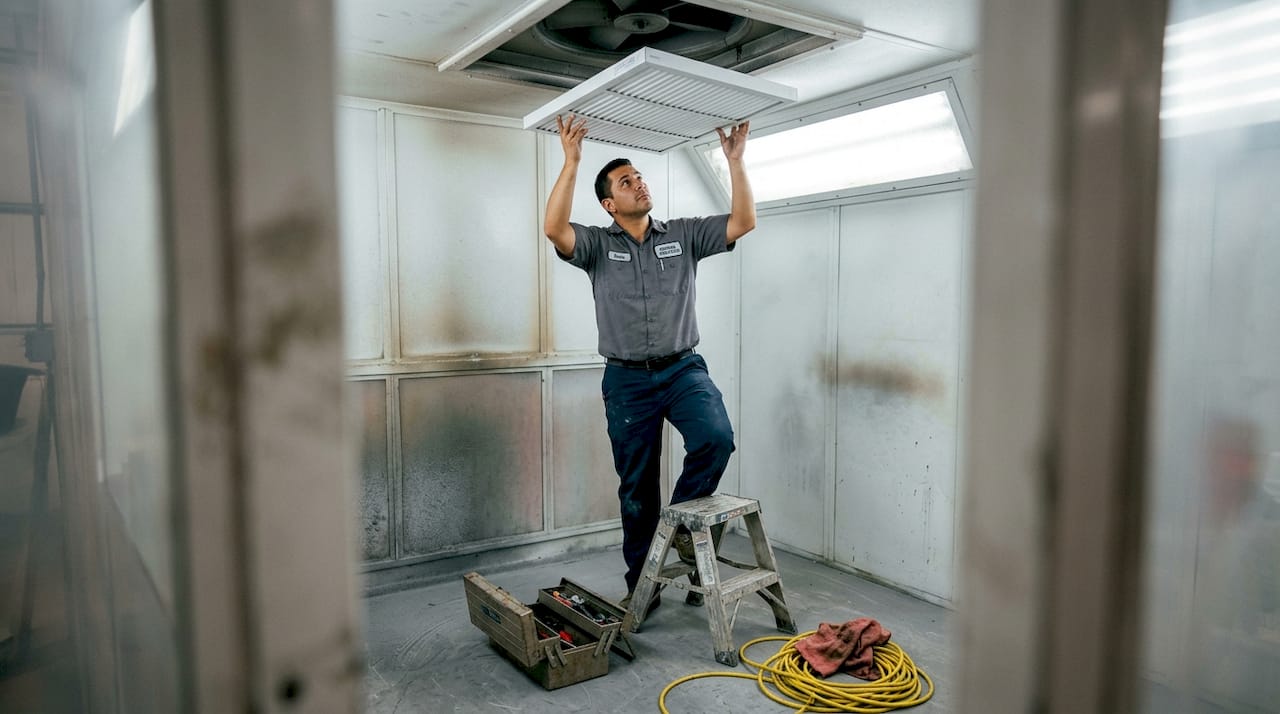
Improved first-pass quality rates minimize material waste across the production cycle. When parts receive acceptable finishes on initial application, facilities avoid the environmental costs of rework including additional paint, solvents, and cleaning agents. Reduced waste generation lowers disposal costs and decreases the environmental burden of hazardous material handling. Facilities operating dust-free booths report waste reduction rates exceeding 60% compared to conventional spray environments.
| Metric | Before Dust-Free Booth | After Dust-Free Booth | Improvement |
|---|---|---|---|
| Monthly energy use (kWh) | 18,500 | 12,400 | 33% reduction |
| Paint waste (gallons/month) | 85 | 32 | 62% reduction |
| Defect rate (%) | 22% | 2% | 91% reduction |
| Filter replacement frequency | Every 2 weeks | Every 8 weeks | 75% reduction |
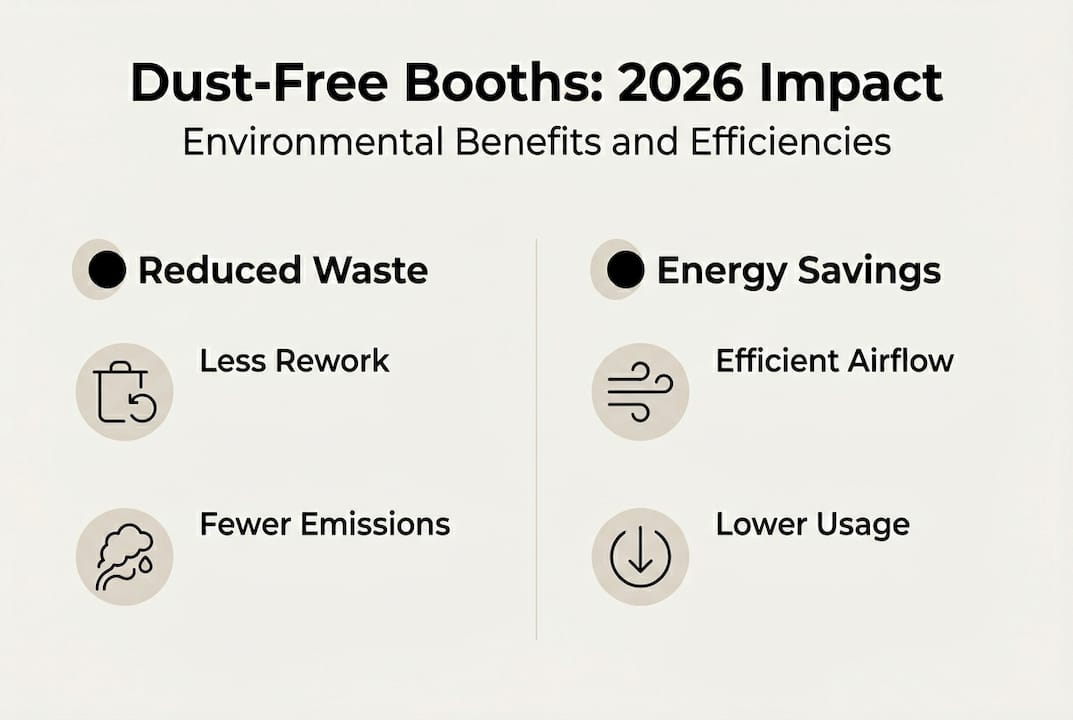
Compliance with environmental regulations becomes more manageable when facilities implement dust-free booth systems. Many jurisdictions enforce strict limits on volatile organic compound emissions, particulate matter release, and hazardous waste generation. Spray booth maintenance workflows that prioritize dust control help facilities meet these requirements while avoiding penalties and maintaining operating permits.
To maximize environmental benefits from dust control implementation, follow these essential steps:
- Conduct baseline measurements of current defect rates, energy consumption, and waste generation to establish improvement benchmarks
- Install high-efficiency filtration systems rated for your specific particulate challenges and booth volume requirements
- Seal all booth penetrations including doors, windows, and utility access points to prevent contamination infiltration
- Implement positive pressure airflow systems that maintain clean air circulation throughout spray operations
- Establish routine filter inspection and replacement schedules based on pressure differential monitoring
- Train staff on proper booth entry procedures to minimize dust introduction from clothing and equipment
- Document environmental performance improvements to support sustainability reporting and regulatory compliance
Pro Tip: Schedule filter inspections every 40 operating hours rather than relying solely on manufacturer recommendations. Actual particulate loads vary significantly based on facility conditions, and proactive replacement prevents efficiency losses that increase energy consumption and compromise air quality.
The cumulative environmental advantages extend beyond individual facilities. Industry-wide adoption of dust-free booth technology could prevent millions of gallons of paint waste annually while reducing energy consumption equivalent to powering thousands of homes. These systems represent practical investments that align operational improvements with environmental responsibility, delivering benefits that satisfy both business objectives and sustainability commitments.
Operational efficiencies gained through dust-free booth systems
Cleaner air quality transforms worker conditions inside spray booth environments. Reduced exposure to airborne particulates decreases respiratory irritation, eye discomfort, and skin contact with contaminants. Workers report improved comfort levels and sustained concentration throughout shifts when operating in dust-free environments. Better working conditions contribute to lower absenteeism, reduced workers’ compensation claims, and improved employee retention in competitive labor markets.
Eliminating defects cuts production downtime dramatically. When parts pass quality inspection on first application, facilities avoid the time-consuming rework cycle that disrupts production schedules. A typical automotive refinishing operation spends 3 to 5 hours per defective part on preparation, respraying, and curing. Multiplied across dozens of weekly defects, this downtime represents substantial lost productivity. Dust-free booths enable consistent throughput by maintaining quality standards that keep production lines moving efficiently.
Material costs decrease when air quality improves finish quality consistently. Facilities using dust-free booth systems report 40% to 60% reductions in paint consumption because parts rarely require additional coats to correct defects. Solvent use drops proportionally as cleaning and preparation steps become less frequent. These savings compound monthly, generating substantial cost reductions that improve profit margins while supporting environmental goals.
Operational benefits from dust-free booth implementation include:
- Predictable production schedules with fewer interruptions for defect correction
- Lower insurance premiums resulting from improved workplace safety records
- Enhanced reputation for quality that attracts premium customers and contracts
- Reduced equipment maintenance costs as cleaner environments extend component life
- Simplified quality control processes with higher first-pass acceptance rates
- Decreased inventory carrying costs for replacement parts and rework materials
Workflow reliability improves when facilities eliminate contamination variables. Production managers can forecast completion times accurately, schedule customer deliveries confidently, and optimize labor allocation without accounting for unpredictable rework demands. This operational predictability enhances customer satisfaction while reducing stress on production teams managing tight deadlines.
The financial return on dust-free booth investment typically materializes within 12 to 18 months through combined savings in materials, labor, energy, and waste disposal. Facilities processing high part volumes see even faster payback periods as efficiency gains multiply across production cycles. Beyond direct cost savings, improved quality metrics strengthen competitive positioning in markets where finish excellence differentiates premium service providers.
Pro Tip: Invest in comprehensive staff training covering proper booth entry procedures, filter monitoring techniques, and contamination prevention protocols. Even the most advanced dust-free booth system performs poorly when operators introduce contaminants through improper practices. Quarterly refresher sessions maintain awareness and reinforce best practices across all shifts.
Sustainability reporting benefits from the measurable improvements dust-free booths deliver. Facilities can document specific reductions in waste generation, energy consumption, and emissions for corporate social responsibility disclosures. These metrics satisfy increasingly stringent stakeholder expectations while supporting certifications like ISO 14001 environmental management standards. Operational efficiency and environmental performance become mutually reinforcing outcomes rather than competing priorities.
Choosing and implementing dust-free booths for your facility
Selecting appropriate dust-free booth systems requires evaluating facility-specific requirements including production volume, part sizes, coating types, and available space. Different booth configurations offer distinct advantages depending on operational priorities and budget constraints. Understanding these options helps facilities make informed decisions that deliver optimal environmental and operational returns.
| Booth Type | Key Features | Best For | Environmental Advantage |
|---|---|---|---|
| Downdraft | Airflow from ceiling to floor, superior particle removal | High-volume automotive refinishing | Lowest particulate emissions |
| Semi-downdraft | Angled airflow, balanced performance and cost | Mid-size industrial operations | Good filtration with moderate energy use |
| Side-draft | Horizontal airflow, compact footprint | Space-constrained facilities | Efficient air circulation in smaller areas |
| Cross-draft | Simple design, lower initial investment | Budget-conscious operations | Basic filtration for light contamination |
Implementing dust-free booth systems successfully requires systematic planning and execution. Follow these essential steps to maximize environmental and operational benefits:
- Assess current contamination sources by conducting a facility audit identifying dust entry points, air quality issues, and defect patterns
- Calculate return on investment by quantifying current waste costs, rework expenses, and energy consumption for comparison against dust-free booth operating costs
- Select booth configuration matching production requirements, space constraints, and budget parameters while prioritizing filtration efficiency
- Prepare installation site by sealing floor cracks, repairing wall penetrations, and upgrading electrical systems to support new equipment
- Install booth components following manufacturer specifications with attention to proper sealing, filter positioning, and airflow verification
- Commission the system through comprehensive testing of pressure differentials, airflow patterns, and filtration effectiveness before production use
- Train all operators on proper booth use, maintenance requirements, and contamination prevention protocols through hands-on demonstrations
- Establish maintenance schedules covering filter inspections, seal checks, and cleaning procedures to sustain long-term performance
Cost considerations extend beyond initial equipment purchase. Factor in installation expenses, electrical upgrades, ongoing filter replacements, and energy consumption when evaluating total ownership costs. However, these investments typically generate positive returns through reduced waste, lower rework costs, and decreased energy consumption. Facilities should request detailed operating cost projections from vendors to support accurate financial planning.
Pro Tip: Partner with experienced vendors who provide comprehensive support including industrial spray booth setup guidance, installation assistance, and ongoing maintenance training. Consider using protective films on booth walls and floors to maintain cleanliness between deep cleaning cycles, extending component life while simplifying routine maintenance.
Ongoing maintenance determines whether dust-free booths deliver sustained environmental benefits. Establish clear responsibilities for daily inspections, weekly filter checks, and monthly deep cleaning procedures. Document maintenance activities to identify patterns, optimize schedules, and demonstrate regulatory compliance. Facilities that treat maintenance as a strategic priority rather than a reactive task achieve superior long-term performance from their dust control investments.
Integration with existing production workflows requires careful planning to minimize disruption. Schedule installation during planned downtime, train staff before going live, and phase in new procedures gradually to allow adjustment periods. Early involvement of production teams in planning and implementation builds buy-in and ensures practical considerations inform decision making. Successful integration transforms dust-free booths from isolated equipment into core components of efficient, environmentally responsible manufacturing operations.
Explore dust-free film solutions to protect your spray booth
Maintaining dust-free booth integrity requires more than advanced filtration systems. Protective films for booth walls and floors provide an additional contamination barrier that extends equipment life while simplifying maintenance. Dust Free Film specializes in spray booth protection solutions designed specifically for automotive refinishing and industrial painting environments.
Our multi-layer electrostatic films adhere securely to booth surfaces, creating smooth, cleanable barriers that prevent dust accumulation in cracks and crevices. The patented application system enables quick, bubble-free installation that minimizes downtime during booth preparation. Heat-resistant and static-free properties ensure films perform reliably in high-temperature spray environments without interfering with coating processes.

Using protective films reduces the frequency of intensive booth cleaning, cutting chemical consumption and waste generation. When films become contaminated, simply remove and replace them rather than scrubbing booth surfaces with harsh cleaning agents. This approach lowers maintenance costs while supporting environmental objectives through reduced chemical use and simplified waste management. Request a quote to explore customized film solutions for your facility’s specific booth configuration and production requirements.
Frequently asked questions
What are the primary environmental benefits of dust-free booths?
Dust-free booths reduce particulate emissions by up to 99.97% through high-efficiency filtration, preventing airborne contaminants from entering surrounding environments. They also minimize paint waste by cutting defect rates, reducing the environmental burden of hazardous material disposal and solvent consumption.
How do dust-free booths improve energy efficiency?
Clean filtration systems and sealed booth construction reduce HVAC workload, lowering electricity consumption for heating, cooling, and air circulation by 20% to 35%. This decreased energy use directly reduces carbon emissions associated with facility operations while cutting utility costs.
Can dust-free booths help facilities meet environmental regulations?
Yes, dust-free booth systems help manufacturing plants comply with strict limits on volatile organic compound emissions, particulate matter release, and hazardous waste generation. Improved air quality and reduced emissions simplify regulatory compliance while avoiding penalties.
What operational efficiencies result from implementing dust-free booths?
Facilities experience fewer defects requiring rework, reducing production downtime by 40% to 60%. Improved air quality enhances worker health and comfort, while predictable quality outcomes enable more accurate production scheduling and resource allocation.
How long does it take to see return on investment from dust-free booths?
Most facilities achieve positive ROI within 12 to 18 months through combined savings in materials, labor, energy, and waste disposal. High-volume operations often see faster payback periods as efficiency gains multiply across production cycles.
What maintenance is required to sustain dust-free booth performance?
Establish routine filter inspections every 40 operating hours, replace filters based on pressure differential monitoring, and conduct monthly deep cleaning of booth surfaces. Proper maintenance ensures sustained environmental benefits and optimal operational performance over the system’s lifespan.