

Even with premium paint, a skilled technician, and a well-maintained gun, a single environmental misstep can ruin a finish before it cures. Dust contamination remains one of the most persistent quality problems in spray booths, and the culprits are often invisible: airflow patterns, humidity swings, temperature drift, and filter pressure drops. Laminar airflow prevents dust contamination and reduces defects, yet many operators focus on technique while overlooking the environment around the vehicle. This guide breaks down every major environmental factor, explains how each one affects your results, and gives you practical steps to control them.
Table of Contents
- Why environmental factors matter in spray painting
- Airflow: Laminar vs. turbulent and their impact on dust control
- Filtration: Types, efficiency, and maintenance essentials
- Managing temperature and humidity for flawless paint results
- Implementing environmental controls: Practical workflows
- Protecting your spray booth: Next steps with Dust Free Film
- Frequently asked questions
Key Takeaways
| Point | Details |
|---|---|
| Laminar airflow is essential | Consistent laminar flow and positive pressure keep dust out and minimize paint defects. |
| Multi-stage filtration prevents contamination | High-efficiency pre-filter, ceiling, and floor filters are crucial for dust-free paint quality. |
| Humidity and temperature affect results | Maintaining ideal booth climate prevents static, curing delays, and dust settling. |
| Routine maintenance prevents costly rework | Daily checks and regular filter changes keep operations efficient and compliant. |
| Integrated solutions simplify dust control | Dust Free Film and advanced controls provide continual protection for optimal outcomes. |
Why environmental factors matter in spray painting
Dust contamination does not just look bad. It creates nibs, fisheyes, and surface defects that require sanding, repriming, and respraying, adding hours of rework to every job. The financial impact compounds fast when you factor in labor, materials, and delayed vehicle turnaround. Understanding [clean spray booth benefits](https://www.dustfreefilm.com/blog/why-maintain-clean spray-booths-for-superior-results/) is the first step toward reducing those costs.
The environment inside a spray booth is shaped by three interlocking forces: airflow, humidity, and temperature. Each one influences the others. A temperature spike can lower relative humidity, which increases static buildup, which attracts more dust to freshly sprayed surfaces. Laminar airflow sweeps overspray, prevents dust contamination, and reduces defects, but only when the system is working correctly.
Operator movement and prep work are also major contamination sources that get underestimated. Walking through a booth stirs settled particles. Sanding a panel nearby without proper containment sends abrasive dust into the air column. Energy costs and regulatory compliance add further pressure, since a poorly controlled environment often means higher fan loads and failed inspections.
Key insight: Most paint defects traced back to “technique” are actually environmental. Fix the booth conditions first, then evaluate the application.
- Dust nibs and fisheyes from airborne particles
- Blushing and slow cure from humidity extremes
- Orange peel and poor flow from temperature swings
- Rework costs from uncontrolled contamination sources
- Compliance risk from inadequate filtration or ventilation
Airflow: Laminar vs. turbulent and their impact on dust control
Airflow is the single most powerful environmental variable in a spray booth. When it works correctly, it carries overspray and airborne particles down and out of the booth before they can settle on a wet surface. When it fails, those same particles recirculate and land exactly where you do not want them.
Laminar airflow prevents dust contamination; turbulent airflow creates eddies that redeposit dust onto surfaces. The industry standard for downdraft laminar flow is 0.25 to 0.30 meters per second across the entire booth cross-section. Drop below that range and particles lose their downward momentum. Exceed it significantly and you risk disturbing wet paint.
Positive pressure and downdraft airflow prevent external dust from entering through gaps, seams, and door edges. Most well-designed booths maintain 10 to 80 Pascals of positive pressure relative to the surrounding shop floor. That pressure differential acts as an invisible barrier, pushing contaminated shop air away from the booth interior.
| Airflow type | Dust behavior | Paint quality impact |
|---|---|---|
| Laminar (0.25–0.30 m/s) | Particles carried downward and out | Consistent, defect-free finish |
| Turbulent (clogged filters) | Eddies redeposit particles on surfaces | Nibs, fisheyes, rework required |
| Insufficient pressure | External dust enters through gaps | Random contamination, unpredictable defects |
Pro Tip: Check your magnehelic gauge before every spray cycle. A reading outside your baseline range is an early warning that filters are loading up or a seal has failed, long before you see defects in the paint.
Building a reliable [dust-free workflow](https://www.dustfreefilm.com/blog/master-dust-free-spray-booth workflow-for-flawless-results/) starts with verifying airflow velocity and pressure at the start of each shift. Pair that with consistent booth preparation steps and you eliminate the two most common sources of contamination before the gun ever fires.
Filtration: Types, efficiency, and maintenance essentials
Filtration is what makes laminar airflow possible. Without clean, properly rated filters, even a well-designed booth degrades into a turbulent, contaminated environment. Multi-stage filtration using pre-filters, ceiling filters, and floor filters is essential, and clogged filters cause pressure loss and contaminant ingress.
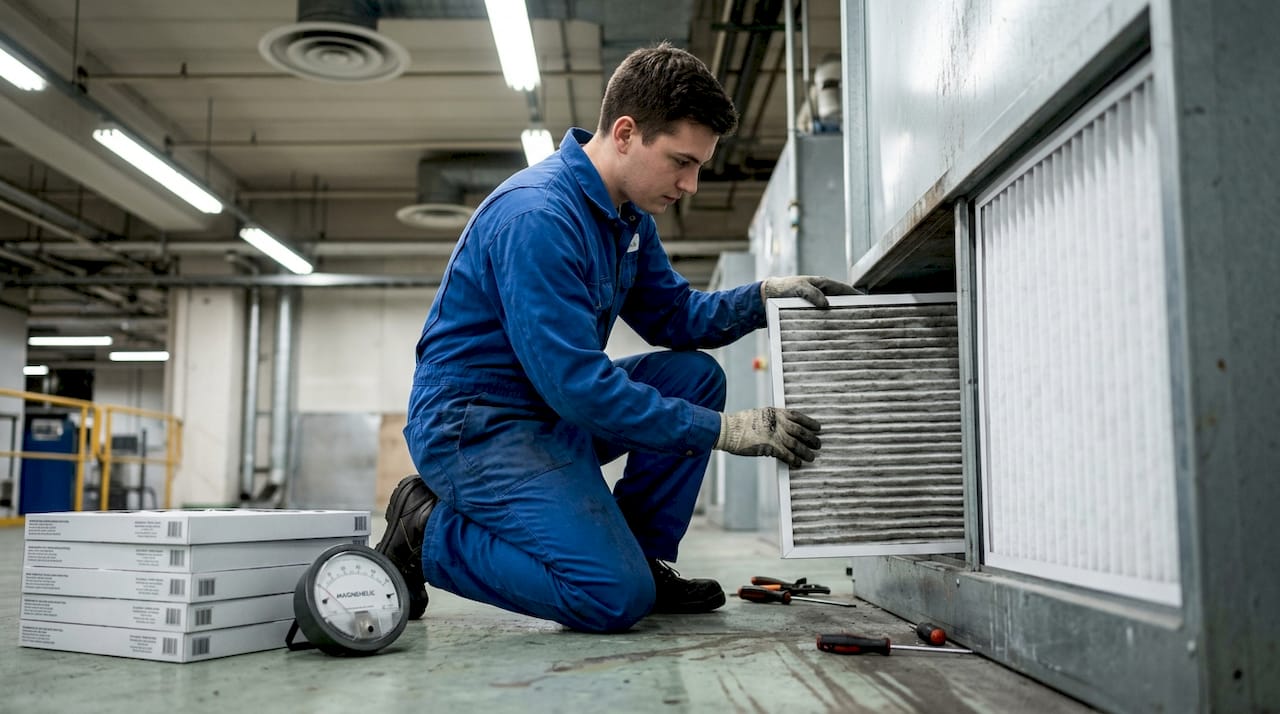
Pre-filters catch large particles before they reach the ceiling filter bank, extending the life of the more expensive primary filters. Ceiling filters distribute incoming air evenly across the booth cross-section, which is what creates laminar flow. Floor filters capture overspray and fine particles on the exhaust side. Each stage has a specific efficiency rating, and letting any one of them degrade affects the entire system.
| Filter stage | Typical efficiency | Replacement indicator |
|---|---|---|
| Pre-filter | 30–50% arrestance | Visual inspection, monthly |
| Ceiling filter | 85–95% efficiency | Magnehelic gauge reading |
| Floor/exhaust filter | 95–98% efficiency | Pressure drop or visual saturation |
EPA requires 98% particulate capture filters in regulated spray booth operations. OSHA and NFPA mandate continuous ventilation and prohibit recirculation of booth air. These are not suggestions. Failing an inspection means downtime, fines, and potential shutdown.
Common pitfalls include waiting until filters are visibly saturated before changing them, and ignoring slow pressure drops that indicate gradual clogging. Industrial filtration value extends beyond paint quality to worker health and facility safety. Use magnehelic gauges daily and set a change schedule based on your production volume, not just the calendar.
- Monitor pre-filters weekly in high-volume shops
- Replace ceiling filters when gauge readings shift 10% from baseline
- Log every filter change with date and gauge reading for compliance records
- Never bypass a filter stage to compensate for a pressure drop
For practical dust reduction tips that complement your filtration system, and for a full [maintenance for dust-free results](https://www.dustfreefilm.com/blog/spray booth maintenance ensuring dust free results/) routine, consistent filter management is the foundation everything else builds on.
Regulatory note: Document your filter change intervals and gauge readings. Inspectors look for records, not just hardware.
Managing temperature and humidity for flawless paint results
Temperature and humidity are the climate variables that most operators try to control but rarely monitor with enough precision. Get them wrong and you get blushing, slow cure, poor adhesion, or a static-charged surface that pulls dust like a magnet.
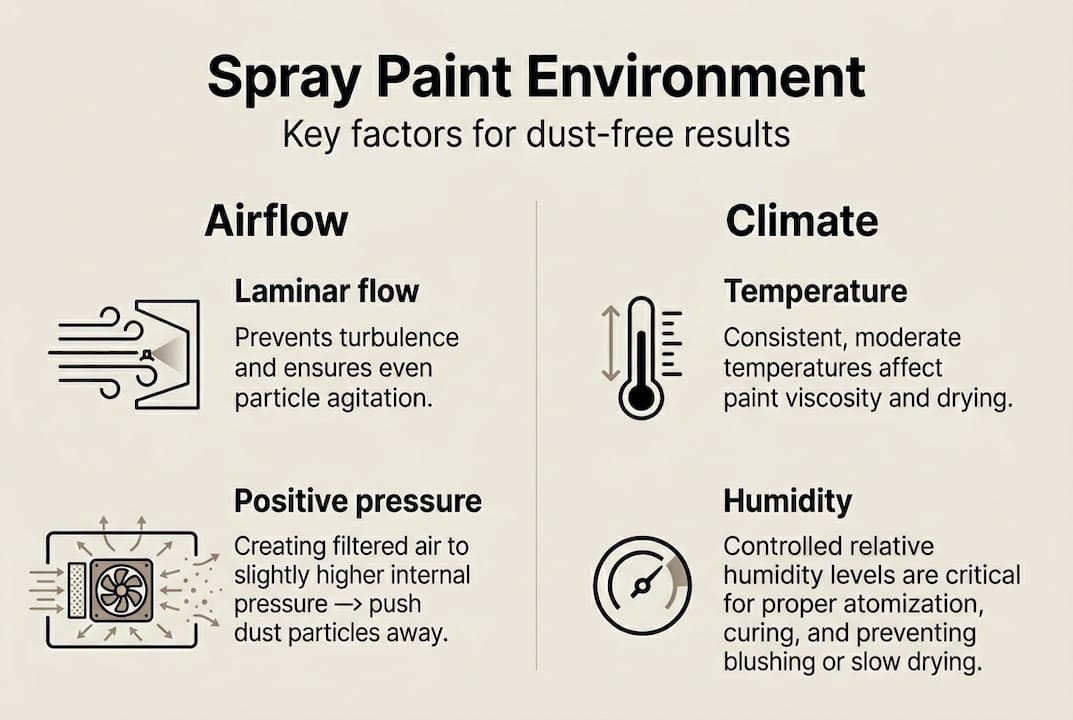
Optimal temperature and humidity ranges prevent static, blushing, slow dry, and ensure proper adhesion and curing. The target window for most automotive and industrial booths is 65 to 75 degrees Fahrenheit and 40 to 60 percent relative humidity. These are not arbitrary numbers. They reflect the conditions under which most solvent-borne and waterborne coatings are formulated to perform.
Low humidity increases static, which attracts dust to freshly sprayed surfaces. In dry climates or during winter heating season, relative humidity can drop well below 40%, turning your booth into a dust magnet even with perfect airflow. High humidity above 60% slows solvent evaporation, causes blushing in lacquers, and can trap moisture under waterborne basecoats.
- Install a calibrated digital hygrometer and thermometer inside the booth, not just in the mechanical room
- Set HVAC controls to maintain 68 to 72 degrees Fahrenheit as a stable operating target
- Use a humidifier or dehumidifier depending on your regional climate and season
- Check readings at the start of each shift and log them alongside your airflow data
- Adjust cure cycle times if temperature or humidity falls outside the target range
Pro Tip: Consistency matters more than hitting an exact number. A booth that holds 70 degrees Fahrenheit and 50% RH reliably will outperform one that swings between 65 and 80 degrees, even if the average looks acceptable on paper.
Pair your climate monitoring with a solid [maintenance checklist](https://www.dustfreefilm.com/blog/spray-booth maintenance checklist for superior results/) and follow [maintenance steps](https://www.dustfreefilm.com/blog/step-by-step spray booth maintenance guide-for-2026/) that account for seasonal climate shifts in your region.
Implementing environmental controls: Practical workflows
Knowing the right setpoints is only half the job. The other half is building daily habits that keep every environmental variable inside its target range, shift after shift, without relying on memory or guesswork.
Regular maintenance reduces rework by preventing defects from turbulent airflow and dust. That means scheduling filter checks, airflow verification, and climate monitoring as fixed tasks, not reactive responses to a bad job. Monitor magnehelic gauges daily for filter life to maintain positive pressure and laminar flow.
- Start of shift: Check magnehelic gauge readings, verify airflow velocity, confirm temperature and humidity are within range
- Before each spray cycle: Inspect booth walls and floor for dust accumulation, check door seals and gaskets
- Weekly: Inspect pre-filters visually, check for air leaks around panels and penetrations
- Monthly: Full filter audit, log pressure readings against baseline, review defect rate trends
- Quarterly: Calibrate sensors, inspect fan belts and motor mounts, review energy consumption data
Pro Tip: Track your defect rate per job alongside your environmental logs. When defect rates spike, cross-reference the data. You will almost always find a corresponding drop in airflow pressure or a humidity excursion that day.
- Seal all wall and floor penetrations with appropriate materials
- Use protective films on booth walls and floors to prevent dust buildup between full cleanings
- Brief every technician on contamination sources before they enter the booth
- Keep prep work and sanding operations physically separated from the spray area
A reliable [maintenance workflow](https://www.dustfreefilm.com/blog/spray booth maintenance workflow for dust free results/) and understanding the [benefits of regular maintenance](https://www.dustfreefilm.com/blog/7 key benefits of regular spray booth maintenance/) will help you build a system that catches problems before they become defects.
Protecting your spray booth: Next steps with Dust Free Film
Environmental control gives you the foundation, but physical dust protection on booth walls and floors is what locks in your results between cleanings and filter changes. Dust that settles on unprotected surfaces becomes airborne again the moment a technician walks through or a fan cycles on.
Dust Free Film solutions are engineered specifically for automotive and industrial spray booths, with multi-layer electrostatic films that trap dust on contact and peel away cleanly when saturated. The patented dispenser system makes installation fast and bubble-free, so your team spends time painting, not prepping. Whether you run a single-bay body shop or a high-volume industrial facility, the right film configuration reduces contamination, extends filter life, and cuts rework costs. Request a quote to find the configuration that fits your booth size, production volume, and budget.
Frequently asked questions
What are the minimum recommended airflow and pressure values for spray booth dust protection?
A downward laminar flow of 0.25 to 0.30 m/s and positive pressure between 10 and 80 Pascals are the accepted standards for effective dust control in automotive and industrial spray booths.
How often should spray booth filters be replaced to avoid dust contamination?
Filters should be monitored daily with magnehelic gauges, and clogged filters cause pressure loss and contaminant ingress, so replacement should happen whenever readings shift from baseline or efficiency drops below regulatory minimums.
What humidity and temperature settings ensure optimal paint adhesion and cure?
Maintain booth temperature between 65 and 75 degrees Fahrenheit and humidity between 40 and 60% RH. Optimal temperature and humidity ranges prevent static buildup, blushing, and curing failures in both solvent-borne and waterborne systems.
Which regulatory standards apply to spray booth filtration and ventilation?
EPA requires 98% particulate capture filters, while OSHA and NFPA mandate continuous ventilation and prohibit recirculation of booth exhaust air in regulated spray painting operations.
What is the best practical workflow for ongoing environmental control in spray booths?
Daily gauge checks, scheduled filter replacements, leak inspections, and regular maintenance prevents defects from turbulent airflow, making defect rate tracking the most reliable indicator of whether your environmental controls are working.
Recommended
- Master Dust-Free Spray Booth Workflow for Flawless Results
- Industrial Spray Booth Setup Guide for Dust-Free Finishes
- Air Quality in Spray Booths: Impact on Finish Quality
- How to Protect Spray Booths for Dust-Free Painting Results
- Ensure Good Quality Wood And Paint Finish - Log Cabin Kits To Buy Online