

TL;DR:
- Effective automotive refinishing relies equally on proper dust control and quality equipment. Shops that implement containment, airflow management, and routine cleaning reduce contamination, ensuring higher finish quality. Management must embed dust prevention into daily culture to achieve consistently flawless results and minimize rework.
Choosing the right paint is only half the battle in automotive refinishing. The other half is invisible, airborne, and relentlessly working against your finish from the moment sanding starts. Microscopic dust particles are the silent saboteurs of even the most skilled technicians, settling into wet coatings and creating defects that force expensive rework. Shops that consistently deliver flawless results understand that dust management is not a secondary concern — it is a core operational discipline. This guide breaks down the complete dust-control chain, from containment strategies to environmental controls, so you can protect your work and your margins.
Table of Contents
- Understanding the dust threat in automotive refinishing
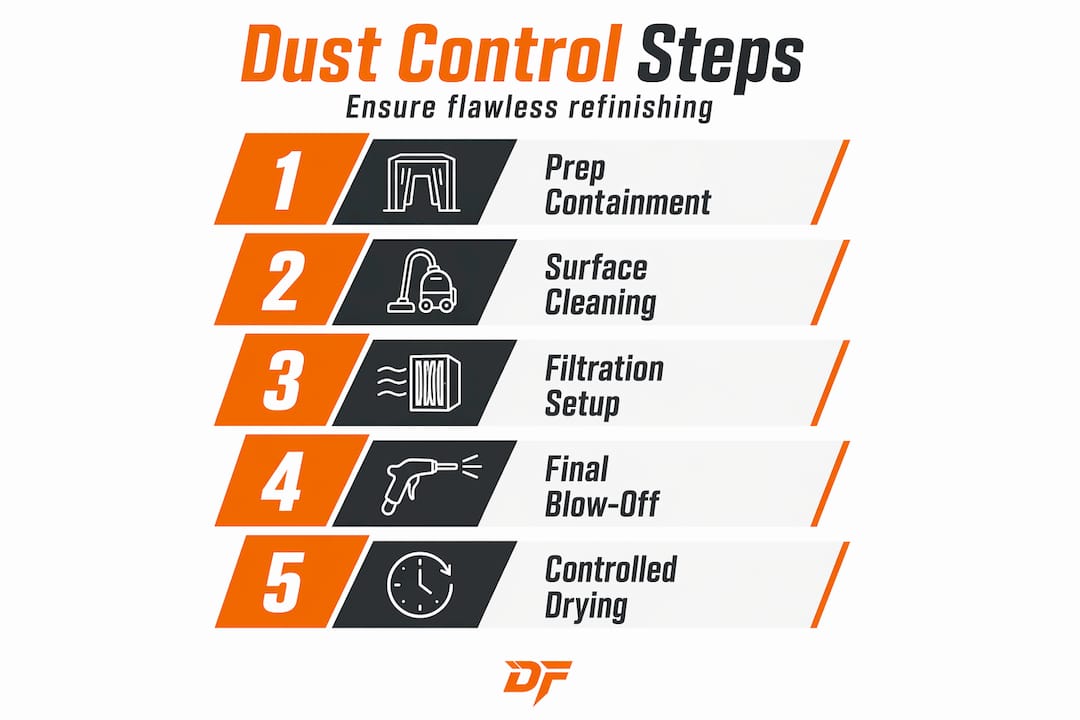
- Breaking down the dust-control chain: Step-by-step essentials
- Choosing your booth and filter setup: What really matters
- Environmental controls: Going beyond simple filtration
- Timing, workflow, and real-world pitfalls: How to achieve “dust-free” finishes
- A fresh perspective: Why dust control is management’s blind spot — and how to fix it
- Boost your shop’s results with proven dust protection solutions
- Frequently asked questions
Key Takeaways
| Point | Details |
|---|---|
| Containment is step one | Dedicated prep containment with filtration is the foundation of effective dust protection in refinishing. |
| Sequential cleaning matters | Blow-off and re-clean steps remove hidden dust right before each coating, preventing defects. |
| HEPA and airflow boost results | High-efficiency filters and well-designed airflow systems are key for capturing airborne dust at source. |
| Control your environment | Managing humidity and static reduces dust sticking, making professional finishes consistently attainable. |
| Timing and discipline | Following precise process timing prevents dust issues and ensures ‘dust-free’ benchmarks are consistently achieved. |
Understanding the dust threat in automotive refinishing
Dust is not just a nuisance. In an automotive refinishing environment, it is a direct threat to paint quality, schedule, and profitability. Every prep step — from sanding sealer coats to blocking primer — releases thousands of fine particles into the air. These particles do not simply fall to the floor and stay there. They migrate, travel on air currents, and resettle on surfaces you cleaned minutes earlier.
The most damaging particles are those you cannot see with the naked eye. Particles under 10 microns stay airborne for extended periods and are precisely the size that embeds into wet clearcoat, creating the “dirt nibs” and inclusions that require costly re-buffing or even respray. A single sanding session in an adjacent prep area can contaminate a booth that took considerable effort to clean.
Many shop managers underestimate just how quickly dust migrates. Research consistently shows that dedicated prep-stage containment and filtration/airflow are the foundation of dust control because sanding and prep dust, if uncontained, will inevitably reach the paint zone. General shop cleaning — sweeping floors, wiping surfaces — does not substitute for this.
Here is what makes refinishing-specific dust control different from everyday cleaning:
- Source containment: Dust must be captured at the point of generation, not chased after it spreads.
- Airflow management: The booth environment must move air in controlled directions to remove airborne particles without redistributing them.
- Sequential discipline: Each process step must end with a clean-down before the next begins.
- Surface protection: Booth walls and floors accumulate dust and become secondary contamination sources if not properly protected.
“A compact prep booth creates a clean, controlled, and dust-managed environment that isolates sanding work from the final paint zone, dramatically reducing cross-contamination risk.” — Preparation Booth AMTPR121
Understanding clean booth strategies is the necessary first step before investing in any equipment or procedural changes. The goal is not just cleanliness — it is engineered contamination prevention at every stage.
Breaking down the dust-control chain: Step-by-step essentials
Effective dust control is a chain, and like any chain, it breaks at its weakest link. One missed step can undo all the effort that came before it. The following sequence is the backbone of a reliable, repeatable dust-protection process for any refinishing shop.
- Prep-stage containment: Isolate all sanding, featheredging, and body work inside a dedicated prep area or prep booth. Never sand in or near the paint booth.
- Initial blow-off: Use compressed air to remove loose sanding dust from the vehicle surface, working from top to bottom and panel by panel.
- Tack cloth wipe-down: Follow the blow-off immediately with a tack cloth to capture particles that compressed air dislodged but did not remove from the surface.
- Solvent wipe or surface cleaner: Apply a panel wipe or surface cleaner to remove residual contamination and static charge that attracts dust back to panels.
- Booth environment check: Verify filtration is clean, airflow is balanced, and no settled dust is visible on booth walls, floors, or ceiling filters before the vehicle enters.
- Final tack before spray: Perform one last tack wipe immediately before triggering the spray gun. This is non-negotiable.
The importance of the blow-off and re-clean steps cannot be overstated. 3M’s standard operating procedures for heavy-duty truck repair confirm that aggressive blow-off and surface cleaning are used explicitly before coatings to prevent contamination-related defects — and this discipline applies equally to passenger vehicle refinishing.
Reviewing your spray booth prep steps and aligning them with a proven dust-free workflow will reveal gaps that are costing you quality right now.
Comparison: Dedicated prep booth vs. DIY containment
| Factor | Dedicated prep booth | DIY plastic sheeting/tape-off |
|---|---|---|
| Airflow control | Engineered, balanced | None or minimal |
| Dust capture efficiency | High (filtered exhaust) | Low (dust escapes freely) |
| Setup time per job | Fast (permanent setup) | Slow (rebuilt each use) |
| Cross-contamination risk | Low | High |
| Long-term cost | Lower per job | Higher (labor, rework) |
| Operator comfort | Ventilated, safe | Often uncomfortable |
Pro Tip: Always perform your final blow-off and surface clean immediately before moving a vehicle into the booth and triggering paint. Even a 20-minute delay between cleaning and spraying allows significant dust resettlement on panel surfaces, especially in high-traffic shops.
Choosing your booth and filter setup: What really matters
Equipment decisions have long-term consequences. When evaluating booths and filtration systems, move past the marketing language and focus on measurable specifications that actually determine dust-capture performance.
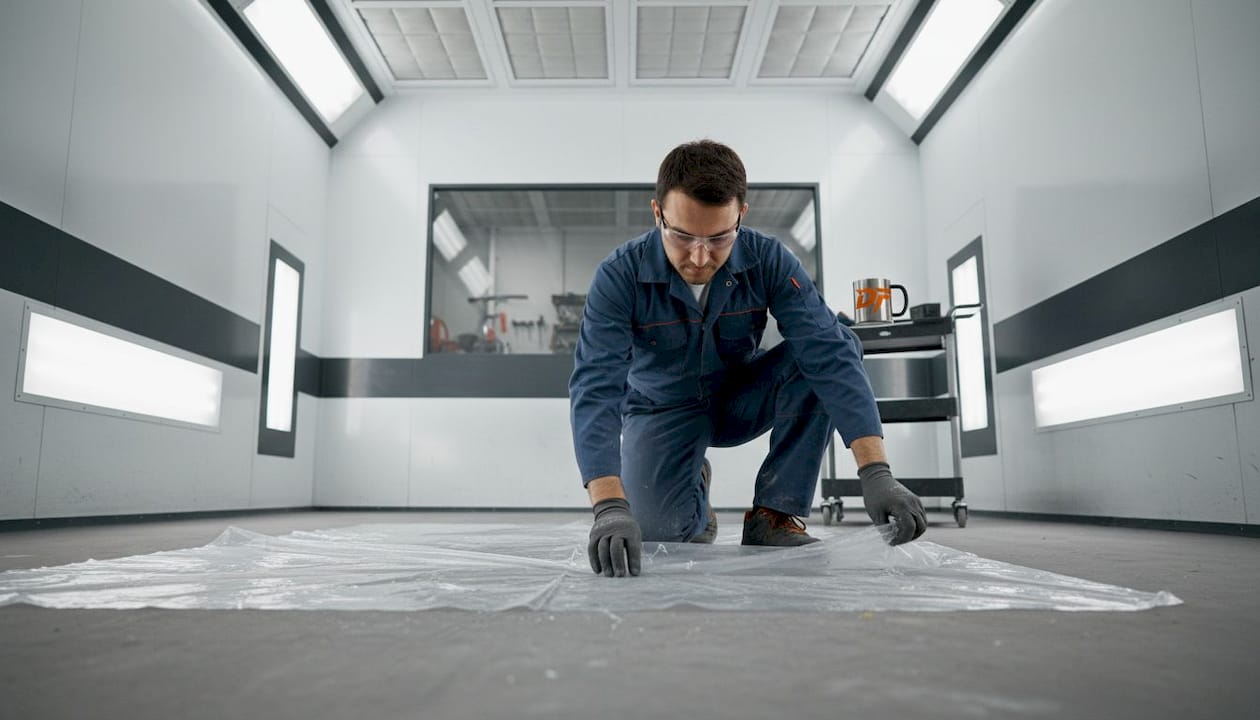
HEPA after-filters with 99.97% efficiency are the gold standard benchmark for dust control in finishing environments. These filters capture particles down to 0.3 microns, which covers the particle sizes most responsible for paint contamination. Any system that does not include HEPA-grade filtration at the exhaust stage is leaving significant contamination risk on the table.
Airflow volume matters equally. Systems capable of moving up to 27,000 CFM (cubic feet per minute) can clear airborne particles far more rapidly than undersized units, reducing the window in which dust is suspended and available to contaminate wet coatings. Higher CFM also means the booth recovers faster between coats during multi-stage refinishing jobs.
Booth and filtration specifications comparison
| Specification | Minimum acceptable | Recommended target | High-performance |
|---|---|---|---|
| Filter efficiency | 85% (standard) | 95% (EU class F9) | 99.97% (HEPA) |
| Airflow at operator level | 80 fpm | 100 fpm | 120 fpm |
| Exhaust filtration | Single-stage | Two-stage | Three-stage with HEPA |
| Filter service interval | Every 3 months | Every 4–6 weeks | Usage-based monitoring |
| Booth wall protection | None | Disposable film | Multi-layer peelable film |
Before investing in a booth or upgrading filtration, ask your vendor these key questions:
- What is the documented filter efficiency rating, and at what particle size?
- How does the exhaust system handle peak sanding-dust loads versus normal spray operations?
- What is the recommended filter change interval under your expected production volume?
- Does the booth design include positive pressure to prevent outside air infiltration?
- What certifications does the booth carry, and how do they translate to your local regulatory requirements?
Proper booth setup processes also influence how well even the best filtration performs. A well-specified booth installed or operated incorrectly will underperform a mid-range booth managed with discipline. Understanding how dust-control system layouts can be adapted from industrial manufacturing settings also gives shop owners ideas for improving airflow routing and containment design.
Environmental controls: Going beyond simple filtration
Filtration handles the air. But the environment inside and around your booth involves factors that filtration alone cannot address. Humidity, static charge, airflow velocity, and physical sealing all contribute to how much dust reaches wet paint.
Relative humidity in the 50–60% range is the recognized target for finishing environments. At this level, static charge on panel surfaces is reduced, and airborne particles are heavier and fall more quickly rather than floating indefinitely. Below 40% humidity, static buildup becomes a serious problem. Panels act like magnets for airborne dust, pulling particles back onto freshly cleaned surfaces. Above 65%, moisture-related adhesion problems emerge in some coating systems. Managing humidity and static, alongside balanced airflow, is operational dust control that no filter can replace.
Airflow velocity at the operator level should sit between 100 and 120 feet per minute (fpm). This range is fast enough to carry airborne particles toward exhaust filters but not so turbulent that it disrupts atomization patterns or creates swirling that redistributes settled dust. Measuring this with an anemometer at multiple points in the booth is a quick, inexpensive diagnostic step that most shops skip.
Physical sealing is frequently overlooked. Any gap around booth doors, light fixtures, or penetrations for hoses and cables is a pathway for unfiltered shop air to enter. Even small gaps allow dust migration from adjacent prep and fabrication areas.
Here is a routine monitoring checklist every operator should follow at the start of each shift:
- Verify humidity level with a calibrated hygrometer
- Check airflow with a handheld anemometer at face-height center of the booth
- Inspect booth door seals for damage or compression failure
- Confirm intake and exhaust filter loading (pressure differential gauges if installed)
- Visually check booth walls and floor for settled dust and contamination
Pro Tip: Install a grounding strap on the vehicle before final surface prep. Static discharge tools and anti-static wipe solutions provide a meaningful additional layer of protection, particularly in low-humidity or high-production environments. Explore proven paint booth dust control methods and spray booth maintenance steps to build these checks into a repeatable daily routine.
Timing, workflow, and real-world pitfalls: How to achieve “dust-free” finishes
Even a perfectly equipped and maintained booth cannot guarantee a clean finish if workflow timing and shop habits introduce contamination. The concept of “dust-free” in a refinishing context has a very specific technical meaning that most shops misapply.
Dust-free time is a coating performance benchmark. It refers to the point at which a freshly applied coating film has hardened enough that airborne dust particles landing on its surface will no longer embed. PPG’s fast-drying clearcoat in the PPG Deltron line demonstrates what is achievable: dust-free in 15 minutes at 20°C, polishable in 45 minutes. These metrics define the window in which your booth environment matters most for protecting the finish.
The practical implication is straightforward. For the first 15 minutes after application, every particle of airborne dust in the booth is a threat. This is when booth discipline, filtration performance, and static control deliver their return on investment.
Here is a timing framework for minimizing contamination risk:
- Complete all surface prep and cleaning before the vehicle enters the booth.
- Allow 5 minutes of booth air circulation after the vehicle is positioned but before spraying, to clear any disturbed dust.
- Apply coating and track dust-free time per the product’s technical data sheet (TDS).
- Do not open booth doors until the dust-free window has passed.
- For multi-coat work, perform a light tack between coats during any staging pause longer than 10 minutes.
- Log application times and environmental conditions for each job to build a shop-specific quality record.
The most common real-world pitfalls are predictable: opening the booth door early to check results, skipping the tack wipe between coats under time pressure, and failing to re-clean the booth walls and floor between jobs. Each of these is a management and culture problem as much as a technical one. Reviewing your contamination prevention guide gives you a structured framework for addressing these pitfalls systematically.
Pro Tip: Always verify dust-free and recoat windows against the specific product’s TDS, not general rules of thumb. Manufacturer timing claims are performance benchmarks measured under controlled conditions. Your actual environment may require longer windows depending on temperature, humidity, and coating thickness.
A fresh perspective: Why dust control is management’s blind spot — and how to fix it
Here is an uncomfortable truth most industry discussions skip. Shops that struggle with dust contamination usually do not have an equipment problem. They have a priority problem.
Walk through most body shops and you will find expensive spray guns, premium paint lines, and sophisticated mixing systems. Then look at the booth walls, caked with dust residue. Look at the prep area, where sanding happens three feet from the open booth door. The spending follows the glamour, and dust control is not glamorous.
The chain principle of dust protection makes the management failure visible: contain the source during sanding, clean aggressively between steps, and control the booth environment so settled dust never reaches wet coating. Every link must hold. Managers who focus on the spray equipment while neglecting prep containment and booth wall hygiene are breaking the chain at the cheapest and easiest links to fix.
“Dust control works when it is culture, not a checklist. When every technician owns the outcome, the whole system functions. When it is one person’s job, it becomes nobody’s job under pressure.”
The fix is not a single capital purchase. It is embedding dust awareness into daily routines, shift handovers, and quality checks. It is measuring rework rates and tracing them back to contamination events. It is making booth cleanliness a metric that gets reviewed alongside throughput and billable hours.
Shops that achieve consistently dust-free results share one trait: their managers treat the booth environment with the same seriousness they treat paint selection. That shift in mindset costs nothing and delivers measurable results faster than any equipment upgrade.
Boost your shop’s results with proven dust protection solutions
If this guide has made one thing clear, it is that even the best booth and filtration setup can be undermined by contamination that builds up on walls, floors, and surfaces between jobs. Protecting those surfaces directly is where Dust Free Film delivers results that equipment alone cannot.
At Dust Free Film, we manufacture multi-layer electrostatic booth wall and floor protectors designed specifically for automotive refinishing environments. Our patented dispenser system allows quick, bubble-free installation that any technician can complete without downtime. The films are heat-resistant, static-free, and built for high-traffic production settings. When a layer gets contaminated, you peel it off and expose a clean surface instantly, without cleaning chemicals or lost production time. Shops using our products across multiple bays and refinishing zones report measurable reductions in rework and faster throughput. Visit dustfreefilm.com to explore our product range, request a custom configuration for your facility, or connect with our team for volume pricing.
Frequently asked questions
What is the most effective way to prevent dust contamination during automotive refinishing?
The most effective method combines dedicated prep-stage containment with aggressive cleaning between steps and high-efficiency filtration running throughout the entire workflow, not just during spraying.
How does humidity affect dust control in a paint booth?
Maintaining relative humidity around 50–60% reduces static charge on panel surfaces, which prevents airborne dust from being attracted back to freshly cleaned panels before and during coating application.
What does dust-free time mean for refinishing products?
Dust-free time is the minimum period after application during which a coating must cure before airborne particles can no longer embed in the surface, and it is a product performance benchmark, not a guarantee of a contamination-free process.
Are HEPA filters necessary in automotive spray booths for dust control?
HEPA after-filters rated at 99.97% efficiency are the most reliable standard for capturing the smallest airborne particles, making them strongly recommended for shops prioritizing consistent, high-quality finishes.
Why do shops still have dust issues even with advanced paint booths?
Because sanding dust from prep areas escapes containment and resettles during process transitions, meaning booth filtration alone cannot compensate for inadequate prep-stage containment and insufficient cleaning discipline between steps.