
TL;DR:
- A facility audit for paint booths verifies airflow, filter condition, fire safety, and documentation to ensure safety and compliance. Regular internal checks and professional audits prevent costly overexposure, fire hazards, and regulatory violations. Proper documentation and follow-up actions strengthen safety efforts and optimize operational performance.
A facility audit for paint booths is a structured, evidence-based evaluation that verifies whether a spray booth operates safely, meets regulatory requirements, and performs within design specifications. Known formally as a thorough examination and test in occupational health frameworks, this process covers airflow velocity, filter condition, fire suppression readiness, and documentation integrity. Regulations such as COSHH, DSEAR, OSHA, and NFPA set the compliance baseline. Without a scheduled paint booth inspection, facilities expose workers to solvent vapor overexposure, face enforcement actions, and risk unplanned shutdowns that cost far more than any audit fee.
What does a facility audit for paint booths involve?
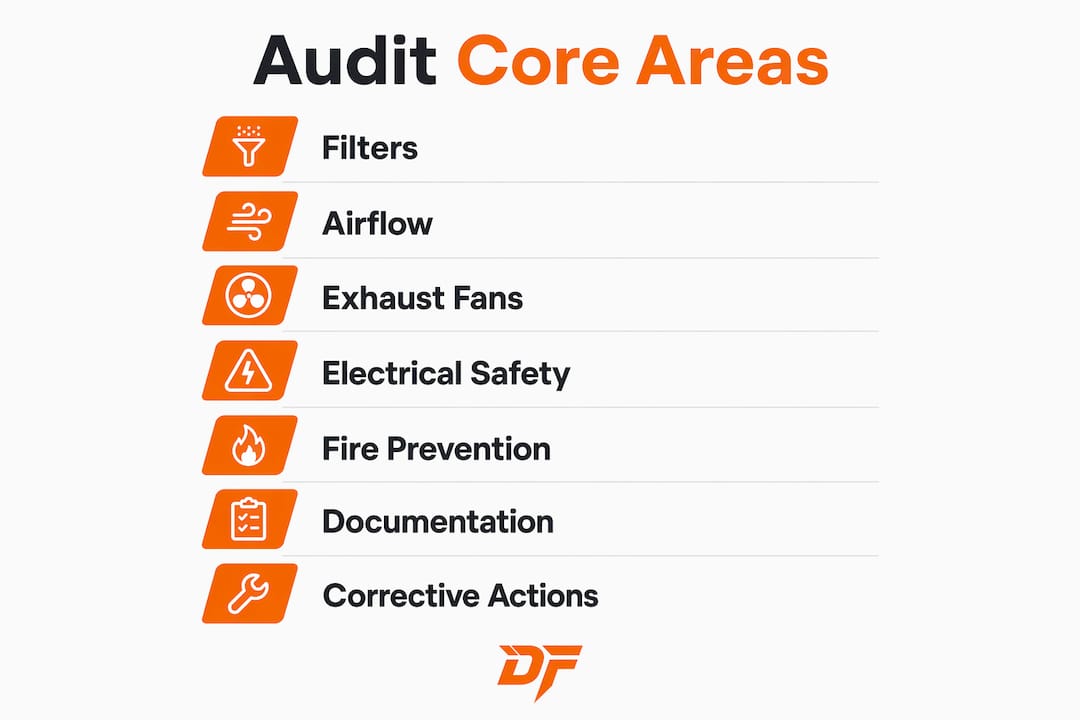
A paint booth audit covers seven core areas, each tied directly to worker safety or regulatory compliance. Qualified auditors examine filter status, airflow velocity at the breathing zone, exhaust fan function, electrical and lighting safety, interior overspray buildup, ductwork integrity, and fire suppression system pressure. Missing any one of these areas produces an incomplete picture of booth health.
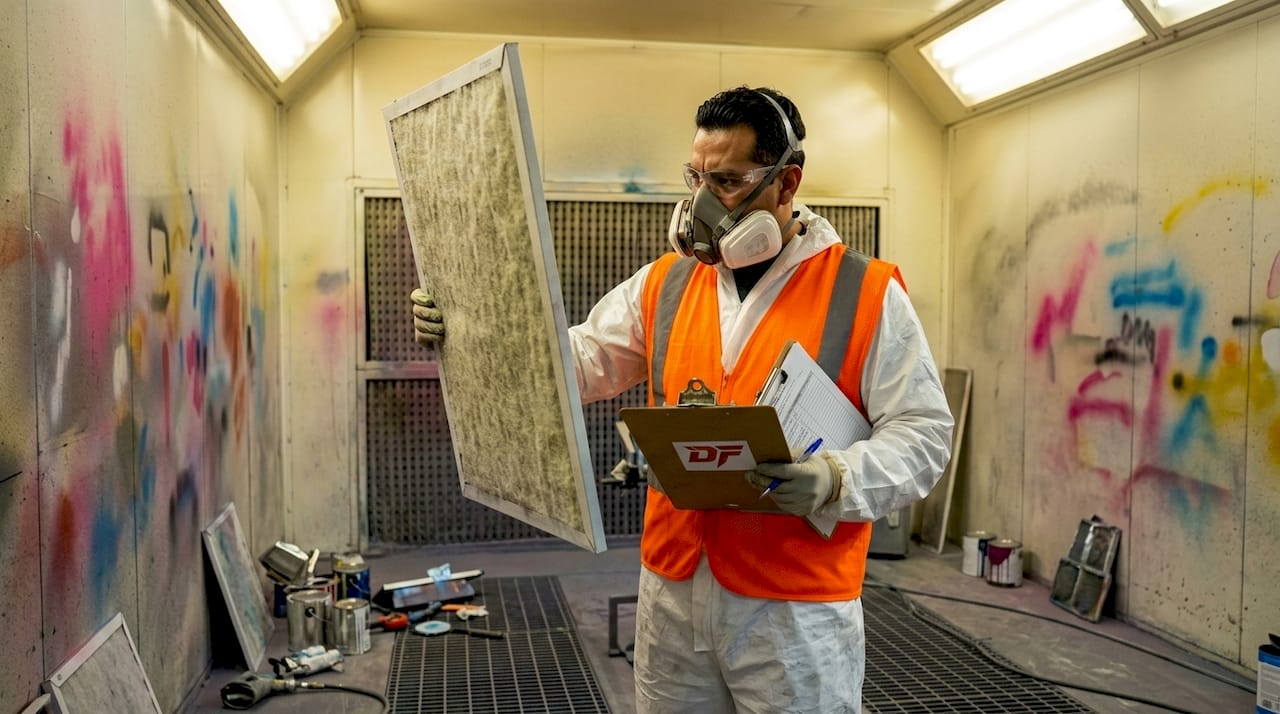
The most technically demanding check is airflow velocity measurement. Target velocity is 0.3–0.5 m/s at the worker’s spraying position, not at the fan outlet or an empty corner of the booth. A fan can run at full speed while airflow at the breathing zone falls below design specification. That gap is exactly what a proper audit catches.
Filter condition is the most common failure point. Paint arrestor filters progressively choke airflow as overspray accumulates, causing booths to fail velocity testing even when all other systems appear functional. Built-in pressure gauges on filter housings often drift over time, giving false readings. Auditors rely on calibrated external instruments to verify actual performance.
The audit scope also includes a review of maintenance logs, filter replacement records, and previous inspection reports. Proper recordkeeping is as critical to passing an inspection as the physical condition of the equipment. Regulators cite facilities for missing documentation even when the booth itself is in good shape.
- Filter status: Check paint arrestor and exhaust filters for loading and airflow restriction.
- Airflow velocity: Measure at the worker’s breathing zone with calibrated equipment, not built-in gauges.
- Exhaust fan function: Confirm fan speed, belt tension, and motor condition.
- Electrical and lighting safety: Inspect for explosion-proof fixtures and proper grounding.
- Overspray buildup: Assess interior walls, floors, and ductwork for accumulated paint solids.
- Ductwork integrity: Check for leaks, corrosion, and blockages that reduce capture efficiency.
- Fire suppression system: Verify pressure gauges, nozzle placement, and last service date.
Pro Tip: Schedule internal checks weekly for filters and monthly for airflow, then bring in a qualified professional for a full examination at least every 14 months to meet COSHH requirements.
Audit frequency follows a two-tier model. Internal teams handle weekly filter checks and monthly airflow reviews. Professional audits must occur at least annually, with COSHH requiring a thorough examination by a competent person no less than every 14 months for booths in regular industrial use.
Why are facility audits critical for paint booth safety and compliance?
A paint booth inspection serves as the primary mechanism for identifying compliance gaps before regulators do. Environmental and safety audits identify permit gaps, documentation lapses, and physical performance issues before enforcement actions occur. They also serve as documented proof of good-faith compliance effort, which carries weight with both regulators and insurers.
The consequences of skipping audits are concrete and costly. Facilities face four categories of risk:
- Worker health hazards: Inadequate airflow allows solvent vapors and paint particulates to accumulate at the breathing zone, exceeding OSHA permissible exposure limits.
- Fire and explosion risk: Overspray buildup in ducts and on booth surfaces creates fuel loads that violate NFPA 33 requirements for spray application operations.
- Regulatory fines and shutdowns: OSHA and state environmental agencies issue citations and stop-work orders when booths fail inspection or lack required documentation.
- Insurance exposure: Insurers use audit records to assess coverage eligibility. Gaps in inspection history can void claims after a fire or injury event.
Audit documentation functions as legal evidence. Maintenance logs, filter change records, and signed inspection reports demonstrate that a facility took reasonable steps to maintain a safe environment. Missing or incomplete maintenance logs frequently cause non-compliance citations regardless of the booth’s physical condition. That means a perfectly functioning booth can still fail an inspection on paperwork alone.
For compliance officers, the facility audit process is the clearest line between proactive management and reactive crisis response. Audits conducted on schedule, with findings documented and corrective actions tracked, build a defensible compliance record that protects the facility across regulatory, legal, and operational dimensions.
How can facility audits improve paint booth performance and reduce costs?
Audits deliver measurable operational benefits beyond regulatory compliance. Effective audits balance safety compliance, production uptime, and energy efficiency rather than treating inspections as a regulatory burden. Catching a clogged filter bank early costs a fraction of what an unplanned shutdown costs in lost production and emergency labor.
Airflow is the single variable that connects safety, finish quality, and energy consumption. When airflow drops below design specification, overspray stays suspended longer, settles on wet paint surfaces, and degrades finish quality. The exhaust fan works harder to compensate, consuming more energy without restoring proper capture velocity. An audit catches this performance drift before it affects production output.
- Early filter replacement: Replacing filters before they choke airflow prevents velocity failures and protects finish quality.
- Energy waste detection: Audits identify fans running at excess speed to compensate for blocked filters, a pattern that inflates energy costs without improving safety.
- Overspray buildup control: Catching interior paint accumulation early reduces fire risk and extends booth service life. Dustfreefilm’s multi-layer electrostatic booth wall and floor protectors reduce buildup directly, making audits faster and corrective action simpler.
- Downtime prevention: Identifying worn belts, failing motors, or corroded ductwork during a scheduled audit avoids mid-production failures.
- Finish quality protection: Proper airflow at the breathing zone removes particulates before they settle on coated surfaces, reducing rework rates.
Pro Tip: Use audit findings to build a predictive maintenance schedule. If filters reach 80% loading at week six consistently, set replacement at week five. That one adjustment eliminates reactive shutdowns.
For facility managers, the audit report is a planning document, not just a compliance record. Trends in filter loading rates, velocity measurements, and overspray accumulation tell you exactly where the booth is heading before it gets there. Pairing booth efficiency strategies with regular audit data produces a feedback loop that keeps performance stable across production cycles.
What are best practices for conducting effective paint booth audits?
A structured audit protocol produces consistent, defensible results. Standard audit protocol involves an opening meeting to clarify objectives, a detailed physical walkthrough, a review of performance logs, and a closing meeting where all parties agree on corrective actions. Skipping the opening or closing meeting turns an audit into an informal walkthrough with no accountability structure.
Corrective action tracking separates effective audit programs from paper exercises. Facilities that lack follow-up on audit findings face repeated problems and higher compliance risk. Every finding needs an assigned owner, a deadline, and a verification step confirming the fix was completed. Without that loop, the same issues appear in the next audit cycle.
Integrating audit findings into a broader safety management system multiplies their value. Findings feed into training programs, maintenance schedules, and procurement decisions. A recurring finding about filter loading, for example, should trigger a review of filter specifications, not just a replacement order. For guidance on managing inspection documentation across industrial settings, structured recordkeeping systems provide a replicable framework that holds up under regulatory scrutiny.
| Best practice | Why it matters |
|---|---|
| Opening and closing meetings | Establishes shared objectives and confirms corrective action ownership |
| Calibrated measurement tools | Prevents false readings from drifting built-in gauges |
| Corrective action tracking | Eliminates repeat findings and reduces long-term compliance risk |
| Integrated maintenance scheduling | Converts audit data into predictive maintenance rather than reactive repairs |
| Indexed documentation | Protects the facility during regulatory inspections and insurance reviews |
Audit findings also inform dust control practices that reduce contamination between inspection cycles. Facilities that treat audits as a continuous feedback loop rather than an annual event maintain tighter control over booth conditions and spend less time managing compliance crises.
Key Takeaways
A facility audit for paint booths is the primary tool for maintaining regulatory compliance, worker safety, and operational performance in industrial spray environments.
| Point | Details |
|---|---|
| Audit scope covers seven areas | Filters, airflow, exhaust fans, electrical safety, overspray, ductwork, and fire suppression must all be evaluated. |
| Airflow must be measured at the breathing zone | A reading at the fan or duct does not confirm worker protection; calibrated measurement at the spray position is required. |
| Documentation is as critical as equipment | Missing maintenance logs cause compliance citations even when the booth is physically in good condition. |
| Audits reduce operational costs | Early detection of filter clogging and airflow drift prevents unplanned downtime and excess energy consumption. |
| Corrective action tracking prevents repeat findings | Assigning owners and deadlines to every finding closes the feedback loop and lowers long-term compliance risk. |
Why I think most facilities are auditing their booths wrong
Most paint booth audits I see treat the inspection as a pass/fail event. The auditor walks through, marks findings, hands over a report, and leaves. The facility files the report, fixes the most obvious items, and waits for the next scheduled visit. That cycle produces compliance on paper but not in practice.
The real value of a paint booth audit shows up between inspections. When you track filter loading rates over six months, you stop replacing filters on a calendar schedule and start replacing them based on actual performance data. That shift alone reduces both over-replacement waste and the risk of a mid-cycle velocity failure. The audit report is the starting point for that analysis, not the end of it.
The other mistake I see consistently is treating airflow measurement as a confirmation step rather than a diagnostic one. Facility managers assume that if the fan is running and the gauge reads normal, the booth is fine. It often is not. The gauge drifts. The filters load unevenly. The velocity at the breathing zone drops below 0.3 m/s while every indicator suggests normal operation. That is the scenario that produces both regulatory failures and worker exposure events.
Audits work best when they are built into the operational rhythm of the facility, not bolted on as a compliance obligation. The facilities that get the most from their inspection programs are the ones where the maintenance team, the safety officer, and production management all review findings together and treat corrective actions as operational priorities. That culture does not happen automatically. It gets built through consistent audit practice and leadership that takes findings seriously.
— Dust
How Dustfreefilm supports paint booth audit readiness
Paint booth audits consistently flag overspray buildup on walls and floors as both a fire hazard and a contamination source. Dustfreefilm’s multi-layer electrostatic booth wall and floor protectors address that finding directly. The films reduce accumulated paint solids between audit cycles, making inspections faster and corrective action less disruptive to production schedules.
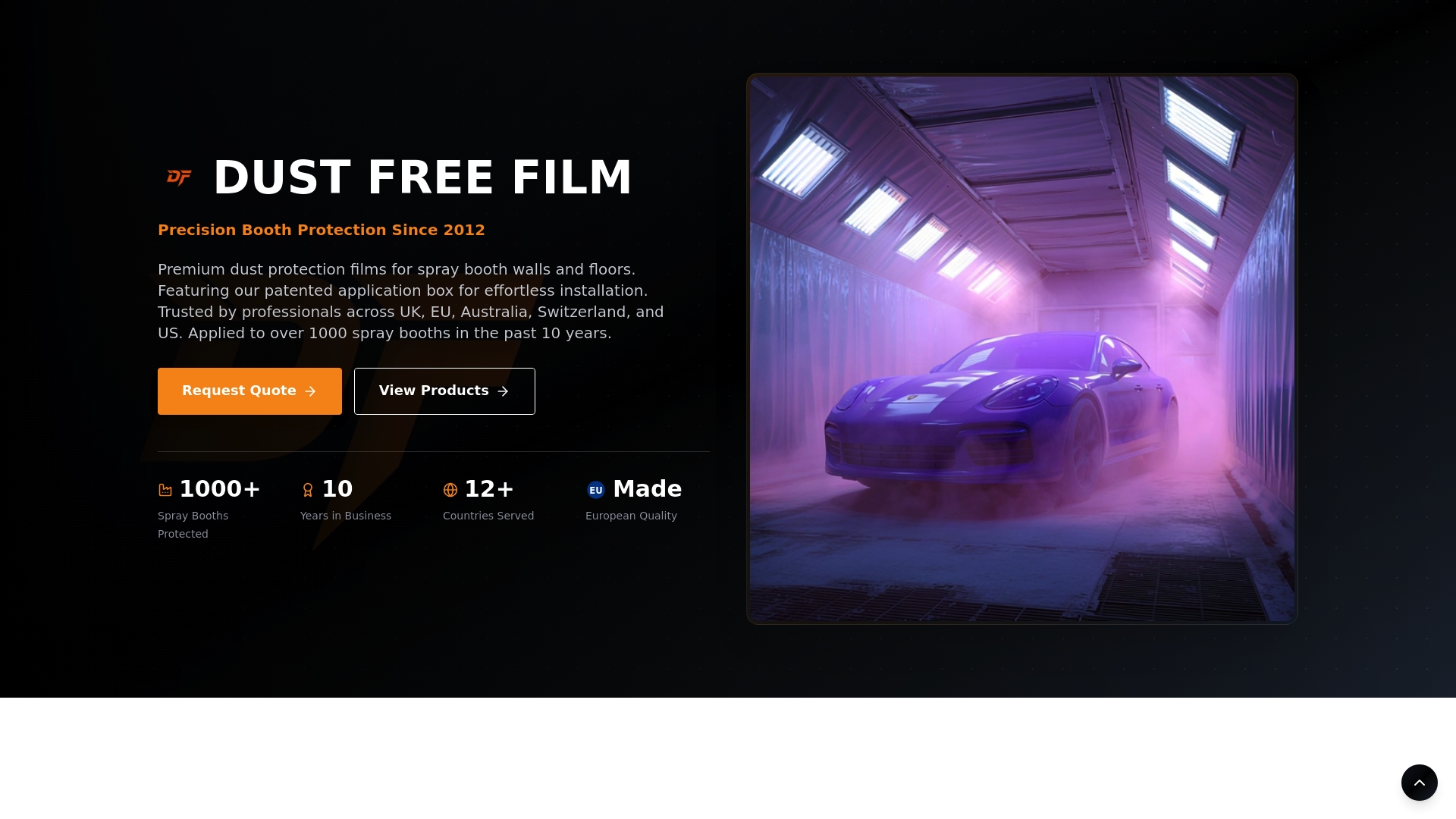
Dustfreefilm has supported auto body shops and industrial spray facilities since 2012 with dust protection films built to European manufacturing standards. Their patented dispenser system allows quick, bubble-free installation that holds up under high-traffic production conditions. Facility managers looking to reduce audit findings related to contamination and surface buildup can explore Dustfreefilm’s booth protection solutions and see how the right protective film changes what auditors find on inspection day.
FAQ
What is a facility audit for paint booths?
A facility audit for paint booths is a structured evaluation that verifies airflow performance, filter condition, fire suppression readiness, and regulatory documentation compliance. It is required at least every 14 months under COSHH for booths in regular industrial use.
How often should a paint booth be professionally inspected?
Professional inspections must occur at least annually, with COSHH requiring a thorough examination by a qualified person no less than every 14 months. Internal teams should conduct filter checks weekly and airflow reviews monthly.
What causes most paint booth audit failures?
Paint arrestor filters are the most common failure point, as progressive loading chokes airflow and causes booths to fail velocity testing. Missing or incomplete maintenance documentation is the second most frequent cause of non-compliance citations.
What airflow velocity is required at the breathing zone?
The target airflow velocity at the worker’s spraying position is 0.3–0.5 m/s. Measuring only at the fan or duct does not confirm worker protection and does not satisfy audit requirements.
Why does documentation matter as much as equipment condition?
Regulators treat maintenance logs, filter change records, and signed inspection reports as legal evidence of compliance. Incomplete records produce citations regardless of the booth’s physical condition, making indexed documentation a non-negotiable part of any audit program.