

Yes, sub-15 to sub-30 minute powder booth changeovers are realistic, but only with an integrated approach: cyclone reclaim, automated gun purging, and surface protection working together rather than one upgrade in isolation. The single biggest lever is the reclaim and purge system, since it governs how much powder has to be flushed before the next color is clean. Vendor-reported systems claim 6 to 10 minute changeovers, and practitioner guidance backs 12 to 15 minute reclaim-to-reclaim times as achievable with full implementation. High-mix shops tend to recoup that equipment premium fast, because every minute saved is a minute back in production.
TL;DR:
- Cyclone reclaim systems enable changeovers in roughly 6 to 10 minutes, but full implementation typically achieves 12 to 15 minutes in practice.
- Parallel operator tasks, including gun purge, hopper swap, and film replacement, are essential to hitting the fastest changeover times.
- Using surface protection film can save 20 to 30 minutes per changeover by reducing manual scrubbing and cleanup efforts.
- Fast changeover equipment becomes cost-effective mainly for high-mix, small-batch shops with frequent color switches, not for continuous high-volume production.
- Proper planning, role assignment, and adherence to standardized routines significantly impact achieving and maintaining quick changeover times.
Table of Contents
- What Equipment Actually Makes a Fast Booth Changeover Possible
- How Do You Sequence a Changeover to Hit 10 to 30 Minutes?
- Why Surface Protection Film Cuts Changeover Time
- How to Justify Fast-Change Equipment to Procurement
- A Pre-Flight Checklist You Can Print This Week
- Safety Protocols Specific to Rapid Changeover Processes
- Training and Personnel Practices That Keep Changeovers Fast
- Author Perspective: The Pitfalls Nobody Puts in the Spec Sheet
- Fitting Dust Free Film Into Your Changeover Routine
- Sources
- FAQ
What Equipment Actually Makes a Fast Booth Changeover Possible
Speed comes from the booth acting as one coordinated system, not from any single accessory. Gun technology, feed centers, and booth geometry all have to be engineered around the same goal: less powder trapped in the system when you switch colors.
Cyclone reclaim versus cartridge modules. Cyclone systems separate overspray by centrifugal force and self-clean between colors, which is why vendor booths built around them advertise those 6 to 10 minute change times. Cartridge filter systems recover powder more precisely for single-color runs but need longer purge cycles between colors, since residual powder clings to filter media in a way cyclones avoid.
Booth cabin construction. Non-conductive PVC sandwich walls and smooth, sloped floors stop powder from building up in seams and corners where cartridge-style booths tend to trap fines. Small, sectioned automatic zones mean less interior surface area to clear between runs.
Airflow and PLC control. Downdraft extraction keeps powder moving down and out rather than swirling into corners, and PLC-controlled powder circulation keeps the volume of airborne powder low at any given moment, which directly shrinks the flush volume needed at changeover.
Gun, feed center, and collector strategy. The details that matter most on the shop floor:
- Automated interior gun purging clears internal powder paths without manual disassembly.
- Blow-off nozzles knock residual powder from gun barrels and hoses in seconds.
- Feed-center hopper cleaning cycles empty and reset supply lines between colors.
- Roll-away collector modules let you swap the entire reclaim unit rather than clean it in place.
- Staging a redundant collector module lets one team run production while another preps the next color.
Pass-through booths built around this kind of module swap can support continuous runs without ever disassembling the booth structure, which is exactly the setup RTT Finishing Solutions points to for shops that can’t afford a stopped conveyor.
How Do You Sequence a Changeover to Hit 10 to 30 Minutes?
Speed is mostly a scheduling problem. Two operators working parallel tasks will always beat one operator working a serial checklist, even with identical equipment.
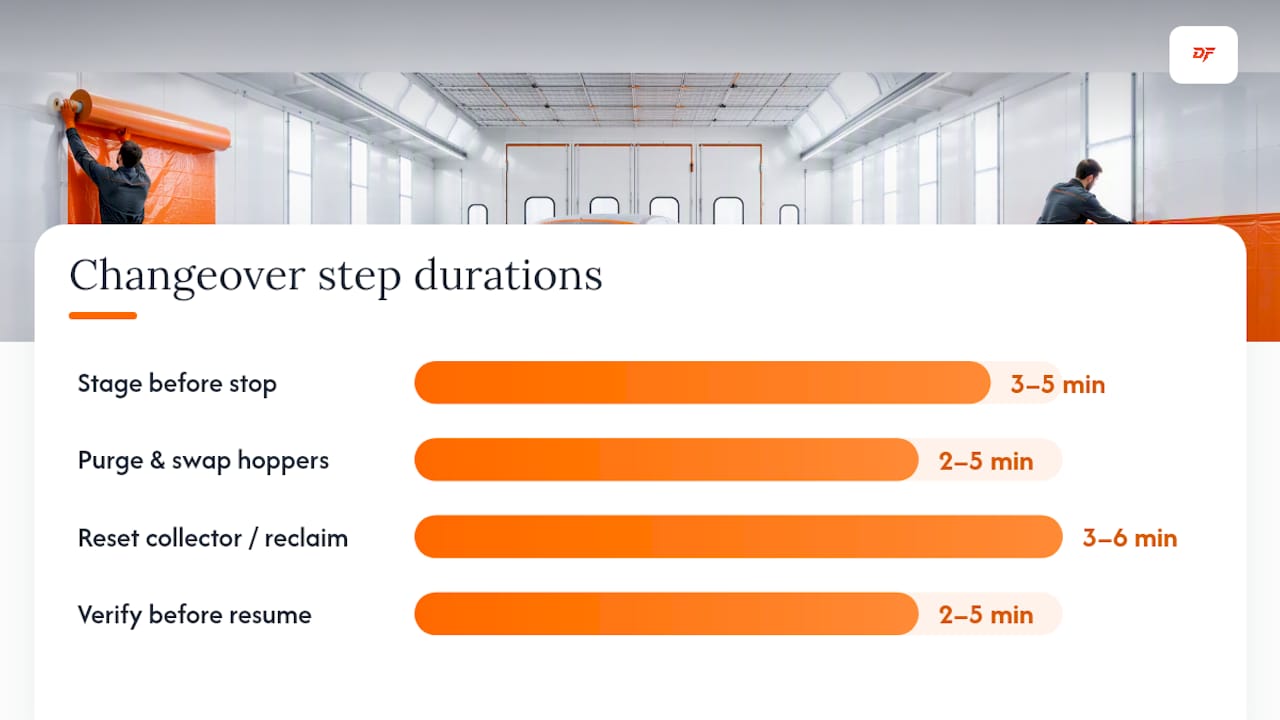
- Stage before you stop the line (3 to 5 minutes). Confirm the spare collector module is loaded, film layers are pre-cut and ready, spare hoppers are clean, and hand tools are within reach. This step happens while the current color is still running.
- Purge guns and swap hoppers in parallel (2 to 5 minutes). One operator runs the automated interior gun purge and blow-off cycle while a second operator pulls the old hopper, drops in the new color, and starts the cyclone dump if the booth requires it.
- Reset the collector and reclaim path (3 to 6 minutes). Roll the staged collector module into position, or clear the active one, and confirm reclaim is flowing to the correct hopper.
- Peel and replace protective film on high-contact surfaces (concurrent with steps 2 to 3). A third team member, where staffing allows, strips the top film layer at touch-up stations and gun access points instead of wiping them down.
- Verify before full resume (2 to 5 minutes). Spray a test panel on scrap stock, check for cross-contamination or color shift, confirm reclaim bin readings look normal, and only then bring the line back to full speed.
Pro Tip: Assign one person as the “purge and gun” role and one as the “hopper and collector” role every single shift, not just when you remember to. Rotating those roles randomly is the fastest way to add five unplanned minutes to a changeover that should take fifteen.
Vendor claims of 6 to 10 minute changes assume ideal conditions and a fully staffed, practiced team. Plan for variability, and treat parallel task assignment as the thing that actually protects your 30 minute ceiling on a bad day.
Why Surface Protection Film Cuts Changeover Time
Every minute an operator spends scrubbing walls or waiting on a blow-down cycle is a minute the booth sits idle instead of coating parts. Multi-layer electrostatic film changes that math by trapping fines and overspray on a removable surface instead of letting it bond to bare booth walls, where it eventually needs solvent or manual labor to remove.
The mechanics matter here. A properly charged film surface attracts airborne particulate more effectively than a static wall does, and because the top layer peels away cleanly, operators expose a fresh capture surface in seconds rather than scrubbing residue loose. A patented single-operator dispenser box, with a freely rotating roll and an integrated cutting bar, lets one person apply a straight, tape-free line without a second set of hands holding the roll steady.
Where you place film matters as much as the film itself:
- Full wall coverage, since that’s the largest surface exposed to overspray.
- Touch-up stations and gun access points, which get handled constantly and accumulate fast.
- Grooves, seams, and corners where a rigid wall would trap fines permanently.
- Access panels and under-floor gratings, which are easy to forget and hard to clean once contaminated.
Peeling a fouled layer instead of scrubbing it typically saves 20 to 30 minutes of labor per changeover in high-mix operations, according to practitioner reporting from booth protection manufacturers.
That time savings shows up twice: once in the changeover itself, and again in reduced operator exposure to scraping, lifting, and solvent cleaning.
How to Justify Fast-Change Equipment to Procurement
The argument procurement wants is simple: total cost of downtime versus capital outlay. Downtime cost is lost throughput multiplied by margin per hour, plus labor spent on the changeover itself, plus any rework from cross-contamination. Compare that number against the price premium of cyclone reclaim, automated purge guns, and film systems, and the payback period usually becomes obvious fast.
Reclaim efficiency is the other half of the equation. Some cyclone-based systems report system efficiency up to roughly 97%, meaning far less powder ends up wasted in the flush between colors. That reduction in material spend compounds every single changeover, not just the first one.
Fast-change capital tends to pay off fastest for high-mix, small-batch shops and contract coaters running frequent color switches. Single-color, high-volume manufacturers running the same product for weeks at a time see a much longer payback window, since they simply don’t changeover often enough to recoup the premium quickly. Industry guidance on cost-to-benefit trade-offs backs that split.
Track these metrics if you’re piloting new equipment:
- Elapsed changeover time, start to full production resume.
- Parts scrapped or reworked due to cross-contamination.
- Reclaim rate by weight or percentage.
- Operator hours logged specifically on the changeover task.
A Pre-Flight Checklist You Can Print This Week
Consistency beats cleverness here. A team that runs the same sequence every time, with clear role assignments, will beat a more sophisticated booth run by a disorganized crew.
Before the change:
- Confirm spare collector module is staged and ready to roll in.
- Confirm film layers are pre-cut, numbered, and accessible at each application point.
- Lay out sample test panels for post-change verification.
During the change: 4. Assign one operator to gun purge and blow-off. 5. Assign one operator to hopper swap and collector reset. 6. Assign a third role, if staffing allows, to peel and replace film at touch-up zones.
After the change: 7. Spray a test panel and inspect for color shift or contamination. 8. Check reclaim bin readings against expected baseline. 9. Log total elapsed time and any deviations for the next shift review.
| Checklist stage | Primary owner | Target time |
|---|---|---|
| Pre-change staging | Line lead | 3 to 5 minutes |
| Gun purge and hopper swap | Two operators, parallel | 2 to 6 minutes |
| Film peel and replace | Third operator (if available) | Concurrent |
| Verification and resume | Line lead | 2 to 5 minutes |
Log every changeover against this timeline. A shop that reviews its own numbers monthly finds bottlenecks a lot faster than one that assumes the SOP is working.
Safety Protocols Specific to Rapid Changeover Processes
Speed and safety pull against each other unless you build safeguards into the sequence itself. The biggest risk in a fast changeover isn’t the pace, it’s the shortcuts people take under time pressure.
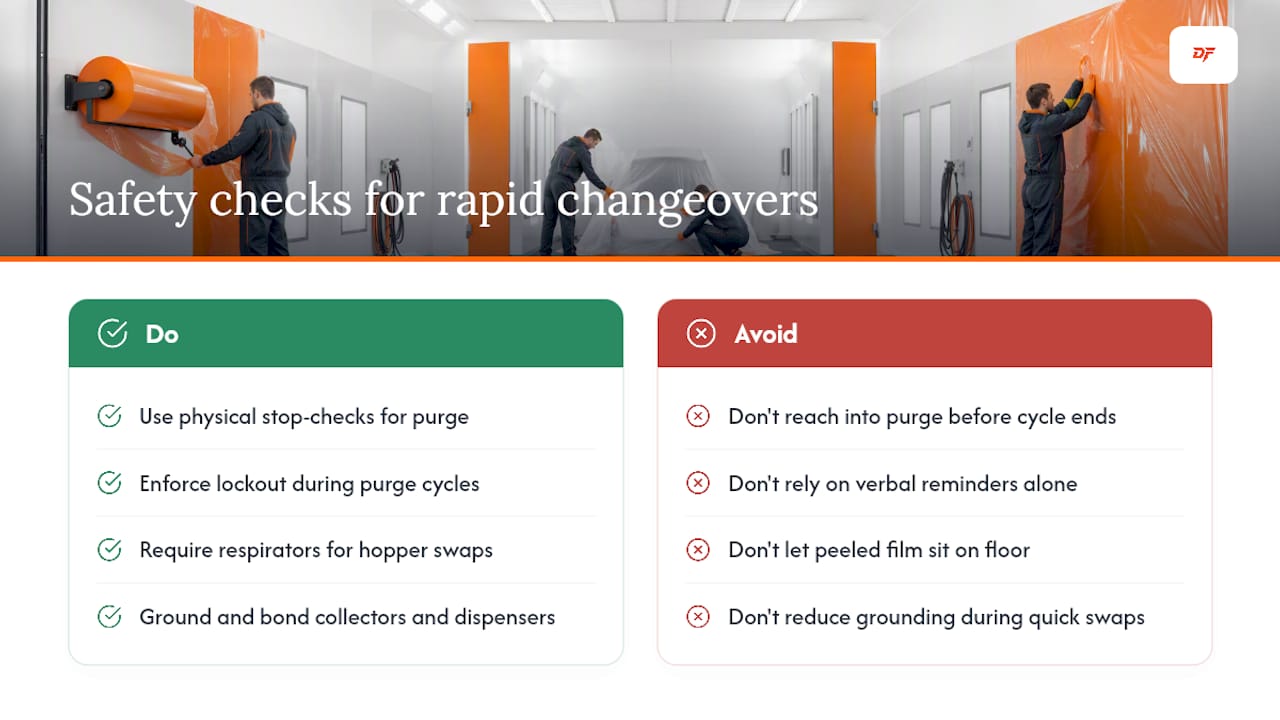
Lockout procedures for gun purge cycles still apply even when the purge itself takes seconds. An operator reaching into a purge line before the automated cycle completes is a common injury point in rushed changeovers, and it’s worth a physical stop-check rather than a verbal reminder alone. Respiratory protection stays required during hopper swaps and collector resets, since disturbing settled powder during a fast swap can spike airborne concentration briefly, even in booths with strong downdraft extraction.
Static discharge is a real concern around film application and removal, particularly with electrostatically charged surfaces near powder guns. Ground straps and proper bonding on collector modules and dispenser hardware need the same attention during a 12 minute changeover as during routine maintenance, not less.
Housekeeping around peeled film matters too. Discarded film layers carry fine powder residue and should go straight into a designated waste container rather than sitting on the booth floor mid-changeover, where they become a slip hazard for an operator moving quickly between stations. None of these steps add meaningful time to the sequence. They just require building them into the SOP instead of assuming a fast crew will remember them under pressure.
Training and Personnel Practices That Keep Changeovers Fast
Equipment sets the ceiling on changeover speed. Training determines whether you actually hit it. A booth capable of a 12 minute change will run 25 minutes with an undertrained crew, and no amount of hardware investment fixes that gap on its own.
Cross-train every operator on both roles in the parallel sequence, gun purge and collector/hopper swap, rather than letting one person specialize in only one task. Shops that rely on a single “changeover expert” lose their speed advantage the moment that person is out sick or on a different line. Run timed practice changeovers during slower production periods, not just during live color switches when mistakes cost real output.
Make the printable checklist part of onboarding, not an optional reference. New operators should walk through the sequence with a supervisor at least twice before running it solo, since the parallel task timing is the part that’s hardest to learn from a written sheet alone.
Track individual and crew-level changeover times over weeks, not single shifts, and review the data as a team. A five minute variance between two equally trained operators usually points to a missing pre-stage step, not a skill gap, and that’s the kind of insight a quick team review catches faster than a top-down audit ever will.
Author Perspective: The Pitfalls Nobody Puts in the Spec Sheet
Most fast-changeover pitches focus on gun purge times and reclaim percentages, and skip the contamination hiding in ducts, grates, and access panels that never show up on a spec sheet. Those hidden spots are usually what turns a clean 15 minute changeover into a recurring quality complaint three shifts later. Film applied to those overlooked zones, not just the visible walls, is what actually protects the number you’re chasing.
The other failure point is coordination, not equipment. A booth rated for a 10 minute change will run 25 if two operators aren’t clear on who owns which task. Clear role assignment removes more variance than any single piece of hardware. And even the fastest booth still needs a periodic deeper clean. A fast SOP manages daily contamination; it doesn’t replace the maintenance schedule that keeps fines from accumulating somewhere the film and purge cycle never reach.
— Pavlos - Angelos Filippakis
Fitting Dust Free Film Into Your Changeover Routine
Dust Free Film is the alternative to scrubbing booth walls between every color change: peel a fouled layer, expose a fresh one, and get back to spraying without a solvent cycle or a crew standing around with rags. The multi-layer Wall Protector and heavy-duty Floor Protector are built for exactly this, with a slightly tacky, electrostatically charged surface that captures overspray better than bare walls ever could.
Procurement teams evaluating this for a changeover SOP should look for the details that actually save time on the floor: tape-free overlapping edges, visible layer numbering so nobody guesses which layer is next, integrated length markings for fast cutting, and heat resistance up to 80°C for booths running hot. The patented dispenser box lets one installer apply a straight line solo, no second person holding the roll.
Running a pilot is straightforward. Cover one booth’s high-contact zones, film touch-up stations and access panels for a two-week production cycle, and log changeover time, film consumption, and operator hours against your current baseline before and after. Most shops see the time saved inside the first few changeovers. Request a quote or find a distributor to scope a configuration for your booth dimensions.
Sources
- New equipment — Slocum Equipment
- Color change time in a booth — Products Finishing (Rodger Talbert)
- Fast Color Change (FCC) — Binks / Ransburg
FAQ
What Is a Realistic Fast Booth Changeover Time?
Most well-equipped booths with cyclone reclaim, automated gun purge, and surface protection can achieve 12 to 15 minute reclaim-to-reclaim changeovers, with some vendor systems claiming 6 to 10 minutes under ideal conditions.
Does Booth Surface Film Actually Speed Up Changeovers?
Yes. Peeling a contaminated film layer instead of manually scrubbing walls or waiting on extended blow-down cycles typically saves 20 to 30 minutes of labor per changeover in high-mix operations.
Is Cyclone Reclaim Better Than Cartridge Filters for Fast Changeovers?
Cyclone systems generally self-clean faster between colors and support the shortest advertised change times, while cartridge filters recover powder more precisely but need longer purge cycles, making them better suited to single-color, high-volume runs.
How Many Operators Do You Need for a Fast Changeover?
Two operators working in parallel, one on gun purge and one on hopper/collector swap, is the minimum for hitting a 15 to 30 minute target reliably; a third operator handling film replacement shortens it further.
When Is Fast-Change Equipment Worth the Capital Cost?
High-mix, small-batch shops and contract coaters that changeover frequently recover the premium fastest, while single-color, high-volume manufacturers see a much longer payback window since they changeover far less often.