
TL;DR:
- Fire suppression in spray booths involves mandatory automatic systems that detect heat or flames and quickly deploy extinguishing agents to prevent fire spread. These systems are essential because solvent vapors ignite rapidly, and manual response is too slow to prevent damage and ensure safety. Regular inspections, physical interlock testing, and proper maintenance are critical to compliance and effective fire protection.
Fire suppression in spray booths is defined as an automatic detection and extinguishing system engineered to stop fires before they spread in environments saturated with flammable vapors and overspray residue. These systems are not optional. OSHA, NFPA 33, and NFPA 17/17A set the mandatory framework governing installation, inspection, and maintenance for any facility using flammable finishing materials. Spray booths rank among the highest fire hazard environments in industrial settings because solvent vapors accumulate rapidly and ignite with minimal energy. Understanding how these systems work is the first step toward protecting your facility, your workers, and your compliance record.
What is fire suppression in spray booths?
Fire suppression in spray booths refers to purpose-built automatic systems that detect heat or flame and deploy a suppression agent within seconds. The industry term is “fixed fire suppression system,” and it covers dry chemical, wet chemical, and clean-agent installations. Standard office sprinklers do not qualify. OSHA 29 CFR 1910.94 and NFPA 33 both require systems specifically rated for flammable liquid environments. The core function is speed: spray booth fires involving solvent vapors can flash across an entire booth in under a second, far faster than any human response.
The importance of fire suppression in these environments comes down to chemistry. Flammable coating vapors mixed with air create a combustible atmosphere that ignites at very low temperatures. A single spark from static electricity, a motor, or a light fixture is enough. Fixed suppression systems exist because ventilation alone cannot eliminate ignition risk entirely, and manual extinguisher response is almost always too slow for vapor fires.
How do fire suppression systems in spray booths work?
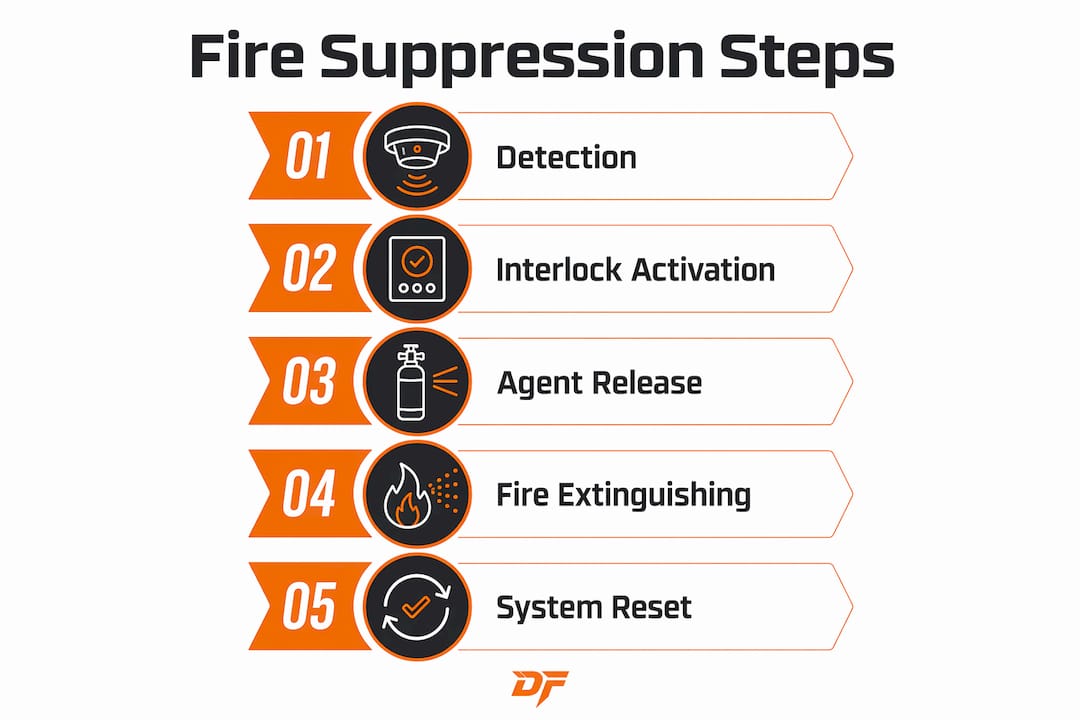
The chain of events from ignition to suppression follows a tight sequence, and every link in that chain matters.
-
Detection. Multi-spectrum flame detectors identify the specific infrared and ultraviolet signatures of a fire in milliseconds. Standard smoke detectors fail in spray booths because coating particles clog sensors and create false alarms. Heat detectors serve as a backup layer, triggering at a set temperature threshold.
-
Signal transmission. The detector sends an electrical signal to the suppression control panel, which confirms the alarm and initiates discharge. This happens in under three seconds in most certified systems.
-
Agent discharge. The system releases a suppression agent through nozzles positioned to cover the entire booth interior. Dry chemical agents such as Monoammonium Phosphate or Sodium Bicarbonate interrupt the chemical chain reaction of combustion and coat fuel surfaces to smother flames. Clean-agent systems use gaseous compounds that suppress fire without leaving residue, which matters when protecting expensive spray equipment.
-
Interlock activation. The suppression system simultaneously shuts down ventilation fans and closes dampers. This step is critical. Active airflow feeds oxygen to a fire and can carry burning vapors beyond the booth. The interlock also cuts power to spray equipment, stopping the source of additional flammable material.
-
Alarm notification. The control panel triggers audible and visual alarms, alerting workers to evacuate and notifying emergency services if the system is connected to a monitoring service.
Pro Tip: Never assume a pressure gauge check confirms your interlock is working. Physical verification of fan shutdown and damper closure during each inspection is the only way to confirm the system will perform correctly during an actual fire event.
What are the key regulatory requirements for spray booth fire suppression?
Compliance is not a checklist exercise. It is a legal obligation with direct consequences for facility managers who fall short.
OSHA and NFPA 33 require automatic fire suppression systems in spray booths using flammable liquids. These systems must be professionally inspected annually per NFPA 17 (dry chemical) or NFPA 17A (wet chemical). NFPA 2001 governs clean-agent systems. Each standard specifies inspection scope, documentation requirements, and component testing protocols.
Key compliance requirements include:
- Annual professional inspection. A certified technician must inspect, test, and document the entire system. Inspection tags expired beyond 12 months result in immediate safety citations and increase the risk of system failure during a fire.
- Portable fire extinguishers. Extinguishers rated 20-B:C must be installed within 10 feet of the spray booth. Monthly visual inspections with documented records are required, along with annual professional servicing.
- Interlock testing. Annual inspections must verify that the suppression system actually shuts down ventilation and spray equipment. Pressure checks alone do not satisfy this requirement.
- Accessibility. Extinguishers must remain unobstructed at all times. Blocked extinguishers are among the most common violations found during fire marshal inspections.
- Documentation. Maintain written records of every inspection, test, and maintenance action. Fire marshals request these records during audits, and gaps in documentation are treated as compliance failures.
Pro Tip: Schedule your annual suppression system inspection and your ventilation system service on the same day. Testing both together confirms the interlock shuts down airflow correctly, which a suppression-only inspection cannot verify in isolation.
Common compliance failures include expired inspection tags, missing monthly extinguisher logs, blocked extinguisher access, and interlock systems that have never been physically tested. Each failure carries citation risk and, more importantly, leaves your facility unprotected.
Why are dry chemical and clean-agent systems preferred over standard sprinklers?
Water is the wrong tool for a spray booth fire. Standard sprinklers are insufficient in spray booth interiors because water spreads flammable liquid fires rather than extinguishing them. When water hits a pool of burning solvent, it can scatter burning fuel across a wider area, accelerating the fire rather than stopping it.
NFPA regulations permit alternative suppression systems inside spray booth interiors while still requiring standard sprinklers in the surrounding building structure where applicable. This creates a two-layer approach: specialized suppression inside the booth, water-based protection for the building around it.
The table below compares the three primary suppression agent types used in spray booth systems:
| Agent type | How it works | Best application |
|---|---|---|
| Dry chemical | Interrupts combustion chemistry; coats fuel surfaces | High-volume production booths with flash fire risk |
| Wet chemical | Saponifies burning oils and fats; cools surfaces | Booths with heated coating processes |
| Clean agent | Displaces oxygen; leaves no residue | Booths with sensitive electronics or precision equipment |
Dry chemical systems using Monoammonium Phosphate or Sodium Bicarbonate are the most common choice in automotive and industrial finishing environments. They knock down vapor fires faster than any water-based system because they attack the combustion reaction directly rather than relying on cooling alone.
One frequently missed compliance detail involves sprinkler head protection. Plastic bags on sprinkler heads to prevent overspray buildup violate NFPA 13. Plastic bags create ignition risks and block the thermal elements that trigger the sprinkler. Only NFPA-approved non-meltable protective covers are permitted. Local fire marshal amendments may impose additional restrictions beyond the base NFPA standards, so always verify local code requirements before selecting protective covers.
What practical steps can facility managers take to maintain fire suppression?
Maintenance is where compliance either holds or fails. A system that was correctly installed three years ago and never tested since is not a functioning safety system. It is a liability.
The spray booth maintenance checklist for fire suppression covers several non-negotiable actions:
- Test interlocks physically. Verify fan shutdown and damper closure during every annual inspection. A pressure gauge reading does not confirm that airflow actually stops.
- Log monthly extinguisher checks. Walk the booth perimeter, confirm extinguisher pressure is in the green zone, check for physical damage, and sign the log. Missing a single month creates a documentation gap that fire marshals flag.
- Keep extinguishers accessible. Never store materials, equipment, or supplies within 10 feet of a booth extinguisher. Access must be immediate.
- Replace expired inspection tags immediately. Do not wait for the next scheduled inspection cycle. An expired tag is a citation waiting to happen.
- Verify suppression nozzle positioning. Nozzles shift over time due to vibration and cleaning. Confirm coverage angles match the original system design at every annual inspection.
Ventilation control is the first line of defense in fire safety in spray booths. Maintaining vapor concentration below 25% of the Lower Explosive Limit (LEL) reduces ignition risk before suppression ever activates. A well-maintained ventilation system reduces the frequency and severity of fire events, making suppression activation a last resort rather than a routine occurrence.
Pro Tip: Train every booth operator on the location and operation of the manual suppression pull station. Operators who have never touched the system in an emergency will hesitate. A 30-minute annual training session eliminates that hesitation.
Operator training on fire suppression system usage and emergency procedures significantly improves response speed and reduces fire impact. Training should cover evacuation routes, manual activation procedures, and the specific hazards of the coatings used in your facility.
Key takeaways
Fire suppression in spray booths requires purpose-built automatic systems, annual certified inspections, and integrated interlock testing to meet OSHA and NFPA 33 standards and protect against rapid vapor fires.
| Point | Details |
|---|---|
| Specialized systems required | Dry chemical, wet chemical, or clean-agent systems are mandatory; standard water sprinklers are not sufficient inside spray booth interiors. |
| Annual inspection is law | OSHA and NFPA 17/17A require professional inspection every 12 months; expired tags result in immediate citations. |
| Interlocks must be physically tested | Fan shutdown and damper closure must be verified by physical test, not pressure gauge readings alone. |
| Ventilation is the first defense | Keeping vapor concentration below 25% of the LEL reduces ignition risk before suppression activates. |
| Operator training reduces fire impact | Annual training on manual activation and emergency procedures measurably improves emergency response outcomes. |
What I’ve learned from watching facilities get this wrong
Most fire suppression failures I’ve seen in spray booth environments share one root cause: the system was installed correctly and then ignored. Facility managers treat the annual inspection as a paperwork exercise rather than a functional test. The interlock gets checked on paper. The fan never actually shuts down during the test. Then a fire happens, the suppression agent discharges, and the ventilation system keeps running, pulling burning vapors through the booth and into the building.
The integration between suppression and ventilation is the most underappreciated detail in spray booth fire safety. These two systems must work as one. When they don’t, suppression activation can actually make a fire worse by creating airflow that carries burning material beyond the booth boundary.
The second pattern I’ve seen repeatedly is deferred maintenance on portable extinguishers. Managers focus on the fixed suppression system and forget that the 20-B:C extinguisher within 10 feet of the booth is the first tool an operator will reach for. An extinguisher with an expired tag or a blocked access path is useless in the first 30 seconds of a fire, which is often the only window where manual intervention makes a difference.
My advice is direct: treat your suppression system like your most critical piece of production equipment. Schedule inspections proactively, test interlocks physically, and make sure every person who works near the booth knows exactly what to do when the alarm sounds.
— Dust
Dustfreefilm and your spray booth safety program
Dustfreefilm has worked with auto body shops and industrial finishing facilities since 2012, supplying dust protection films that keep booth interiors clean and compliant between paint cycles.
A clean booth is a safer booth. Overspray residue buildup on walls and floors creates additional fuel load that makes fire suppression systems work harder. Dustfreefilm’s multi-layer booth protection films reduce residue accumulation, support faster booth turnaround, and complement the fire suppression and ventilation systems your facility depends on. Explore Dustfreefilm’s full range of booth safety resources to see how dust control and fire safety work together in high-production environments.
FAQ
What is fire suppression in spray booths?
Fire suppression in spray booths is an automatic system that detects flames or heat and deploys a suppression agent to extinguish fires in flammable coating environments. OSHA and NFPA 33 require these systems in any booth using flammable liquids.
Why can’t standard water sprinklers be used inside spray booths?
Water spreads flammable liquid fires rather than extinguishing them, making standard sprinklers dangerous inside spray booth interiors. NFPA regulations require dry chemical, wet chemical, or clean-agent systems inside the booth itself.
How often do spray booth fire suppression systems need inspection?
NFPA 17 and NFPA 17A require annual professional inspection of fixed suppression systems. Portable fire extinguishers require monthly visual checks with documented records and annual professional servicing.
What is a suppression system interlock and why does it matter?
An interlock is a mechanism that shuts down ventilation fans and spray equipment the moment the suppression system activates. Without it, active airflow feeds oxygen to the fire and can carry burning vapors beyond the booth.
What suppression agents are used in spray booth systems?
The most common agents are Monoammonium Phosphate and Sodium Bicarbonate dry chemicals, which interrupt combustion chemistry and smother fuel surfaces. Clean-agent systems are used where residue-free suppression is required to protect sensitive equipment.