
TL;DR:
- High-durability booth film is a multi-layer or liquid-applied protective coating designed to shield spray booths from overspray, dust, and wear while simplifying cleaning. Its measurable properties—such as abrasion resistance, static charge, thermal insulation, chemical resistance, and reflectivity—dictate performance and longevity, with multi-layer films offering up to 12 months of protection. Proper selection, surface preparation, and scheduled replacement are essential for maximizing benefits like improved paint quality, reduced cleaning time, and lower energy costs.
High-durability booth film is a specialized protective material engineered to shield spray booth interiors from overspray, airborne dust, and mechanical wear while maintaining the clean conditions required for flawless paint finishes. In the automotive refinishing and industrial coating sectors, the industry standard term is spray booth protective film, though “high-durability booth film” describes the performance tier that separates professional-grade products from basic disposable sheeting. Understanding what separates a high-quality booth film from a standard alternative determines how consistently your booth produces defect-free results and how much time your team spends on cleaning versus painting.
What is high-durability booth film and how does it work?
High-durability booth film is defined as a multi-layer or liquid-applied protective coating designed to adhere to spray booth walls, ceilings, floors, and glass surfaces, capturing overspray and contaminants before they can compromise active paint work. Products like BAXT LAYERSHIELD WP10 from DTC and Gratch LiquiFoil represent the two dominant technology categories in this space. Both are engineered to address the same core problem: spray booths accumulate overspray, dust, and chemical residue at a rate that degrades surface reflectivity, contaminates fresh paint, and forces costly cleaning shutdowns.
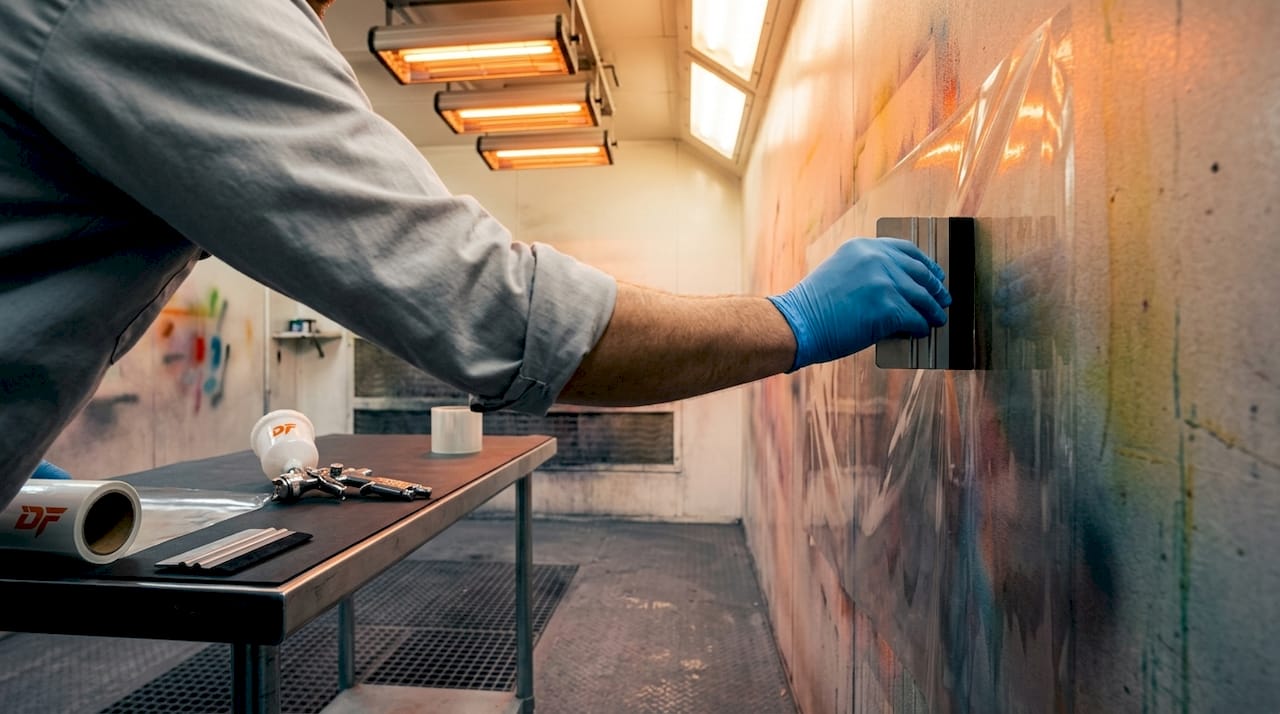
The film acts as a sacrificial barrier. Instead of scrubbing booth walls with solvents between jobs, technicians peel or strip the film layer and expose a fresh surface underneath. This approach reduces cleaning time while protecting the underlying booth structure from long-term chemical and abrasion damage. For high-volume auto body shops and industrial painting facilities, the operational math is straightforward: less downtime per cycle means more vehicles or components processed per shift.
What performance characteristics define high-durability booth films?
The term “high-durability” is not marketing language. It refers to measurable material properties that determine how well a film performs under the thermal, chemical, and mechanical stresses of an active spray booth environment.
The core performance characteristics include:
- Mechanical strength and abrasion resistance. Film hardness directly improves durability by protecting substrates from wear, corrosion, chemicals, and environmental factors. Harder films resist the physical contact that occurs during booth entry, equipment movement, and cleaning routines.
- Static charge for contaminant capture. High-durability self-adhesive films carry an electrostatic charge that actively attracts airborne particles away from the work zone. This is a passive contamination control mechanism that operates continuously during painting.
- Thermal insulation. The static charge and insulating properties of products like BAXT LAYERSHIELD WP10 reduce booth heat loss, which lowers energy consumption during heated cure cycles.
- Chemical resistance. Films must withstand solvent-based overspray, thinners, and cleaning agents without delaminating or releasing contaminants back into the booth atmosphere.
- Transparency or reflectivity. High-quality booth film maintains light reflectivity inside the booth, which is critical for accurate color matching and defect detection during application.
Pro Tip: When evaluating film options, request technical data sheets and look specifically for abrasion cycle ratings and hardness values. Advanced polyimide films, for example, achieve surface hardness up to 5H with mechanical modulus exceeding 6 GPa. These metrics give you a quantitative basis for comparing durability claims across products.
How does multi-layer booth film technology work?
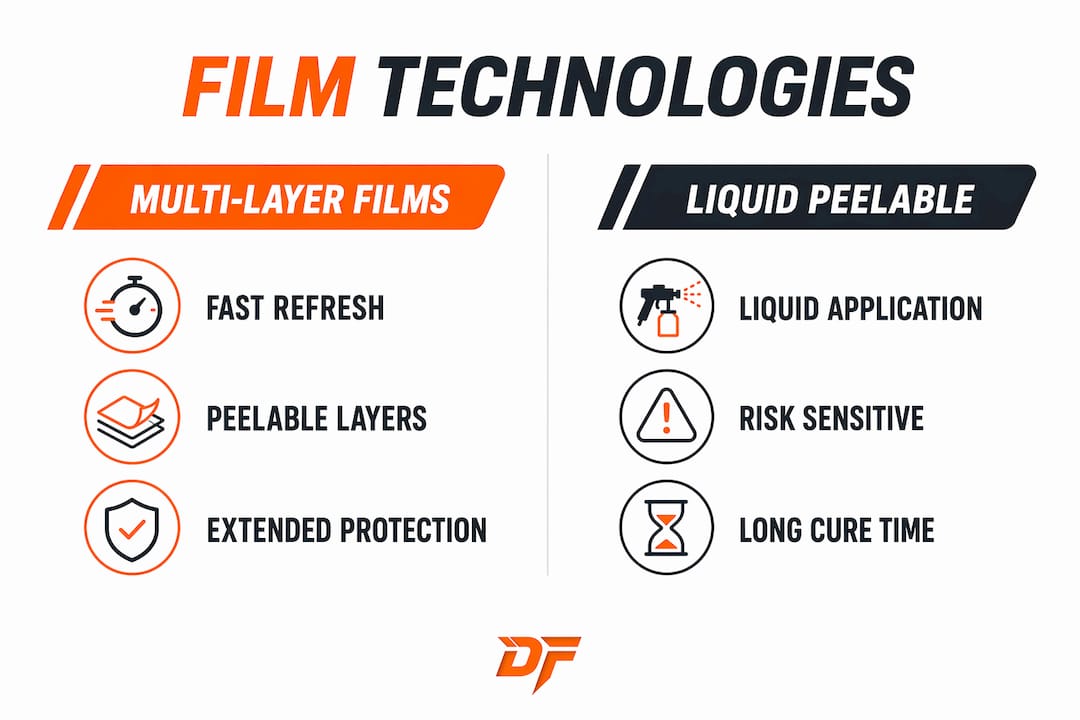
Multi-layer booth film technology is the most significant advancement in spray booth protection over the past decade. Rather than applying and removing a single film repeatedly, multi-layer systems stack several peelable layers into a single installation.
The BAXT LAYERSHIELD WP10 operates on this principle with five separate peelable layers in one product. Here is how the process works in practice:
- Install the multi-layer film onto booth walls using the self-adhesive backing. No additional tools or accessories are required for application.
- The outermost layer captures overspray, dust, and contaminants during normal booth operation.
- When the surface becomes saturated or visually degraded, the technician peels the top layer cleanly away, exposing a fresh layer underneath.
- This process repeats up to five times before the base film requires replacement.
- The BAXT LAYERSHIELD WP10 provides up to 12 months of protection across all five layers under typical operating conditions.
The advantages of this design over single-layer films are significant. Refresh cycles take minutes rather than hours. There is no adhesive residue to clean between cycles. The insulating and electrostatic properties are maintained across all five layers, so performance does not degrade as the film ages.
Comparison: Multi-layer self-adhesive film vs. liquid peelable coating
| Feature | Multi-layer self-adhesive film | Liquid peelable coating |
|---|---|---|
| Application method | Peel-and-stick, no tools needed | Roller or sprayer, requires drying time |
| Refresh speed | Seconds per panel | 1 to 4 hours drying per layer |
| Layer count | Fixed (e.g., 5 layers) | Unlimited reapplication |
| Consistency | Uniform from day one | Depends on application skill |
| Operational risk | Minimal | Dry time and thickness management required |
| Best suited for | High-volume, fast-turnaround operations | Lower-frequency use or irregular surfaces |
Pro Tip: For booths running two or more shifts per day, multi-layer self-adhesive films deliver a faster return on investment because the refresh cycle does not interrupt production. Liquid coatings make more sense for facilities with longer intervals between full booth cleanings.
What are peelable liquid films and how do they compare?
Peelable liquid booth coatings represent an alternative approach to spray booth protection. Products like Gratch LiquiFoil are water-based, non-toxic formulations that are applied wet and dry into an elastic protective layer that can be peeled away intact once saturated.
The key characteristics of liquid peelable films include:
- Application flexibility. Liquid coatings can be applied with a roller or sprayer, making them practical for irregular surfaces, curved panels, or areas where self-adhesive films do not conform easily.
- Drying time of 1 to 4 hours. The drying time depends on ambient temperature, ventilation, and layer thickness. This is the primary operational constraint for liquid coatings.
- Multi-layer reapplication. Once a layer is peeled, a fresh coat can be applied immediately, giving the system an indefinite service life on a given surface.
- Protection scope. Liquid films protect against overspray, dust, and light mechanical stress on walls and ceilings.
The operational risk with liquid coatings is real and should be treated as a quality control issue rather than routine maintenance. Poor application causes weak spots that reduce protection and can lead to film tearing during removal, leaving residue on booth surfaces. Controlling layer thickness and ensuring adequate drying before booth use are non-negotiable steps. Facilities that treat liquid film application as a quick task rather than a controlled process consistently report inconsistent results.
What are the practical benefits of high-durability booth films?
The advantages of high-durability film extend across every dimension of spray booth operation, from paint quality to energy costs.
Protective films improve paint finish quality by reducing overspray contamination that would otherwise settle on active work surfaces. In automotive refinishing, a single dust inclusion in a clear coat requires sanding and repolishing, which adds 30 to 60 minutes to a job. Multiply that across a week of production and the cost of contamination becomes concrete.
The practical benefits across a typical auto body shop or industrial painting facility include:
- Reduced cleaning frequency. Booth walls protected by high-durability film require deep cleaning far less often, cutting solvent use and labor hours.
- Extended booth component life. Walls, light fixtures, and glass panels protected by film accumulate far less permanent overspray buildup, reducing the frequency of structural maintenance.
- Lower energy consumption. The insulating properties of films like BAXT LAYERSHIELD WP10 reduce heat loss through booth walls during cure cycles, which directly lowers gas or electric heating costs.
- Faster booth turnaround. Peeling a film layer takes minutes. Solvent-cleaning a contaminated wall takes significantly longer and requires ventilation time before the next job can begin.
- Floor protection. High-durability floor films protect booth floors from overspray accumulation and chemical spills, reducing slip hazards and extending floor coating life. Dustfreefilm’s floor protection options cover the full range of industrial booth configurations.
How to select and maintain high-durability booth films
Selecting the right film starts with understanding your booth’s operating conditions and your team’s workflow. The wrong product for your environment will underperform regardless of its technical specifications.
Key selection criteria:
- Durability rating and layer count. For high-volume operations, prioritize multi-layer films with at least five peelable layers. For lower-frequency use, liquid coatings offer cost flexibility.
- Adhesion compatibility. Proper surface preparation including cleaning and drying is required before applying any booth film. Contaminated or damp surfaces cause adhesion failure regardless of film quality.
- Temperature rating. Confirm the film’s heat resistance matches your booth’s cure cycle temperatures. Films that soften or delaminate under heat introduce contamination rather than preventing it.
- Storage and shelf life. Most self-adhesive booth films have a shelf life of 12 to 24 months when stored in cool, dry conditions away from direct sunlight. Liquid coatings have similar constraints and should not be applied from containers that have been opened and resealed multiple times.
Pro Tip: Label film rolls with their installation date. Tracking how long each section has been in service helps you schedule replacements proactively rather than reacting to visible degradation. This is especially important for ceiling films, which are harder to inspect during normal operations.
Maintenance best practices are straightforward but frequently overlooked:
- Peel film layers before they become so saturated that removal tears the underlying layer.
- Inspect film edges after every booth cleaning to catch lifting corners before they become full delamination.
- Replace floor films on a fixed schedule rather than waiting for visible wear, since floor film degradation is a slip and contamination risk simultaneously.
Film selection reference
| Booth condition | Recommended film type | Key consideration |
|---|---|---|
| High-volume, fast turnaround | Multi-layer self-adhesive | Minimize refresh downtime |
| Irregular or curved surfaces | Liquid peelable coating | Application flexibility |
| High-temperature cure cycles | Heat-resistant self-adhesive | Confirm temperature rating |
| Floor protection | Dedicated floor film | Slip resistance and chemical resistance |
Key takeaways
High-durability booth film is the single most cost-effective investment a spray booth operator can make to simultaneously improve paint quality, reduce cleaning labor, and lower energy costs.
| Point | Details |
|---|---|
| Definition and purpose | High-durability booth film protects spray booth surfaces from overspray, dust, and mechanical wear. |
| Multi-layer technology | Products like BAXT LAYERSHIELD WP10 deliver up to 12 months of protection across five peelable layers. |
| Liquid vs. self-adhesive | Self-adhesive films refresh in seconds; liquid coatings require 1 to 4 hours of drying and skilled application. |
| Operational benefits | Films reduce cleaning time, extend booth component life, lower energy use, and improve paint finish quality. |
| Selection and maintenance | Surface preparation and scheduled replacement cycles are the two factors most responsible for film performance. |
What I’ve learned from years of watching booths run with and without proper film
The facilities that get the most out of high-durability booth films are not the ones with the most sophisticated products. They are the ones that treat film management as part of their production process rather than an afterthought. I have seen shops invest in premium multi-layer films and then leave them in place until they are so saturated with overspray that peeling them becomes a 20-minute job instead of a 2-minute one. The film did its job. The process failed it.
The comparison between multi-layer self-adhesive films and liquid peelable coatings is often framed as a product debate, but it is really a workflow question. If your booth runs five or more jobs per day, the 1 to 4 hour drying window of a liquid coating is a production constraint you cannot absorb. If your booth runs one or two jobs per day with longer intervals between cycles, liquid coatings offer real cost flexibility and surface conformity that self-adhesive films cannot match on complex geometries.
The energy argument for high-durability films is underappreciated. Booth heating is a significant operating cost, and the insulating effect of wall films is not trivial over a full year of operation. Facilities that track their energy consumption before and after installing quality wall films consistently report measurable reductions in heating costs during cure cycles.
My honest recommendation: start with a film selection guide that matches product specifications to your specific booth conditions, then build a replacement schedule into your standard operating procedures from day one. The film is the easy part. The discipline to manage it correctly is what separates consistent results from inconsistent ones.
— Dust
Protect your booth with Dustfreefilm’s professional-grade solutions
Dustfreefilm has manufactured premium spray booth protective films since 2012, supplying auto body shops, industrial painting facilities, and manufacturing plants across multiple countries with products built to European manufacturing standards.
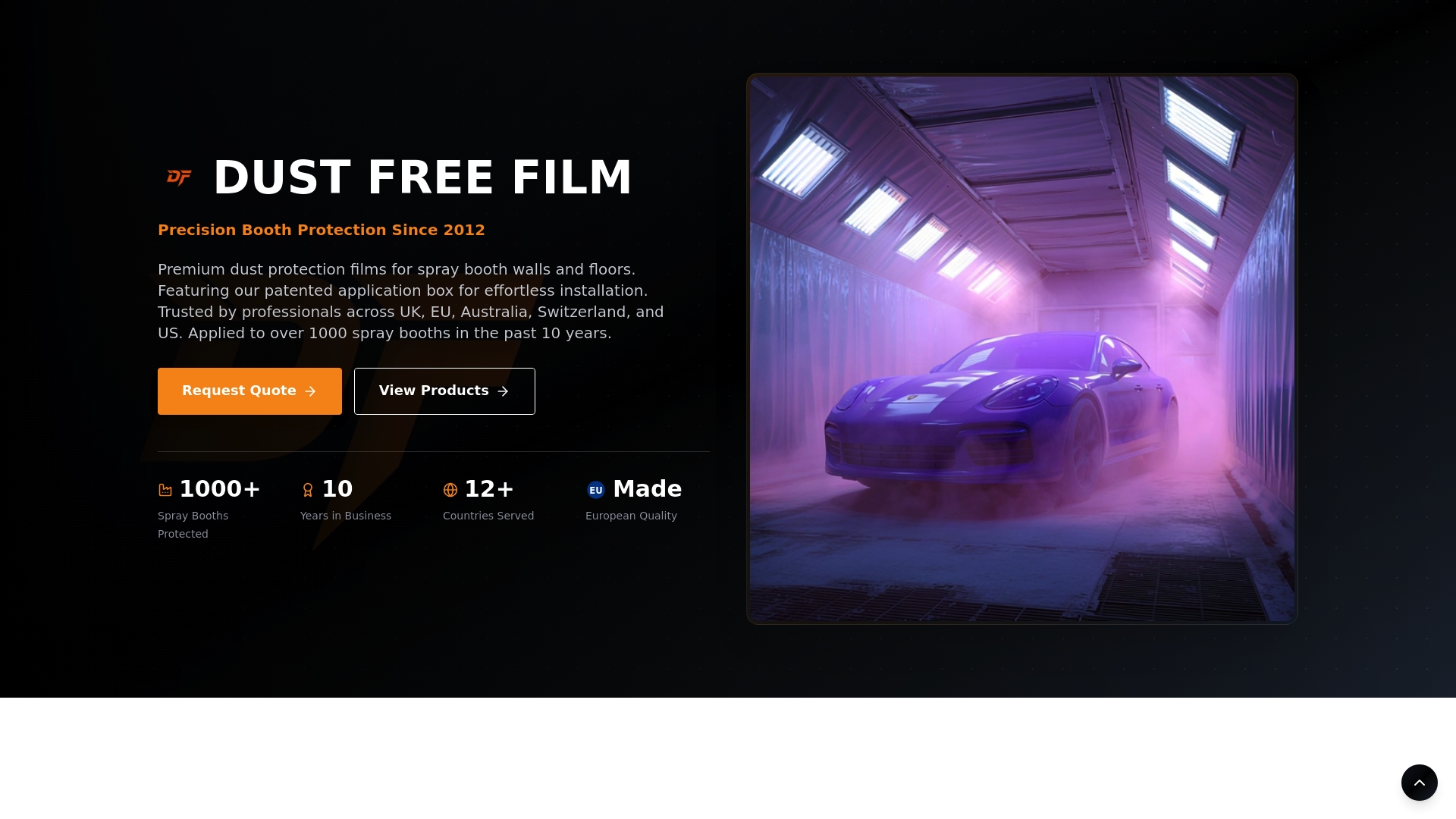
Dustfreefilm’s multi-layer electrostatic wall protectors and dedicated floor films are engineered for high-traffic industrial environments, featuring patented bubble-free installation systems that get your booth protected and back in production fast. Whether you need wall and floor protection for a single booth or a custom configuration for a large-scale facility, Dustfreefilm offers flexible options including bulk purchasing and custom sizing. Request a quote directly through the Dustfreefilm quote page to get product recommendations matched to your booth specifications and volume requirements.
FAQ
What is high-durability booth film made of?
High-durability booth films are typically constructed from polyethylene or polyimide-based materials with self-adhesive or electrostatic backing layers. Liquid variants like Gratch LiquiFoil use water-based polymer formulations that cure into an elastic, peelable protective layer.
How durable is booth film under daily spray booth conditions?
Multi-layer self-adhesive films like BAXT LAYERSHIELD WP10 provide up to 12 months of protection across five peelable layers under typical operating conditions. Durability depends on booth temperature, overspray volume, and how consistently replacement cycles are followed.
What are the main uses of booth film in automotive shops?
Booth film protects walls, ceilings, glass panels, and floors from overspray accumulation, dust contamination, and chemical exposure. It reduces cleaning frequency, extends booth component life, and improves paint finish quality by keeping active work zones free of airborne contaminants.
What are the advantages of high-durability film over standard booth liners?
High-durability films offer measurable advantages including electrostatic contamination capture, thermal insulation that reduces heating costs, multi-layer refresh capability, and resistance to the chemical and mechanical stresses of daily industrial use. Standard liners provide basic coverage without these performance properties.
How do I know when to replace my booth film?
Replace film layers before visible saturation causes tearing during removal. For multi-layer films, peel each layer as soon as surface reflectivity or cleanliness degrades noticeably. For liquid coatings, inspect for cracking, lifting edges, or areas where the film has thinned unevenly, and reapply before those areas fail completely.