

Every paint job, regardless of precautions, contains some level of dust contamination. Studies show that even in controlled spray booth environments, dust particles embed in wet paint layers, creating defects that compromise finish quality and drive up rework costs. Understanding where dust originates, how it damages painted surfaces, and which control methods actually work separates profitable operations from those bleeding money on corrections. This guide examines evidence-based dust control strategies that reduce contamination, improve paint quality, and cut rework expenses in automotive refinishing and industrial painting facilities.
Table of Contents
- Key takeaways
- The impact of dust on paint quality
- Primary dust sources and misconceptions in paint environments
- Spray booth filtration and ventilation best practices
- Practical dust control measures and rework reduction strategies
- Discover dust control solutions for superior paint finishes
- How dust affects paint quality: frequently asked questions
Key Takeaways
| Point | Details |
|---|---|
| Dust embeds in paint | Dust particles embed in wet paint layers, creating defects that require sanding and rework. |
| Major dust sources | Painter skin and clothing account for the majority of dust, with booth surfaces and vehicle contributing smaller but significant amounts. |
| Booth cleanliness matters | Controlling booth cleanliness and filtration helps reduce airborne dust and surface contamination during spraying. |
| Rework cost impact | Dust related defects drive up labor and materials costs due to additional sanding, coatings, and polishing. |
| Prevention strategies | Use PPE, tack cloths, proper filtration, and maintain spray booth balance to minimize dust transfer and improve finish quality. |
The impact of dust on paint quality
Dust contamination creates multiple failure modes in painted surfaces. Dust particles embed in wet paint layers, forming visible dust nibs or dirt specks that create rough texture, reduce gloss, and require sanding or polishing rework. These imperfections are immediately visible under proper lighting and detectable by touch, signaling quality failures to customers.
Beyond surface texture issues, dust causes micro-scratches on clear coat when wiped, dulls finish, traps moisture leading to water spots or oxidation, and accelerates wear if accumulated. Each embedded particle acts as an abrasive point during buffing or cleaning, gradually degrading the protective clear coat layer. The resulting damage compounds over time, shortening the lifespan of the finish.
The financial impact extends beyond aesthetics. Rework caused by dust contamination can double labor and materials cost per job. Technicians must sand affected areas, reapply coats, and polish surfaces to acceptable standards. This cycle consumes shop time, delays customer deliveries, and erodes profit margins on what should be straightforward refinishing work.
Common dust-related paint defects include:
- Dust nibs creating raised bumps requiring wet sanding removal
- Dull or hazy finish from microscopic particle interference
- Orange peel texture amplified by dust preventing proper flow
- Adhesion failures where dust prevents paint-substrate bonding
- Premature clear coat degradation from trapped contaminants
“Nearly all paint jobs suffer some level of dust contamination from multiple sources. The question isn’t whether dust will appear, but how effectively you control it to maintain acceptable quality standards.”
Understanding these mechanisms clarifies why reducing spray booth dust requires systematic approaches rather than hoping for clean conditions. Each contamination pathway demands specific countermeasures.
Primary dust sources and misconceptions in paint environments
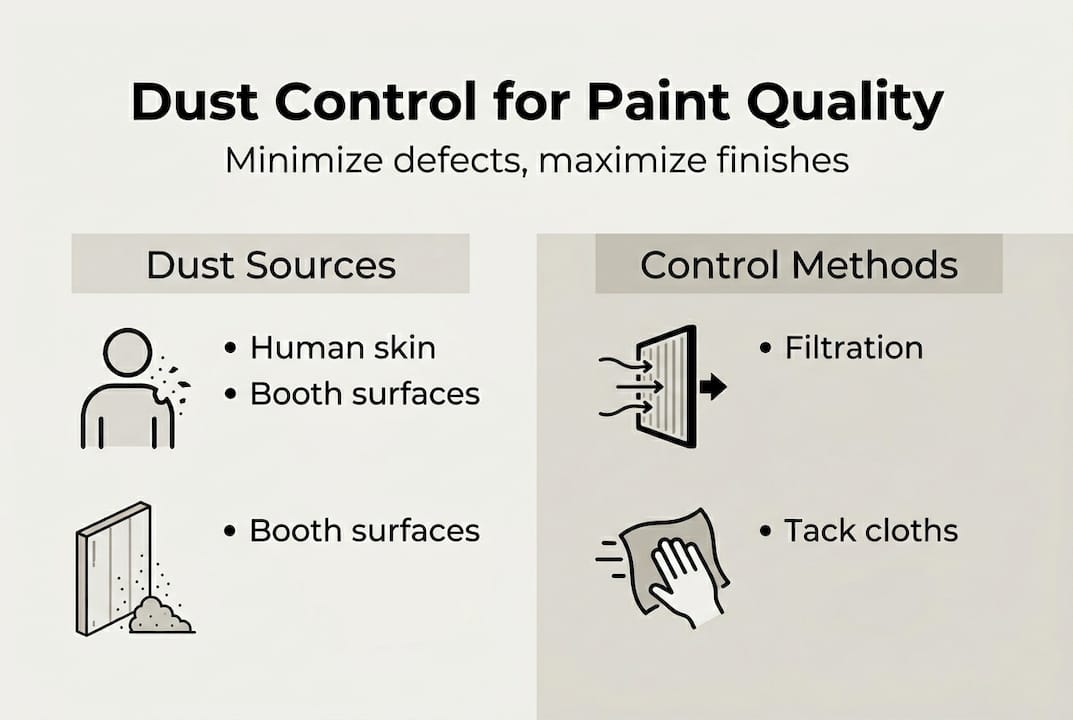
Identifying where dust originates reveals surprising truths about contamination control. Research shows that painter skin and clothing contribute 50-70% of dust, with booth surfaces contributing 40% and the vehicle itself only 10%. This distribution contradicts the common assumption that environmental dust dominates contamination.
Human sources generate continuous particle streams during painting operations. Skin cells shed naturally at rates of thousands per minute. Fabric fibers detach from clothing with every movement. Hair releases particles despite caps or nets. These biological and textile sources create a constant dust cloud around painters, settling directly into wet paint as application proceeds.
Booth contamination, while secondary, still matters significantly. Dust accumulates on walls, floors, and fixtures between jobs. Air currents during spraying lift settled particles back into circulation. Inadequate filtration allows external dust infiltration. Each factor adds to the contamination load that painters must manage.
A persistent myth claims that wetting floors reduces airborne dust. The same research found wetting floors doesn’t reduce dust in painting environments. Water may temporarily suppress some settled particles but doesn’t address the primary human sources or prevent booth dust from becoming airborne during high-velocity spraying operations.
Effective dust control requires addressing these realities:
- Focus personal protective equipment on containing painter-generated particles
- Implement strict clothing protocols using lint-free suits and gloves
- Maintain booth cleanliness through regular washing and vacuuming cycles
- Ensure proper spray booth dust control tips are followed consistently
- Verify spray booth setup guide standards for airflow and filtration
Pro Tip: Conduct a simple test by placing clean black paper in your booth overnight. The visible dust accumulation reveals your baseline contamination rate and helps prioritize control measures.
Recognizing that painters themselves are the largest dust source shifts control strategies toward personal hygiene and PPE rather than solely environmental modifications. Both matter, but resource allocation should reflect actual contribution percentages.
Spray booth filtration and ventilation best practices
Engineered air handling systems form the foundation of dust control in professional spray environments. Multi-stage filters capturing particles larger than 10μm at 82.5% efficiency and particles larger than 1μm at 98% efficiency with air velocity between 0.25 and 0.30 meters per second are essential to reduce dust contamination. These specifications aren’t arbitrary; they target the particle size ranges that cause visible paint defects.
Pre-filtration stages remove larger particles before air enters the main booth volume. G3-rated pre-filters capture construction dust, lint, and larger environmental contaminants. This initial screening extends the life of downstream filters and maintains consistent airflow rates. Neglecting pre-filtration causes premature clogging of expensive final filters.
Ceiling or supply filters provide the critical final cleaning stage. F5-rated filters capture the 1 to 10 micron particles that embed in wet paint as dust nibs. These filters must maintain specified efficiency while allowing proper air velocity. Restricted airflow from clogged filters reduces contamination control and disrupts spray patterns.
Balanced airflow patterns prevent dust circulation and maintain booth cleanliness. Downdraft configurations pull contaminated air downward and away from painted surfaces. Positive pressure relative to surrounding areas prevents infiltration of external dust. Air changes per hour must meet minimum thresholds to continuously flush particles from the work zone.
The financial case for proper ventilation is compelling. Ventilation improvements can reduce defects by 45%, cutting rework costs significantly. This reduction translates directly to labor savings, faster job completion, and improved customer satisfaction. The payback period for ventilation upgrades often measures in months rather than years.
| Filter Stage | Particle Size | Efficiency | Purpose |
|---|---|---|---|
| Pre-filter (G3) | >10μm | 82.5% | Remove large dust, lint, debris |
| Final filter (F5) | >1μm | 98% | Capture paint-damaging fine particles |
| Air velocity | N/A | 0.25-0.30 m/s | Maintain proper particle removal rate |
| Air changes | N/A | 15-20 per hour | Continuously flush contaminated air |
Maintaining this performance requires discipline. Filter change intervals depend on usage intensity but typically range from quarterly to annually. Visual inspection catches obvious problems, but pressure differential monitoring provides objective performance data. Rising pressure drop signals filter loading and approaching change-out time.
Regular booth cleaning complements filtration by reducing the dust reservoir available for re-entrainment. Protecting spray booths through systematic maintenance prevents contamination buildup. Walls, floors, and fixtures require periodic washing to remove accumulated overspray and dust.
Pro Tip: Install magnehelic gauges across each filter stage to monitor pressure drop in real time. Replace filters when pressure exceeds manufacturer specifications, not on arbitrary calendar schedules. This approach optimizes both performance and filter costs.
Following a comprehensive spray booth maintenance workflow ensures that ventilation and filtration systems deliver consistent contamination control across all jobs.
Practical dust control measures and rework reduction strategies
Engineering controls provide the foundation, but operational practices determine actual contamination levels in finished work. Personal protective equipment directly addresses the largest dust source by containing particles shed from painters. Wearing disposable PPE suits and nitrile gloves minimizes skin and fabric dust shedding during application. These barriers prevent the 50 to 70 percent of contamination originating from human sources.
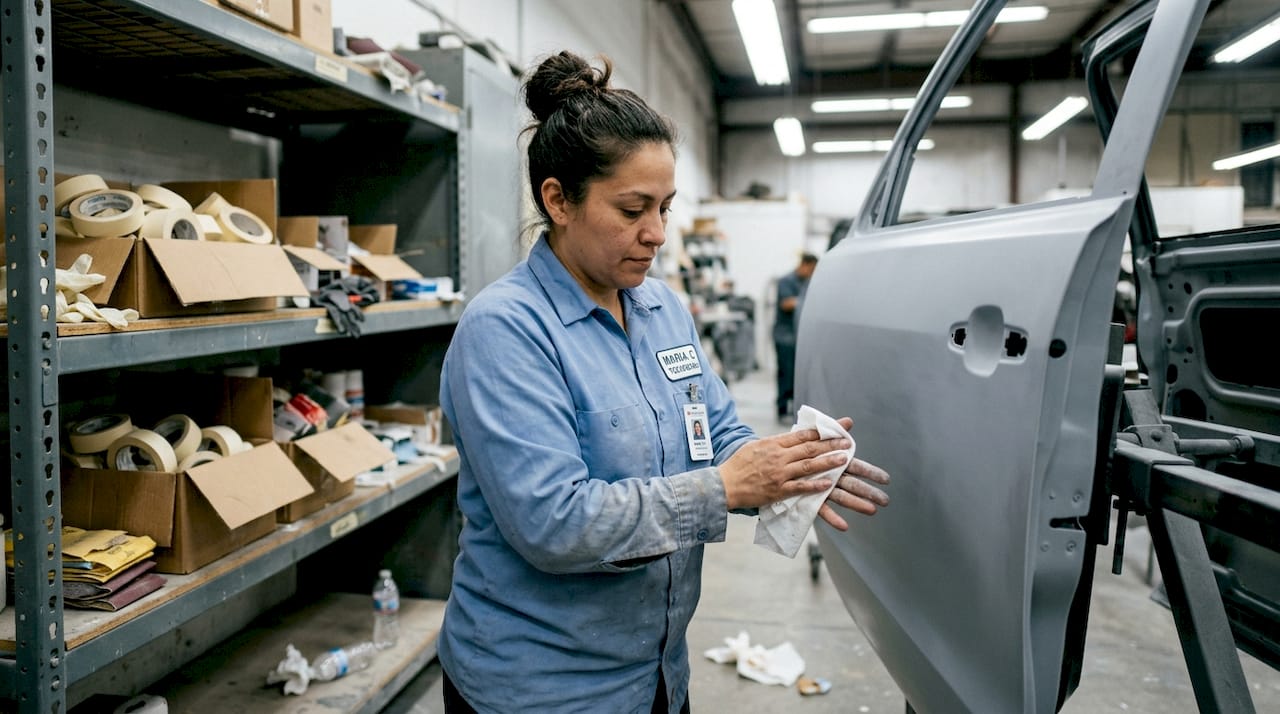
Tack cloths capture dust immediately before each coat application. These sticky cloths lift particles from surfaces without leaving residue. Proper technique involves light, overlapping strokes across all painted areas. Skipping this step guarantees that settled dust becomes embedded in the next wet coat.
Sanding between coats removes imperfections before they become permanent. Use of tack cloths, P400-P800 grit sanding and polishing between coats removes dust nibs effectively. Wet sanding with these grits levels embedded particles without creating deep scratches. Dry sanding works for spot corrections but generates its own dust that requires thorough removal.
The economics justify these extra steps. Dirt rework costs average about $170 per repair order, and ventilation combined with PPE can reduce defects by 45%. Spending five minutes on tack cloth application and inter-coat inspection prevents hours of correction work and material waste.
A systematic workflow minimizes contamination at every stage:
- Clean booth walls, floors, and fixtures before bringing in work
- Inspect and verify filter condition and airflow performance
- Prepare vehicle surface through proper sanding and solvent wiping
- Don clean PPE suit, gloves, and hair covering immediately before painting
- Use tack cloth on all surfaces within two minutes of paint application
- Apply paint with proper technique maintaining optimal spray distance
- Allow flash time between coats per manufacturer specifications
- Tack cloth and inspect between each coat for embedded particles
- Wet sand any nibs with appropriate grit before applying next coat
- Final polish after cure using compound appropriate for clear coat hardness
Strict booth preparation prevents re-contamination from previous jobs. Following detailed spray booth preparation steps establishes clean conditions before work begins. This includes vacuuming floors with HEPA filtration, wiping surfaces with tack cloths, and allowing ventilation to run for several minutes before introducing painted parts.
Comprehensive paint booth contamination prevention addresses all contamination pathways through coordinated engineering and operational controls. No single measure eliminates dust, but layered defenses reduce it to acceptable levels.
Pro Tip: Create a pre-paint checklist that painters must complete and sign before spraying. This accountability measure ensures consistent execution of dust control protocols even during busy periods when shortcuts become tempting.
Training reinforces these practices across all staff members. Regular refreshers on dust sources, control methods, and rework costs keep contamination control top of mind. New technicians require thorough orientation on facility-specific protocols before working independently.
Discover dust control solutions for superior paint finishes
Implementing the strategies outlined requires both operational discipline and physical protection for your spray environment. Dust Free Film manufactures premium protective films engineered specifically for automotive refinishing and industrial painting applications. Our multi-layer electrostatic booth wall and floor protectors create barriers that prevent dust accumulation on booth surfaces, directly addressing the 40 percent of contamination originating from booth sources.

These films feature heat-resistant, static-free construction suitable for high-traffic industrial settings. The patented application system enables quick, bubble-free installation that minimizes booth downtime. When films become contaminated with overspray or dust, simple replacement restores clean conditions in minutes rather than hours required for traditional booth cleaning.
Our solutions complement the filtration and ventilation systems you’ve already invested in. By controlling surface contamination, protective films reduce the particle reservoir available for re-entrainment into booth air. This layered approach delivers measurable improvements in paint quality and reductions in rework frequency.
Facilities serving multiple customers or handling high-volume work benefit most from protective film systems. The time savings from rapid changeovers between jobs, combined with reduced cleaning labor, typically offset film costs within months. Custom configurations accommodate various booth sizes and layouts.
Explore how dust free film spray booth protection integrates with your existing contamination control program. Our team helps you select appropriate products based on your specific refinishing applications, booth configuration, and volume requirements. Request a dust free film quote to discover how protective films can enhance your paint quality and operational efficiency.
How dust affects paint quality: frequently asked questions
What are dust nibs and why do they matter?
Dust nibs are tiny particles that embed in wet paint, creating raised bumps or rough texture on the finished surface. They reduce gloss, require sanding to remove, and signal quality failures to customers. Even small nibs are visible under proper lighting and detectable by touch.
Why do painters contribute more dust than the spray booth?
Human skin sheds thousands of cells per minute, and clothing releases fabric fibers with every movement. Research shows painter skin and clothing contribute 50 to 70 percent of total dust, while booth surfaces contribute 40 percent and vehicles only 10 percent. This makes personal protective equipment critical for contamination control.
How does multi-stage filtration reduce paint defects?
Pre-filters remove particles larger than 10 microns at 82.5 percent efficiency, while final filters capture particles larger than 1 micron at 98 percent efficiency. This two-stage approach targets the particle sizes that cause visible paint defects. Combined with proper air velocity, these systems can reduce defects by up to 45 percent.
What does dust contamination rework actually cost?
Dirt-related rework averages $170 per repair order when accounting for labor, materials, and booth time. Jobs requiring correction often double their total cost compared to initial estimates. These expenses accumulate quickly across multiple jobs, significantly impacting shop profitability.
When should I sand between paint coats?
Sand between coats whenever you detect dust nibs or surface imperfections during inspection. Use P400 to P800 grit wet sanding to level embedded particles without creating deep scratches. Always follow with tack cloth application before applying the next coat. This inter-coat correction prevents minor issues from becoming permanent defects.