

TL;DR:
- Dust contamination causes costly rework and affects paint quality and worker health.
- Proper layering of barriers, airflow, and cleaning strategies significantly reduces airborne particles.
- Consistent SOPs and staff buy-in are critical to effective dust control and flawless finishes.
Even a single microscopic particle landing on fresh paint can turn a flawless finish into an expensive callback. Dust at the PM1 to PM10 scale, which is invisible to the naked eye, settles in clearcoat during spray application and causes fisheyes, craters, and texture defects that require full panel rerefinishing. Most shop managers assume that sweeping the floor and wiping down surfaces before a job is enough protection. It is not. This guide explains exactly how dust barriers work, which setups fit different shop layouts, and how layering barriers with complementary controls will raise your finish quality and cut rework hours.
Table of Contents
- Why dust control matters in auto refinishing
- How dust barriers function: Core principles and types
- Implementing dust barriers: Strategies for real-world shops
- Beyond barriers: Integrating control measures for best results
- What most guides miss about dust barriers
- Ready to upgrade your shop’s dust control?
- Frequently asked questions
Key Takeaways
| Point | Details |
|---|---|
| Dust barriers prevent defects | Using barriers keeps microscopic dust from ruining paint finishes and reduces costly rework. |
| Adapt barriers to your shop | Choose barrier types and strategies based on shop layout, workflow, and team needs for the best outcome. |
| Layered control is essential | Barriers work best as part of a full dust control system with cleaning and air management. |
| Consistency matters most | Routine use and staff buy-in determine the real-world effectiveness of any dust barrier setup. |
Why dust control matters in auto refinishing
Paint defects caused by airborne particles are not just a nuisance. They represent real money lost on materials, labor, and customer goodwill. A single rework job can consume two to four additional labor hours, plus primer, base, and clear, all because contamination slipped through during the spray window.
The dust-free painting advantages go well beyond cosmetics. When your booth produces consistent, defect-free panels, your team moves faster, your cycle time drops, and your customer satisfaction scores climb. Conversely, shops that treat dust control as an afterthought spend a disproportionate share of their week on correction work.
Here is what happens at the particle level during a typical refinishing job:
- Dust suspended in booth air settles into wet basecoat and clearcoat, creating inclusions that cure in place
- Sanding dust from adjacent bays migrates through gaps in booth doors or poorly sealed curtain edges
- Dead skin cells, lint from shop towels, and booth overspray buildup all contribute to the contamination load
- Airborne particles from prep areas travel on air currents generated by technicians walking through the shop
Beyond finish quality, paint quality improvements are directly tied to worker health. Isocyanate particles and sanding dust classified as PM1 through PM10 are respirable, meaning they penetrate deep into lung tissue. Shops that do not control these particles expose their techs to long-term respiratory risk and face potential regulatory liability.
Research confirms that layered approaches reduce rework, airborne PM1 to PM10 levels, and health exposures simultaneously, making barrier-equipped processes a proven standard in high-volume refinishing environments.
“Layered approaches including barriers reduce rework, airborne PM1-PM10 levels, and health exposures, producing measurable improvements in both quality outcomes and worker conditions.”
The financial case is straightforward. Every dollar invested in reliable dust containment returns multiple dollars in avoided rework, reduced material waste, and faster vehicle throughput. The question is not whether to use barriers, but which type to deploy and where.
How dust barriers function: Core principles and types
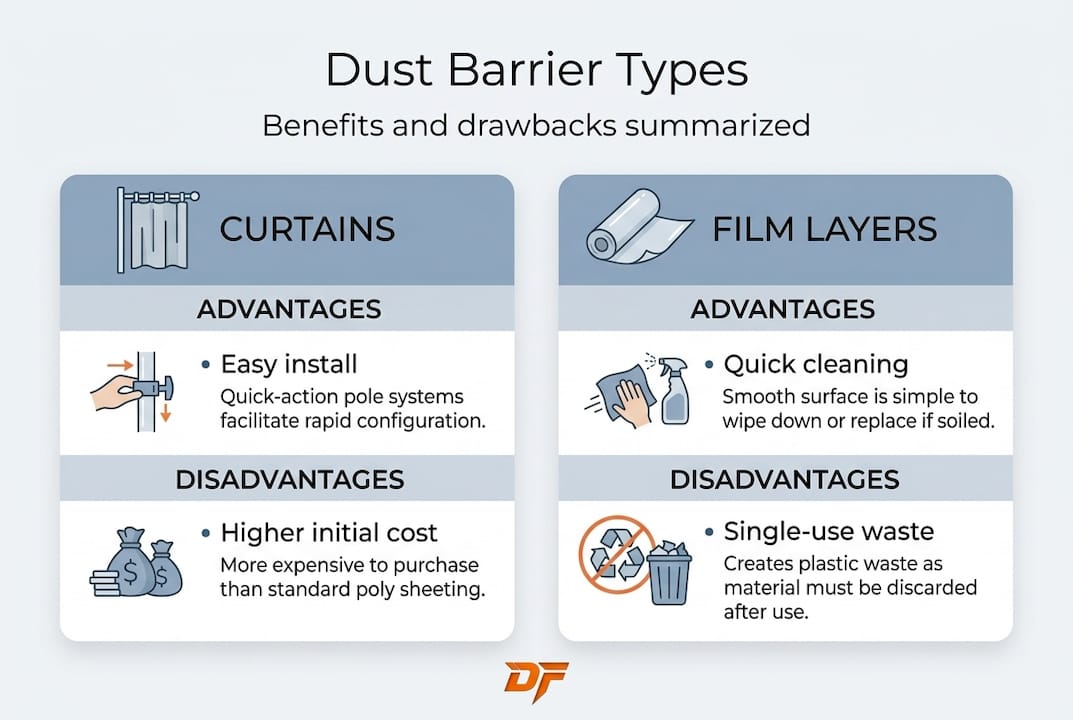
A dust barrier is any physical system designed to prevent airborne particles from reaching a surface during the spray or cure phase. That definition covers a wide range of solutions, from heavyweight plastic curtains to precision-engineered multilayer electrostatic films.
Understanding the differences between barrier types helps you match the right tool to each situation. Here is a comparison:
| Barrier type | Best application | Key advantage | Limitation |
|---|---|---|---|
| Plastic curtains | Open bays, mobile repair | Portable, low cost | Less effective seal |
| Fabric curtains | Temporary enclosures | Reusable, flexible | Require regular cleaning |
| Booth wall films | Enclosed spray booths | Static-free, fast change | Fixed installation |
| Floor films | Booth floors | Traps settled dust | Must be peeled regularly |
| Rigid panels | Permanent partitions | Durable long-term | High installation cost |
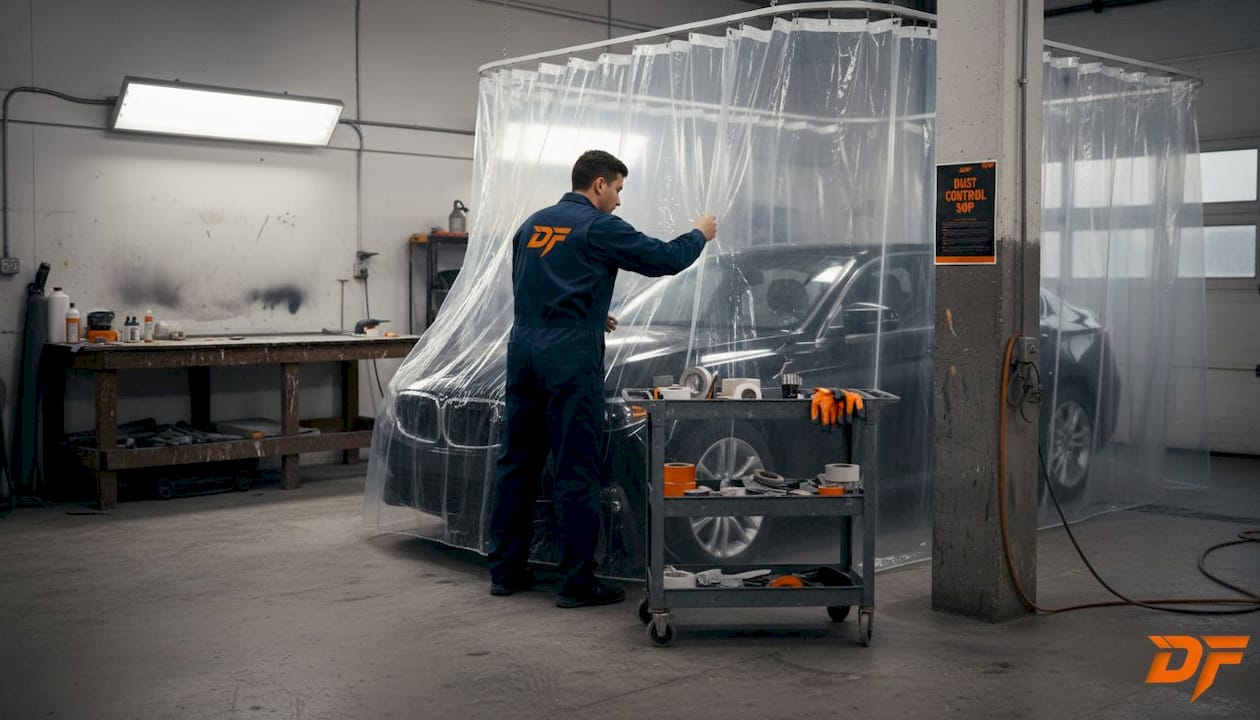
Curtain systems create temporary enclosures for mobile sanding or open shop layouts, and positive pressure inside those enclosures prevents dust ingress from surrounding areas. This is an important distinction: the curtain alone does not eliminate contamination. It works because it traps pressurized, filtered air and prevents external particles from flowing in.
Specialty booth films take a different approach. Applied directly to booth walls and floors, these multilayer electrostatic films neutralize static charge, which is a major but often overlooked driver of dust adhesion. Static buildup on bare booth walls acts like a magnet, pulling particles off surfaces and recirculating them into the spray environment. A properly applied static-free film eliminates that mechanism entirely.
To understand the physical protection workflow these types of spray booth barriers provide, think of it as a sequential chain:
- Gross contamination is blocked at the booth perimeter by curtains or sealed doors
- Residual particles settling on walls are captured by the film surface rather than being dislodged by airflow
- Floor films trap particles that fall from the vehicle and walls, preventing them from being kicked back into the air
- After the job, the outermost film layer is peeled away, revealing a fresh, clean surface for the next vehicle
- The booth is ready for the next job in minutes rather than requiring a full deep-clean cycle
Pro Tip: For shops running both enclosed booths and open-bay prep work, use permanent film on booth walls paired with portable curtain systems in the prep area. You get the best contamination control for both zones without overspending on either.
The multilayer peel system is one of the most practical innovations in spray booth protection. Rather than scrubbing walls between jobs, technicians simply remove the top layer and expose a clean surface underneath. In a busy shop running multiple vehicles per day, this time saving adds up to hours per week.
Implementing dust barriers: Strategies for real-world shops
Knowing the product options is one thing. Fitting them into your specific shop layout is another. Three common shop configurations each call for a distinct approach.
| Shop setup | Recommended barrier strategy | Priority area |
|---|---|---|
| Traditional enclosed booth | Multilayer wall and floor films | Walls and floor peeling routine |
| Open bay with prep work | Portable curtains plus floor film | Curtain sealing and airflow direction |
| Mobile repair operation | Portable curtain tent systems | Wind and positive pressure management |
| Multi-booth production facility | Combined films and zoning curtains | Cross-contamination between bays |
For enclosed booths, the biggest gains come from clean booth practices that include a consistent film peeling schedule. Many shops make the mistake of leaving booth wall films in place too long. Once the outermost layer accumulates overspray and sanding dust, it stops performing as a clean capture surface and starts shedding particles back into the spray environment. Peeling on a set schedule, whether per job or per day depending on volume, keeps the booth in optimal condition.
Open bay environments present a different challenge. Multi-layer dust protection benefits these setups too, but the perimeter containment must come first. Without walls to mount film on, portable curtain frames become the primary barrier. Position them to create the smallest practical enclosure around the work area to maximize the effectiveness of your air filtration.
Common pitfalls to avoid when implementing barriers include:
- Setting booth airflow too high, which creates turbulence that lifts settled particles off floor films and walls
- Using curtain systems without sealing the bottom edge to the floor, leaving a gap for contaminated air to flow under
- Installing booth films without removing existing overspray buildup first, which prevents proper adhesion
- Skipping the static neutralization step in booths with high static buildup before applying electrostatic film
- Reusing disposable film layers by wiping them down rather than peeling them off
Layered approaches are effective even where no rigid enclosure exists, as in open or mobile setups, confirming that shop type is not an excuse for poor contamination control. And as research on temporary enclosures confirms, curtains can create effective temporary enclosures in challenging environments, but airflow must be carefully managed to avoid undermining the enclosure’s effectiveness.
Pro Tip: Write barrier setup and teardown steps directly into your standard operating procedures (SOPs) for each bay type. When barrier management is a named step in the job process rather than an informal habit, technician compliance goes up and inspection callbacks go down.
Involving your team in the selection process also pays dividends. When techs participate in choosing between barrier options, they understand why the system works and take more ownership over maintaining it correctly.
Beyond barriers: Integrating control measures for best results
Barriers alone will reduce contamination significantly. But the shops producing the most consistent, defect-free finishes treat barriers as one layer in a coordinated system. Think of it as rings of defense, each one catching what the previous ring misses.
A complete layered control framework for automotive refinishing includes these measures:
- Zone separation: Physically separate sanding, prep, and spray areas to prevent cross-contamination at the source. Even a simple curtain between the prep bay and the spray booth entrance reduces the particle load entering your refinishing environment.
- Scheduled cleaning cycles: Booth walls, floors, and ledges collect dust between film peel cycles. Scheduled damp-wiping of surfaces outside the film coverage area removes particles before they migrate inward.
- Air management: Booth air pressure must be slightly positive relative to the surrounding shop to prevent contaminated outside air from being drawn in when the booth door opens. Regular filter inspection and replacement is non-negotiable.
- Humidity control: Maintaining relative humidity in the 45 to 60 percent range significantly reduces electrostatic particle adhesion and keeps dust particles heavier, so they settle to the floor rather than remaining suspended in the spray zone.
- Entry discipline: Lint-free garments, tacky mats at booth entrances, and a “no walking through during spray” rule eliminate the single biggest source of contamination in many shops, which is the technician themselves.
- Equipment maintenance: Spray guns with worn seals or dirty air caps introduce contaminants directly into the paint stream. Regular equipment inspection is a dust control measure, not just a tool maintenance task.
Research confirms that humidity, positive pressure, and multi-layered strategies further drive down airborne particle levels beyond what any single measure achieves alone.
Connecting all these elements to paint booth contamination prevention requires thinking about the full vehicle journey through your shop. Every handoff point, from the disassembly bay to the paint booth to the cure station, is an opportunity for contamination to occur or be prevented.
“Humidity, positive pressure, and multi-layered strategies further drive down airborne particle levels, demonstrating that no single control method outperforms a coordinated, systemic approach.”
When you build this layered system consciously, the results compound. Fewer particles in the air means less film depletion, longer periods between deep-clean cycles, and more spray jobs completed without a rework flag. The initial investment in the full system pays back faster than any single-point solution.
What most guides miss about dust barriers
Here is something worth saying plainly: most shops that struggle with dust contamination are not using the wrong products. They are using the right products inconsistently.
We have worked with shops that invested in premium booth films and saw marginal improvement, not because the films failed, but because technicians were skipping the peel cycle when they were busy or rushed. The product works. The process broke down. That is a management and culture problem, not a product problem.
The real difference between a shop that eliminates dust callbacks and one that still battles them month after month comes down to two things: consistent SOPs and staff buy-in. Managers who walk the floor and check barrier condition before every spray job, not just after a bad inspection report, build the standard into the team’s daily rhythm. The techs who understand why the barrier matters, not just that it is required, maintain it correctly even when supervision is light.
Achieving flawless finishes is ultimately less about technology and more about discipline. The technology enables the result. The discipline delivers it reliably.
One practical step that more shop managers should take is empowering technicians to report barrier issues without fear of blame. If a film is not adhering properly, or a curtain track is damaged, or a seal is loose, you want that information immediately, not after a vehicle comes out with inclusions in the clear. Create a simple reporting habit, even just a whiteboard in the booth area, where techs can flag barrier condition issues for the next shift.
Pro Tip: Rotate responsibility for booth barrier inspection among your senior techs. When different team members are accountable for the check, you build redundancy into the system and invest multiple people in the outcome.
The shops that lead in refinishing quality are not necessarily the ones with the newest equipment. They are the ones where the standard is maintained every day, by every person who enters the booth.
Ready to upgrade your shop’s dust control?
If this article helped clarify what effective dust control actually looks like in practice, the next step is finding the right products for your specific setup.

At Dust Free Film, we manufacture premium multilayer electrostatic booth films designed specifically for automotive refinishing environments. Our patented dispenser system makes installation fast and bubble-free, and our heat-resistant, static-free films are built for the demands of high-volume production shops. Whether you run a single enclosed booth or a multi-bay production facility, we can configure a barrier solution that fits your workflow and budget. Explore dust barrier films to see our full product range, or request a custom quote and get pricing and recommendations tailored to your shop’s specific needs.
Frequently asked questions
What types of dust barriers are best for automotive refinishing?
Curtains, films, and fixed panels are commonly used options, and the right choice depends on your shop’s workflow and physical layout. Curtains create temporary enclosures that work well for mobile sanding or open shop configurations, while multilayer films are the preferred solution for enclosed spray booths.
Do dust barriers reduce the need for recleaning or repainting?
Yes, effective barriers significantly reduce the frequency of rework by minimizing airborne contaminants during the spray phase. Research confirms that layered approaches including barriers reduce rework along with airborne particle levels and health exposures in refinishing environments.
Can dust barriers be used in open or mobile repair operations?
Yes, portable curtain systems offer a practical way to contain dust in non-enclosed or mobile scenarios. Curtains create temporary enclosures for mobile sanding or open shop layouts and work most effectively when combined with positive pressure airflow management.
What else should be used alongside dust barriers for best results?
Combining barriers with humidity control, zone separation, positive pressure airflow, and scheduled cleaning cycles delivers the most reliable protection. Humidity, positive pressure, and multi-layered strategies further drive down airborne particle levels beyond what barriers alone can achieve.