
TL;DR:
- Protective films prevent dust and overspray contamination, ensuring superior paint finishes.
- Regular film replacement every 60 to 90 days maintains contamination control and booth cleanliness.
- Using industry-quality, heat-resistant, multi-layer films enhances efficiency and reduces rework costs.
Paint quality matters, but it’s only part of the equation. Even the most carefully selected basecoat or clearcoat can fail when invisible enemies like airborne dust, loose debris, and drifting overspray land on a freshly coated surface. In a busy auto body or industrial painting facility, that kind of contamination isn’t rare — it’s a constant threat. Protective films for spray booths are one of the most effective yet underused defenses against it. This guide walks through how contamination happens, how films stop it, what to look for when choosing a film, and how to apply and maintain them for consistently flawless results.
Table of Contents
- Why dust and overspray sabotage superior paint finishes
- How protective films prevent contamination in spray booths
- Choosing the right film for your facility and process
- Implementing film protection: Best practices and maintenance
- Our take: The hidden ROI of film protection
- Elevate your paint finish with Dust Free Film solutions
- Frequently asked questions
Key Takeaways
| Point | Details |
|---|---|
| Films block contaminants | Protective films trap dust and overspray, ensuring consistently clean paint finishes. |
| Regular replacement matters | Replacing films every 60-90 days keeps protection consistent for top-quality results. |
| Choose the right film | Selecting films with proper durability and heat resistance is crucial for your specific spray booth. |
| ROI extends beyond materials | Investing in quality film protection reduces costly rework and boosts overall efficiency. |
Why dust and overspray sabotage superior paint finishes
Building on the need for more than just high-quality paint, let’s examine the most common enemies of a flawless finish.
Dust is not just a nuisance. A single particle of dust, invisible to the naked eye under normal lighting, can settle into a wet coat and cause a crater or fisheye that requires full rework to correct. In automotive refinishing, that means sanding back, recoating, and re-curing — an expensive, time-consuming cycle that could have been avoided entirely with the right precautions in place.
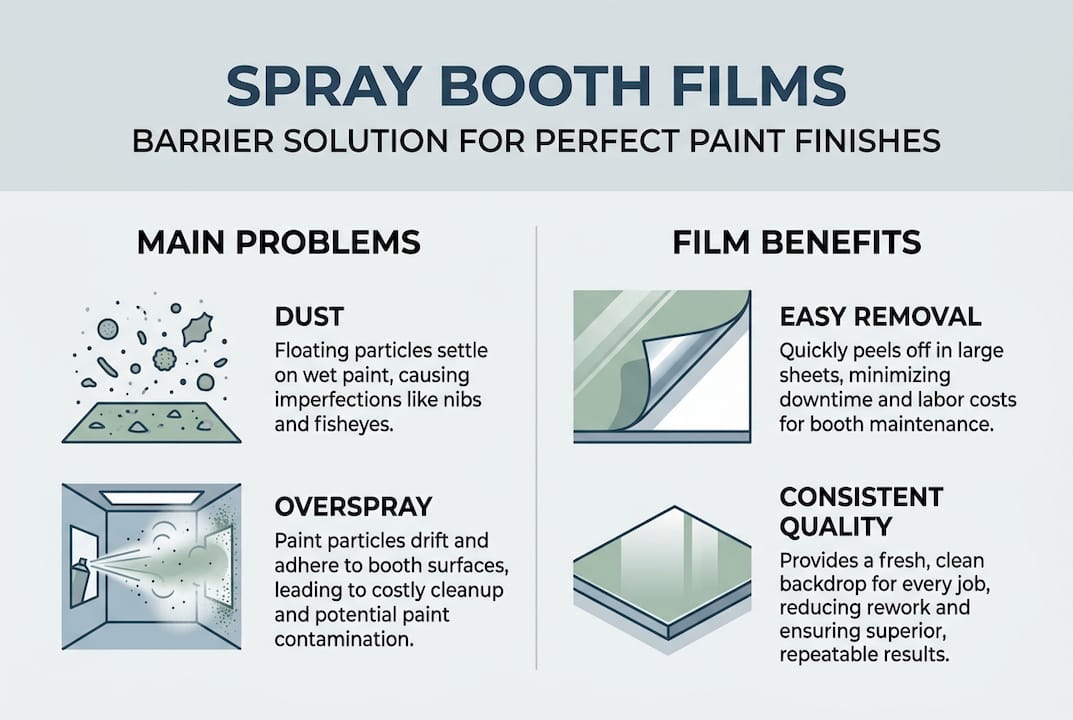
Overspray is an equally serious problem. When paint mist drifts beyond the target surface and lands on booth walls, floors, or lights, it builds up layer after layer. That accumulated overspray can flake off during a future spray cycle and land directly on a fresh coat, creating texture defects and contamination that are difficult to trace back to their origin. Technicians often blame the paint or the gun when the real culprit is the booth environment itself.
The consequences of an uncontrolled booth environment go beyond individual job failures. Quality rejects, customer complaints, insurance claims, and the cost of wasted materials stack up quickly. For larger industrial painting operations handling high volumes, even a modest increase in rework rates can translate into thousands of dollars lost each month.
The most effective way to stop these threats at the source is to contain them before they can circulate. Here’s what contamination actually looks like in a working booth:
- Airborne dust settles during and after spraying, especially during surface preparation stages
- Overspray drift occurs when spray pressure or incorrect gun settings send fine mist beyond the work surface
- Floor disturbance kicks up settled debris when technicians or vehicles move through the booth
- Wall buildup accumulates over time if surfaces are not protected and cleaned regularly
- Light fixture residue creates a secondary source of contamination as overspray bakes onto unprotected fixtures and then chips off
“Protective films applied to spray booth floors, walls, windows, and lights trap overspray, dust, and dirt, preventing contamination of painted surfaces for superior paint finishes.”
Achieving dust-free finishes consistently requires a physical solution, not just process discipline. Films give you that physical barrier across every surface that could otherwise become a contamination source. Learning how to protect spray booths with the right film strategy is the first step toward reducing costly rejections and rework.
How protective films prevent contamination in spray booths
After understanding the sources of contamination, learn how films intervene to prevent these issues — delivering a foundation for better paintwork.
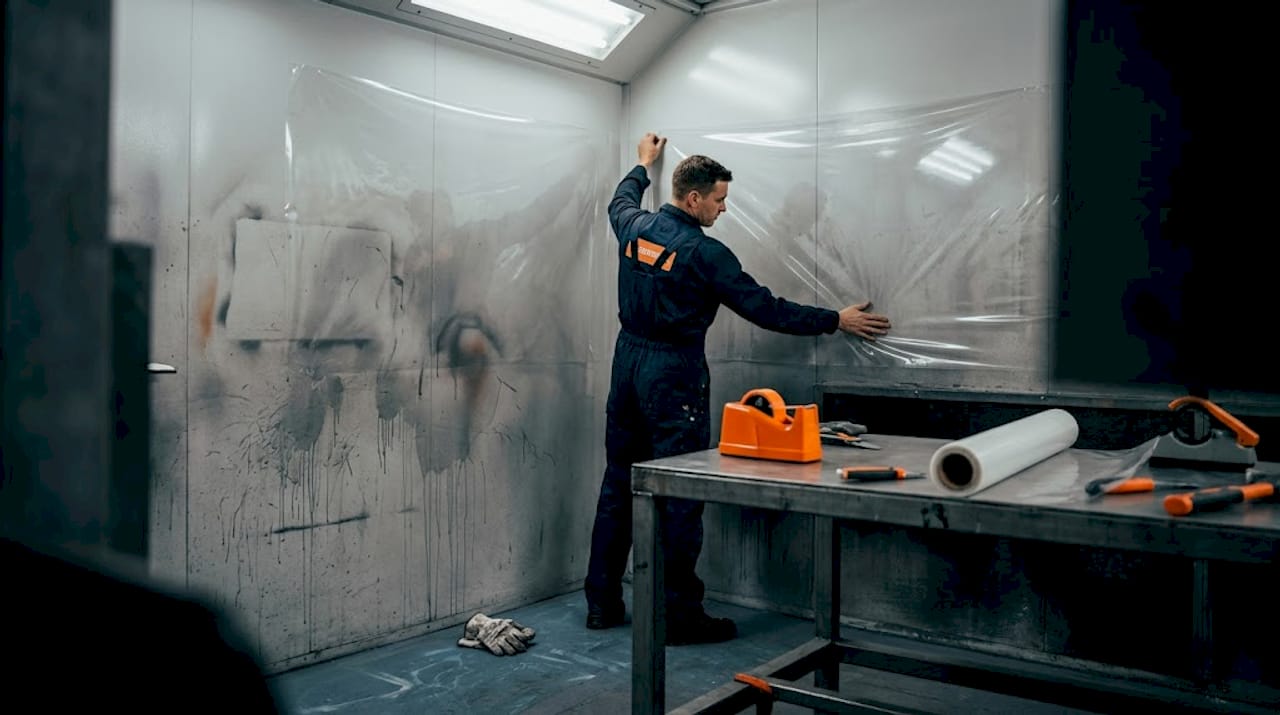
Protective films work by creating a dedicated physical barrier across the interior surfaces of a spray booth. Rather than allowing overspray and dust to bond to the floor, walls, windows, or light fixtures — where they would become permanent sources of future contamination — films absorb and capture these particles. When the film reaches saturation, you peel it off and expose a fresh, clean surface underneath. It’s a simple concept, but the operational impact is significant.
The mechanism goes beyond just catching particles. Quality films use a combination of light adhesion and controlled surface properties to hold contaminants in place without generating their own static charge. Static electricity in a spray environment is dangerous because it attracts dust and can interfere with the spray pattern. Films designed for spray booth use are specifically engineered to be static-free, meaning they capture particles without drawing new ones in.
Replacement frequency is a key part of making this system work. Most quality booth films should be swapped out every 60 to 90 days, depending on booth volume and the types of coatings used. A film pushed well beyond its effective lifespan starts to release the particles it has captured rather than holding them securely. Think of it like a used air filter — past a certain point, it stops helping and starts hurting.
Here’s a quick comparison of booth surfaces with and without protective film applied:
| Booth surface | Without film | With film |
|---|---|---|
| Floor | Collects overspray layers; dust is disturbed by traffic | Overspray captured; peeled away cleanly during changeover |
| Walls | Buildup flakes off during future spray cycles | Contamination stays bonded to film surface |
| Windows/lights | Residue reduces light quality and chips onto work | Clean surface maintained; visibility preserved |
| Overall rework rate | Higher due to surface contamination events | Reduced through consistent contamination control |
Removal is fast. Most multi-layer film systems are designed so that each layer peels away cleanly without leaving adhesive residue, meaning your turnaround between jobs stays tight. Some systems feature patented dispensers that allow bubble-free installation in minutes, which eliminates one of the most common complaints about film application — trapped air pockets that create uneven surfaces.
Pro Tip: When evaluating films, ask specifically about heat resistance. Films used in bake cycles must withstand booth temperatures up to 200°F without warping, releasing adhesive, or off-gassing. Films that fail under heat become a contamination problem themselves.
Check out specific film application examples to understand how different booth layouts use films across multiple surfaces simultaneously. And if you want to dig deeper into the underlying rationale, the case for using films to enhance spray booth quality is well-supported across a range of facility types and volumes.
Choosing the right film for your facility and process
Knowing how films work, the next step is choosing the right product for your unique booth and operating conditions.
Not all films are equal, and not all booths are alike. A small auto body shop running five cars per week has very different needs from a high-volume OEM supplier painting hundreds of components per shift. Matching film specifications to your actual workflow — rather than just buying the cheapest option available — is where most of the real ROI gets captured.
Start with these core selection criteria:
- Heat resistance: Confirm the film is rated for your cure temperature, especially if you run infrared or convection bake cycles at or near 200°F
- Adhesion level: Too much adhesion and removal becomes difficult or leaves residue; too little and the film lifts during spraying and becomes a defect source
- Thickness and durability: Floors in high-traffic booths need thicker films that resist tearing when vehicles drive over them; wall films can be thinner because they face less mechanical stress
- Transparency: Films used on windows and light fixtures should be optically clear to preserve light quality in the booth
- Multi-layer design: Multi-layer films let you peel one layer at a time between jobs, reducing the time spent on full film replacement
The table below breaks down common film applications by feature priority:
| Application area | Priority features | Replacement frequency |
|---|---|---|
| Floor (vehicle traffic) | High durability, thick gauge, tear-resistant | Every 60 days in high-volume booths |
| Walls | Static-free, smooth surface, good adhesion | Every 60-90 days |
| Windows and lights | Optical clarity, heat resistance | Every 60-90 days or per project |
| Exhaust plenum area | High heat tolerance, clean removal | Per project or monthly |
The protective film market is growing because facilities are realizing that paint job failures are far more expensive than the cost of a good film program. Rework on a single automotive job can run into hundreds of dollars once you account for labor, materials, and the cost of keeping a customer’s vehicle an extra day.
When you choose protective films, consider the full operational picture, not just the unit price per roll. Evaluate film material durability in the context of your throughput and temperature requirements. And if downtime between jobs is a priority, removable protective films with multi-layer construction can dramatically cut your changeover time.
Pro Tip: Request film samples before committing to bulk orders. Apply them across all surface types in your booth and run a bake cycle. Check for adhesion performance, heat stability, and ease of removal before making a large purchase.
Implementing film protection: Best practices and maintenance
Once armed with the right choice, here’s how to install and care for your films to keep dust out and finishes flawless.
A great film applied poorly is almost as bad as no film at all. Air bubbles, uneven edges, and gaps between panels all create opportunities for contamination to slip through or for the film itself to become a problem. Follow a consistent installation and maintenance process to get full value from your investment.
Here’s a step-by-step approach to getting film installation right:
- Clean the surface first. Remove all existing overspray, dust, and residue before applying new film. Any debris underneath the film will create texture bumps and can eventually cause the film to lift at the edges.
- Start from the top. On walls, apply film from the ceiling line downward to avoid trapping air behind the material. Work in sections that match the roll width.
- Use a squeegee or application tool. Smooth each section flat as you go, pressing out air from the center toward the edges. This is where patented dispenser systems have a real advantage — they tension the film automatically and dramatically reduce bubble formation.
- Overlap seams slightly. Where two film panels meet, allow a small overlap rather than butting edges together. Gaps between panels are direct paths for contamination.
- Secure all edges. Loose film edges can lift during high-pressure spraying. Make sure every perimeter edge is firmly bonded or sealed.
- Log your installation date. Track when each area was filmed so you know exactly when replacement is due. A simple log on the booth door works fine.
- Inspect before every shift. A 60-second visual check before starting a job catches lifting edges, tears, or saturation issues before they cause paint defects.
The data on film replacement intervals is clear: every 60 to 90 days for standard operations, with heat-rated films standing up to bake cycles at 200°F without degrading. High-volume operations may need to replace floor films more frequently because heavy vehicle traffic accelerates wear and can cause tearing.
The broader industry is catching on to this. The spray booth protective film market is valued at $1,016.4 million in 2025, growing at a CAGR of 2.7%, which reflects how many facilities are now treating film protection as a standard operational tool rather than an optional add-on.
A proper film application guide will walk through each surface type in detail, including light fixtures and exhaust plenum areas that are often overlooked. The results are worth it: facilities that use films consistently and replace them on schedule report measurable gains in first-pass quality rates and fewer customer complaints. For any shop focused on boosting efficiency, integrating film maintenance into standard operating procedures is one of the highest-leverage steps available.
Pro Tip: Assign film inspection and replacement to a specific technician or team lead as part of their weekly duties. When it’s everyone’s job, it becomes no one’s job. Ownership drives consistency.
Our take: The hidden ROI of film protection
Most facilities that resist investing in protective films are making a cost comparison that isn’t accurate. They see the per-roll price and compare it to zero. What they don’t account for is the real cost of every paint job that needs to be redone because of a dust inclusion or overspray contamination event. The materials, the labor hours, the extended job cycle, the customer conversation — none of that shows up in the line item that says “film budget.” But it all shows up in the profit and loss statement.
The facilities that treat films as a recurring operational tool rather than an occasional fix look at their business differently. They know that ensuring dust-free booths is not a one-time project but an ongoing discipline. And they build that discipline into their operating procedures, their supply ordering, and their staff training.
Here’s the perspective that experience delivers: film protection is not a quality enhancement, it’s a quality floor. Without it, your best possible outcome is limited by environmental chance. With it, your best possible outcome becomes your consistent outcome. Shops that understand this distinction move faster, waste less, and hold their reputation more firmly than those still treating the booth environment as a background variable.
Elevate your paint finish with Dust Free Film solutions
If the principles in this guide resonate with how you think about spray booth quality, the next step is finding film solutions built to match the demands of professional automotive and industrial painting operations.
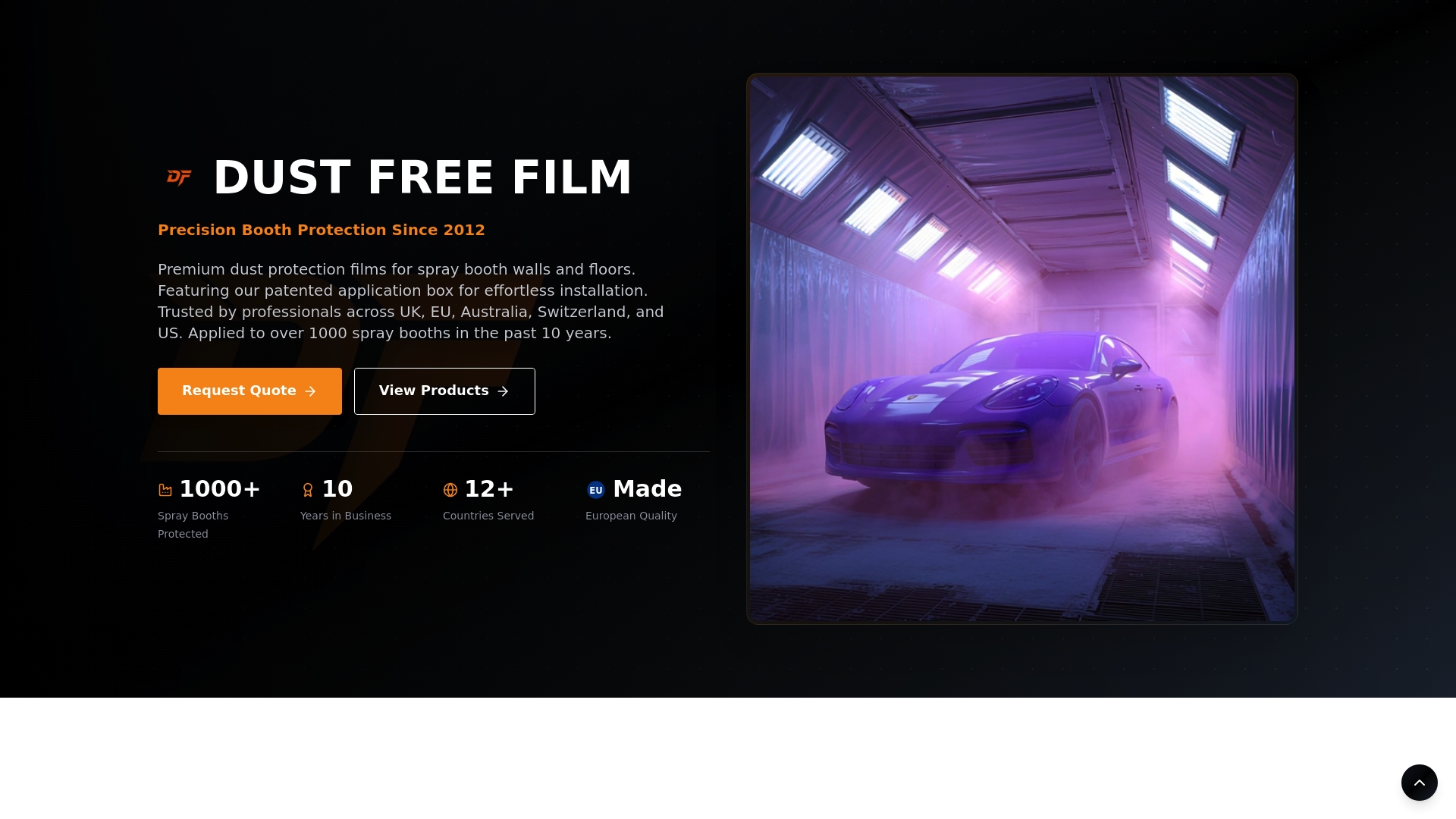
At Dust Free Film, we have been designing and manufacturing premium booth protection films since 2012, built to European manufacturing standards for facilities that cannot afford to compromise on finish quality. Our multi-layer floor and wall protectors, patented dispenser systems, and heat-resistant film products are in use across auto body shops and industrial coating facilities worldwide. Whether you need a standard configuration or a custom setup for a high-volume operation, you can request a quote and we will help you build a film protection program that fits your specific booth, your throughput, and your quality standards.
Frequently asked questions
How often should I replace protective films in my spray booth?
Replace spray booth protective films every 60 to 90 days for optimal dust and overspray control, adjusting frequency based on your booth volume and traffic levels.
Do protective films work with high booth temperatures?
Yes, quality protective films are engineered to withstand up to 200°F, making them fully compatible with infrared and convection bake cure cycles without warping or releasing adhesive.
What are the benefits of using films on booth walls versus just the floors?
Applying films to booth walls means that vertical surface contamination — including overspray buildup that can flake off during future jobs — is captured and removed during each film changeover, not cycled back into your spray environment.
How does the film market reflect changing industry standards?
The spray booth film market is valued at $1,016.4 million in 2025 with a 2.7% CAGR, reflecting the growing recognition among professional facilities that consistent film protection directly supports superior paint quality and operational efficiency.