
TL;DR:
- Selecting the right protective film reduces airborne contamination and improves paint finish quality.
- Proper assessment, matching film properties to environment, and routine monitoring are critical for success.
- Ongoing training and proactive film management outperform reactive, one-time purchasing approaches.
Persistent dust and recurring paint defects are not just frustrating. They are expensive. Every contaminated finish means rework, wasted materials, and delayed delivery. Yet many facility managers and operations directors focus on airflow upgrades or filtration systems while overlooking one of the most direct solutions available: the right protective film. Choosing the correct film for your spray booth walls, floors, and fixtures can eliminate a significant share of airborne contamination at the source. This guide walks you through a practical, step-by-step process to assess your environment, define your requirements, install films correctly, and verify results over time.
Table of Contents
- Assessing your spray booth environment
- Defining your protective film requirements
- Step-by-step process for selecting and installing protective films
- Monitoring results and troubleshooting common issues
- Our perspective: What most facilities overlook about choosing protective films
- Ready to upgrade your booth with the right protective films?
- Frequently asked questions
Key Takeaways
| Point | Details |
|---|---|
| Assess booth needs | Evaluate your spray booth’s environment to define the ideal protective film requirements. |
| Specify film features | Choose film types based on adhesion, thickness, and antistatic properties for best results. |
| Follow step-by-step process | Use a structured selection and installation process to ensure dust-free results. |
| Monitor and adjust | Regularly check, replace, and fine-tune films to maintain optimal booth performance. |
Assessing your spray booth environment
Before you can choose the right film, you need an honest picture of what your spray booth actually faces every day. Booth size, airflow patterns, usage frequency, and contamination sources all shape which film properties will deliver results. A high-volume automotive refinishing shop running three shifts has very different needs than a specialty industrial coating facility running weekly batches.
Start by mapping your contamination sources. Are particles entering from outside the booth through doors or HVAC gaps? Is sanding dust migrating from adjacent prep areas? Are your walls accumulating overspray that later flakes off? Each source calls for a different response in terms of film tackiness, thickness, and coverage area. Ensuring clean paint booths requires understanding where contamination originates, not just where it lands.
Here is a quick overview of key environmental factors and how they affect film selection:
| Environmental factor | Low-intensity booth | High-intensity booth |
|---|---|---|
| Usage frequency | Weekly or less | Daily, multi-shift |
| Dust sources | Minimal, isolated | Sanding, traffic, HVAC |
| Recommended film thickness | 30-50 microns | 60-100+ microns |
| Replacement frequency | Monthly or less | Weekly or per project |
| Static resistance priority | Moderate | High |
Common problems that signal a mismatch between your current film and your booth conditions include:
- Recurring paint flaws such as fisheyes, inclusions, or texture issues that appear despite clean air readings
- Dust accumulation on walls or floors within hours of cleaning
- Maintenance delays caused by time-consuming film removal or surface prep between jobs
- Film lifting or wrinkling that creates pockets where dust collects
Matching film attributes to your specific conditions is not guesswork. Protective films dramatically reduce contamination and improve final product quality in spray environments, but only when the film properties align with the actual demands of the space. Tackiness levels that work in a low-traffic booth may fail in a facility where technicians move equipment and carts across the floor multiple times per shift.
Take time to document your booth’s dimensions, note peak usage hours, and identify the top three contamination complaints from your finishing technicians. That data becomes the foundation for every decision that follows.
Defining your protective film requirements
With your booth’s critical parameters mapped, it’s time to translate those needs into precise film specifications and options. Not all protective films are built the same, and the differences matter more than most purchasing guides acknowledge.
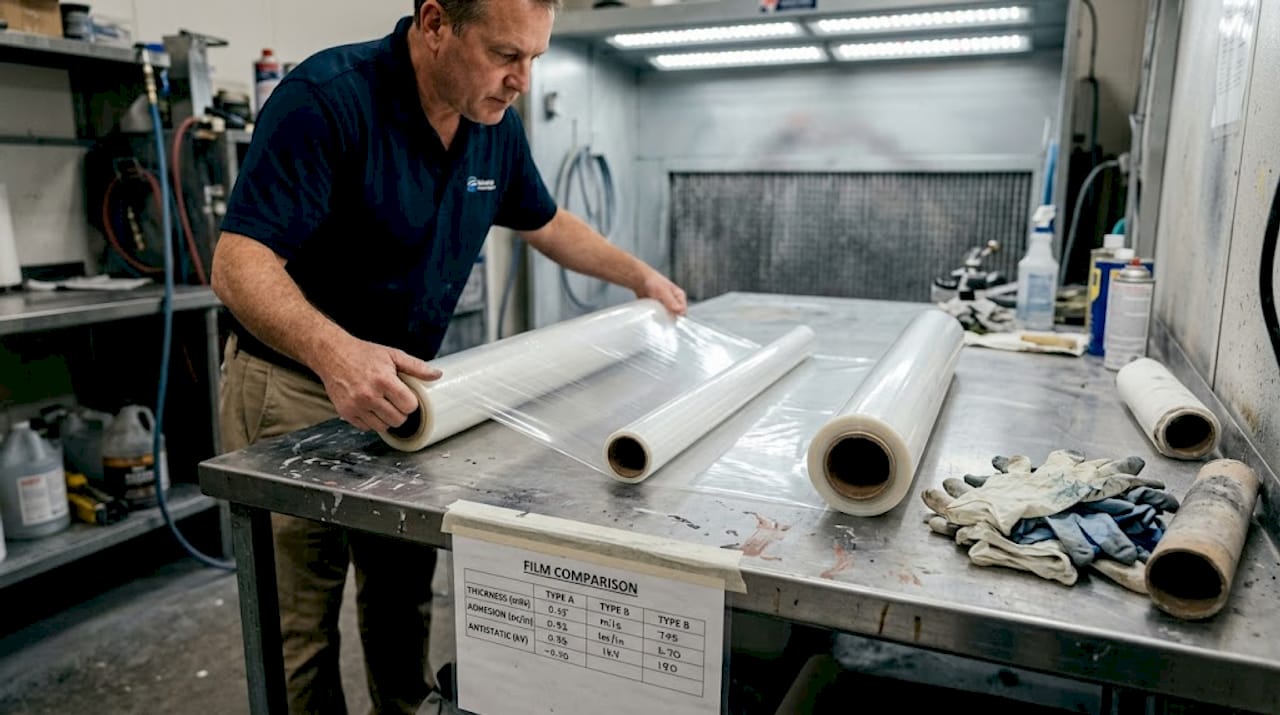
The first decision is film attachment method. Adhesive films bond mechanically to surfaces and provide strong, stable coverage in high-traffic areas. Static-cling films rely on electrostatic attraction and are easier to reposition, making them popular for wall applications where quick changes are needed. Both have a place in a well-designed booth protection strategy.
Here is a side-by-side comparison of the two main film types:
| Feature | Adhesive film | Static-cling film |
|---|---|---|
| Adhesion strength | High | Moderate |
| Repositionability | Limited | Easy |
| Best use | Floors, high-traffic surfaces | Walls, fixtures, ceilings |
| Residue risk | Low with proper product | None |
| Antistatic performance | Varies by product | Inherent in design |
Beyond attachment method, focus on these technical criteria:
- Film thickness: Thicker films (60 microns and above) withstand more physical contact and hold more dust before requiring replacement.
- Width and cut size: Films that match your booth dimensions reduce installation time and eliminate gaps where contamination can enter.
- Dust holding capacity: Multi-layer films allow you to peel away a contaminated layer and expose a fresh surface without full replacement.
- Antistatic properties: For facilities finishing electronics, sensitive coatings, or fine metallic paints, antistatic film is not optional. Static charge actively attracts particles to surfaces, undermining everything else you do.
Innovative protective films maximize paint quality by reducing airborne contamination at the surface level, which is why film specification deserves the same rigor as your filtration or airflow design.
For dust-free paint finishes, the combination of correct thickness, proper width, and antistatic performance creates a system rather than just a surface covering.
Pro Tip: Before finalizing your film budget, calculate the true cost of a single rework job, including labor, materials, and delivery delay. In most facilities, one avoided rework pays for several months of premium film.
Step-by-step process for selecting and installing protective films
Once your requirements are defined, follow this practical methodology for choosing and deploying films in your spray booths. Skipping steps here is where most facilities lose the gains they should be seeing.
- Shortlist suppliers based on your specifications. Request technical data sheets that confirm film thickness, antistatic rating, temperature resistance, and adhesive type. Suppliers who cannot provide these details upfront are not worth your time in an industrial setting.
- Request physical samples before ordering in bulk. Test samples in your actual booth under real operating conditions for at least one full work week. Check for edge lifting, wrinkling under heat, and dust capture performance.
- Calculate your order quantity accurately. Measure all surfaces you intend to cover, add 10-15% for trimming waste, and factor in your planned replacement frequency. Underordering leads to gaps in coverage and inconsistent results.
- Prepare surfaces before installation. Clean all surfaces thoroughly and allow them to dry completely. Any residue, moisture, or loose particles under the film will cause adhesion failures and create contamination pockets.
- Install films using a dispenser system where available. Patented dispenser systems allow bubble-free, fast application that eliminates the wrinkles and air pockets that trap dust. Start from one edge and work systematically across the surface.
- Trim excess film cleanly at edges and seams. Overlapping edges or loose trim points are the first places where films begin to lift. Use a sharp blade and straight edge for clean results.
- Label each installation with the date. This simple step makes replacement scheduling straightforward and removes the guesswork about when a film was last changed.
Optimal selection and installation of protective films greatly improves booth cleanliness and reduces post-painting defects, but the installation step is where many facilities underinvest in training and process.
For practical application examples across different booth types and surface configurations, reviewing real-world use cases before your first installation can prevent common errors.
Pro Tip: Replace films on a fixed schedule, not just when they look dirty. Dust accumulates in layers that are not always visible, and a film that appears clean may already be saturating its holding capacity.
Monitoring results and troubleshooting common issues
Even the best products can face challenges. Here’s how to ensure ongoing success and solve issues as they arise.
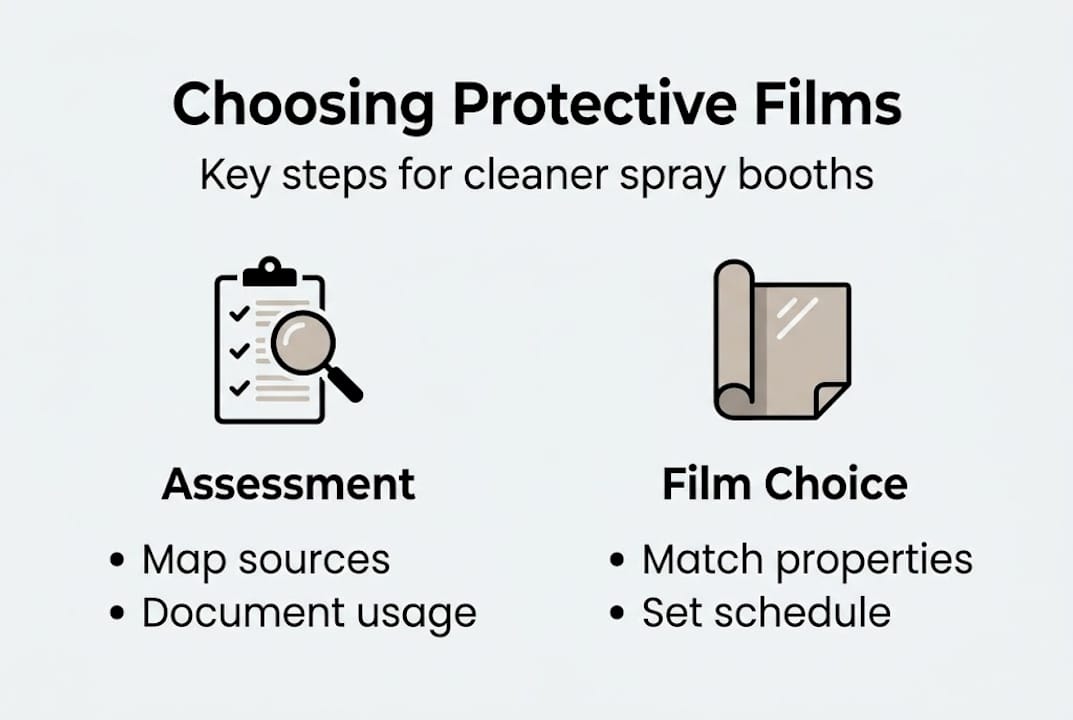
Start by establishing a baseline before you install new films. Count and categorize paint defects per job, log cleaning time per shift, and note any contamination complaints from your finishing team. After 30 days with the new film system in place, compare those numbers directly. The data tells you whether the film is performing as expected or whether adjustments are needed.
Removable protective films reduce booth dust levels by up to 60% and cut cleaning time in half when correctly matched to the environment. That kind of improvement shows up clearly in your defect logs within the first month.
Common issues and their root causes include:
- Lifting edges: Usually caused by surface contamination before installation or an adhesive type that does not match the surface material. Solution: Clean surfaces more thoroughly and switch to a higher-tack adhesive film for problem areas.
- Wrinkling under heat: Occurs when film thickness is too low for the booth’s operating temperature. Solution: Upgrade to a heat-resistant film rated for your booth’s peak temperature.
- Static attraction of particles: Happens when standard films are used in environments that generate electrostatic charge. Solution: Specify antistatic film for all wall and ceiling surfaces.
- Film breakdown before scheduled replacement: Indicates the film’s dust holding capacity is undersized for your contamination load. Solution: Increase film thickness or switch to a multi-layer product.
The facilities that see the biggest gains from protective films are those that treat film management as an ongoing process, not a one-time purchase decision.
The floor protection film benefits extend beyond dust control. Proper floor films also protect against chemical spills and reduce slip hazards, which matters in any facility where safety and quality go hand in hand.
Our perspective: What most facilities overlook about choosing protective films
After working with auto body shops and industrial coating facilities across multiple countries since 2012, we have seen a consistent pattern. Facilities that struggle with dust and finish quality are almost never using the wrong product. They are using the right product incorrectly, or they are changing it reactively rather than proactively.
The real differentiator is operational mindset. A facility that trains its team on proper film installation, runs quarterly reviews of defect data, and adjusts film specifications based on seasonal or production changes will outperform a facility with a bigger budget but no process discipline.
Most purchasing decisions are made once and then forgotten. Film type gets locked into a supply order, and nobody questions it again until a quality crisis forces a review. That is backwards. Reviewing your film choice quarterly, the same way you review your filtration or equipment maintenance schedule, is what separates consistently clean booths from ones that cycle through the same problems year after year.
The benefits of removable films go beyond convenience. They support a culture where film changes are routine, fast, and expected, rather than disruptive events that technicians avoid as long as possible.
Invest in training. Recheck your installation process every six months. Treat film management as a quality system, not a supply expense.
Ready to upgrade your booth with the right protective films?
Now that you understand the full process, sourcing the right films for your facility is straightforward. Dust Free Film manufactures premium booth wall and floor protection films built specifically for automotive refinishing and industrial spray environments, with patented dispenser systems that make installation fast and bubble-free.
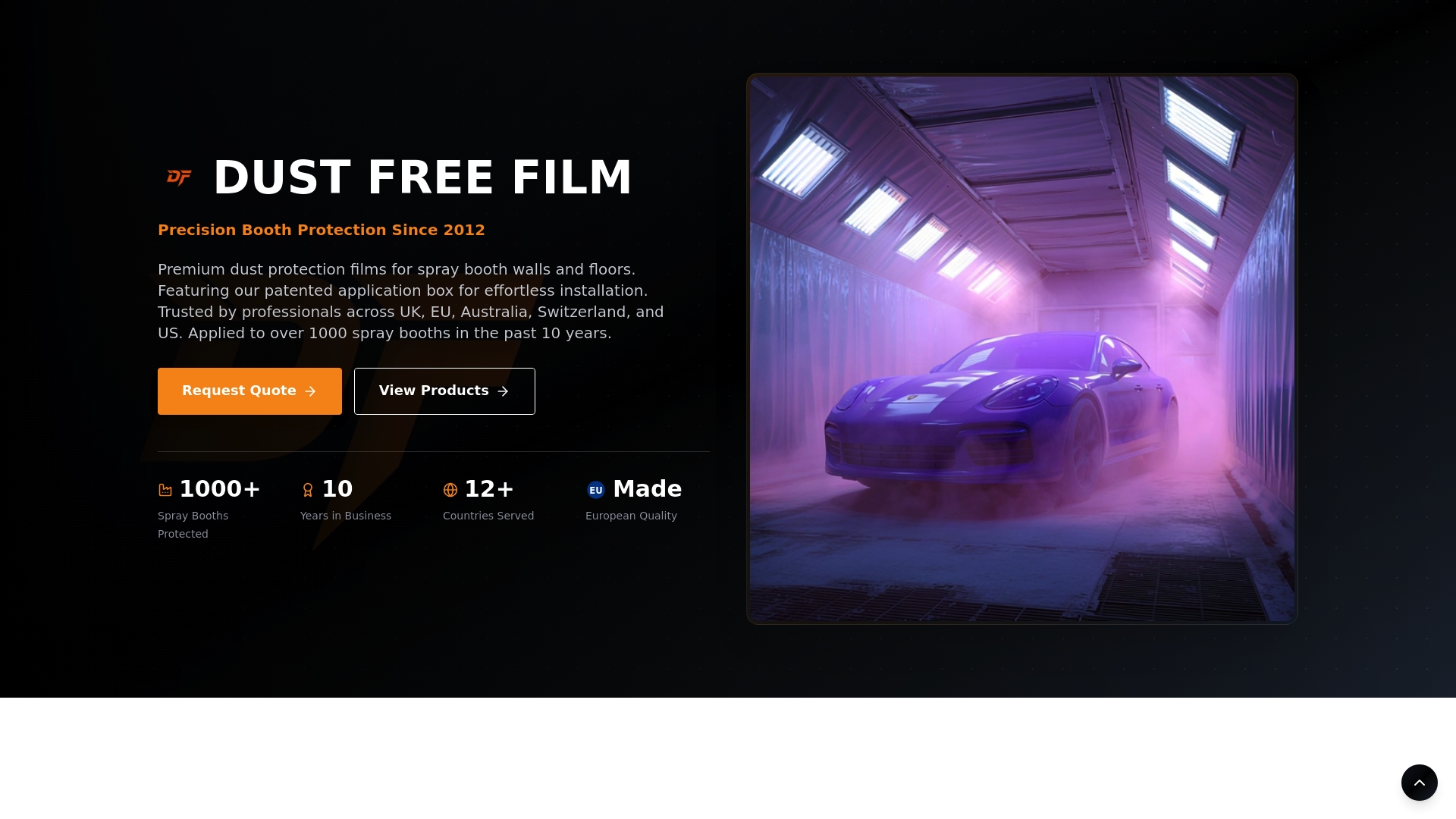
Whether you need standard configurations or custom sizing for large-scale operations, our team is ready to help you match the right film to your exact booth conditions. Visit shop spray booth protection films to browse the full product range, or go directly to request a quote for a tailored recommendation based on your facility’s specific requirements.
Frequently asked questions
What is the difference between adhesive and static-cling protective films?
Adhesive films bond mechanically to surfaces while static-cling films rely on static electricity for attachment. For high-traffic spray booths, adhesive types offer stronger and longer-lasting protection than static-cling alternatives.
How often should protective films be replaced in spray booths?
Replace films based on manufacturer guidelines or whenever dust buildup is visible. Most facilities benefit from a monthly or project-based schedule, and routinely replacing films sustains optimal dust control results over time.
Can protective films improve paint finish quality?
Yes. Protective films reduce airborne dust and debris at the surface level, which directly lowers paint defect rates. Cleaner booths with films consistently yield superior finish quality compared to unprotected surfaces.
Are removable or disposable films better for industrial facilities?
Removable films are ideal for periodic changes and quick cleaning cycles in ongoing operations. Disposable films may suit single-use or short-term projects where removable films simplify maintenance and speed up turnaround between jobs.
What’s the most common mistake when choosing protective films?
Most facilities overlook the need to match film thickness and static resistance to their specific booth environment. Matching film properties to booth conditions is the single most important factor in achieving consistent, long-term performance.