

Poor spray booth airflow causes more paint defects than most facility managers realize. Dust contamination, orange peel texture, and uneven drying all trace back to inadequate air movement through your booth. When airflow underperforms, overspray lingers, particles settle on wet surfaces, and finish quality suffers. Optimizing your spray booth airflow transforms these frustrations into consistent, professional results. This guide walks you through understanding airflow types, preparing your booth environment, executing practical improvements, and verifying performance to achieve the dust control and finish quality your operation demands.
Table of Contents
- Key takeaways
- Understanding spray booth airflow types and requirements
- Preparing your spray booth for airflow improvement
- Step-by-step guide to improving spray booth airflow
- Verifying and troubleshooting airflow performance
- Discover Dust Free Film for spray booth protection
- Frequently asked questions about spray booth airflow improvement
Key Takeaways
| Point | Details |
|---|---|
| Airflow type tradeoffs | Downdraft yields the cleanest finish but costs more, while crossdraft costs less yet offers faster air changes with reduced contaminant control. |
| Vehicle positioning matters | In downdraft setups centering the vehicle ensures even air flow around all surfaces to prevent turbulence and defects. |
| Critical airflow requirements | Maintain consistent velocity across the work area, sufficient air changes per hour, balanced intake and exhaust, and proper temperature control. |
| Measurement tools | Use anemometers to map velocity and Magnehelic gauges to monitor filter resistance and catch degradation early. |
Understanding spray booth airflow types and requirements
Spray booth airflow comes in two primary configurations: downdraft and crossdraft. Each delivers distinct performance characteristics that directly impact your finish quality and operational costs. Downdraft systems pull air vertically downward through the booth, typically operating at 50 to 125 feet per minute. This configuration creates the cleanest painting environment because gravity and airflow work together to remove overspray and contaminants efficiently. Crossdraft booths move air horizontally across the workspace at higher velocities, usually 100 to 150 FPM, offering faster air changes but less precise contaminant control.
The velocity differences between these systems reveal important trade-offs. Higher airflow in crossdraft booths costs less to install and operate but produces less clean results than downdraft configurations. Downdraft systems require more sophisticated ductwork and stronger fans to achieve vertical air movement, increasing initial investment. However, the superior finish quality justifies the expense for high-end automotive refinishing and precision industrial coating applications. Your choice depends on balancing budget constraints against quality requirements and the types of finishes your customers expect.
Matching airflow type to your facility needs determines long-term success with spray booth air quality improvements. Production shops handling volume work often choose crossdraft for speed and economy. Custom paint shops and manufacturers requiring flawless finishes invest in downdraft systems despite higher costs. Understanding these fundamentals helps you optimize existing equipment or plan intelligent upgrades.
| Airflow type | Typical velocity (FPM) | Installation cost | Finish quality | Best applications |
|---|---|---|---|---|
| Downdraft | 50-125 | Higher | Superior | High-end automotive, precision industrial |
| Crossdraft | 100-150 | Lower | Good | Production shops, volume work |
| Semi-downdraft | 75-100 | Moderate | Very good | Mixed use facilities |
Critical airflow requirements for automotive and industrial spray booths include:
- Consistent velocity across the entire work area to prevent dead zones where contaminants accumulate
- Sufficient air changes per hour to remove solvent vapors and maintain safe working conditions
- Balanced intake and exhaust to prevent pressure imbalances that draw in unfiltered air
- Temperature control within the airflow system to ensure proper paint curing and operator comfort
Preparing your spray booth for airflow improvement
Vehicle positioning makes or breaks airflow effectiveness regardless of your booth type. In downdraft configurations, centering the vehicle is critical because air must flow evenly around all surfaces. Off-center placement creates turbulence on one side while starving the other of adequate air movement. This asymmetry causes uneven drying, color variations, and increased defect rates. Crossdraft booths require different positioning strategy: align panels perpendicular to airflow direction so air sweeps across surfaces uniformly rather than hitting edges that create turbulence.
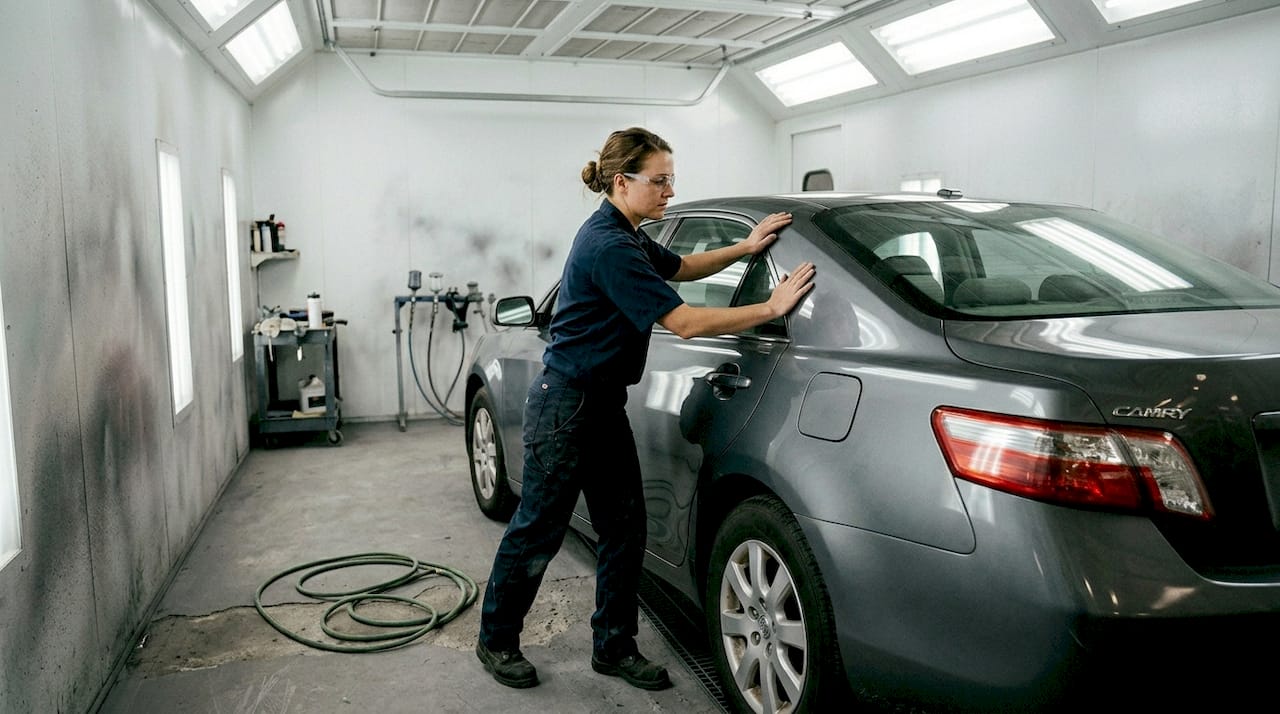
Gathering the right measurement tools before starting airflow improvements saves time and ensures accuracy. You need an anemometer to measure air velocity at multiple points throughout the booth. Digital models with data logging capabilities let you track patterns over time and identify degradation trends. Magnehelic pressure gauges installed across filter banks show when resistance increases beyond acceptable levels. These gauges cost little but provide invaluable early warning of filter loading. A basic toolkit should also include flashlights for inspecting ductwork, wrenches for fan adjustments, and cleaning supplies for removing accumulated overspray.
Verifying equipment status before making airflow changes prevents wasted effort on symptoms rather than root causes. Check these items systematically:
- Fan operation and belt tension to ensure motors deliver rated performance
- Filter condition across intake and exhaust banks for visible loading or damage
- Ductwork integrity including joints, seals, and access panels for air leaks
- Booth door seals and gaskets that might allow unfiltered air infiltration
- Lighting systems that could obstruct airflow paths or create heat pockets
Pro Tip: Install anemometers and pressure gauges as permanent monitoring equipment rather than using portable units for occasional checks. Daily velocity and pressure readings let you spot gradual performance decline before it affects finish quality. This proactive approach costs less than reactive troubleshooting after defects appear.
Follow spray booth setup tips to create an optimal baseline before attempting airflow modifications. Proper preparation reduces variables and makes improvement efforts more effective.
Step-by-step guide to improving spray booth airflow
Systematic airflow improvement follows a logical sequence that builds on accurate measurement and targeted adjustments. Start with baseline data, make one change at a time, and verify results before proceeding. This methodical approach identifies what actually works versus changes that waste resources.
-
Measure current airflow velocity at nine points across the booth using a grid pattern: three measurements each at operator height, mid-level, and floor level. Record all readings to establish your performance baseline.
-
Check pressure differential across each filter bank using magnehelic gauges. New filters typically show 0.1 to 0.3 inches water column. Readings above 0.8 inches indicate replacement time approaches.
-
Inspect fan performance by checking belt tension, bearing noise, and motor amperage draw. Fans operating below rated capacity often need simple belt adjustments rather than expensive replacements.
-
Clean intake plenums and ductwork to remove accumulated dust that restricts airflow. Even thin dust layers reduce effective duct diameter and increase system resistance.
-
Replace loaded filters based on pressure readings rather than arbitrary time schedules. Pressure-based filter changes optimize costs by using full filter capacity without risking airflow degradation.
-
Calibrate fan speed controls if your system includes variable frequency drives. Matching fan output to actual booth requirements reduces energy waste while maintaining adequate velocity.
-
Seal air leaks around doors, access panels, and duct joints using appropriate gaskets and sealants. Small leaks compound across large booth surfaces, significantly impacting overall performance.
-
Re-measure airflow velocity and pressure after each major change to quantify improvement and guide further adjustments.
| Measurement point | Target velocity (FPM) | Acceptable pressure (in. w.c.) | Action if outside range |
|---|---|---|---|
| Intake plenum | System dependent | 0.1-0.3 (clean filters) | Replace filters above 0.8 |
| Work zone center | 50-125 (downdraft) | N/A | Adjust fan speed or check obstructions |
| Work zone edges | Within 15% of center | N/A | Improve air distribution or seal leaks |
| Exhaust plenum | System dependent | 0.3-0.6 | Clean ductwork or check fan |
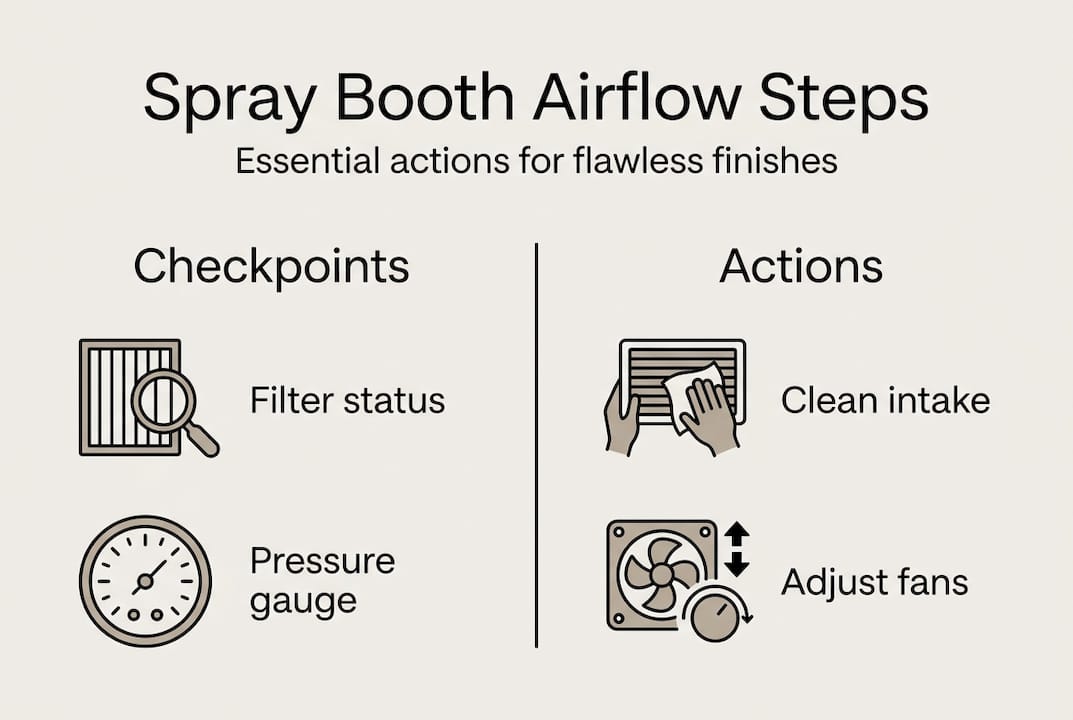
Regular spray booth maintenance keeps airflow improvements sustainable over time. Filters degrade predictably, but cleaning schedules for fans and ductwork depend on your specific coating materials and production volume.
Pro Tip: Monitor your pressure gauge trend rather than absolute readings. A filter showing 0.5 inches today but 0.3 inches last week indicates rapid loading that suggests upstream contamination or booth sealing problems worth investigating.
Verifying and troubleshooting airflow performance
Post-improvement verification confirms your changes delivered expected results and identifies remaining issues. Compare new velocity measurements against your baseline data and target specifications. Velocity should fall within your booth type’s normal range and vary no more than 15% between measurement points. Greater variation indicates distribution problems like blocked ducts, misaligned dampers, or air leaks that undermine overall performance. Pressure readings across filter banks should drop after cleaning or replacement, then gradually increase as filters load during normal operation.
Recognizing airflow problems before they cause paint defects saves money and customer relationships. Watch for these warning signs during daily operations:
- Overspray haze lingering in the booth after painting indicates insufficient air changes or dead zones where contaminants accumulate
- Uneven drying patterns across painted surfaces suggest airflow velocity varies too much between different booth areas
- Dust particles visible on wet paint despite clean filters point to air leaks drawing unfiltered air into the workspace
- Solvent odors persisting longer than normal mean exhaust airflow has decreased below safe levels
Daily visual checks catch degradation before velocity measurements show significant decline. Your painters notice subtle changes in how overspray behaves and how quickly solvents flash off. Listen to their observations because they spend hours in the booth environment detecting patterns that periodic measurements might miss.
Troubleshooting common airflow issues:
- Recheck door and panel seals if velocity drops suddenly without filter pressure increase, indicating new air leaks
- Inspect ductwork for collapsed sections or debris accumulation when pressure rises faster than filter loading explains
- Verify fan rotation direction and belt condition if velocity never reaches target levels despite clean filters
- Examine booth layout for new obstructions like improperly stored equipment blocking air paths
- Test makeup air temperature and volume to ensure balanced booth pressurization
Regular airflow monitoring transforms reactive maintenance into predictive management. Catching small problems early prevents the compounding failures that shut down production and compromise finish quality.
Implementing dust reduction strategies alongside airflow optimization creates comprehensive quality control. Airflow moves contaminants, but source control prevents them from entering your booth environment in the first place.
Discover Dust Free Film for spray booth protection
Optimizing airflow solves half the dust control equation. The other half involves protecting booth surfaces from contamination that airflow must then remove. Dust Free Film manufactures premium protective films specifically engineered for spray booth environments where dust control directly impacts finish quality. Our multi-layer electrostatic films trap particles before they become airborne, reducing the contamination load your airflow system must handle.

Our patented dispenser system enables quick, bubble-free installation that maintains protective coverage without creating new contamination sources during film changes. The films withstand the heat and chemical exposure typical in automotive and industrial painting while remaining static-free to avoid attracting additional particles. Combining optimal airflow with surface protection creates the dust-free environment that flawless finishes demand. Explore Dust Free Film solutions designed for professional spray booth applications or request a quote to see how protective films complement your airflow improvements.
Frequently asked questions about spray booth airflow improvement
How often should spray booth airflow be measured?
Measure airflow velocity weekly during normal operations and immediately after any maintenance affecting fans, filters, or ductwork. Daily pressure gauge checks provide early warning of filter loading between detailed velocity measurements. This combination catches both sudden failures and gradual performance decline.
What are the risks of incorrect vehicle positioning in airflow?
Incorrect positioning creates turbulent airflow patterns that cause uneven paint drying, color variations, and increased defect rates. In downdraft booths, off-center vehicles starve one side of adequate airflow while creating excessive velocity on the other. Crossdraft booths suffer when panels block rather than align with air movement, trapping overspray and contaminants.
Can filter replacement timing vary depending on booth use?
Yes, filter life depends on coating volume, material type, and upstream filtration effectiveness. High-volume shops applying solvent-based coatings load filters faster than occasional users spraying waterborne products. Monitor pressure rise across filter banks rather than following fixed replacement schedules to optimize filter utilization without risking airflow degradation.
What is the best way to detect airflow problems before paint defects appear?
Install permanent pressure gauges and conduct daily visual inspections for overspray haze, unusual odors, or drying pattern changes. Train painters to report subtle airflow changes they notice during normal work. Combining instrumentation with operator awareness catches problems in early stages when simple corrections prevent quality issues.
How does temperature affect spray booth airflow performance?
Temperature changes air density, which affects both velocity and volume measurements. Cold intake air increases density and can boost actual airflow even if velocity readings stay constant. Hot booth conditions reduce air density, potentially decreasing effective contamination removal despite unchanged velocity. Maintain consistent booth temperature for reliable airflow performance and proper paint curing.
Should airflow velocity stay constant during the entire painting process?
Most booths benefit from slightly reduced airflow during application to minimize overspray disturbance, then increased velocity during flash and cure stages to accelerate solvent removal. However, velocity should never drop below minimum thresholds that compromise operator safety or allow dangerous vapor accumulation. Consult your booth specifications for recommended velocity ranges across different process stages.