

TL;DR:
- Maintaining a clean spray booth environment requires controlling airflow, filter health, and cleaning sequences aligned with ventilation patterns. Proper equipment, pressure monitoring, and detailed documentation are essential for effective cleaning and OSHA compliance. Regular inspection and cleaning of ductwork, plenums, and fans, combined with staff training and proper filtration, minimize contamination and improve finish quality.
A clean spray booth environment is defined as a controlled workspace where airflow, filtration, and surface cleanliness work together to prevent dust and overspray from contaminating paint finishes. Facility managers who understand how to maintain clean booth environment conditions consistently produce better finishes, reduce rework costs, and stay on the right side of OSHA regulations. The three pillars of booth cleanliness are airflow management, filter health, and cleaning sequences aligned with ventilation patterns. Get all three right and your booth performs like a precision instrument. Miss any one of them and contamination finds its way back into your work.
How to maintain a clean booth environment: tools and prerequisites
Before any cleaning protocol delivers results, you need the right equipment in place. Skipping this step is the most common reason well-intentioned cleaning routines fail.
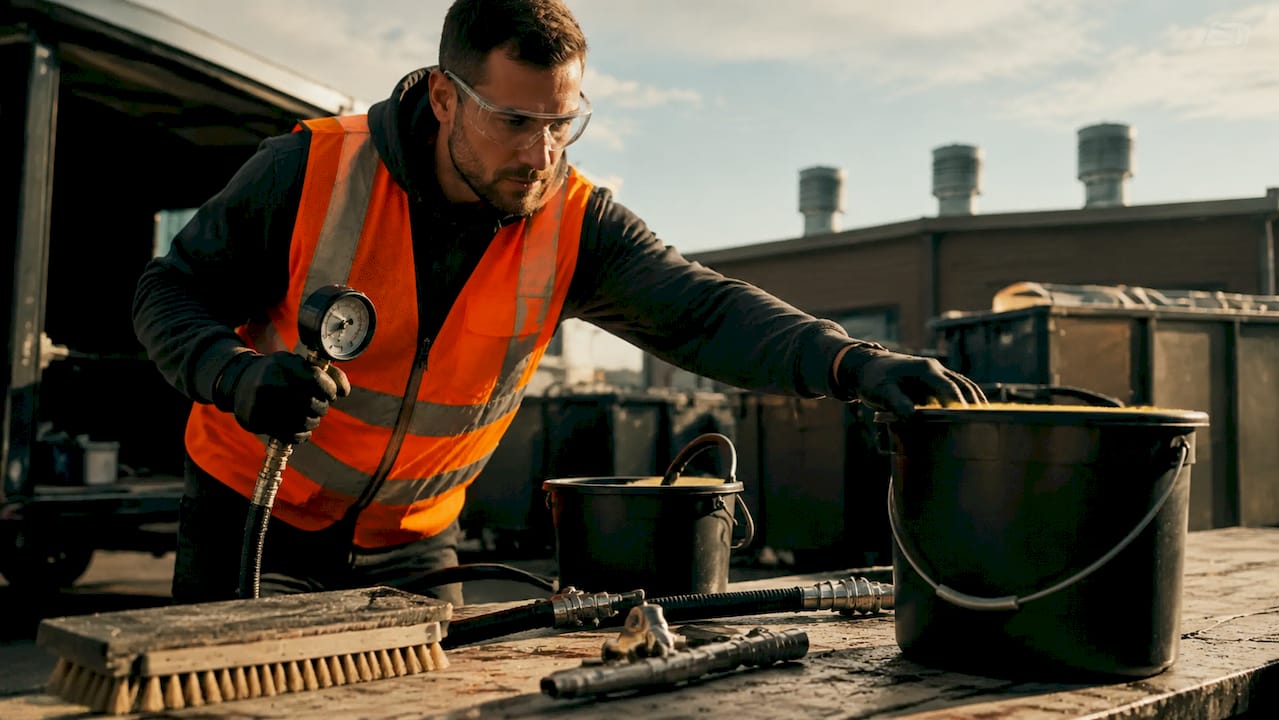
Airflow monitoring tools are non-negotiable. A Magnehelic gauge or a digital manometer gives you real-time pressure differential data across filters. These readings tell you far more than a visual inspection ever could. Without them, you are guessing at filter condition and airflow balance.
Filters by type and inspection need:
| Filter Type | Primary Function | Inspection Trigger |
|---|---|---|
| Intake (ceiling) filters | Remove incoming particulates | Pressure drop increase on manometer |
| Arrestor (exhaust) filters | Capture overspray before exhaust | Visual loading plus pressure data |
| Carbon filters | Absorb solvent vapors | Odor breakthrough or manufacturer interval |
Cleaning materials and PPE must be matched to spray booth conditions. Standard shop rags and household cleaners are not adequate. Use tack cloths, lint-free wipes, and solvent-compatible cleaning agents. Operators need supplied-air respirators or NIOSH-approved half-face respirators, chemical-resistant gloves, and disposable coveralls to avoid reintroducing fibers into the booth.
Documentation tools close the loop. A digital maintenance log or a paper booth cleaning checklist with date, operator name, filter readings, and observations creates an audit trail. OSHA compliance requires cleaning at “frequently recurring intervals” based on observed residue accumulation, not fixed calendar dates. That means your records need to reflect actual conditions, not just scheduled dates.
Pro Tip: Mount your Magnehelic gauge at eye level near the booth entrance so operators check it automatically before every shift. A reading that has moved more than 20% from baseline is your signal to inspect filters immediately.
What is the right cleaning sequence for a spray booth?
Cleaning sequence is the single most overlooked variable in booth maintenance. Most operators clean where they see dirt. The correct method is to clean in the direction of airflow, always moving toward exhaust or return vents. Cleaning aligned with airflow reduces recontamination by preventing particle backflow into cleaner zones. Moving against airflow pushes particles back into areas you just cleaned.
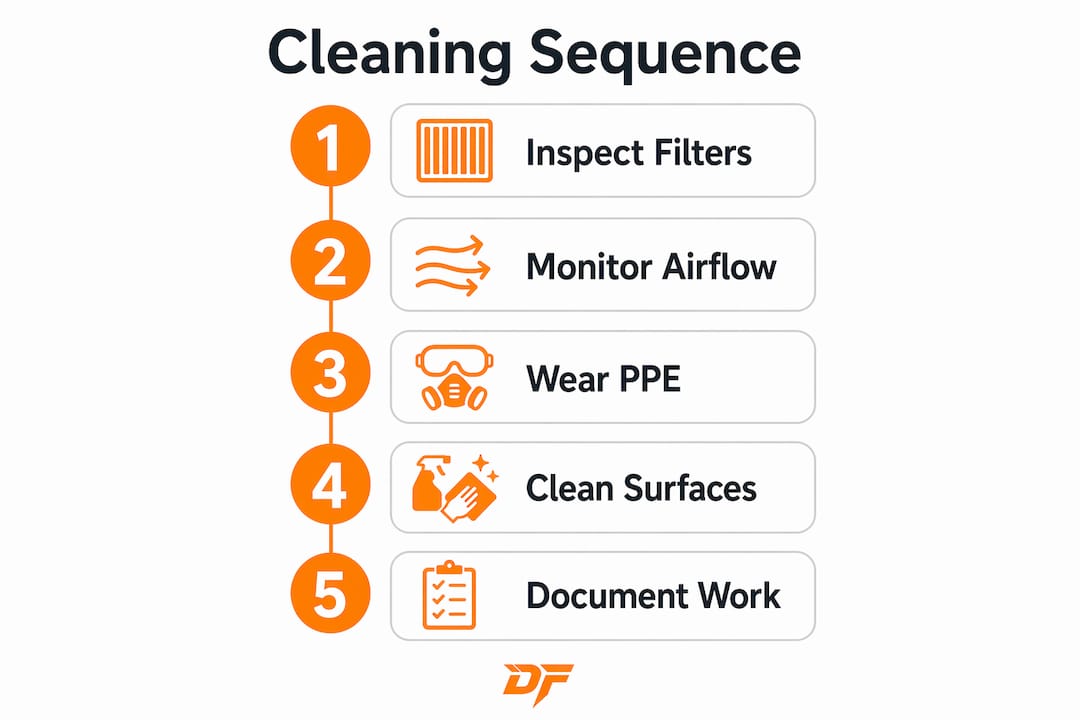
Here is the correct sequence for a standard spray booth:
- Verify airflow is active. Never clean a booth with ventilation off. Active airflow carries dislodged particles toward exhaust filters rather than letting them resettle.
- Start at the cleanest zone. Begin at the intake end or ceiling plenum area and work toward the exhaust wall.
- Clean walls and fixtures top to bottom. Gravity and airflow both pull particles downward and toward exhaust. Work with both forces.
- Clean the floor last. The floor collects everything that falls from walls and fixtures. Cleaning it first guarantees recontamination from above.
- Inspect exhaust filters after cleaning. Dislodged particles load exhaust filters faster during a cleaning cycle. Check readings immediately after.
- Log the cleaning event. Record filter readings before and after, any visible residue levels, and the operator’s name.
Cleaning frequency should be driven by visual residue buildup and airflow performance data, not a fixed weekly schedule. A high-volume production booth may need daily attention. A lower-throughput facility may clean every two or three days. Operator cleaning behavior critically impacts contamination levels, which means staff training on this sequence is as important as the sequence itself.
Pro Tip: Post a laminated airflow direction diagram inside the booth at the operator’s eye level. When staff can see the airflow path, they instinctively clean in the right direction.
How do filters affect booth air quality and finish results?
Filter condition is the most direct lever you have over booth air quality. Clogged filters reduce airflow and lower overspray capture efficiency, which means more airborne particulates and more finish defects. A filter that looks only half-loaded can already be restricting airflow enough to cause problems.
The correct method is to use pressure drop measurements rather than visual inspection alone. Managing filter loading by pressure drop rather than appearance or calendar service life improves replacement timing and prevents airborne dust buildup. Replace filters when manometer readings show a pressure drop that exceeds the manufacturer’s specified maximum, not when the filter looks dirty.
Filter condition comparison:
| Condition | Pressure Drop | Airflow Impact | Action Required |
|---|---|---|---|
| New filter | Baseline reading | Full rated airflow | None |
| Moderately loaded | 10–20% above baseline | Minor velocity reduction | Monitor closely |
| Heavily loaded | >20% above baseline | Significant velocity loss | Replace immediately |
| Clogged | Off-scale or alarm | Airflow failure risk | Emergency replacement |
Balanced makeup air is equally critical. Makeup air volume within 10% of exhaust volume prevents negative booth pressure. Negative pressure draws unfiltered air through gaps and seams, introducing contaminants you cannot filter out. Verify this balance during every filter change cycle, not just during annual inspections.
OSHA mandates a minimum air velocity of 100 fpm across the open face of a spray booth to prevent overspray suspension. Monthly airflow verification with an anemometer confirms you are meeting this threshold. Falling below it is both a compliance failure and a direct cause of finish contamination.
Pro Tip: Keep a spare set of exhaust filters on the shelf at all times. When a reading triggers replacement, you want to swap immediately rather than run a degraded booth while waiting on a parts order.
What maintenance challenges come from booth design features?
Booth design creates maintenance challenges that standard cleaning routines do not address. Downflow plenum designs are the most common source of hidden contamination.
Downflow booth plenums require airflow velocities above 2,500 fpm to prevent overspray from settling in the plenum chamber. When velocity drops below that threshold, overspray settles on plenum surfaces and becomes a recurring contamination source. You clean the booth floor and walls, but the plenum keeps reseeding the air with particles.
Key design-related maintenance challenges include:
- Plenum chambers: Inspect quarterly for settled overspray. Access panels are often poorly marked. Map them during initial facility setup.
- Ductwork runs: Residue accumulates in horizontal duct sections and at bends. Mapping contamination pathways from intake to exhaust identifies every critical cleaning zone, including ductwork and fan components that operators typically ignore.
- Fan blades and housings: Overspray buildup on fan blades reduces efficiency and creates an imbalance that stresses bearings. Inspect fan components every 90 days in high-production environments.
- Intake plenum baffles: These distribute incoming air evenly. Clogged baffles create uneven airflow patterns that push contamination toward work surfaces.
Contamination pathway summary:
| Component | Risk | Inspection Interval |
|---|---|---|
| Ceiling intake plenum | Uneven airflow, particle release | Quarterly |
| Ductwork horizontal runs | Settled overspray, fire risk | Every 90 days |
| Exhaust fan blades | Imbalance, efficiency loss | Every 90 days |
| Exhaust plenum | Overspray accumulation | Monthly visual check |
Engineering design and rigorous housekeeping together produce the best dust control results. You cannot clean your way out of a design problem, but you can use cleaning data to identify where design improvements are needed.
How do you troubleshoot common booth cleaning mistakes?
Most booth contamination problems trace back to a short list of repeatable operator errors. Identifying them is straightforward once you know what to look for.
Common mistakes and their consequences:
- Cleaning against airflow: Particles pushed back into clean zones recontaminate surfaces before paint is applied. This single error can double your rework rate.
- Ignoring ductwork and fans: OSHA requires cleaning of booth, ductwork, and fan components at intervals based on observed residue. Skipping these areas creates fire hazards and a hidden reservoir of particles that reenter the booth during operation.
- Skipping documentation: Without records, you cannot identify patterns in contamination events or demonstrate compliance during an inspection. A simple booth maintenance checklist takes less than five minutes to complete and creates a defensible record.
- Using the wrong cleaning tools: Dry sweeping or compressed air blasting inside a booth suspends particles rather than removing them. Use vacuum extraction with HEPA filtration or damp wiping methods instead.
“Operator cleaning behavior critically impacts contamination levels. Cleaning staff must be trained carefully in airflow-aligned cleaning sequences.” — Cleanroom Cleaning Guide
Consistent record keeping also serves a second purpose. When you track filter readings, cleaning dates, and contamination events together, patterns emerge. You may discover that contamination spikes every time a specific operator cleans, or that finish defects increase after filter changes. That data turns reactive troubleshooting into preventive management. Review your spray booth maintenance workflow at least quarterly to catch these patterns before they become costly problems.
Key takeaways
Effective spray booth cleanliness requires combining airflow management, pressure-based filter monitoring, and direction-aligned cleaning sequences to prevent contamination at every stage.
| Point | Details |
|---|---|
| Clean with airflow direction | Always clean toward exhaust vents to prevent particles from recontaminating clean zones. |
| Use pressure data for filters | Replace filters based on manometer readings, not visual inspection or calendar schedules. |
| Map all contamination pathways | Include ductwork, fan blades, and plenums in your cleaning scope, not just visible booth surfaces. |
| Balance makeup and exhaust air | Keep makeup air within 10% of exhaust volume to prevent negative pressure and contaminant ingress. |
| Document every cleaning event | Records of filter readings and cleaning actions support OSHA compliance and reveal contamination patterns. |
What i’ve learned running spray booth maintenance programs
Most facility managers I talk to focus their attention on the booth interior and treat everything else as secondary. That instinct is understandable. The booth interior is where the work happens and where defects show up. But the contamination that ruins a finish usually originates somewhere you are not looking.
The plenums and ductwork are where I have seen the most persistent problems. A shop will run a tight cleaning schedule on the booth floor and walls for months, then wonder why they keep getting dirt nibs in their topcoats. Nine times out of ten, the answer is in the exhaust plenum or a horizontal duct run that nobody has touched since installation. Once you map those pathways and add them to your regular inspection cycle, the contamination rate drops fast.
The other lesson that took me longer to appreciate is that engineering and housekeeping are not substitutes for each other. You cannot install better filters and skip the cleaning. You cannot clean more frequently and ignore airflow balance. The two approaches work together. When one is weak, the other cannot compensate. The shops that get this right treat their dust reduction strategy as a system, not a checklist.
Staff training is the hardest part to sustain. The airflow-aligned cleaning sequence makes complete sense when you explain it once. Three weeks later, under production pressure, operators default to cleaning wherever they see dirt. Building the sequence into a posted visual guide inside the booth, and reviewing it during shift briefings, is the only reliable way to keep it consistent.
— Dust
Protect your booth walls and floors with Dustfreefilm
Cleaning protocols reduce contamination. Dustfreefilm products reduce how much contamination accumulates in the first place.

Dustfreefilm manufactures multi-layer electrostatic booth wall and floor films that prevent overspray from bonding to booth surfaces. The films are heat-resistant, static-free, and designed for high-traffic industrial environments. When overspray cannot grip the surface, cleaning cycles take less time and filters stay cleaner longer. The patented dispenser system allows quick, bubble-free installation without shutting down production for extended periods. If you are managing a high-volume auto body shop or an industrial painting facility, request a quote to find the right configuration for your booth size and production volume.
FAQ
How often should a spray booth be cleaned?
OSHA requires cleaning at “frequently recurring intervals” based on observed residue accumulation, not a fixed schedule. High-production booths may need daily cleaning, while lower-volume operations may clean every two to three days.
What is the minimum air velocity required in a spray booth?
OSHA mandates a minimum of 100 fpm across the open face of a spray booth. Verify this monthly with an anemometer to confirm compliance and prevent overspray suspension.
When should spray booth filters be replaced?
Replace filters when manometer or differential pressure gauge readings exceed the manufacturer’s specified maximum pressure drop. Pressure drop measurements are more reliable than visual inspection or calendar-based schedules.
Why does negative booth pressure cause contamination?
Negative pressure draws unfiltered air through gaps and seams in the booth structure. Keeping makeup air within 10% of exhaust volume prevents this condition and stops unfiltered contaminants from entering the workspace.
What areas are most often missed in booth cleaning?
Ductwork, fan blades, and plenum chambers are the most commonly neglected areas. Mapping contamination pathways from intake to exhaust identifies these hidden reservoirs and assigns clear cleaning responsibilities to prevent recurring contamination.