

TL;DR:
- Maintaining humidity between 40% and 60% is crucial for preventing defects in automotive paint processes.
- Controlling humidity also optimizes curing schedules and reduces rework and material waste.
Maintaining relative humidity between 40% and 60% is the single most controllable variable separating a flawless automotive finish from a rework cycle. Drop below 40% RH and you get static buildup, rapid solvent flash-off, dry spray, and orange peel texture. Push above 65–70% and moisture gets trapped beneath the coating, producing blushing, fish-eyes, and adhesion failures. The cost of getting it wrong is concrete: a single humidity excursion in a reactive PID-controlled booth can send 8–12 bodies into the rework loop before the system corrects itself.
Key consequences at a glance:
- Below 40% RH: static charge attracts airborne particles to wet film, solvents evaporate before the film can level, dry spray and orange peel dominate
- Above 65–70% RH: evaporation slows, surface moisture condenses into the coating, blushing and fish-eyes appear, adhesion fails at the substrate interface
- Outside either boundary: defect rates climb, material waste increases, and production scheduling becomes unpredictable
Humidity control is not a background concern. It is a process variable with a direct line to your scrap rate.
How humidity levels drive paint defects in your booth
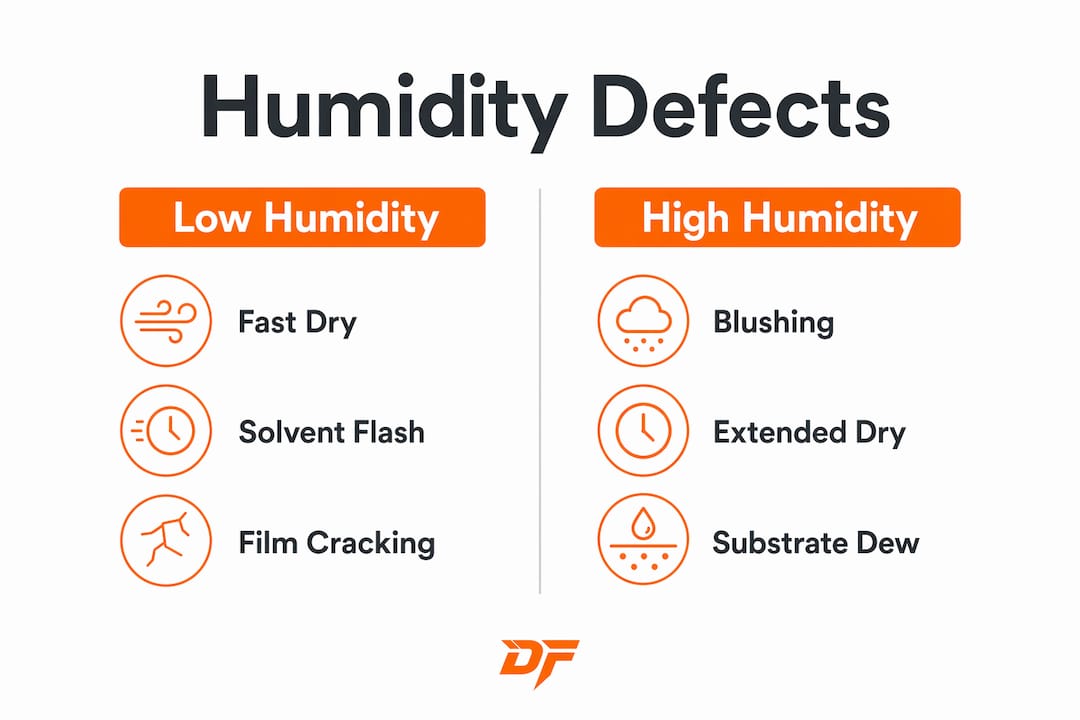
Low and high humidity produce distinct, diagnosable defect signatures. Knowing which condition caused a defect is the difference between applying the right fix and making things worse.
Low humidity defects center on speed. Dry air below 40% RH causes solvents to flash off faster than the film can flow and level. The result is a pebbled, rough surface texture rather than a smooth film. Simultaneously, dry air is an electrical insulator, so static buildup increases dramatically, attracting airborne dust and debris directly onto the wet film. Poor film formation and contamination combine to make low-humidity conditions the leading rework driver during dry seasons.
High humidity defects are subtler and often misdiagnosed. Blushing is the classic example: as solvents evaporate in high-RH air, they cool the surface enough to condense ambient moisture into the coating, producing a milky or hazy finish. Operators sometimes treat this as simple slow drying and wait it out, which does not fix the underlying chemistry. Fish-eyes form when surface moisture disrupts coating adhesion at a localized level. Sustained high RH on primer coats traps moisture between the substrate and the topcoat, causing peeling and flaking in service.
Dew point and substrate temperature interact in a way that catches even experienced operators off guard. The substrate surface must stay at least 3°C–5°C above the dew point to prevent invisible condensation from forming before the coating is applied. A substrate that reads dry to the touch can still carry a condensation film if the temperature differential is too narrow.
Pro Tip: Blow your spray gun air onto a clean glass surface before starting a shift. Water droplets on the glass mean moisture in your compressed air supply, a hidden defect source that ambient RH readings will never catch. Check moisture separators and drain traps at the same time.
What high humidity does to your drying and cure schedule
High humidity extends drying times far beyond what most production schedules account for; this is why understanding Film PPF Mat pour voiture : une solution de protection auto-cicatrisante et facile à installer pour votre carrosserie is essential to maintaining paint film quality in automotive manufacturing. At 50% RH, a typical waterborne topcoat reaches tack-free in 1–2 hours. Once RH climbs above 70%, that same coat can take several hours longer to reach tack-free, and total cure time can significantly increase, which effectively halts throughput on a high-volume line.
The physical mechanism is straightforward. Evaporation requires the air to accept moisture vapor. When ambient RH is already high, the air’s capacity to absorb additional vapor drops, so solvent and water removal from the film slows proportionally. Physical science research on polymer paint behavior adds a nuance: as a polymer solution dries, the polymer molecules migrate to the surface and form a dense layer that can temporarily shield evaporation from humidity effects. Final cure, however, remains humidity-dependent once that surface layer forms.
| Relative Humidity | Tack-Free Time | Total Dry Risk |
|---|---|---|
| 40–50% RH | 1–2 hours | Low |
| 50–65% RH | 1–2 hours | Moderate |
| 65–70% RH | several hours longer | High |
| Above 70% RH | several hours longer | Very High |
Low humidity accelerates surface drying but creates its own scheduling problem. A film that skins over before it fully levels traps solvents underneath, which can cause cracking or a brittle finish over time. The optimal 40%–60% window exists precisely because it balances evaporation speed against film formation quality.
Operational benefits of controlling humidity and dew point precisely
Stable RH control does more than prevent defects. It makes production predictable. When your booth holds 50% RH consistently, cure schedules match the manufacturer’s Technical Data Sheet, recoat windows are reliable, and throughput planning becomes straightforward. Some moisture-cure urethanes actually require controlled humidity levels to cure correctly, so checking the TDS for coating-specific requirements is non-negotiable before assuming a universal range applies.
Predictive humidity control takes this further. Standard PID controllers react after the RH sensor crosses a threshold. By the time the dehumidifier ramps, air mixes, and RH stabilizes, the booth has already been spraying in degraded conditions. iFactory AI’s predictive system forecasts RH excursions 15–30 minutes ahead and writes corrected setpoints back to the HVAC before the threshold is crossed. A Tier-1 paint shop deployment documented 18% fewer dirt and inclusion defects, a 70% reduction in RH standard deviation, and $28,000 in annual savings per booth with a four-month payback. Documented studies put paint-shop HVAC energy savings at 20%–46% when predictive control replaces standard PID.
Pro Tip: Place RH sensors at multiple points: booth inlet, mid-booth spray zone, and exhaust. A single sensor near the HVAC unit misses localized humidity pockets that form around the spray zone, especially during high-production periods. Calibrate sensors against a reference instrument at least quarterly.
Methods and technologies for humidity measurement and control:
- Calibrated digital thermohygrometers with ±2% RH accuracy for real-time monitoring at spray height
- Multi-point sensor arrays covering inlet, spray zone, and exhaust for spatial RH mapping
- Refrigerated or desiccant air dryers on compressed air lines to eliminate moisture at the gun
- Adiabatic humidification systems that add moisture through controlled evaporation without surface wetting
- Predictive control platforms that forecast excursions and auto-adjust HVAC setpoints proactively
- Seasonal recalibration routines to account for summer humidity loads and winter dry-air conditions
Seasonal factors matter more than most shops acknowledge. Summer air carries far more moisture at the same RH reading than winter air does, and monsoon or coastal climates can overwhelm undersized dehumidification systems entirely. Building a booth efficiency plan around seasonal RH baselines, rather than reacting to excursions, is what separates consistent producers from chronic rework shops.
Real-world humidity management: what controlled booths actually look like
The Tier-1 BIW paint shop case documented by iFactory AI is worth examining in detail. A booth supervisor tracked defects against RH readings for 14 months and found that most dirt inclusions on the night shift appeared during early morning hours, with elevated relative humidity recorded in one specific booth. The HVAC was reactive, correcting only after the sensor alarm triggered. By then, significant spray time had elapsed at degraded conditions, allowing multiple bodies per night to enter the rework loop. Switching to predictive control reduced sustained RH levels and cut dirt and inclusion defects significantly.
Shops operating in dry climates face the opposite problem. During winter months, indoor RH can fall below 30% without active humidification, triggering static-related contamination and dry spray that looks, at first glance, like a gun setup issue. Facilities that maintain ideal booth conditions year-round through adiabatic humidifiers report more consistent film build and fewer unexplained finish variations between shifts. The pattern holds across automotive, aerospace, and general metal finishing: controlled RH produces predictable output; uncontrolled RH produces surprises.
Dustfreefilm keeps your booth clean while you control the climate
Humidity management solves one half of the paint booth environment equation. Dust and particulate contamination solve the other. Even a perfectly humidity-controlled booth produces defects if airborne particles reach the wet film.

Dustfreefilm’s multi-layer electrostatic protective films are designed specifically for automotive and industrial spray booths, covering walls and floors to capture and contain dust before it reaches the spray zone. The films are static-free, heat-resistant, and built for high-traffic production environments. The patented dispenser system allows quick, bubble-free installation, so booth downtime stays minimal. Custom configurations are available for non-standard booth geometries, and bulk purchasing options support high-volume operations. When humidity excursions are already creating rework pressure, the last thing you need is a dust contamination problem compounding the loss. Explore Dustfreefilm’s full range of booth protection solutions and see how cleaner surfaces and controlled environments work together for a finish that holds up.
Key Takeaways
Maintaining relative humidity between 40% and 60% in automotive and industrial paint booths is the most direct lever for reducing defects, controlling cure schedules, and protecting production throughput.
| Point | Details |
|---|---|
| Optimal RH window | Hold booth RH at 40%–60%; deviations in either direction produce distinct, costly defect types. |
| Dew point margin | Keep substrate temperature at least 3°C–5°C above the dew point to prevent condensation and subsequent adhesion failure. |
| Drying time risk | Above 70% RH, tack-free time increases by 300–400%, with total drying time stretching from 24 to 72 hours. |
| Predictive control payback | iFactory AI deployments document 18% fewer defects, 70% lower RH deviation, and $28K annual savings per booth. |
| Dustfreefilm’s role | Multi-layer electrostatic booth films eliminate particulate contamination that compounds humidity-related defects. |