

A single microscopic dust particle measuring just 10 microns can cause a visible fisheye defect that ruins an entire automotive paint job. These invisible contaminants create costly quality failures, safety risks, and expensive rework cycles. This guide reveals how facility managers can eliminate dust-related paint defects through proven environmental controls, particle management strategies, and operational best practices that deliver consistently superior finishes.
Table of Contents
- How Dust Impacts Paint Quality In Automotive And Industrial Environments
- Techniques And Environments That Control Dust For Optimal Paint Finishes
- Particle Size Management And Process Controls To Prevent Dust-Related Defects
- Best Practices To Implement And Maintain Dust-Free Painting Environments
- Explore Dust-Free Solutions For Superior Paint Finishes
- Frequently Asked Questions
Key takeaways
| Point | Details |
|---|---|
| Dust particles cause critical defects | Microscopic dust creates fisheyes, bubbling, and peeling that compromise both appearance and protective coating integrity. |
| Cleanroom environments improve results | Controlled particulate and humidity enhance paint adhesion and long-term durability while reducing defect rates. |
| High-pressure humidification captures dust | Fine water particles settle airborne contaminants before they reach painted surfaces, preventing costly defects. |
| Particle size affects coating performance | Proper size distribution prevents aggregates that cause visual flaws and ensures stable, consistent color and viscosity. |
| Systematic dust control cuts costs | Effective measures deliver up to 60% defect reduction and 15-20% lower rework expenses through improved first-pass yield. |
How dust impacts paint quality in automotive and industrial environments
Even particles smaller than the width of a human hair cause devastating paint failures. Microscopic dust particles create defects like bubbling and fisheyes that appear as visible imperfections on finished surfaces. These contaminants interfere with paint adhesion, creating weak points where coatings separate from substrates.
The economic and safety consequences extend far beyond aesthetics. Dust significantly degrades finishes through orange peel and blistering, forcing expensive rework cycles that consume labor hours and materials. When defective painted components reach assembly lines, they create safety risks that can trigger costly recalls and liability issues.
Common dust-related paint defects include:
- Fisheyes: crater-like depressions caused by contamination preventing proper wetting
- Orange peel: rough, textured surface resembling citrus skin from uneven flow
- Bubbling: trapped air or moisture under paint layers creating raised spots
- Peeling: premature coating failure where paint separates from the substrate
Facility managers often misattribute these defects to application technique or paint formulation problems. The reality is that environmental dust control represents a major controllable factor that directly impacts finish quality and operational costs.
Dust contamination accounts for a significant percentage of automotive paint defects, yet many facilities underestimate the importance of rigorous particulate control in achieving consistently flawless finishes.
Understanding how spray booth air quality affects finish outcomes provides the foundation for implementing effective dust control strategies. Temperature, humidity, and air velocity all influence how particles move through painting environments and interact with wet coatings.
Techniques and environments that control dust for optimal paint finishes
Modern automotive manufacturing relies on sophisticated environmental controls to eliminate dust-related defects. Cleanroom environments maintain controlled particulate levels, humidity, and static that dramatically improve paint adhesion, consistency, and long-term durability. These controlled spaces prevent contamination at every stage of the coating process.
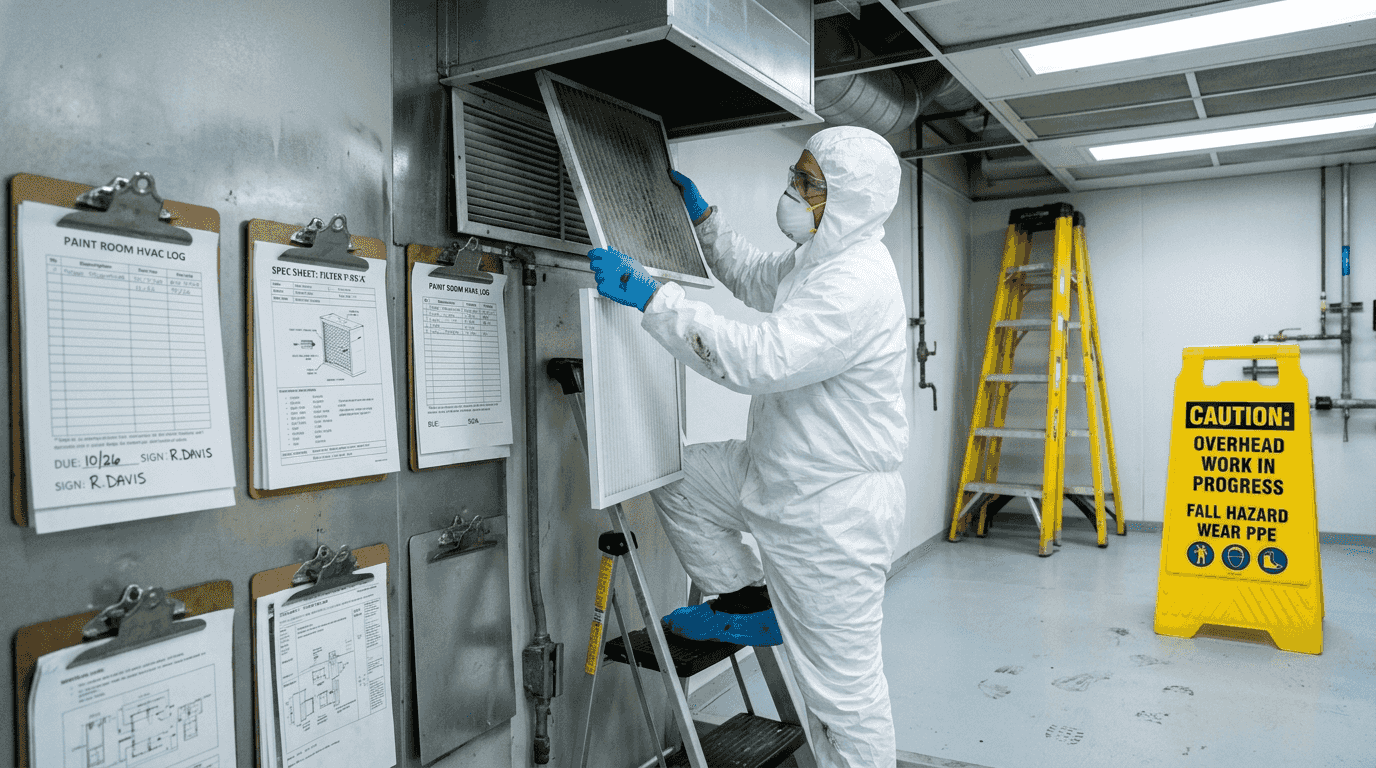
Spray booths equipped with HEPA filtration systems form the cornerstone of industrial dust control. Proper filtration dramatically reduces paint defects by removing airborne particles before they reach wet surfaces. Multi-stage filtration captures progressively smaller contaminants, with final HEPA stages removing particles down to 0.3 microns at 99.97% efficiency.
High-pressure humidification technology offers a complementary approach to particulate control. Water particles capture and settle airborne dust before contaminants land on painted surfaces. This method provides the added benefit of adiabatic cooling, which improves worker comfort while maintaining optimal coating conditions.
Key environmental control systems include:
- HEPA filtration: removes particles down to 0.3 microns with high efficiency
- High-pressure humidification: captures dust with fine water droplets
- Positive pressure systems: prevents outside contamination from entering spray areas
- Temperature and humidity control: maintains ideal conditions for paint application and curing
- Static elimination: reduces particle attraction to charged surfaces
Advanced automotive facilities now integrate cleanroom standards into wet painting operations, recognizing that investment in environmental controls pays dividends through reduced defect rates and enhanced finish quality. Optimizing spray booth efficiency requires balancing airflow, filtration, and environmental parameters.
Pro Tip: Combine mechanical filtration with humidification systems for maximum dust control effectiveness. The dual approach captures particles through both physical barriers and moisture attraction, while adiabatic cooling improves working conditions during hot weather operations.
Regular monitoring of environmental parameters ensures systems maintain effectiveness over time. Digital sensors track particle counts, humidity levels, and temperature in real time, alerting operators to conditions that could compromise finish quality.
Particle size management and process controls to prevent dust-related defects
Particle size distribution in paint formulations directly influences coating performance, appearance, and longevity. Proper particle analysis ensures product performance and aesthetic quality by preventing aggregates that create visual defects and compromise protective properties. Particle size affects viscosity, color consistency, and shelf stability.
Systematic contamination control requires structured diagnostic approaches. The 4M1E framework addresses root causes by examining Man (operator practices), Machine (equipment condition), Material (paint and substrate quality), Method (application procedures), and Environment (dust and climate control). This comprehensive analysis identifies specific improvement opportunities.
Monitoring particle size involves proven measurement techniques:
- Laser diffraction analysis measures particle distribution across size ranges from nanometers to millimeters.
- Dynamic light scattering determines particle size in liquid suspensions with high precision.
- Optical microscopy provides visual confirmation of aggregate formation and contamination.
- Automated particle counters track real-time environmental contamination levels in spray booths.
The relationship between particle characteristics and paint defects appears in measurable patterns:
| Particle Size Range | Effect on Paint | Common Defects |
|---|---|---|
| Under 1 micron | Excellent dispersion, smooth finish | Minimal defects when properly formulated |
| 1 to 10 microns | Affects gloss and color uniformity | Slight texture variations, reduced gloss |
| 10 to 50 microns | Visible surface irregularities | Orange peel, rough texture, poor flow |
| Over 50 microns | Severe quality issues | Fisheyes, craters, coating failure |
Facility managers benefit from understanding that environmental dust particles follow similar size-defect relationships. Controlling airborne contaminants in the same size ranges prevents similar quality issues even when paint formulation remains optimal.
Integrating particle management with facility operations requires attention to both spray booth setup and operational procedures. Equipment configuration and daily practices work together to maintain particle control.
Pro Tip: Schedule particle size analysis quarterly to detect formulation drift or contamination trends before they create widespread defects. Early detection allows corrective action that prevents costly quality failures and maintains customer satisfaction.
Process documentation creates accountability and enables continuous improvement. Recording environmental conditions, particle measurements, and defect rates reveals patterns that guide targeted interventions for maximum impact.
Best practices to implement and maintain dust-free painting environments
Establishing effective dust control requires systematic approaches that address equipment, procedures, and personnel. Comprehensive cleaning protocols remove accumulated contaminants before they become airborne during painting operations. Preventive maintenance ensures filtration systems, humidifiers, and air handling equipment perform at design specifications.
Staff training forms the foundation of sustainable dust control programs. Operators must understand why environmental management matters and how their actions influence finish quality. Training covers proper material handling, equipment operation, cleaning procedures, and contamination prevention protocols.
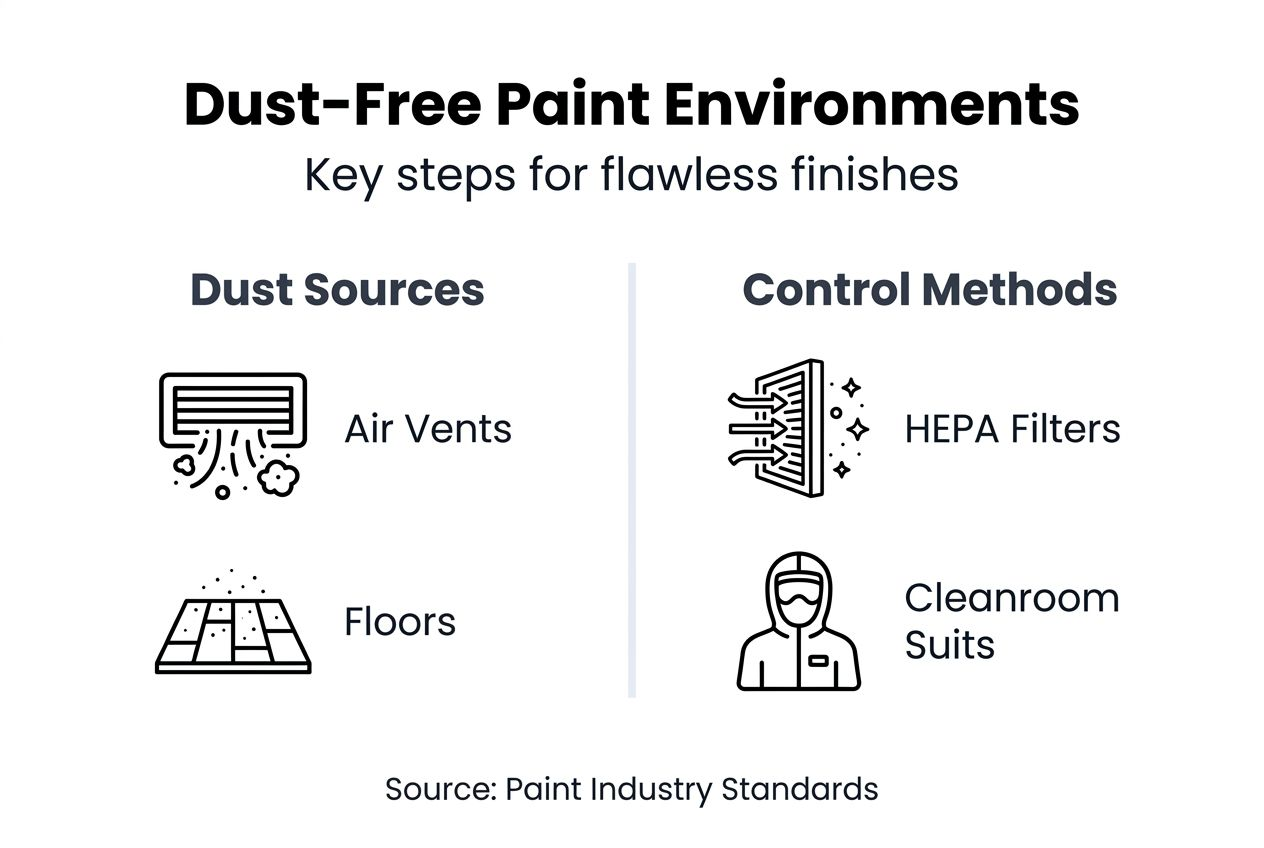
High-quality dust barriers protect spray booth surfaces from contamination buildup. Dust free films on walls and floors create cleanable surfaces that prevent particle generation from substrate deterioration. These protective layers simplify cleaning while extending booth infrastructure lifespan.
Regular monitoring identifies opportunities for improvement before defects escalate. Tracking particle counts and defect rates reveals trends that guide resource allocation and process refinement. Maintaining dust-free environments delivers up to 60% defect reduction and 15-20% lower rework costs through improved first-pass yield.
Sequential maintenance tasks preserve dust-free conditions:
- Inspect and replace air filters according to pressure drop measurements or manufacturer schedules.
- Clean booth walls, floors, and equipment using approved methods that avoid creating airborne dust.
- Verify humidification system operation and water quality to prevent mineral deposits.
- Test static elimination equipment to ensure proper grounding and ionization.
- Calibrate particle counters and environmental sensors for accurate monitoring.
- Document all maintenance activities and defect rates to track program effectiveness.
Daily operational practices maintain environment integrity:
- Conduct pre-shift booth inspections to identify contamination or equipment issues
- Use tacky mats at booth entrances to capture footwear-borne particles
- Minimize booth traffic during painting operations to reduce disturbance
- Stage materials in clean areas away from high-traffic zones
- Clean spray equipment thoroughly between color changes to prevent cross-contamination
Following a comprehensive spray booth maintenance checklist ensures no critical tasks get overlooked during busy production periods. Systematic approaches prevent the gradual degradation that leads to quality problems.
Implementing proper spray booth preparation steps before each painting session creates consistent starting conditions. This standardization reduces variability and improves quality predictability across shifts and operators.
Cost-benefit analysis demonstrates the value of dust control investments. Calculate total defect costs including materials, labor, equipment time, and customer dissatisfaction. Compare these expenses against dust control system costs to justify capital expenditures and ongoing operational budgets.
Benchmarking against industry standards provides context for performance evaluation. Leading automotive facilities achieve defect rates below 5% through rigorous dust control, while facilities with inadequate controls often exceed 20% defect rates. This performance gap translates directly to profitability and competitive advantage.
Explore dust-free solutions for superior paint finishes
Achieving consistently flawless paint finishes requires more than operational discipline. Purpose-built dust free film protection provides durable wall and floor barriers that prevent contamination in spray booths and painting environments. These multi-layer electrostatic films feature patented application systems for quick, bubble-free installation.
Facility managers benefit from European manufacturing standards that deliver heat-resistant, static-free protection suitable for high-traffic industrial settings. Custom configurations accommodate unique booth dimensions and operational requirements. Bulk purchasing options support large-scale operations while maintaining budget efficiency.
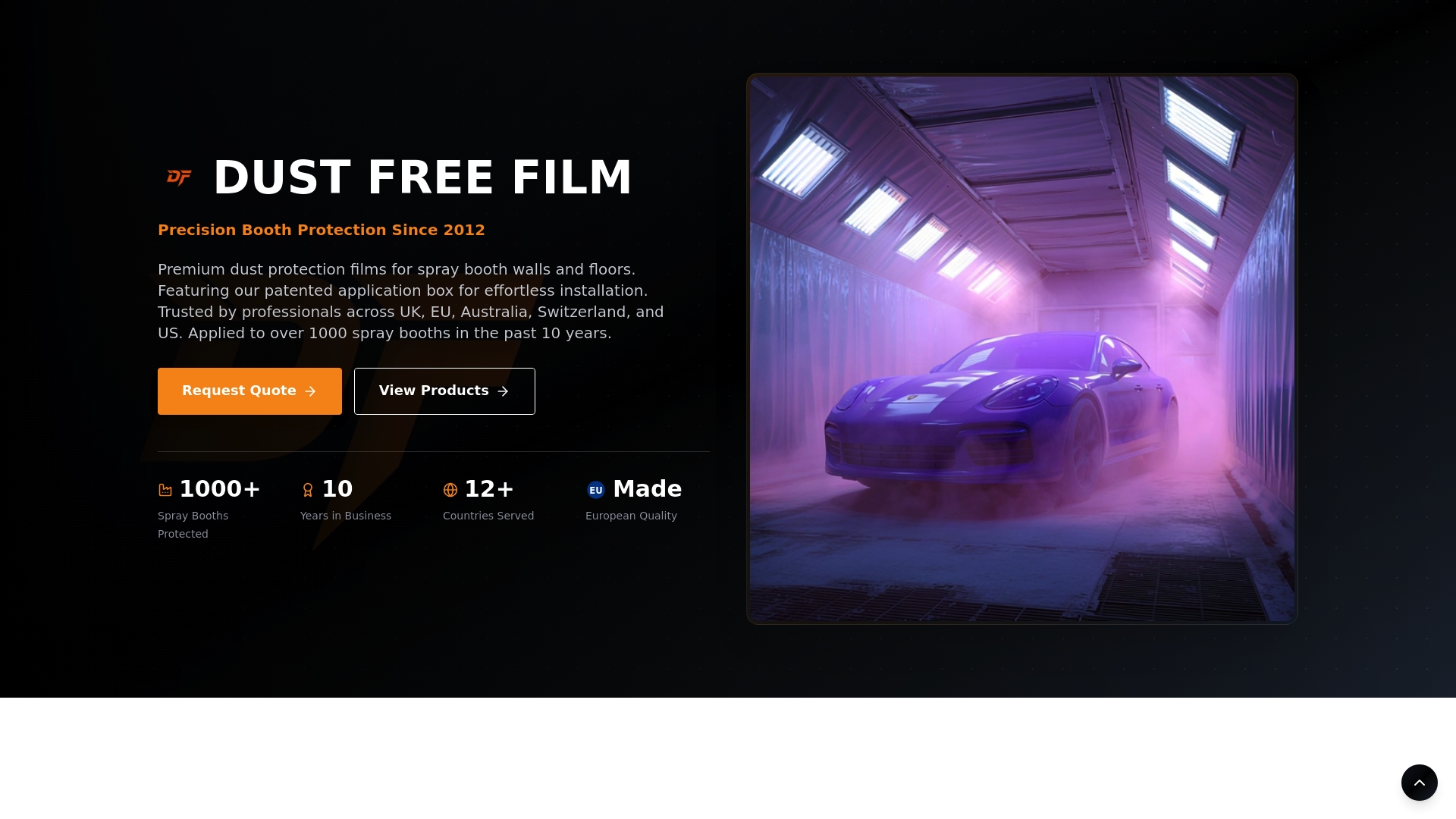
Expert consultation helps identify the optimal dust control solutions for your specific environment and production volume. Request a dust free film quote to discover how purpose-built protective films complement your existing operational and technological controls. Combining proven products with best practices delivers the defect-free painting environments that drive quality, efficiency, and profitability.
Frequently asked questions
What causes dust defects in paint finishes?
Dust defects occur when airborne particles land on wet paint and interfere with proper coating flow and adhesion. Particles create fisheyes, orange peel, and bubbling by preventing uniform surface wetting and trapping air or moisture under the coating layer. Even microscopic contaminants produce visible defects that require expensive rework.
How does particle size affect paint performance?
Particle size distribution influences paint viscosity, color consistency, and long-term stability. Oversized particles or aggregates create surface texture, reduce gloss, and compromise protective properties. Proper particle size ensures smooth application, uniform appearance, and stable shelf life. Monitoring particle distribution prevents quality issues before they reach production.
What technologies reduce airborne dust in paint booths?
HEPA filtration systems remove particles down to 0.3 microns with 99.97% efficiency, forming the primary defense against airborne contamination. High-pressure humidification captures dust with fine water droplets before particles reach painted surfaces. Positive pressure systems prevent outside contamination from entering spray areas. Combined technologies deliver comprehensive dust control for optimal finish quality.
How often should spray booths be maintained for dust control?
Daily inspections identify immediate contamination or equipment issues requiring attention. Filter replacement follows manufacturer schedules or pressure drop measurements, typically monthly to quarterly depending on usage intensity. Comprehensive deep cleaning occurs quarterly or semi-annually based on production volume. Regular maintenance prevents gradual performance degradation that leads to quality problems and expensive corrective actions.
Can dust-free environments reduce overall painting costs?
Effective dust control delivers measurable cost savings through reduced defect rates and rework expenses. Facilities implementing comprehensive dust management achieve up to 60% fewer paint defects and 15-20% lower rework costs. Improved first-pass yield increases production capacity without additional equipment investment. Quality improvements also enhance customer satisfaction and reduce warranty claims, delivering sustained competitive advantage and profitability.