

TL;DR:
- Proper booth preparation prevents contamination-related rework and ensures consistent first-pass finishes. Daily cleaning, airflow monitoring, and structured maintenance are essential practices that improve finish quality and operational efficiency. Dust Free Film protective solutions further reduce dust accumulation, maintaining a consistently clean booth environment.
A single contamination event in a spray booth can send a freshly painted panel back to square one, burning labor hours, materials, and customer trust in one stroke. The industrial booth preparation process is the difference between a facility that produces first-pass finishes consistently and one that absorbs rework costs as a fact of life. This guide walks facility managers and quality control professionals through every phase of effective booth preparation, from understanding how your booth systems behave to building the maintenance structure that keeps contamination out of your finished product.
Table of Contents
- Understanding the industrial booth preparation process and system fundamentals
- Pre-installation planning and logistics for spray booth readiness
- Daily and routine cleaning for dust control and compliance
- Airflow and filtration checks to ensure finish quality and operational efficiency
- Implementing an effective maintenance checklist for industrial booth preparation
- Rethinking spray booth preparation: beyond routine cleaning
- Enhance your spray booth preparation with Dust Free Film protection solutions
- Frequently asked questions
Key Takeaways
| Point | Details |
|---|---|
| Comprehensive preparation | Effective booth prep starts with logistics planning and a staged pre-build to avoid costly delays. |
| Consistent dust control | Daily cleaning and waste management prevent fire hazards and maintain airflow integrity. |
| Performance-based maintenance | Filter changes and airflow checks should be governed by data, not just scheduled routines. |
| System-level monitoring | Managing contamination and airflow holistically supports stable finishes and uptime. |
| Protective solutions | Using Dust Free Film reduces dust buildup and complements disciplined booth preparation. |
Understanding the industrial booth preparation process and system fundamentals
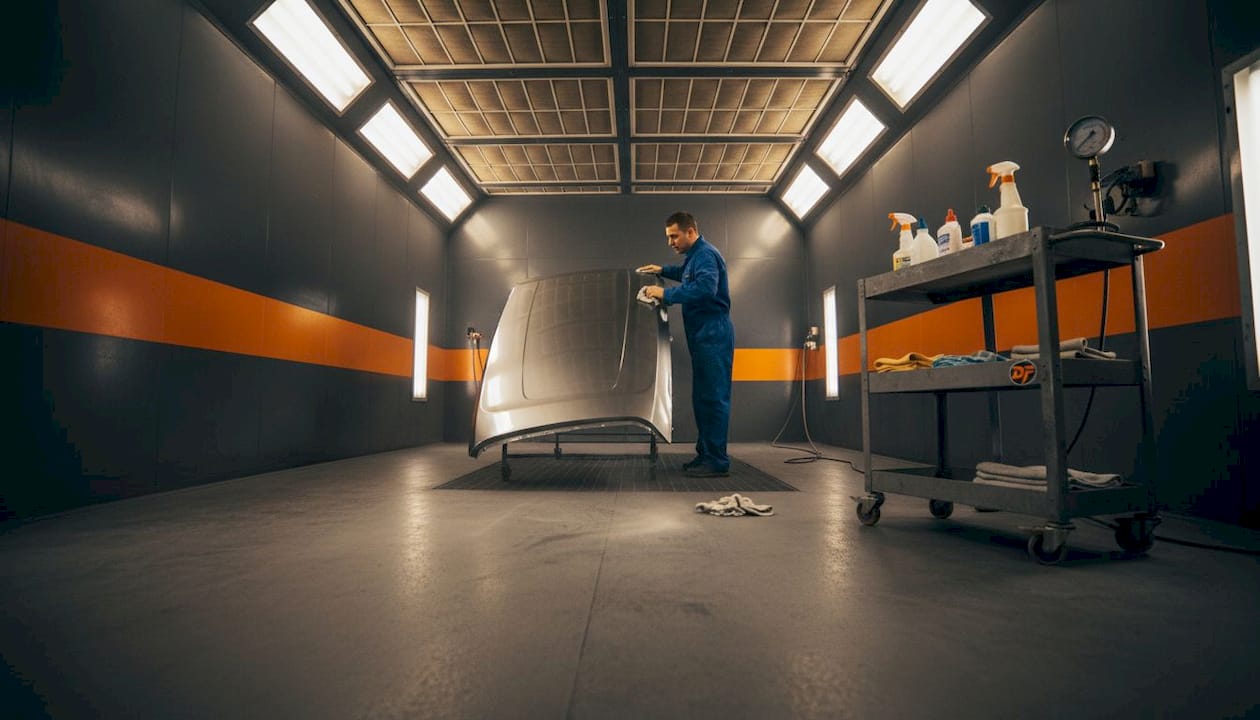
Before you can prepare a spray booth properly, you need to understand what the booth is actually doing at each stage of operation. A spray booth is not a passive room. It is an active environmental system where airflow, temperature, pressure, and filtration interact continuously.
Key structural and operational components every facility manager should know:
- Insulated wall panels that reduce heat loss during the drying phase and limit temperature fluctuation
- Service and access doors that must seal tightly to prevent uncontrolled air infiltration carrying external dust
- Intake and exhaust fans that generate and maintain the airflow volume required for safe vapor concentration levels
- Heat exchangers and burners that bring air to the target temperature for the drying phase without introducing combustion byproducts
- Ceiling and floor filtration media that capture airborne particulate before it reaches the work surface
The painting phase operates under laminar downward airflow conditions. Air flows from the ceiling filters downward across the vehicle or part surface and exits through the floor filters, carrying overspray with it. Any disruption to this pattern creates turbulence, and turbulence deposits overspray where you do not want it. Spray booths operate in painting and drying phases requiring precise ventilation, heating, and filtration controls for stable conditions.
The drying phase switches the booth into a recirculating or high-temperature mode. Air is reheated and recirculated to cure the coating without introducing new outside air at a rate that would cool the panel below cure temperature. Each phase puts different demands on your fans, filters, and seals, which means your preparation approach must account for both.
Understanding these systems is not academic. It tells you exactly where contamination enters, accumulates, and gets redistributed, which is the foundation of any targeted booth preparation technique.
Pre-installation planning and logistics for spray booth readiness
The most avoidable failures in industrial booth setup happen before the first tool is picked up. Poor logistics planning creates idle labor, rushed installs, and missed steps that compound into finish quality problems for months.
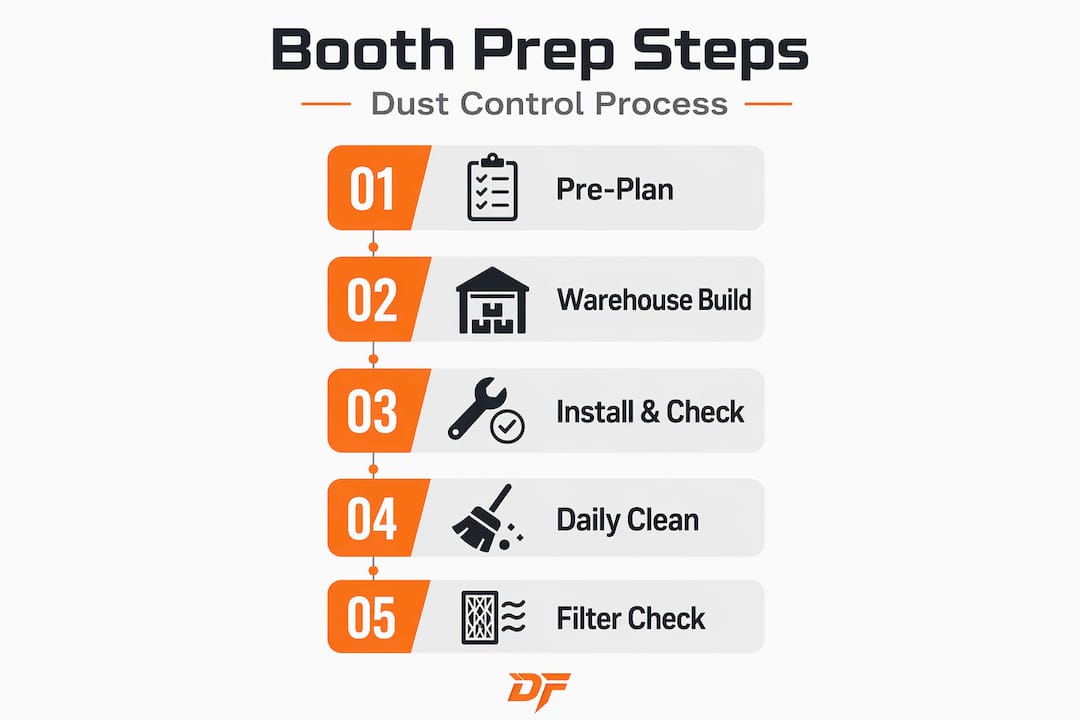
A structured pre-installation planning sequence:
- Confirm booth dimensions precisely, including ceiling height, door placement, and floor drain locations
- Verify venue or facility labor rules and any union jurisdiction requirements at least 30 days in advance
- Complete all insurance documentation, service agreements, and compliance paperwork before materials arrive
- Ship materials to a staged advance warehouse rather than directly to the install site
- Run a full pre-build rehearsal in the warehouse to identify missing hardware, fitment issues, or sequencing errors
- Create a digital install map with each crate or pallet labeled using QR codes tied to the map
- Schedule labor in phases aligned with the verified install sequence to eliminate waiting time between steps
The booth setup workflow begins with pre-show logistics: verify dimensions, confirm labor rules, complete paperwork 30 or more days ahead, and use an advance warehouse to stage materials efficiently.
The warehouse pre-build step is where experienced facility teams separate themselves from teams that learn on install day. Running through the physical sequence once, in a controlled environment, surfaces every fitment issue and every missing component before the clock is running at the actual facility. It costs time upfront and saves significantly more on the back end.
Common pre-installation oversights that cause downstream problems:
| Risk area | Consequence if missed | Prevention action |
|---|---|---|
| Unverified booth dimensions | Panels that do not fit or seal correctly | Measure twice with drawings and a site visit |
| Labor rule violations | Work stoppages and penalty charges | Confirm union rules before contracting labor |
| Materials shipped to site | Idle crews waiting on deliveries | Route all materials through advance warehouse |
| No pre-build rehearsal | Missing hardware found on install day | Full physical rehearsal before shipping |
| No digital install map | Crews opening wrong crates in wrong sequence | QR-coded crate map distributed before arrival |
Pro Tip: Assign a single logistics owner who is accountable for the pre-build rehearsal and the install map. Distributed accountability in booth installation planning is where critical details fall through.
For more on this, the industrial spray booth setup guide covers how setup sequencing directly affects long-term dust control performance.
Daily and routine cleaning for dust control and compliance
Daily housekeeping in a spray booth is not a janitorial function. It is a contamination control function with direct ties to finish quality, fire safety, and regulatory compliance.
OSHA requires spray residues not to accumulate to fire hazard levels and mandates cleaning at frequently recurring intervals, with frequent emptying of waste metal containers at least once per shift.
A daily cleaning sequence for compliant spray booths:
- Remove all overspray residue from walls, floors, and fixtures using booth-approved cleaning tools
- Empty all waste containers into approved sealed metal receptacles at the end of every shift, not at the end of the day
- Inspect hidden zones including fan housings, duct entry points, and ceiling perimeter ledges for accumulated dust and fiber
- Wipe down door seals and check for coating buildup that could prevent a full seal
- Clear the floor filter media of any heavy overspray deposits that would restrict exhaust airflow
“Effective dust control depends on airflow maintenance, filtration monitoring, and removing contaminants beyond visible surfaces daily.” Paint Booth Cleaning for quality, airflow, and uptime.
The contamination you can see is rarely the contamination that causes your finish defects. Dust fibers that settle on top of ceiling filters get drawn back into the airstream during the next spray cycle. Overspray buildup on fan housings gradually alters airflow patterns in ways a visual inspection will never catch. The paint booth cleanliness practices that consistently produce clean finishes go well beyond mopping the floor and wiping walls.
High-risk zones frequently skipped in daily cleaning:
- Fan blade surfaces and motor housings
- Lighting fixture tops and frames
- Door frame recesses and hinge areas
- Floor filter perimeter seals
- Air intake plenum chambers
Your paint booth dust safety program should map these zones explicitly so daily crews are not relying on general instruction to find them. And a well-designed booth maintenance checklist keeps these zones in the daily workflow, not treated as occasional deep-clean items.
Pro Tip: Photograph your high-risk zones in a clean state immediately after a thorough deep clean. Use those photos as the baseline standard that daily crews compare against before signing off.
Airflow and filtration checks to ensure finish quality and operational efficiency
Filter replacement on a calendar schedule is one of the most common and costly mistakes in preparing industrial booths. A filter that looks intact visually may already be restricting airflow enough to compromise finish quality. A filter that looks dirty may still be performing within specification.
Filter condition affects airflow and overspray removal. Differential pressure tracking and airflow validation ensure filters are changed based on performance, not fixed schedules.
Core airflow and filtration monitoring tasks:
- Read and record differential pressure across intake and exhaust filters at the start of every shift
- Compare readings against the booth manufacturer’s placard range for acceptable operating pressure drop
- Validate airflow velocity using a calibrated manometer or anemometer at minimum monthly
- Inspect exhaust fan blades for overspray accumulation that adds weight and reduces efficiency
- Check intake filter frames for gaps or bypass points where unfiltered air enters the booth
| Monitoring parameter | Tool required | Replacement trigger |
|---|---|---|
| Intake filter pressure drop | Magnehelic gauge or digital manometer | Exceeds upper placard limit |
| Exhaust filter pressure drop | Magnehelic gauge or digital manometer | Exceeds upper placard limit |
| Airflow velocity | Anemometer | Falls below booth spec range |
| Fan blade condition | Visual and weight check | Visible buildup or vibration |
| Filter frame seal integrity | Visual with flashlight | Any visible gap or bypass |
Managing booth ventilation phase modes and control systems maintains stable paint and drying conditions. This means your monitoring approach must account for the different demands each phase places on the filtration and airflow system.
Pro Tip: Install a simple logging clipboard directly on the booth control panel. Crews who record pressure readings as a physical step before starting a job will catch filter loading events that a digital system might not flag until the next scheduled review.
Your spray booth maintenance guide and dust-free maintenance practices both reinforce why performance-triggered replacement beats scheduled replacement every time.
Implementing an effective maintenance checklist for industrial booth preparation
A checklist is only as useful as its structure. Facility managers who hand crews a single combined list of tasks get inconsistent results because not everything needs daily attention, and lumping tasks together causes the truly daily items to get skipped when a crew is behind schedule.
A structured checklist broken into daily, weekly, monthly, and quarterly tasks protects finish quality, improves training, and addresses known defect causes systematically.
Maintenance frequency framework:
- Daily: Overspray removal from all surfaces, airflow gauge readings, waste container emptying, door seal inspection, floor filter check
- Weekly: Detailed filter inspection and pressure data review, airflow velocity validation, lighting fixture cleaning and output check, fan housing visual inspection
- Monthly: Mechanical safety checks on fan motors and drives, electrical connection tightening, door seal replacement assessment, exhaust stack inspection
- Quarterly: Full system calibration, burner and heat exchanger service, deep duct inspection, and resolution of any recurring defect patterns identified in the monthly reviews
What separates a checklist that works from one that collects dust:
- Each task has a measurable pass/fail criterion, not a subjective “check if okay” instruction
- Each task has a named owner or role responsible for completion
- Signatures or digital confirmation are required, not optional
- Failed items trigger a specific escalation path, not just a note on the sheet
- The checklist is reviewed quarterly and updated when new contamination sources are identified
| Frequency | Primary focus | Key outcome |
|---|---|---|
| Daily | Contamination removal and airflow check | Prevents finish defects in production |
| Weekly | Filter and airflow validation | Maintains consistent spray conditions |
| Monthly | Mechanical and electrical integrity | Prevents unplanned downtime |
| Quarterly | Deep service and defect pattern review | Drives continuous quality improvement |
Pro Tip: Connect your quarterly review directly to your rework log. If a contamination-related defect appears more than twice in a quarter, the checklist needs a new task, not a reminder to do the existing ones better.
The spray booth maintenance checklist and step-by-step maintenance guide both provide frameworks you can adapt to your facility’s specific booth configuration.
Rethinking spray booth preparation: beyond routine cleaning
Here is the uncomfortable truth most spray booth maintenance programs will not say out loud. Cleaning the booth is not the same as controlling contamination. Facilities that treat these as identical activities consistently accept higher rework rates than they need to.
Routine, schedule-based cleaning is often insufficient. Integrating airflow validation and contamination behavior control is key to stable paint quality and uptime.
The shift that matters is moving from reactive cleaning to active contamination governance. That means understanding how overspray plumes move through your specific booth geometry, where they deposit based on airflow asymmetries, and which cleaning activities actually address the contamination pathway versus which ones just make the booth look clean.
Most defects traced back to spray booth contamination are not caused by the most visible buildup. They are caused by the dust that settled on a ceiling filter frame edge and got dislodged by the airflow change when the booth switched from painting to drying mode. They are caused by the fiber that came off a worn door seal and traveled exactly where laminar flow directed it. Understanding the spray booth maintenance workflow at a system level, rather than a task level, is what separates facilities with consistent first-pass yields from those chasing defects one rework at a time.
The financial case is straightforward. A first-pass yield improvement of even five percent in a mid-volume spray facility represents significant material savings, labor recovery, and throughput gains. Performance-based filter management, contamination pathway mapping, and structured checklists with real accountability mechanisms are the tools that produce that improvement. Not a deeper cleaning bucket.
Enhance your spray booth preparation with Dust Free Film protection solutions
The preparation work covered in this guide establishes the foundation. But even the most disciplined cleaning routine cannot stop dust from re-accumulating on booth walls and floors between cycles, which is exactly the gap that protective film addresses.

Dust Free Film manufactures multi-layer electrostatic protective films purpose-built for spray booth walls and floors in automotive refinishing and industrial painting facilities. The films are heat-resistant, static-free, and designed to peel off in layers, taking accumulated overspray and dust with them instead of requiring manual cleaning. This directly reduces cleaning frequency, shortens turnaround time between jobs, and keeps your booth in a consistently prepared state. When you are ready to quantify the right configuration for your facility’s volume and booth dimensions, request a quote to get product specifications and pricing tailored to your operation.
Frequently asked questions
What is the most critical daily task for spray booth dust control?
Daily cleaning of spray residues and emptying waste containers in approved metal bins prevents fire hazards and maintains airflow efficiency. Cleaning at recurring intervals and proper waste disposal are explicit OSHA requirements, not optional best practices.
How often should spray booth filters be replaced?
Filters should be replaced based on differential pressure readings and performance data rather than fixed schedules to ensure stable airflow and finish quality. Filter replacement strategies that rely on pressure-drop validation prevent both premature replacement and costly underperformance.
What preparations reduce idle labor costs during booth installation?
Shipping materials to an advance warehouse and conducting full pre-build rehearsals minimize delays and idle labor expenses during installation. Use of advance warehouses and warehouse pre-builds resolve fitment and sequencing issues before crews are on the clock at the actual facility.
Why is managing airflow important beyond visible cleaning in spray booths?
Invisible dust and overspray in airflow pathways can recirculate and cause finish defects even when the booth appears visually clean. Airflow and overspray plume checks identify hidden contamination that visual inspections consistently miss.
How does Dust Free Film help in spray booth preparation?
Dust Free Film provides multi-layer protective coverings for booth walls and floors that capture overspray and dust between jobs, reducing cleaning labor and keeping the booth in a ready state. Peeling off a spent layer takes seconds and eliminates the manual scrubbing that would otherwise pull your team away from production.