
TL;DR:
- Precise industrial coatings terminology is essential to ensure compliance, prevent disputes, and maintain project quality. Misusing terms like surface preparation standards or coating layer specifications can lead to warranty failures and costly rework. Mastering this technical language enables better communication, cost control, and regulatory adherence in industrial coating projects.
Misreading a single term in a coating specification can void a warranty, trigger a project dispute, or cause premature coating failure on a structure worth millions. Industrial coatings terminology is not just paint vocabulary. It’s a precise technical language that governs how specifications are written, how work is inspected, and how compliance is verified. This guide breaks down the core terms, surface preparation standards, performance metrics, and application jargon that industrial professionals encounter daily. Master this language and you gain control over project outcomes, contractor conversations, and regulatory documentation.
Table of Contents
- Key takeaways
- Industrial coatings terminology: the core foundations
- Surface preparation standards and terminology
- Coating performance characteristics and types
- Application and inspection terms
- Practical implications of mastering coatings terminology
- My take on the real cost of coatings jargon confusion
- Keep your spray booth as precise as your specifications
- FAQ
Key takeaways
| Point | Details |
|---|---|
| Terminology drives compliance | Vague or incorrect coating terms in contracts lead to disputes, rejected work, and failed warranties. |
| Surface prep standards are non-negotiable | SSPC-SP5 and SSPC-SP10 define specific cleanliness levels that must be explicitly referenced in specs. |
| Coating systems are layered | Primer, intermediate coat, and topcoat must be chemically compatible; ignoring DFT requirements voids warranties. |
| Performance terms vary by application | Elongation, tensile strength, and UV stability mean different things across epoxy, polyurea, and acrylic systems. |
| Precision protects your budget | Accurate industrial coatings terminology prevents rework, reduces contamination risk, and supports cost control. |
Industrial coatings terminology: the core foundations
Most professionals in industrial sectors encounter the phrase “industrial coatings” and picture thick paint. That misunderstanding is where problems start. Industrial coatings are engineered multi-layer systems designed to perform under specific chemical, thermal, and mechanical stresses. Each layer serves a function, and the terminology around each component reflects that precision.
Composition terms you need to know
Understanding what a coating is made of directly affects how you specify, apply, and inspect it. Here are the foundational composition terms:
- Binder: The film-forming component that holds the coating together and determines many performance properties. Epoxy binders offer chemical resistance; polyurethane binders provide UV stability and flexibility.
- Pigment: Solid particles that provide color, opacity, and sometimes functional properties such as corrosion inhibition (zinc phosphate pigments) or heat reflection.
- Solvent: The liquid carrier that reduces viscosity for application. Solvent-borne coatings use organic solvents; waterborne coatings use water as the primary carrier, a growing preference due to VOC regulations.
- Additives: Specialty components added in small quantities to improve flow, adhesion, UV resistance, or anti-microbial performance. Additives like adhesion promoters are often misunderstood as optional but are frequently specification requirements.
- DFT (Dry Film Thickness): The thickness of the cured coating, measured in mils or microns. DFT is one of the most referenced terms in any coating specification, and neglecting DFT requirements voids warranties and triggers coating failure.
- WFT (Wet Film Thickness): Measured during application to estimate DFT. WFT and DFT are related but not equal; the ratio depends on the volume solids percentage of the product.
- Recoat window: The time period after applying one coat during which the next coat must be applied to achieve proper intercoat adhesion. Applying outside this window is a common cause of delamination.
- Cure time: The time required for the coating to achieve its full mechanical and chemical properties. Cure time differs from dry time; confusing the two leads to premature service exposure.
Common coating types definitions
The types of industrial coatings professionals specify most often include epoxy (two-component systems offering strong adhesion and chemical resistance), polyurethane (valued for UV stability and flexibility), polyurea (fast-cure systems with 300% to 600% elongation suitable for dynamic substrates), zinc-rich primers (sacrificial corrosion protection for steel), and powder coatings (solvent-free systems applied electrostatically and cured thermally). Each category carries its own specification language, and using the wrong term in a purchase order or contract can result in the wrong product being applied.
Surface preparation standards and terminology
No section of industrial paint terminology creates more project disputes than surface preparation. The reason is simple: the terms are highly specific, but they are frequently used loosely. SSPC surface preparation standards span from SP-1 (solvent cleaning) through SP-16 (brush-off blast), each with distinct cleanliness and profile requirements that are not interchangeable.
The two most commonly specified standards in heavy industrial work are SSPC-SP5 and SSPC-SP10. Here is how they compare:
| Standard | Cleanliness level | Staining allowed | Typical cost per sq ft |
|---|---|---|---|
| SSPC-SP5 (White Metal) | 100% clean substrate | 0% | $3.50 to $5.00 |
| SSPC-SP10 (Near-White Metal) | 95% clean substrate | Up to 5% light staining | $2.50 to $4.00 |
SP5 requires 100% removal with zero staining and is typically specified for immersion service or highly corrosive environments. SP10 permits minor light staining on no more than 5% of the surface and covers most structural steel applications. Selecting the wrong standard in a specification does not just affect cleanliness. It affects project cost, contractor bidding, and coating warranty coverage.
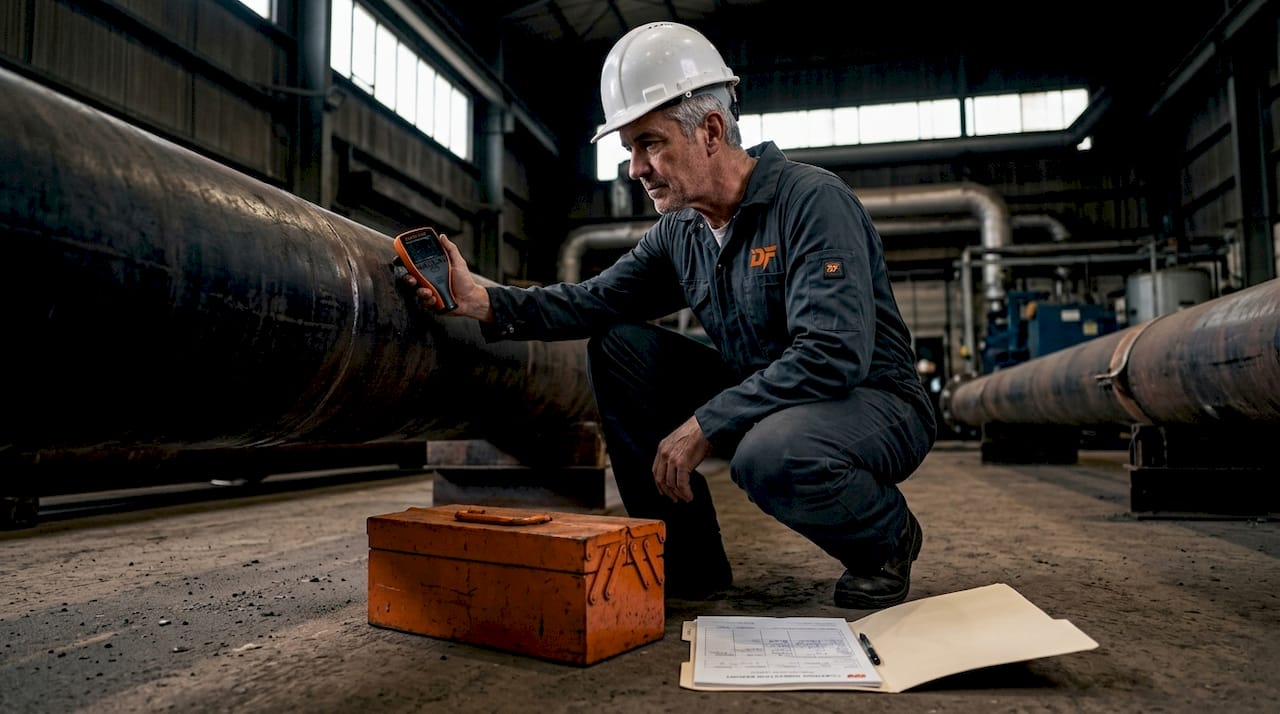
Anchor profile is equally critical. This term refers to the microscopic peaks and valleys created on a surface by abrasive blasting or power tool preparation. Without an adequate anchor profile, typically 50 to 100 µm Rz for high-performance coatings, the coating adhesion fails prematurely regardless of how clean the surface is. Profile measurement uses methods defined in ASTM D4417, including replica tape and digital gauges.
Unified AMPP standards combine legacy SSPC and NACE requirements with an explicit emphasis on inspection criteria. The professional takeaway is that specifying a standard without naming the inspection method and frequency creates ambiguity that contractors can exploit and that inspectors cannot enforce.
Pro Tip: When writing surface preparation specifications, always include three explicit elements: the SSPC standard, the anchor profile range using ASTM D4417, and soluble salt limits verified via Bresle patch testing. Leaving any of these undefined is the most common source of contract disputes in industrial coating projects.
Coating performance characteristics and types
Knowing the coating types definitions is step one. Understanding the performance terminology that defines what those coatings must actually do is where specifications become meaningful. This section covers the terminology industrial professionals use when selecting systems for specific service environments.
-
Corrosion resistance refers to the coating’s ability to protect the substrate from oxidation and chemical attack. This is quantified through salt spray testing (ASTM B117) and is the primary selection criterion for coatings on offshore structures, chemical plants, and water treatment facilities.
-
Abrasion resistance describes how well a coating withstands mechanical wear. The abrasion resistant coatings market reached $12.4 billion in 2025, reflecting heavy demand in oil and gas, manufacturing, and food processing sectors where wear degradation is a constant operational concern.
-
Elongation is the percentage a coating film can stretch before it cracks or breaks. Acrylic coatings per ASTM D6083 must meet at least 100% elongation and 100 psi tensile strength, while polyurea systems far exceed those thresholds. Specifying an acrylic where a high-elongation polyurea is required is a structural and financial mistake.
-
UV stability measures resistance to photodegradation from ultraviolet exposure. Epoxies chalk and fade under UV. Polyurethane topcoats retain color and gloss outdoors, which is why two-coat epoxy-urethane systems are the standard architecture for atmospheric exposure.
-
OEM coatings are factory-applied systems designed for specific manufactured components, formulated to meet the substrate and service environment of that product. Confusing OEM specifications with field-applied maintenance coatings is a common error in manufacturing environments.
-
High-temperature coatings are specifically engineered to maintain adhesion and protection at elevated service temperatures, often 400°F to 1200°F. Using a standard epoxy where a silicone-based high-temp coating is required will result in blistering and failure within weeks.
-
Waterborne and low-VOC coatings are increasingly required across industrial sectors. Sustainable, green coating formulations are driven by environmental regulations, with waterborne and low-VOC systems becoming mandatory in segments such as EV manufacturing. Understanding VOC content limits (expressed in grams per liter) in your jurisdiction is now a compliance requirement, not a preference.
Application and inspection terms
Getting the coating to the substrate correctly requires its own vocabulary. Misunderstanding these terms is a direct path to application failure, and most coating failures trace back to improper surface prep or ignored system specifications, not to the coatings themselves.
Key application and inspection terms every industrial professional should own:
- Airless spray: A high-pressure application method that atomizes coating without air, suitable for high-viscosity industrial coatings. Tip size selection directly affects film build and coverage.
- Thermal spray: A process where coating material is melted and propelled onto the substrate. Used for metallic coatings such as zinc and aluminum applied to structural steel for long-term corrosion protection.
- Powder coating: An electrostatically applied dry powder cured in an oven, producing a uniform, solvent-free film. The term “powder coating” is not interchangeable with liquid paint and requires a completely different application environment and equipment.
- Soluble salt testing: Uses the Bresle patch method to measure chloride, sulfate, and nitrate contamination on a prepared surface. Soluble salts under a coating accelerate osmotic blistering, making this test a warranty condition on many marine and immersion projects.
- Surface profile gauge: A device used to measure anchor profile depth per ASTM D4417. SSPC-SP10 requires visual cleanliness, anchor profile per TDS, and soluble salts testing as three distinct verification steps, not one.
- Intercoat adhesion: The bond strength between consecutive coating layers. Applying a topcoat outside the recoat window, or applying an incompatible product, causes delamination that is expensive to remediate.
Pro Tip: During application inspection, always record WFT at multiple points across each application pass rather than relying on a single end-of-pass measurement. Variation in WFT indicates inconsistent technique or equipment issues that will produce non-uniform DFT in the cured film.
Practical implications of mastering coatings terminology
Precision in industrial coatings terminology is directly linked to operational and financial outcomes. Consider what is at stake in a mid-scale steel structure project where corrosion management through protective coatings can save 15 to 35% of corrosion damage costs. Misapplying a specification term is not a paperwork error. It’s a budget exposure.
Scenario: A specifier writes “blast to near-white” without citing SSPC-SP10, without specifying a profile range, and without defining the inspection frequency. The contractor blasts to a commercial standard (SP-6), the coating is applied, the inspector has no contractual basis to reject the work, and the coating begins to delaminate within 18 months. The primary cause of coating disputes is vague “equivalent” language without explicit inspection criteria in contracts. The fix is terminology precision from the first draft of the specification.
Here is where mastering the language pays off directly:
- Cost control: Accurate DFT specification prevents over-application (wasted material) and under-application (warranty failure and rework).
- Regulatory compliance: Correct VOC terminology in specifications and safety data sheets keeps projects aligned with EPA and state environmental regulations.
- Contractor communication: Specifiers and contractors using the same AMPP terminology reduce change orders, minimize RFIs, and close project faster.
- Inspection authority: Inspectors can only enforce what is written. Precise terminology gives inspection personnel the contractual basis to accept or reject work.
The spray painting machine market is projected at $7.2 billion by 2033, reflecting the scale at which industrial coating operations are growing. As project scale grows, so does the cost of terminology errors. Investing time in understanding the full coating specifications guide used on your projects is one of the most practical steps any industrial professional can take.
My take on the real cost of coatings jargon confusion
I’ve worked closely with industrial coating environments long enough to recognize a pattern. The disputes rarely start with bad products. They start with bad language. A project spec that says “equivalent preparation” instead of citing SSPC-SP10 with ASTM D4417 profile measurement is not a minor oversight. It’s an open invitation for misinterpretation, and when the coating fails, everyone points fingers at everyone else while the real cause, ambiguous terminology, is sitting right there in the original document.
What frustrates me most is how preventable this is. The AMPP unified standards exist precisely to give everyone on a project the same reference point. But professionals still skip citing them explicitly, either because they assume the contractor knows, or because they don’t know the difference between SP5 and SP10 themselves. Both assumptions are costly.
My advice is simple. Treat industrial coatings terminology the way a structural engineer treats load calculations. You don’t approximate. You look up the specific term, cite the specific standard, and define how it will be verified. That discipline alone, applied consistently to specification language, separates projects that run clean from projects that run over budget and over deadline.
The application environment matters too. Dust contamination during coating application is a terminology issue as much as it is a physical one. Understanding what a dust-free spray environment actually requires, in measurable terms, is part of the same discipline. If your spec doesn’t define contamination control requirements, don’t be surprised when the finish fails quality inspection.
— Dust
Keep your spray booth as precise as your specifications
Understanding industrial coatings terminology is only half the battle. The other half is controlling the application environment so that precision in specification actually translates to precision in finish quality.
At Dustfreefilm, we manufacture premium multi-layer electrostatic protection films for spray booth walls and floors, used in automotive refinishing, industrial painting, and high-demand manufacturing facilities. Our films are heat-resistant, static-free, and designed for environments where contamination control directly affects coating outcomes. When your specs demand a clean, controlled application surface, our spray booth protection films deliver the environment to back them up. Ready to eliminate dust contamination from your coating process? Request a quote today and see what a controlled environment can do for your finish quality.
FAQ
What is industrial coatings terminology?
Industrial coatings terminology is the standardized technical language used to specify, apply, inspect, and evaluate engineered coating systems in industrial environments. It covers composition terms, surface preparation standards, performance metrics, and application methods.
What is the difference between SSPC-SP5 and SSPC-SP10?
SSPC-SP5 (White Metal) requires 100% clean substrate with zero staining, while SSPC-SP10 (Near-White Metal) allows up to 5% light staining on the surface. SP5 is required for immersion and highly corrosive service conditions; SP10 covers most structural steel applications.
Why does DFT matter in coating specifications?
Dry Film Thickness (DFT) defines the cured coating layer thickness and directly affects corrosion protection, warranty compliance, and service life. Applying below the specified DFT voids warranties and accelerates coating failure.
What causes most industrial coating failures?
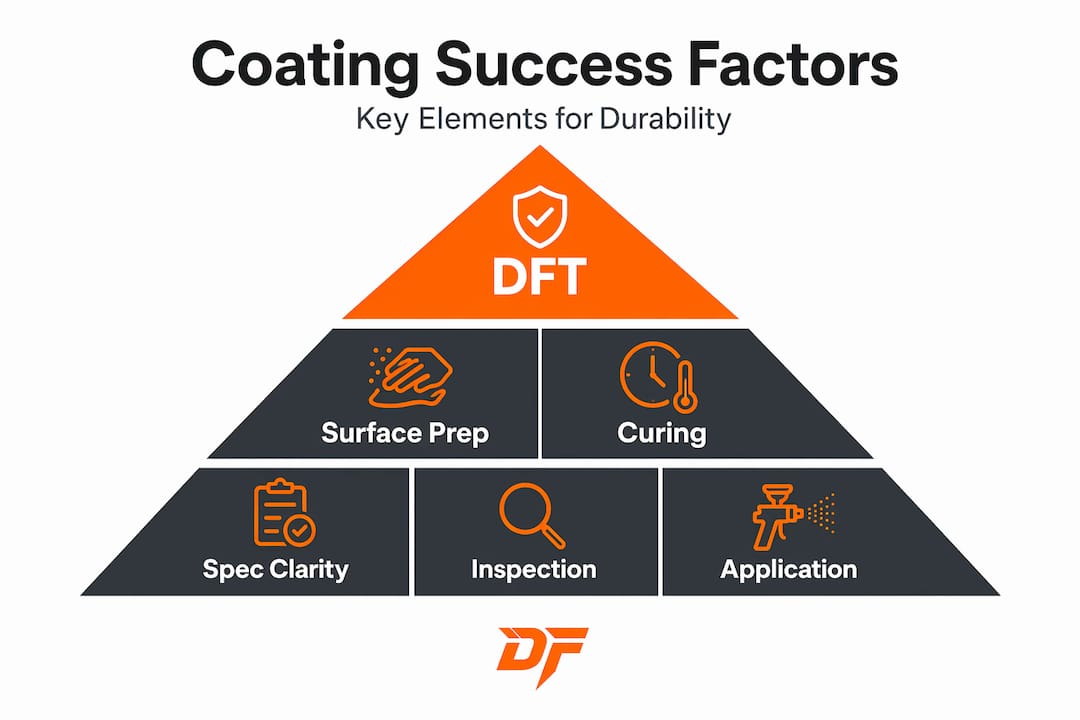
Most coating failures result from improper surface preparation or deviation from system specifications, not from product defects. Ignoring recoat windows, inadequate anchor profile, and soluble salt contamination are the leading technical causes.
What are low-VOC coatings and why are they required?
Low-VOC coatings contain reduced levels of volatile organic compounds, measured in grams per liter. Environmental regulations in sectors including EV manufacturing increasingly require waterborne and low-VOC formulations to meet air quality compliance standards.