

TL;DR:
- Dust exposure in industrial painting involves airborne particulates like silica, lead, isocyanates, and chromium, which pose serious health risks. Managing these hazards requires engineering controls, proper ventilation, and appropriate respiratory protection to prevent acute and long-term illnesses. Relying solely on PPE is insufficient; effective dust control depends on proactive safety measures integrated from project planning onward.
Dust exposure in industrial painting environments is defined as occupational contact with airborne particulates generated during surface preparation, coating application, and cleanup. These particulates include respirable crystalline silica, lead dust, isocyanates, and hexavalent chromium. Each one carries documented health consequences ranging from respiratory irritation to permanent lung disease and cancer. Industrial painting dust risks explained properly means going beyond a compliance checklist. Safety managers and facility operators who understand the chemistry and mechanics of dust generation are better positioned to protect workers before exposure becomes a medical event.
What are the main types of hazardous dust in industrial painting?
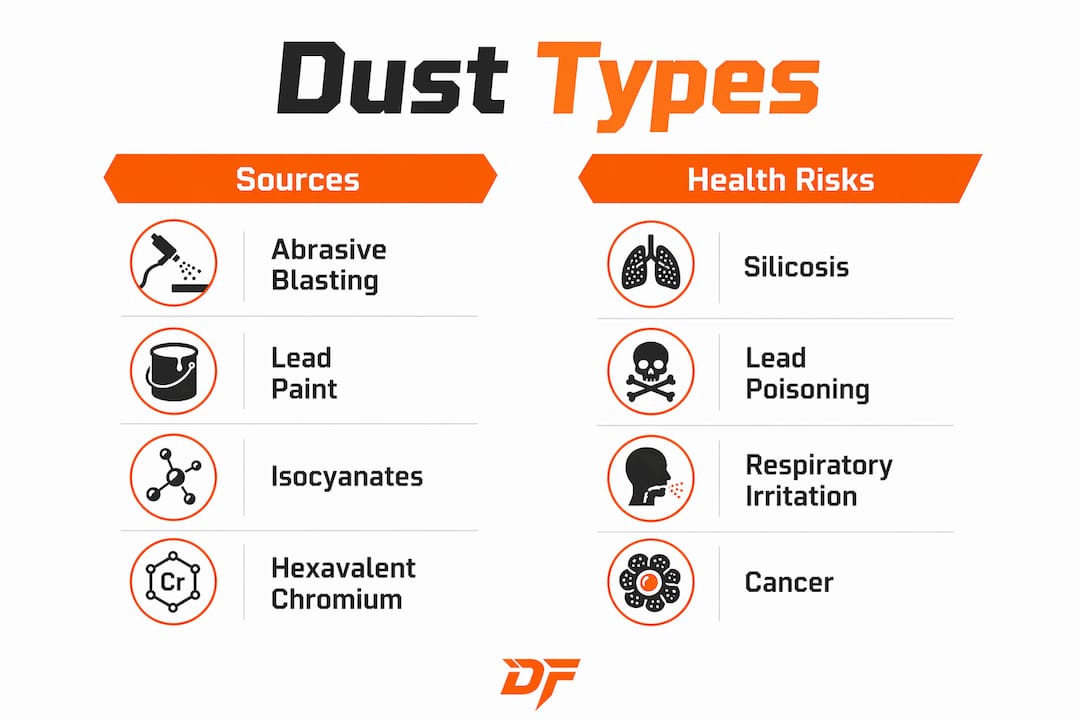
Industrial painting generates several distinct categories of hazardous dust, each with a different source and toxicity profile. Knowing which dust type is present determines which controls are required.
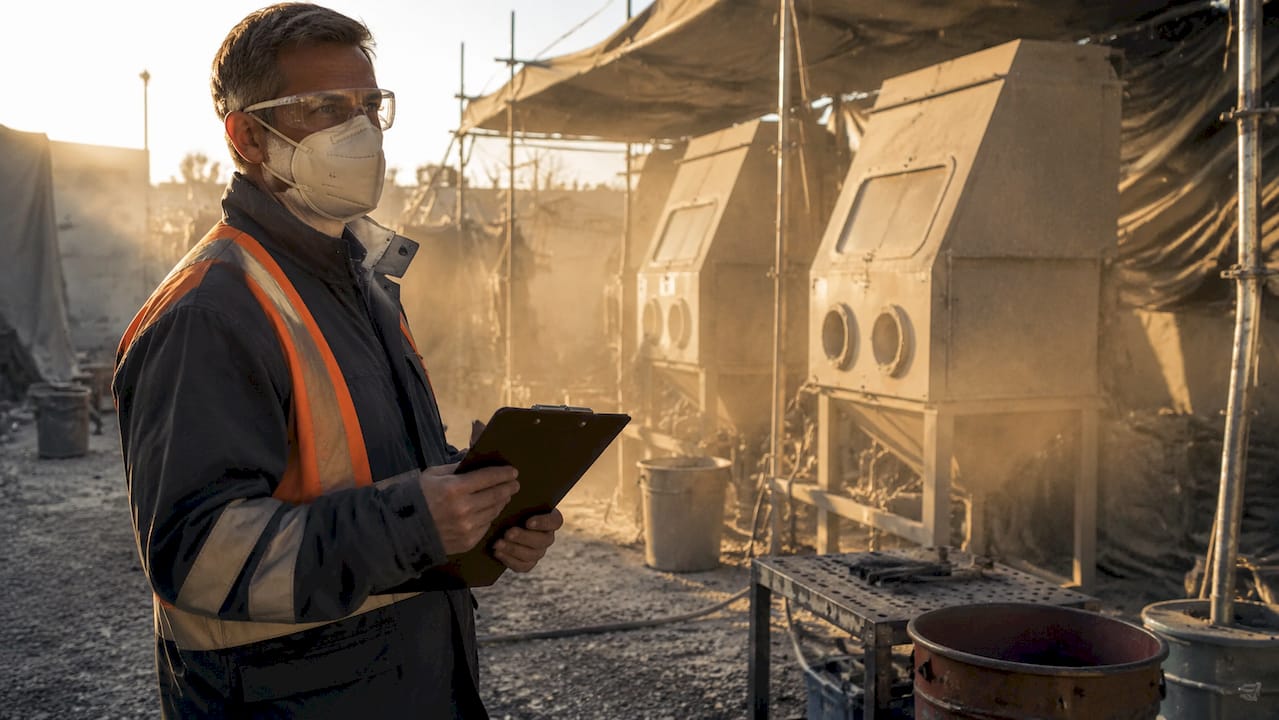
Abrasive blasting is the single largest source of hazardous dust in industrial painting. It releases respirable crystalline silica, lead, and hexavalent chromium simultaneously. OSHA mandates supplied-air respirators for workers in blasting zones because silica exposures routinely exceed the permissible exposure limit of 50 µg/m³ as an 8-hour time-weighted average.
Lead dust is the second major category. Pre-1978 paint surfaces contain lead that becomes instantly airborne during dry sanding, scraping, or blasting. The toxicity is cumulative. Workers do not need to inhale large quantities to accumulate dangerous blood lead levels over time.
Isocyanates present a different kind of threat. Polyurethane coatings release isocyanate-containing dust and vapor during spray application. A single acute exposure can cause permanent sensitization, meaning the worker develops occupational asthma that persists even after all exposure ends.
Hexavalent chromium appears in certain industrial primers and anti-corrosion coatings. It is a confirmed human carcinogen. Solvent vapors, while not particulate dust, accumulate alongside these dusts and compound the respiratory burden on workers.
| Dust type | Primary source | Key health risk |
|---|---|---|
| Respirable crystalline silica | Abrasive blasting on concrete or masonry | Silicosis, lung cancer |
| Lead dust | Sanding or blasting pre-1978 painted surfaces | Neurological, kidney, reproductive damage |
| Isocyanates | Polyurethane spray coating application | Permanent occupational asthma |
| Hexavalent chromium | Anti-corrosion primers and specialty coatings | Lung cancer, nasal perforation |
| Solvent vapors | All spray painting operations | Respiratory irritation, CNS effects |
What are the health effects of industrial painting dust exposure?
The health effects of industrial painting dust fall into two categories: short-term acute reactions and long-term chronic disease. Both categories carry serious consequences for workers and liability exposure for facilities.
Short-term symptoms include eye, nose, and throat irritation, headaches, and skin dermatitis. Workers in industrial painting environments show higher rates of dermatitis and eye injuries compared to the general workforce. These symptoms are often dismissed as minor, which is exactly why they become entry points for chronic disease.
Long-term effects are where industrial dust health hazards become irreversible. Silica dust causes silicosis, a progressive fibrosis of the lung tissue that has no cure. Hexavalent chromium exposure is linked to lung cancer. Both conditions develop over years of repeated exposure, often without obvious early symptoms.
Lead accumulation causes neurological damage, kidney disease, and reproductive harm. Blood lead spikes have been observed in workers who ate near abrasive blasting operations without direct inhalation exposure. This demonstrates that ingestion through hand-to-mouth contact is a real and underestimated route of lead entry.
Isocyanate sensitization stands apart from the other hazards because the threshold for harm is not defined by a safe exposure level. Once sensitized, a worker cannot return to isocyanate environments without triggering asthma attacks. The sensitization is lifelong.
“Isocyanate sensitization can occur from a single acute exposure and causes lifelong occupational asthma; supplied-air respiratory protection is mandatory in such work.” — JSABuilder Painting & Coating Safety Analysis
How do industrial painting processes create dust hazards?
Dust hazards in industrial painting do not arise only from the paint itself. The preparation work that precedes coating application generates the highest concentrations of hazardous particulates.
Sanding, scraping, and abrasive blasting all fracture surface materials into fine particles. The finer the particle, the deeper it travels into the lung. Particles classified as respirable, meaning smaller than 10 microns in diameter, reach the alveoli where the body cannot clear them effectively. This is why surface preparation is the highest-risk phase of any industrial painting project.
Spray application creates a different but equally serious hazard. Overspray generates fine aerosol droplets carrying isocyanates, solvents, and other coating chemicals. In enclosed or poorly ventilated spaces, these aerosols accumulate rapidly. Flammable vapor concentrations in confined painting spaces can reach explosive levels in minutes, not hours. Human senses like smell are unreliable for detecting when concentrations have crossed into the danger zone.
Static discharge is an underappreciated ignition source in spray environments. Dry dust particles and solvent vapors both carry electrostatic charge. OSHA requires the removal of ignition sources within 20 feet of spray painting operations because vapor concentrations exceeding 25% of the lower explosive limit create flash fire conditions.
- Surface preparation (sanding, blasting, scraping) generates the highest particulate loads.
- Spray application adds isocyanate aerosols and solvent vapors to the air.
- Enclosed spaces accelerate concentration buildup.
- Static discharge from dust and vapors creates ignition risk.
- Inadequate ventilation allows all hazards to compound simultaneously.
Pro Tip: Install continuous atmospheric monitoring equipment calibrated for both vapor concentration and particulate levels before any confined-space painting begins. Do not rely on worker-reported symptoms or smell as early warning signals.
What practical controls reduce dust exposure in industrial painting?
Effective dust control in industrial painting follows the hierarchy of controls: elimination, substitution, engineering controls, administrative controls, and personal protective equipment, in that order. Relying solely on PPE is insufficient. Engineering controls must be the primary line of defense.
Engineering controls
Containment and ventilation are the two most effective engineering tools. Properly designed spray booths with directional airflow capture overspray and particulates before they reach the worker’s breathing zone. High-efficiency filtration systems remove fine particles from recirculated air. Dust control in blasting and spraying depends on containment, ventilation, and filtration working together. No single measure is adequate alone.
Wet methods during surface preparation reduce airborne silica and lead dust significantly. Wet sanding and wet blasting keep particles bound to the surface rather than suspended in air. Where wet methods are not feasible, local exhaust ventilation attached directly to sanding tools captures dust at the source.
Respiratory protection
Respirator selection must match the specific dust type present. Supplied-air respirators are mandatory for abrasive blasting with silica-containing materials and for isocyanate spray application. Half-face air-purifying respirators with appropriate cartridges are acceptable for lower-risk tasks like light sanding of non-lead surfaces. A written respiratory protection program, as required by OSHA 29 CFR 1910.134, must govern all respirator use.
Pro Tip: Fit-test every worker annually and after any significant change in facial structure. A respirator that does not seal correctly provides no meaningful protection against respirable particles.
Housekeeping and contamination prevention
- Vacuum with HEPA-filtered equipment rather than dry sweeping, which re-suspends settled dust.
- Establish a decontamination station at the exit of all lead and silica work areas.
- Prohibit eating, drinking, and smoking in or near painting and blasting zones.
- Require workers to change out of contaminated work clothing before leaving the facility.
- Bag and label contaminated clothing for laundering separate from household laundry.
Take-home contamination through lead dust on clothing creates secondary exposure risks for workers’ families. Blood lead levels in non-exposed household members have spiked as a result of contaminated work clothes entering the home. This is a regulatory and ethical liability that facility operators must address through formal decontamination protocols.
Key Takeaways
Controlling industrial painting dust requires engineering solutions, not just respirators. Facilities that treat dust as a compliance issue rather than a health priority consistently face higher injury rates and regulatory penalties.
| Point | Details |
|---|---|
| Dust types vary by process | Blasting releases silica and lead; spray application releases isocyanates and solvent vapors. |
| Isocyanate risk is irreversible | A single acute exposure can cause permanent occupational asthma with no safe return threshold. |
| Engineering controls come first | Ventilation, containment, and wet methods must precede PPE in the control hierarchy. |
| Take-home contamination is real | Lead dust on work clothing can raise blood lead levels in workers’ household members. |
| Atmospheric monitoring is mandatory | Human senses cannot detect explosive or toxic vapor concentrations reliably. |
What safety managers consistently get wrong about dust control
Most safety managers I work with understand the big hazards on paper. Where programs break down is in the gap between written procedures and daily practice. Painting is consistently underestimated as a low-risk task, which is exactly what makes it dangerous. Workers and supervisors who treat spray painting as routine are the ones who skip the atmospheric monitor calibration or forget to check the booth filter pressure drop.
The hierarchy of controls is not a suggestion. Facilities that build their safety program around PPE as the primary defense are one respirator failure away from a serious exposure event. I have seen programs where workers were issued the correct respirator but never fit-tested, never trained on cartridge change schedules, and never told that isocyanate cartridges have no odor warning. That is not a safety program. That is documentation.
The take-home lead contamination issue deserves more attention than it gets. Invisible lead dust transfers from work clothes to vehicles and homes, creating health risks for people who never set foot in a facility. Facilities that do not provide on-site decontamination and separate laundry protocols are exposing non-workers to an occupational hazard. That is both a moral failure and a legal exposure.
Proactive safety integration at the project planning stage prevents the most costly failures. Treating industrial painting safety as a compliance checkbox leads to higher costs and failures. The time to design dust controls into a project is before the equipment is ordered, not after the first air sample comes back over the OSHA limit.
— Dust
How Dustfreefilm supports dust control in industrial spray booths
Dustfreefilm has manufactured protective films for industrial spray booths since 2012. Their multi-layer electrostatic wall and floor protectors are designed to contain dust and overspray at the source, reducing the contamination that accumulates on booth surfaces between jobs.
Dustfreefilm’s films are heat-resistant and static-free, which matters in environments where electrostatic charge contributes to both dust adhesion and ignition risk. The patented dispenser system allows quick, bubble-free installation, so booth preparation does not become a bottleneck in high-throughput facilities. For safety managers looking to reduce cross-contamination between paint jobs and cut cleanup time, Dustfreefilm’s spray booth protection films offer a practical, facility-tested solution. Their booth dust control guide is also a useful starting point for operators building or revising a dust management program.
FAQ
What is the most dangerous dust type in industrial painting?
Respirable crystalline silica from abrasive blasting is among the most dangerous, with OSHA’s permissible exposure limit of 50 µg/m³ routinely exceeded in blasting operations. Isocyanates are equally serious because a single exposure can cause permanent occupational asthma.
How does lead dust exposure happen without direct contact?
Lead dust becomes airborne during dry sanding or blasting of pre-1978 painted surfaces and settles on skin, clothing, and surfaces. Workers can ingest it through hand-to-mouth contact, and contaminated clothing can transfer it to household members.
Are paint fumes and dust the same hazard?
No. Paint fumes are vapor-phase chemicals, primarily solvents and isocyanates, while dust is particulate matter from surface preparation or dried coating. Both require control, but the protection methods differ. Supplied-air respirators address both; standard dust masks do not protect against vapors.
What does OSHA require for spray painting operations?
OSHA requires ignition sources to be removed within 20 feet of spray painting operations and mandates a written respiratory protection program under 29 CFR 1910.134. Atmospheric monitoring for vapor concentrations is required in confined spaces.
Can a spray booth filter alone control industrial painting dust risks?
No. Booth filters capture overspray and some particulates, but they do not address dust generated during surface preparation outside the booth. Effective dust exposure control requires ventilation, containment, wet methods, and proper respirator use working together.