

TL;DR:
- A proper industrial coating requires precise surface preparation, environmental controls, and documented hold points to ensure longevity. Documented QC measures like thickness verification, adhesion tests, and environmental logs are essential for warranty and durability. Failures often stem from poor execution, incomplete documentation, or inadequate environmental control, not product quality.
A spec-grade industrial paint job comes down to eight non-negotiable controls. Get these right and you have a coating that performs for its full design life. Miss any one of them and you are usually looking at early failure, warranty disputes, or a full blast-and-recoat at three times the original cost.
Quick-spec checklist — paste this into your RFQ:
- Surface prep: Specify SSPC-SP 10 (near-white blast) minimum for steel in corrosive environments; SSPC-SP 5 (white metal) for immersion or severe chemical service. Require photographic documentation and anchor profile readings before primer.
- Anchor profile: Verify with Testex replica tape or a digital profile gauge; confirm the mil range matches the coating manufacturer’s Technical Data Sheet (TDS).
- Coating system: Name the full system (primer/intermediate/topcoat), not just a product. Specify epoxy, polyurethane, or zinc-rich primer as appropriate to the service environment.
- Environmental controls: Substrate temperature must stay at least 5°F (3°C) above the dew point throughout application and cure. Log humidity, air temperature, and surface temperature every shift.
- Film thickness hold points: Require wet film thickness (WFT) checks during application and dry film thickness (DFT) readings after each coat. Document with calibrated gauge serial numbers.
- Documented inspections: Contractor delivers environmental logs, batch/lot numbers, DFT records, and photos at each hold point. No sign-off without records.
- Contractor qualifications: Require SSPC QP 1 or QP 2 certification and AMPP-certified inspection personnel on site.
- Dust control plan: Require a written plan for dust management in the spray environment, including booth protection, airflow management, and contamination prevention before work begins.
Table of Contents
- What does surface preparation actually require on an industrial job?
- How do you choose the right coating system for your environment?
- How do you control application variables that affect film integrity?
- What QC metrics should you require before signing off on each coat?
- How should you budget for maintenance and inspection cycles?
- What safety and compliance requirements apply to industrial painting in the U.S.?
- How do you diagnose and fix the most common coating defects?
- Why does the 80/20 rule hold up in industrial coating performance?
- Key Takeaways
- What patterns separate successful industrial coating projects from failures?
- Standards and sources worth citing in your specs
What does surface preparation actually require on an industrial job?
Surface preparation quality is the single biggest factor in how long a coating lasts. Abrasive blasting is the gold standard for steel, and SSPC/AMPP cleanliness levels give you a verifiable language to put in a spec. The three you will use most often are SP 5 (white metal, for immersion and severe chemical service), SP 10 (near-white blast, the workhorse for most structural steel), and SP 6 (commercial blast, acceptable for mild interior environments).
Abrasive blasting is not the only option. Hydroblasting suits situations where abrasive containment is impractical or where existing coatings contain lead. Power-tool cleaning (SSPC-SP 3) is a fallback for localized repairs when blasting is not feasible, though it rarely achieves the anchor profile that a TDS requires. Solvent cleaning (SSPC-SP 1) is always the first step regardless of method: remove oil, grease, and salts before any mechanical prep, or you will grind contamination into the surface.
Anchor profile is where many specs fall short. Even perfectly cleaned steel will fail if the profile depth is wrong for the coating system. Testex Press-O-Film replica tape gives you a physical record you can file; digital profile gauges are faster for high-volume readings. Typical ranges run from 1.5 to 4 mils depending on the system, but always confirm against the manufacturer’s TDS, not industry averages.
Hold points matter here. Require the contractor to stop, measure, photograph, and log surface cleanliness and profile before primer application. That record is your warranty evidence.
Pro Tip: On thin-walled sections or light structural members, over-profiling is a real risk. Specify the upper limit of the profile range, not just the minimum, and require the contractor to document both the low and high readings across the surface.
How do you choose the right coating system for your environment?
Pick the coating system to match substrate, exposure, and expected service life — and specify the entire system, not a single product. Substituting one component voids the manufacturer’s warranty and removes your recourse if the coating fails.

Epoxies are the workhorse build coat for most industrial applications. They deliver strong chemical and abrasion resistance and form an effective moisture barrier. Their weakness is UV exposure: epoxies chalk and yellow outdoors, which is why they are almost always paired with a polyurethane topcoat on exterior steel.
Aliphatic polyurethanes go on top. They hold color and gloss under UV, resist weathering, and provide the hard, cleanable surface most facility managers want on exterior structures and equipment. For interior, low-UV environments, a two-coat epoxy system often covers the full requirement without a urethane topcoat.
Zinc-rich primers are the corrosion-protection layer for bare steel. Inorganic zinc silicates are the most durable and are common in marine and petrochemical environments. Organic zinc-rich epoxy primers are easier to apply and recoat. Both work through cathodic protection, sacrificing the zinc to protect the steel underneath.
System layering in an RFQ looks like this:
- Environment: exterior structural steel, coastal/moderate corrosion zone
- System: inorganic zinc primer (appropriate DFT range) / epoxy intermediate (appropriate DFT range) / aliphatic polyurethane topcoat (appropriate DFT range)
- Total DFT target: appropriate total dry film thickness
- Warranty condition: full TDS compliance and documented hold points
Pro Tip: Before finalizing the spec, pull the manufacturer’s TDS and warranty document together. Confirm that the primer, intermediate, and topcoat are all from the same approved system. Mixing brands across coats is a common mistake that voids coverage even when each individual product is high quality.
How do you control application variables that affect film integrity?
Consistent application and environmental control are the practical gatekeepers of film integrity. Specify equipment type, transfer efficiency expectations, and material handling rules in the contract — not as suggestions, but as hold-point conditions.
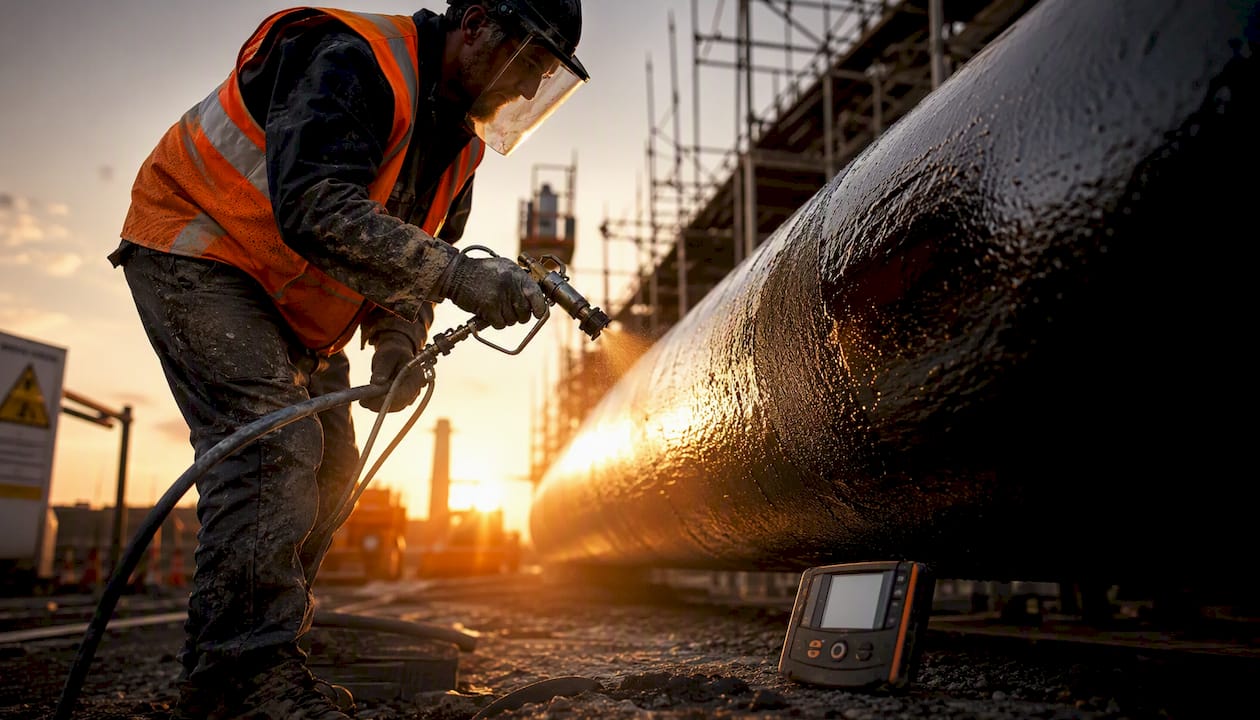
For production speed and heavy film builds, airless spray is the standard. It delivers high transfer efficiency and handles high-viscosity materials like epoxy build coats well. Air-assisted airless adds atomization control for finish quality on topcoats. Conventional air spray is slower and less efficient but gives the finest atomization for thin-film topcoats where appearance matters. Match the equipment to the coat, not to what the crew already owns.
Material handling is where small errors compound fast. Two-component coatings (most epoxies and polyurethanes) have strict mix ratios and pot lives. A crew that mixes a full kit at the start of a hot shift and applies it over three hours is applying degraded material for the last hour. Require batch traceability: lot numbers logged per coat, per area, per shift. Filter coatings through the appropriate mesh size to remove agglomerates before they reach the gun.
Environmental control is non-negotiable. The substrate must stay at least 5°F (3°C) above the dew point throughout application and the full cure window. Invisible condensation on the surface is one of the leading causes of adhesion failure, and it leaves no visible trace until the coating delaminates months later. Require calibrated hygrometers and surface temperature probes on site, with readings logged every two hours minimum.
Recoat windows shift significantly with temperature. At 77°F a solvent-borne epoxy may be recoatable in four hours; at 50°F that same product can require 12 or more hours. Build that into the schedule and budget before work starts, not after a delay hits.
Pro Tip: To prevent solvent pop, avoid applying thick single coats of fast-solvent materials in direct sun or on hot steel. Slow the solvent blend or apply in cooler morning hours. For active facilities, dust contamination between coats is as damaging as solvent pop — require booth wall and floor protection to be in place before any spray work begins.
What QC metrics should you require before signing off on each coat?
Require WFT and DFT verification with documented hold points and a minimum sampling frequency before any sign-off. Without those records, you have no warranty and no recourse.
| Coat type | Typical WFT range | Typical DFT target | Common service category |
|---|---|---|---|
| Zinc-rich primer | 4–6 mils WFT | 3–4 mils DFT | Structural steel, corrosive exterior |
| Solvent-borne epoxy primer | 6–10 mils WFT | 4–6 mils DFT | General industrial, moderate exposure |
| Epoxy build coat | 8 mils WFT | 6 mils DFT | Chemical/immersion service |
| Aliphatic polyurethane topcoat | 4–6 mils WFT | 2–3 mils DFT | Exterior UV exposure, color retention |
WFT checks happen during application, while the coating is still wet, using a notched or comb gauge. DFT readings come after cure, using a calibrated magnetic or eddy-current gauge.
: coatings applied too thin underperform, and coatings applied too thick can crack or fail to cure properly.
For adhesion, ASTM D4541 pull-off testing is the standard. Require it on representative areas after the final coat has fully cured. For immersion service or buried structures, holiday/pinhole detection (ASTM D5162 or NACE SP0188) finds discontinuities that DFT readings will not catch.
The contractor’s QC package should include:
- Environmental logs (temperature, humidity, dew point) per shift
- WFT readings per coat, per area
- DFT readings with calibrated gauge serial numbers
- Photographs of surface cleanliness and profile before primer
- Adhesion test reports (ASTM D4541)
- Material batch/lot numbers per coat
- Holiday test results for immersion or buried service
Pro Tip: For larger surfaces, use a statistical sampling plan: SSPC-PA 2 specifies minimum DFT reading frequency by area. A single spot reading in the center of a large panel is not a representative measurement. Require readings at edges, corners, and welds — those are the areas most likely to be thin.
How should you budget for maintenance and inspection cycles?
Budget for inspection and proactive touch-up cycles from day one. Condition-based maintenance with scheduled inspections costs far less over a coating’s life than letting corrosion progress to the point where a full blast-and-recoat is the only option.
A realistic maintenance budget line includes:
- Annual visual inspection: Check for early rust breakthrough, film cracking, blistering, or mechanical damage. Document with photos and compare against baseline.
- Spot blasting and repair: Address failures at the 1–3% surface area level before they spread. Early intervention is where the cost savings are largest.
- Touch-up materials: Keep a small stock of the original coating system on hand. Substituting a different product for touch-ups creates adhesion and appearance mismatches.
- Access equipment: Scaffolding, lifts, or rope access add significant cost to any maintenance cycle. Factor this into the lifecycle budget at the design stage.
- QA reporting: Each maintenance cycle should generate its own inspection record, not just a work order.
Timeline guidance varies by environment. An aggressive chemical or coastal exposure environment typically warrants inspection every 12 months and targeted touch-up every 2–3 years. A protected interior environment on a well-applied system may go 5–7 years before any intervention is needed. Ask the coating manufacturer for their expected service life under your specific conditions, and build the inspection cycle around that figure, not around a generic industry average.
When reviewing contractor proposals, ask explicitly: what is the expected service life of this system under our conditions, and what does the warranty cover if it falls short? A contractor who cannot answer that question is not the right contractor.
What safety and compliance requirements apply to industrial painting in the U.S.?
Require the contractor to comply with OSHA standards and submit a project-specific safety plan before work begins. That plan, along with training certificates and material Safety Data Sheets (SDSs), belongs in the QC package for audit purposes.
The core safety programs to verify are in place:
- Respiratory protection: OSHA 29 CFR 1910.134 requires a written program, fit testing, and medical evaluation for workers using respirators. Solvent-borne coatings and abrasive blasting both trigger this requirement.
- Fall protection: Any work above 4 feet in general industry (6 feet in construction) requires a fall protection plan under OSHA 29 CFR 1926.502.
- Lockout/tagout (LOTO): For painting near energized equipment, OSHA 29 CFR 1910.147 applies.
- Confined space entry: Tanks, vessels, and enclosed structures require a permit-required confined space program under OSHA 29 CFR 1910.146.
VOC content is regulated at both the federal and state level. The EPA’s VOC guidance applies broadly, but states like California (CARB) and several northeastern states have stricter limits. Low-VOC and waterborne alternatives are increasingly available for epoxies and polyurethanes, though they often require tighter temperature and humidity controls during application and longer dry times. Confirm VOC compliance for your jurisdiction before specifying a product.
Pro Tip: Request the contractor’s safety plan, OSHA 300 log summary, and training certificates as part of the bid package — not after award. A contractor who resists providing these documents before contract is a risk you do not want on site.
How do you diagnose and fix the most common coating defects?
Match the visible defect to the most likely root cause and demand a corrective action before work continues.
| Defect | Common cause | Immediate fix | Prevention |
|---|---|---|---|
| Runs/sags | Excessive film build, gun too close, slow solvent | Sand out when cured, recoat to spec | Enforce WFT checks; adjust gun distance and speed |
| Fish-eyes | Oil or silicone contamination on substrate | Stop work; solvent-clean and re-prep affected area | Require SP 1 solvent cleaning before any mechanical prep |
| Pinholes | Solvent pop, outgassing from porous substrate, coating applied too thick | Sand, spot-prime, recoat | Thin coats; seal porous substrates; avoid hot steel |
| Loss of adhesion | Inadequate surface prep, wrong anchor profile, dew-point violation | Blast to bare metal, re-prep, recoat full system | Enforce hold points; log dew-point readings |
| Blistering | Moisture trapped under film, osmotic pressure, contamination | Remove blistered area, identify moisture source, re-prep | Verify substrate moisture; enforce dew-point rule |
When adhesion failure or blistering appears in a pattern (along welds, at edges, in low spots), stop work immediately and invoke an inspection hold point. Pattern failures almost always indicate a systemic issue with prep or environmental control, not a random defect. Continuing to apply coating over a systemic failure multiplies the rework cost.
For preventing paint defects before they start, the most effective single step is a clean, protected spray environment. Dust and airborne contamination settling into wet film causes fish-eyes and pinholes that are indistinguishable from substrate contamination until you trace the source.
Why does the 80/20 rule hold up in industrial coating performance?
Industry research and practitioner experience consistently show that roughly 80% of a coating’s long-term performance is determined by the 20% of project time spent on surface preparation and environmental control. The paint product itself is rarely the failure point.
“The most effective tool is Z” is a useful heuristic, but in industrial coatings the data is more specific: anchor profile verification and dew-point compliance are the two variables most directly correlated with adhesion failure when they are skipped or poorly documented.
Calibrated hygrometers and surface temperature probes are standard equipment for enforcing the 5°F dew-point rule. The fact that they are standard does not mean they are consistently used. Requiring logged readings in the contract, with a hold-point trigger if the substrate temperature drops within 5°F of the dew point, is what converts a best practice into a contractual obligation.
Sample RFQ language that works:
“The contractor shall document ambient temperature, relative humidity, dew point, and substrate surface temperature at the start of each shift and every two hours during application. Work shall cease if the substrate temperature is less than 5°F (3°C) above the dew point. All readings shall be recorded in the project QC log and submitted with the final QC package.”
Pro Tip: Make the QC package a condition of final payment, not a courtesy deliverable. Manufacturers condition warranties on documented application records. Without that package, a warranty claim is effectively unenforceable.
Key Takeaways
Spec-grade industrial coatings require surface prep, environmental control, and documented hold points — every other variable is secondary.
| Point | Details |
|---|---|
| Surface prep drives longevity | Specify SSPC-SP 10 or SP 5 and require anchor profile verification before primer application. |
| Match the system to the environment | Specify the full primer/intermediate/topcoat system with DFT targets; never allow mid-system substitutions. |
| Enforce environmental hold points | Substrate must stay at least 5°F above dew point; log readings every shift and stop work if the threshold is breached. |
| Require documented QC packages | WFT/DFT logs, adhesion test reports, batch numbers, and photos are warranty prerequisites, not optional extras. |
| Schedule maintenance early | Condition-based inspection and touch-up at the right time costs far less than a full blast-and-recoat after corrosion progresses. |
What patterns separate successful industrial coating projects from failures?
The projects that hold up over time share one characteristic: the manager treated the QC package as the product, not the painted surface. A beautiful finish with no documentation is a liability. A finish with complete hold-point records, calibrated DFT logs, and adhesion test reports is an asset you can defend in a warranty dispute or a regulatory audit.
The failure patterns are equally consistent. Rushed prep because the schedule slipped. Vague specs that let contractors choose their own cleanliness level and profile. No environmental logging, so when blistering appears at month 18 nobody can prove whether the dew-point rule was followed. These are not random bad luck; they are predictable outcomes of under-specified contracts.
One thing worth saying plainly: the coating product is almost never the problem. The brands that dominate industrial specs are well-engineered. What varies is the execution, and execution is controlled by the spec, the hold points, and the contractor’s qualifications. A contractor with SSPC QP 1 certification and AMPP-certified inspectors on site is not a guarantee, but it is a meaningful filter. Ask for those credentials before the bid closes, not after.
When reviewing bids, the contractor who asks the most questions about your surface prep requirements and environmental conditions is usually the one worth hiring. The one who quotes fastest with the fewest questions is the one most likely to cut corners when the schedule gets tight.
Standards and sources worth citing in your specs
These references belong in your RFQ and project file. Requiring contractors to attach supporting test reports against these standards is what makes your QC package defensible.
- SSPC-SP 1 / AMPP: Solvent cleaning — the mandatory first step before any mechanical prep. Removes oil, grease, and soluble salts.
- SSPC-SP 2 / SP 3: Hand-tool and power-tool cleaning. Minimum standard for localized repairs; not suitable where a TDS requires blast-cleaned anchor profile.
- SSPC-SP 5 / NACE No. 1 (White Metal Blast Cleaning): Required for immersion service, severe chemical exposure, and any system where maximum adhesion is critical.
- SSPC-SP 10 / NACE No. 2 (Near-White Blast Cleaning): The standard workhorse for structural steel in corrosive exterior environments.
- SSPC-SP 6 / NACE No. 3 (Commercial Blast Cleaning): Acceptable for mild interior or low-corrosion environments.
- ASTM D4541: Pull-off adhesion test. Require results in the QC package for all structural and immersion-service work.
- ASTM D5162 / NACE SP0188: Holiday detection for immersion-service coatings. Require test reports with voltage settings and pass/fail results documented.
- SSPC-PA 2: Measurement of DFT on steel. Specifies minimum reading frequency by area — cite this in the spec so DFT sampling is not left to contractor discretion.
- AMPP (formerly SSPC/NACE): The consolidated standards body for protective coatings. Contractor QP 1/QP 2 certification and CIP inspector credentials come from AMPP.
Require contractors to attach DFT logs, adhesion test reports, and anchor profile readings as numbered appendices to the QC package. A spec that names the standard but does not require the test report is a spec that will not be enforced.