
TL;DR:
- Choosing the right booth protection film depends on balanced adhesion, chemical resistance, and static cling properties to ensure clean removal and contamination control. Proper compatibility testing with specific substrates, along with customization for width and thickness, optimizes application efficiency and durability across multiple spray cycles. Selecting films that meet actual operational requirements helps prevent finish contamination, reduces rework, and improves overall paint quality.
Picking the wrong booth protection film doesn’t just create a mess. It causes rework, contaminates finishes, and eats into your throughput. The key features of booth protection films determine everything from how cleanly a film peels off your booth walls to whether dust particles settle into your topcoat before you even pick up the gun. This article breaks down the specific technical features that separate high-performance films from generic plastic sheeting, so you can select materials that genuinely protect your paint quality and keep your operation running without interruption.
Table of Contents
- Key takeaways
- 1. Key features of booth protection films: adhesion and residue control
- 2. Material composition and chemical resistance
- 3. Static cling and dust control properties
- 4. Compatibility with booth surfaces and substrates
- 5. Customizability and application efficiency
- 6. Durability and change cycle management
- My take on what actually matters when selecting booth protection films
- Dustfreefilm solutions built around these exact features
- FAQ
Key takeaways
| Point | Details |
|---|---|
| Adhesion balance is non-negotiable | Films must hold firmly during use but release cleanly without leaving residue that costs time and money to remove. |
| Material composition drives durability | LDPE films with heat resistance up to 200°F maintain integrity through curing cycles without melting or tearing. |
| Static cling controls contamination | Electrostatic properties trap dust and overspray at the source, directly improving your final paint finish quality. |
| Substrate compatibility requires testing | Porous or textured booth surfaces need sample testing before full deployment to prevent adhesion failure or surface damage. |
| Customization increases operational efficiency | Matching film width, thickness, and adhesive strength to your specific booth setup reduces waste and speeds up application. |
1. Key features of booth protection films: adhesion and residue control
The most commonly misunderstood feature in any film selection process is adhesion. Most buyers default to “the stronger the better,” but that logic breaks down fast in a real booth environment. Adhesion balance and clean removal are the top criteria buyers use when selecting protective films in 2026, and for good reason.
A film that grips too aggressively will leave adhesive residue on your booth walls, floors, and glass panels. That residue attracts dust, interferes with your next application cycle, and can contaminate fresh paint on nearby surfaces. A film with too little adhesion lifts at the edges, lets overspray migrate underneath, and creates exactly the kind of contamination it was supposed to prevent.
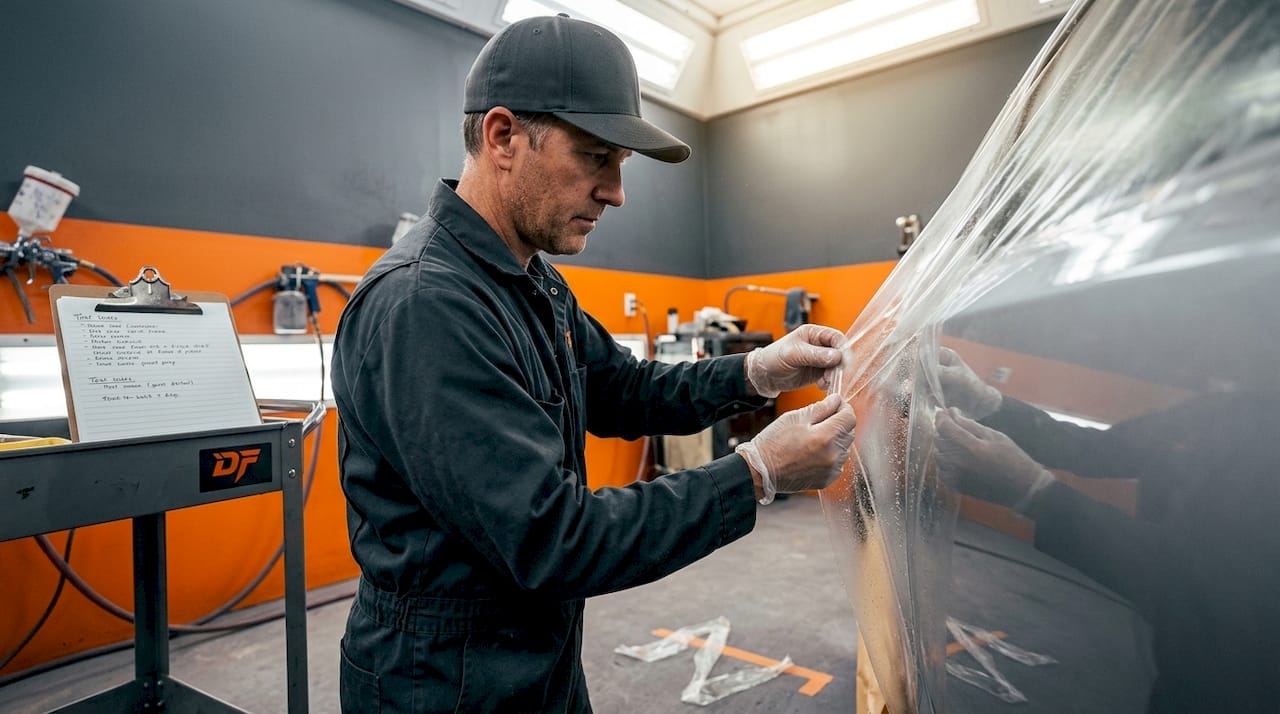
What you want is a film engineered to stay put during the spray and curing process, then release cleanly when you pull it. Residue-free removal is not a luxury feature. It’s a core quality variable that affects your next paint job the moment you start prepping.
Key markers of strong adhesion and residue performance:
- Consistent tack across temperature ranges found in active booths
- No adhesive transfer after removal from smooth or semi-smooth surfaces
- Edge-seal integrity that resists lifting during spray passes
- Clean peel behavior that doesn’t require solvents or scrapers to finish the job
Pro Tip: Run a 24-hour adhesion test on a small section of your booth wall before committing to a full roll. Pull it at an angle and check the surface under direct light for any residue or hazing.
2. Material composition and chemical resistance
The physical makeup of a protection film tells you more about its real-world performance than almost any spec sheet claim. Low-density polyethylene, widely referred to as LDPE, is the industry standard for booth protective films because it balances flexibility, tear resistance, and chemical compatibility without becoming brittle under heat.
Floor protective films in paint booths often need to withstand temperatures up to 200°F, which is the threshold at which many curing ovens operate. Films that can’t hold that rating will soften, stretch, or bond more aggressively to the substrate as heat builds, turning a simple removal into a time-consuming cleanup operation.
Chemical resistance matters just as much. Solvents, reducers, and catalysts used in automotive refinishing are aggressive. A film that absorbs or reacts to these chemicals can degrade mid-job, develop perforations, or leave a chemical residue of its own on booth surfaces. You need a material that repels rather than absorbs what it’s exposed to.
Critical material features to verify before purchase:
- Temperature rating clearly stated (look for 150°F minimum, 200°F preferred)
- Confirmed resistance to lacquers, urethanes, and waterborne paint systems
- Puncture resistance for floor applications in high-traffic areas
- Consistent thickness across the roll without thin spots that compromise durability
- UV stability if any portion of the booth receives direct light exposure
Films rated for temperature and chemical resistance appropriate to your specific processes will last through multiple spray cycles without replacement, which directly reduces your per-job material cost.
3. Static cling and dust control properties
This is where films designed for spray booth use genuinely separate themselves from generic plastic sheeting. Static cling is not just a convenience feature. It’s an active contamination control mechanism. Static cling properties help contain dust and overspray more effectively than non-electrostatic films, which contributes directly to cleaner finishes and fewer defects per job.
Here’s how it works in practice. As particles become airborne during spraying, an electrostatically charged film surface attracts and captures them before they can settle on the vehicle or part being painted. This is the same principle used in multi-layer sticky mats for controlled environments, where adhesion gradients capture up to 99% of footborne particulates at entry points.
For a spray booth, think of it this way:
- Overspray particles become charged during atomization.
- The electrostatically active film wall liner attracts those particles.
- Captured particles cannot re-enter the air column and settle on your painted surface.
- When you peel the film, all trapped contamination leaves with it.
Anti-static film variants exist specifically for environments where electrostatic discharge could cause issues, such as powder coating or certain industrial coating lines. Choosing between standard static cling and anti-static depends entirely on your process chemistry.
Pro Tip: In booths with forced air systems, electrostatic film on walls outperforms non-static alternatives because the turbulent airflow continuously pushes particles toward surfaces. Let the film’s charge do the trapping work for you.
4. Compatibility with booth surfaces and substrates
A film that works perfectly on painted metal panels may lift, bubble, or bond too aggressively on a glass light panel two feet away. Adhesion behavior differs significantly on porous or textured surfaces, and this is where most field failures originate.
Your booth likely contains several substrate types: powder-coated steel walls, tempered glass light panels, rubber floor seals, aluminum trim, and potentially concrete or epoxy floors. Each surface has a different porosity level and surface energy profile that interacts with adhesives differently.
Glass-specific adhesive formulas reduce the risk of hazing and maintain light panel clarity during paint operations. Using a wall film on glass without checking compatibility can result in optical distortion or residue that requires chemical removal.
| Surface type | Compatibility risk | Recommended approach |
|---|---|---|
| Painted metal walls | Low | Standard LDPE film with medium tack |
| Tempered glass panels | Medium | Glass-rated adhesive film only |
| Epoxy or sealed concrete | Medium | Test first; confirm heat and moisture resistance |
| Porous concrete or textured materials | High | Sample test required; deep adhesive penetration likely |
| Rubber or vinyl seals | High | Consult manufacturer; risk of adhesive transfer |
Key considerations when evaluating compatibility:
- Request manufacturer compatibility charts for your specific substrate types
- Sample testing on porous surfaces is critical before committing to bulk installation
- Consider the temperature exposure each surface zone will experience
- Factor in how long the film will stay in place between change cycles
5. Customizability and application efficiency
Off-the-shelf film rolls are not designed for your specific booth dimensions, your turnover pace, or your surface configuration. Customization options in protective films now include width, thickness, adhesive strength, color, branding, and specialized removal properties, and professionals who take advantage of these options see measurable gains in application speed and coverage consistency.
Width matters more than most operators realize. A film that’s too narrow for your wall height requires overlapping, which creates seams where contamination can penetrate. A film matched precisely to your booth wall dimensions can be applied in a single pass with no overlaps and no gaps.
Thickness is a direct trade-off between protection level and ease of application. Thinner films at 0.5 to 1.5 mil apply quickly and conform easily to corners, but they’re more vulnerable to puncture. Heavier films at 2 mil and above provide better durability in high-traffic floor zones but take more time to lay down and may require tools for precise positioning.
Application method also affects your total cost per change cycle. Step-by-step application guides for spray booths consistently show that films paired with proper dispensing systems reduce installation time by eliminating bubbles, wrinkles, and re-application from misalignment. Dustfreefilm’s patented dispenser system is built around this principle.
Film color is often overlooked as a functional choice. Transparent films allow you to inspect booth surfaces without removal. Tinted films can improve contrast visibility during application and make it easier to spot coverage gaps before you start spraying.
Bulk purchasing considerations worth factoring in:
- Volume pricing typically applies at 10 or more rolls, reducing per-roll cost significantly
- Custom-width rolls eliminate waste from trimming standard widths
- Branded or labeled rolls simplify inventory tracking in multi-booth facilities
6. Durability and change cycle management
A film’s durability is not measured only by how long it can stay on the wall before falling apart. It’s measured by how many spray cycles it can withstand before its protective performance degrades and it needs replacing.
Dustfreefilm’s multi-layer approach addresses this directly. Rather than replacing a single thick film between each job, the multi-layer system allows you to peel one layer and expose a fresh surface underneath. This eliminates the full removal and re-application cycle between jobs, cutting your change time from minutes to seconds. For a shop running multiple vehicles per day, that difference compounds into real labor savings across a week.
You can find practical examples of film applications that illustrate exactly how this works across wall and floor configurations. The principle scales from a two-bay body shop to a full production painting line. What changes is the volume and the configuration, not the underlying logic.
A film designed for durability will also maintain its adhesion characteristics across the full temperature range of a working booth cycle, from the ambient temperature during spray application to the elevated temperatures of force-dry or bake cycles. Films that lose tack at elevated temperatures will start to sag or peel mid-cycle, which creates contamination and safety hazards simultaneously.
My take on what actually matters when selecting booth protection films
I’ve reviewed and tested more booth films than I can count at this point, and the pattern is always the same. Facilities that choose based on price per roll are consistently the ones calling about adhesive residue, contaminated finishes, and films peeling off mid-bake. Facilities that choose based on the actual features of protective films for their specific substrates, temperature profiles, and turnover pace almost never have those calls.
What I’ve found is that the single most underrated selection criterion is substrate compatibility testing. Not the spec sheet. Not the manufacturer’s claim about what surfaces it works on. An actual 24-hour test on your specific booth surface at your booth’s operating temperature. Understanding your booth’s substrate types before you buy is not optional. It’s the difference between a film that performs and one that costs you a client vehicle.
The other thing I’d push back on is treating booth film selection as separate from your quality control process. The film you choose is part of your contamination control system. Its static properties, adhesion gradient, and removal behavior all affect the cleanliness of the environment your paint hits. Treating it like a commodity purchase is where quality problems start.
— Dust
Dustfreefilm solutions built around these exact features
If everything you’ve read so far describes the criteria you’ve been trying to match, Dustfreefilm has been engineering to those specifications since 2012. Their spray booth films are self-adhesive, residue-free, and built for the temperature ranges and chemical exposures found in real automotive and industrial painting environments.
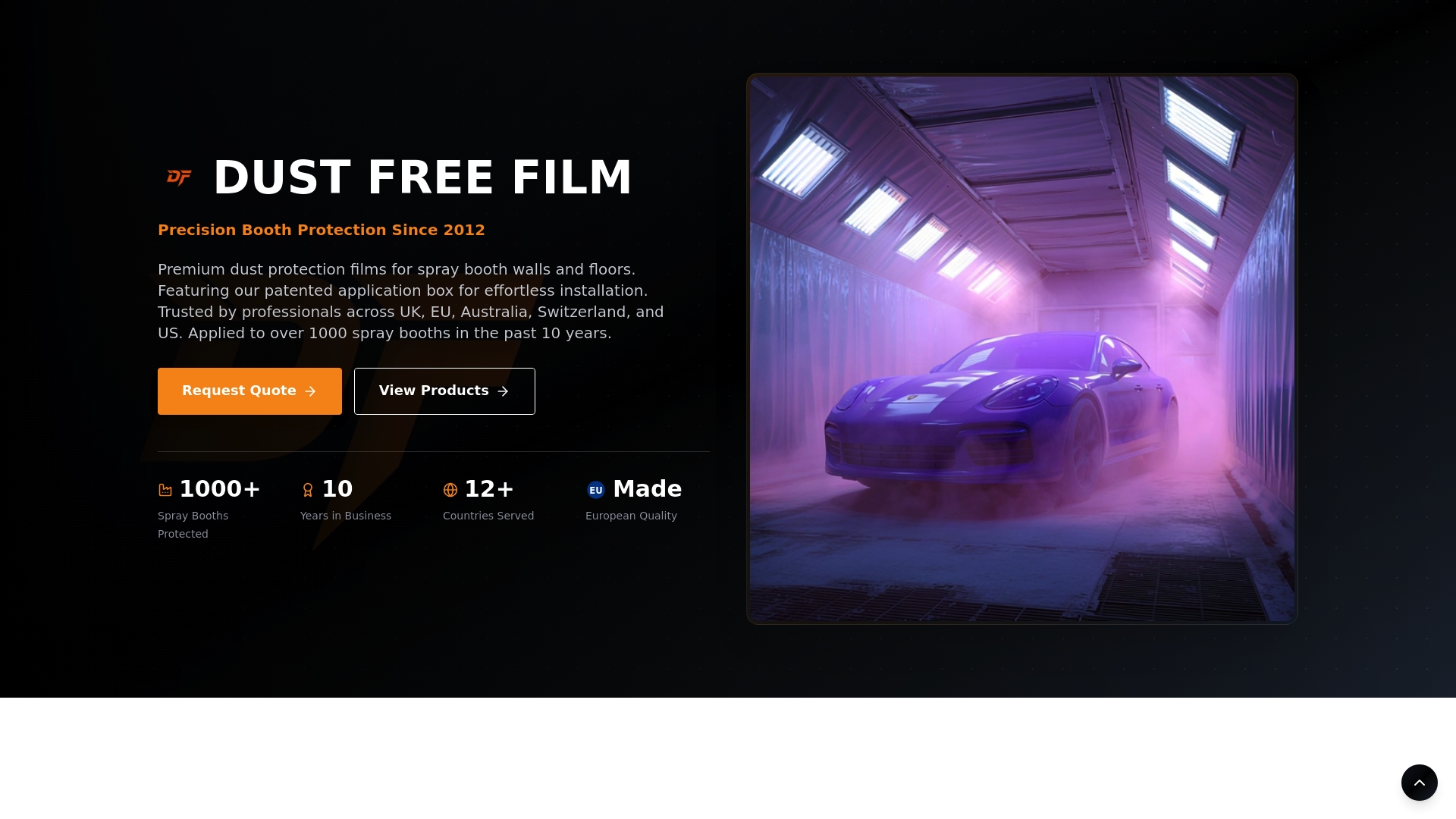
Dustfreefilm’s multi-layer wall and floor protectors are manufactured to European standards and designed around rapid change cycles, with a patented dispenser system that eliminates the application errors that create contamination in the first place. For facilities running high volumes, custom configurations are available to match your exact booth dimensions and substrate types. If you’re ready to match your film spec to your actual booth requirements, the quote request page includes consultation support to help you identify the right configuration before you order.
FAQ
What makes a booth protection film residue-free?
A residue-free film uses a pressure-sensitive adhesive engineered to hold during use but release cleanly when removed, without leaving adhesive transfer on the surface. The adhesive formulation is matched to specific surface types to prevent bonding too aggressively.
How do I know if a film is compatible with my booth surfaces?
Run a sample test on each distinct surface type in your booth, including glass, coated metal, and floor materials, and leave it in place for 24 hours at your typical operating temperature before pulling it.
What film thickness is right for spray booth walls vs. floors?
Wall films typically range from 0.5 to 1.5 mil, which is sufficient for overspray capture without bulk. Floor films generally run 2 mil or heavier to handle foot traffic, equipment movement, and heat from curing cycles.
Why does static cling matter in a paint booth?
Static cling allows the film to attract and capture airborne particles during spraying, preventing them from settling on painted surfaces. This directly reduces the frequency of contamination-related defects in your finished work.
Can booth protection films handle bake cycle temperatures?
Quality films rated for booth use, particularly LDPE-based products, are designed to withstand temperatures up to 200°F, which covers most force-dry and bake cycle requirements in automotive refinishing without softening or bonding issues.