

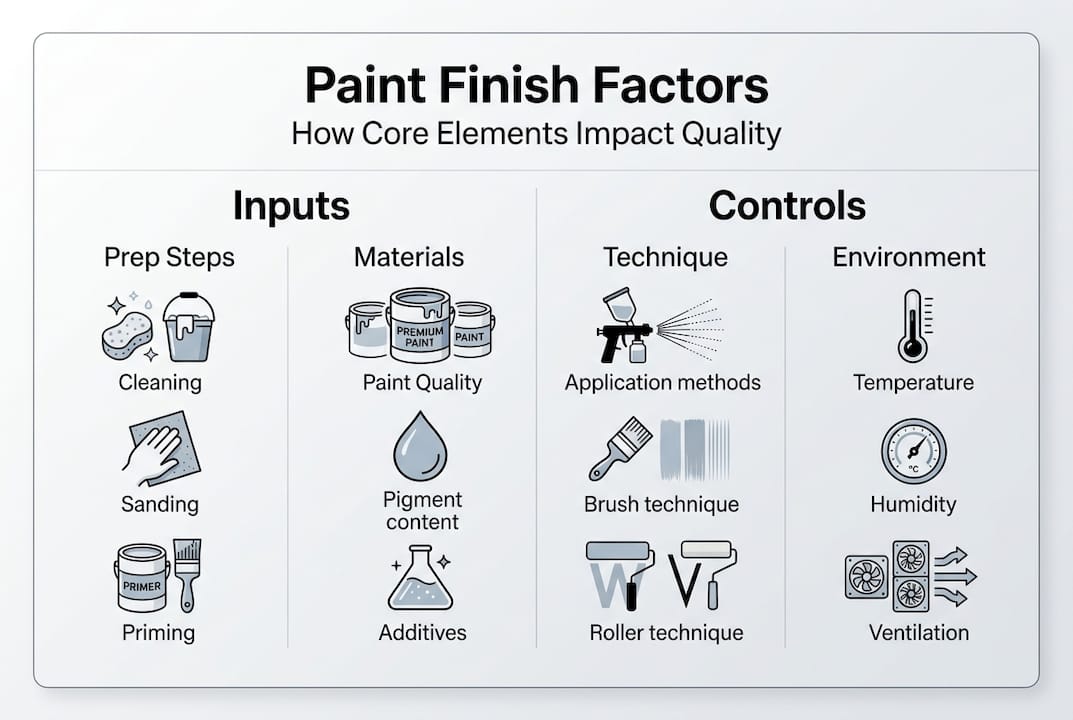
Many professionals assume paint finish quality depends solely on the material itself, but the reality is far more complex. Achieving flawless finishes in automotive refinishing and industrial painting requires mastering multiple interconnected factors that extend well beyond paint selection. Environmental conditions, contamination control, application techniques, and curing processes all play critical roles in determining whether your finish meets professional standards or falls short. Understanding and optimizing these quality factors transforms inconsistent results into reliable, high-grade finishes that satisfy demanding clients and reduce costly rework.
Table of Contents
- Key takeaways
- Understanding core factors affecting paint finish quality
- The role of dust and contamination control in flawless finishes
- Optimizing spray techniques and curing processes to enhance finish quality
- Comparing paint finish quality factors and their impact on operational efficiency
- Explore dust free film solutions for superior spray booth protection
- Frequently asked questions
Key Takeaways
| Point | Details |
|---|---|
| Multiple factors influence finish | Finish quality depends on material, application, and environmental conditions working together rather than paint alone. |
| Dust contamination control | Dust and other contaminants can cause texture defects and are the top priority in professional spray booths. |
| Environmental controls matter | Temperature, humidity, and airflow shape viscosity, evaporation, and cure outcomes for consistent results. |
| Best practices reduce defects | Standardized spraying, curing, and equipment maintenance practices lower defect rates and cut rework. |
Understanding core factors affecting paint finish quality
Paint finish quality emerges from a complex interaction between material properties, application methods, and environmental conditions. While paint formulation establishes baseline performance characteristics, the execution environment determines whether you achieve that potential. Professional spray booth operations must account for variables that amateur settings often overlook.
Surface preparation forms the foundation for any quality finish. Contaminants like oils, oxidation, or previous coating residues create adhesion failures and surface defects that no amount of skill can overcome. Proper cleaning, degreasing, and profiling ensure the substrate accepts the coating uniformly. Skipping or rushing this step guarantees problems downstream.
Environmental conditions like temperature, humidity, and dust significantly impact finish quality in ways that surprise many operators. Temperature affects viscosity, flow, and cure rates. Humidity influences solvent evaporation and can cause blushing in certain coatings. Airborne particles settle onto wet surfaces, creating the texture defects that plague even experienced painters.
Critical environmental factors include:
- Temperature stability between 65°F and 80°F for most automotive coatings
- Relative humidity maintained at 40% to 60% to prevent flash issues
- Positive air pressure preventing outside contaminants from entering
- Consistent airflow patterns eliminating dead zones where particles accumulate
Maintaining clean spray booth environments requires systematic monitoring and control. Digital sensors track conditions in real time, alerting operators to deviations before they compromise quality. Regular calibration ensures accuracy, while documented protocols create consistency across shifts and personnel changes. The investment in monitoring equipment pays dividends through reduced defect rates and improved first-pass success.
Pro Tip: Install temperature and humidity sensors at multiple booth locations, not just near the control panel. Microclimates within large booths can vary significantly, affecting different areas of your workpiece.
Understanding these foundational factors enables you to diagnose quality issues systematically rather than guessing at causes. When defects appear, experienced operators check environmental logs first, eliminating variables before questioning technique or materials. This diagnostic approach saves time and prevents unnecessary material waste. The dust-free environment benefits extend beyond surface quality to include improved worker health and reduced cleaning labor.
The role of dust and contamination control in flawless finishes
Dust contamination represents the single largest threat to paint finish quality in professional operations. Microscopic particles settle onto wet coatings, creating visible texture defects that range from subtle orange peel to pronounced dirt nibs requiring extensive correction. Dust and contaminants can cause over 90% of paint defects in spray booths, making contamination control your highest priority.
Particle sources within spray booths include booth surfaces shedding material, operator clothing releasing fibers, substrate preparation generating dust, and outside air introducing environmental contaminants. Each source requires specific mitigation strategies. Ignoring any single pathway leaves your finish vulnerable to defects that undermine all other quality efforts.
Effective contamination control strategies:
- High-efficiency particulate air filtration systems capturing particles down to 0.3 microns
- Positive pressure differentials preventing unfiltered air infiltration
- Protective films covering walls and floors to eliminate surface shedding
- Proper operator garments made from low-lint materials
- Regular cleaning schedules removing accumulated particulates before they become airborne
Air filtration forms your first defense against contamination. Modern spray booths employ multi-stage filtration with intake filters removing large particles and exhaust filters capturing overspray. Filter maintenance directly impacts performance, as clogged filters reduce airflow and create turbulence that stirs settled particles back into suspension. Pressure differential gauges indicate when replacement becomes necessary, typically well before complete blockage occurs.
Pro Tip: Replace intake filters on a calendar schedule rather than waiting for pressure alerts. Marginal filter performance still allows particle penetration even when airflow seems adequate.
Dust control methods extend beyond filtration to include source elimination. Protective films applied to booth walls and floors prevent the substrate itself from shedding particles. Traditional booth surfaces deteriorate under chemical exposure and mechanical wear, releasing contaminants that filters cannot capture fast enough. Film barriers create smooth, sealed surfaces that trap particles rather than releasing them.
Implementing effective dust management requires understanding particle behavior in spray booth environments. Electrostatic forces attract particles to grounded surfaces, which explains why dust accumulates on booth walls despite airflow designed to carry it away. Anti-static films reduce this attraction, allowing air currents to remove particles more effectively. This seemingly minor detail makes substantial differences in contamination levels.
“Controlling dust at the source through protective films and proper booth maintenance delivers more consistent results than relying solely on air filtration to remove particles after they become airborne.”
Cleaning protocols must address both visible contamination and microscopic particles. Wet wiping removes surface dust without creating airborne clouds that settle onto subsequent work. Tack cloths capture particles from workpiece surfaces immediately before coating. Timing matters as much as technique, with final cleaning occurring as close to paint application as practical to minimize recontamination windows.
Optimizing spray techniques and curing processes to enhance finish quality
Spray application technique directly determines coating uniformity, thickness consistency, and surface appearance. Equipment settings, operator skill, and environmental conditions interact to produce results ranging from show-quality finishes to defect-ridden failures requiring complete rework. Mastering these variables separates professional operations from amateur efforts.
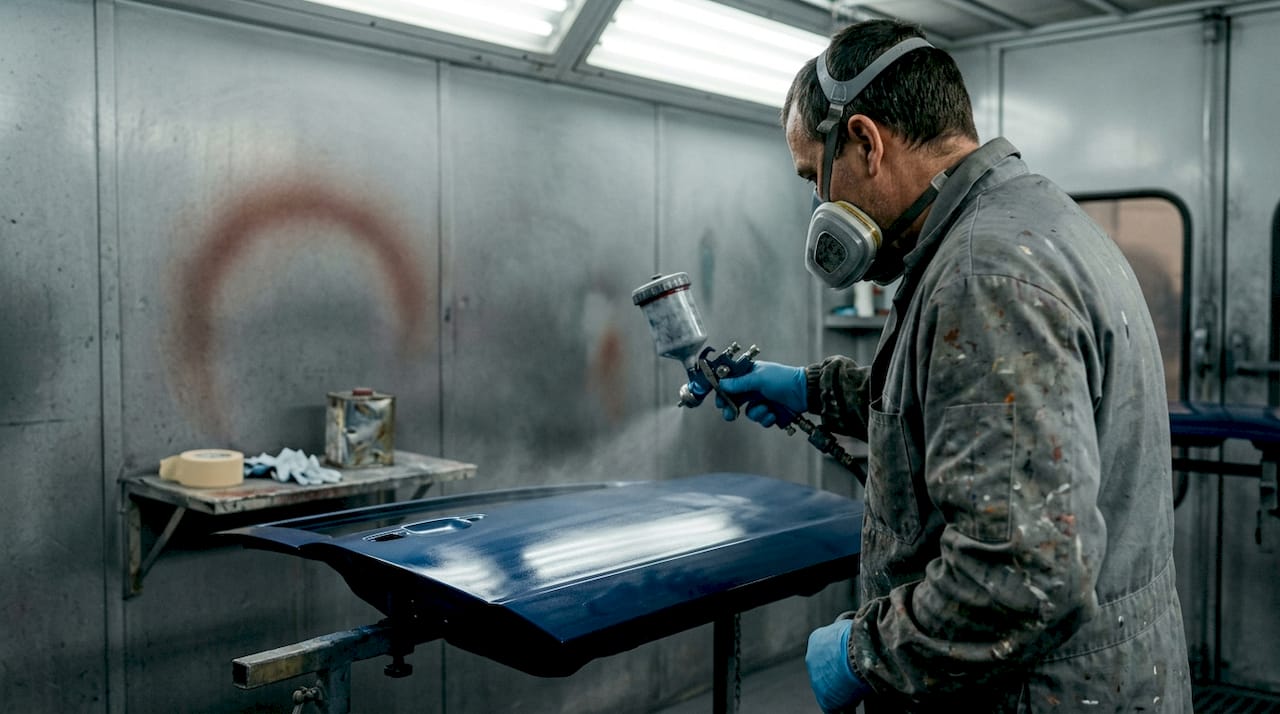
Spray gun selection and setup establish baseline performance capabilities. Gravity-feed guns suit detail work and small parts, while pressure-feed systems handle high-volume production. Fluid tip size must match coating viscosity, with larger orifices required for high-solids materials. Air pressure affects atomization quality, with excessive pressure creating dry spray and insufficient pressure producing runs.
Optimal spray technique parameters:
- Maintain 6 to 8 inches between gun tip and surface for most automotive coatings
- Move at consistent speed of 12 to 18 inches per second to ensure uniform wet film thickness
- Overlap each pass by 50% to eliminate striping and coverage variations
- Keep gun perpendicular to surface, avoiding arcing motions that create uneven application
- Trigger at the beginning and end of each pass to prevent buildup at reversal points
Proper spray techniques help minimize overspray and runs, critical for high-quality finishes. Operator training programs should include practice sessions on scrap panels, allowing skill development without risking production work. Video analysis reveals technique flaws invisible to the operator, accelerating improvement. Experienced painters still benefit from periodic refresher training as products and equipment evolve.
Pro Tip: Mark your ideal spray distance on the gun handle with tape or paint. This visual reference helps maintain consistency throughout long production runs when fatigue affects judgment.
Curing process control determines whether applied coatings achieve their designed performance characteristics. Temperature, time, and airflow must align with manufacturer specifications to develop proper crosslinking, hardness, and chemical resistance. Shortcuts in curing create finishes that appear acceptable initially but fail prematurely in service.
| Curing Parameter | Typical Range | Impact of Deviation |
|---|---|---|
| Temperature | 140°F to 180°F | Low: soft film, poor durability; High: blistering, color shift |
| Time at temperature | 20 to 45 minutes | Short: incomplete cure; Long: brittleness, waste energy |
| Air circulation | 200 to 400 CFM | Insufficient: hot spots; Excessive: surface cooling |
| Humidity during cure | Below 60% RH | High: moisture entrapment, adhesion loss |
Monitoring actual part temperature rather than oven air temperature ensures accurate curing. Infrared thermometers or thermocouples attached to representative parts confirm that the coating reaches specified cure temperature. Large or complex parts may require longer times to achieve uniform heating throughout their mass. Rushing this process to improve throughput creates quality problems that cost far more than the time saved.
Implementing industrial dust prevention during curing prevents contamination of the tacky surface before full cure. Enclosed ovens with filtered air supply protect vulnerable finishes from settling particles. Proper oven maintenance includes regular cleaning to remove accumulated overspray residue that can flake off and contaminate subsequent work.
Comparing paint finish quality factors and their impact on operational efficiency
Different quality factors contribute varying levels of impact on final finish quality and operational efficiency. Understanding these relative contributions allows you to prioritize improvement efforts for maximum return on investment. Not all factors deserve equal attention or resources.
| Quality Factor | Defect Reduction Impact | Implementation Cost | Maintenance Requirement | ROI Timeline |
|---|---|---|---|---|
| Dust control systems | 85% to 95% | Medium | Low | 3 to 6 months |
| Spray technique optimization | 60% to 75% | Low | Medium | 1 to 3 months |
| Temperature/humidity control | 50% to 65% | High | Medium | 6 to 12 months |
| Surface preparation protocols | 70% to 80% | Low | Low | Immediate |
| Curing process control | 55% to 70% | Medium | Low | 3 to 6 months |
Implementing comprehensive dust control and operational best practices significantly reduces defects and boosts productivity. The data clearly shows dust control delivers the highest defect reduction at moderate cost, making it the logical first priority for most operations. Surface preparation follows closely, offering substantial quality improvements with minimal investment beyond training and discipline.
Operational efficiency gains from quality factor optimization include:
- Reduced rework rates cutting labor costs by 40% to 60% in typical operations
- Lower material waste from fewer rejected parts and coating application errors
- Faster throughput from eliminating correction cycles and quality holds
- Improved customer satisfaction reducing warranty claims and reputation damage
- Enhanced worker morale from producing quality work consistently
The relationship between quality factors creates multiplicative rather than additive effects. Excellent dust control combined with poor spray technique still produces defects, while mediocre performance across all factors yields consistently poor results. Balanced improvement across multiple factors generates synergistic benefits exceeding the sum of individual contributions.
Prioritizing improvements requires assessing your current state honestly. Operations already achieving good dust control gain more from optimizing spray technique or curing processes. Facilities struggling with basic contamination issues must address that foundation before fine-tuning advanced parameters. Diagnostic data from defect tracking systems reveals which factors cause the most quality failures in your specific operation.
Tracking spray booth contamination effects through systematic defect logging creates the evidence base for improvement decisions. Categorizing each defect by probable cause identifies patterns that point toward root issues. Monthly analysis reveals whether implemented corrections actually improve results or simply shift problems to different manifestations.
Explore dust free film solutions for superior spray booth protection
Achieving the dust-free environments essential for flawless paint finishes requires more than air filtration alone. Protecting booth surfaces from contamination and deterioration eliminates particle sources at their origin, creating cleaner conditions that filtration systems can maintain more effectively. Spray booth protection film provides a proven solution for operations serious about quality.

Dust Free Film’s multi-layer electrostatic booth wall and floor protectors create sealed barriers that prevent substrate shedding while simplifying maintenance. The patented application system enables quick, bubble-free installation that minimizes downtime. Heat-resistant and static-free construction suits demanding industrial environments where durability matters. Regular film replacement maintains pristine booth conditions without the labor-intensive cleaning traditional surfaces require. Facilities implementing comprehensive protective film systems report substantial reductions in paint defects and rework rates, translating directly to improved profitability and customer satisfaction. Explore how dust-free environment improvements can transform your operation’s quality and efficiency.
Frequently asked questions
What are the main factors that affect paint finish quality?
Surface preparation, environmental control, spray application method, and curing process represent the primary factors determining paint finish quality. Each factor contributes independently while also interacting with others to produce final results. Dust and contamination management within spray booths proves critical for defect prevention, often accounting for the majority of quality issues in professional operations. Temperature and humidity control ensure coatings flow, cure, and develop properties as designed.
How does dust contamination specifically impact paint finishes?
Dust particles settling onto wet paint create visible texture defects including rough surfaces, fisheyes, and uneven gloss that require expensive correction. Even microscopic contamination becomes obvious under proper lighting conditions, failing quality standards for automotive and industrial applications. Paint booth dust control methods address contamination through filtration, surface protection, and cleaning protocols. Uncontrolled dust contamination leads to rework rates exceeding 30% in some operations, consuming profit margins through wasted materials and labor.
What practical steps can improve paint finish quality immediately?
Regular booth cleaning combined with systematic dust control strategies delivers immediate quality improvements in most operations. Calibrating spray equipment to manufacturer specifications and verifying proper technique eliminates application-related defects. Implementing documented procedures for surface preparation ensures consistency across operators and shifts. Clean booths for better paint finish start with protecting surfaces from contamination sources and maintaining positive air pressure to prevent infiltration.
Why is curing process control essential for durable paint finishes?
Proper curing develops the chemical crosslinking that gives coatings their designed hardness, chemical resistance, and durability. Insufficient curing leaves soft spots vulnerable to damage and adhesion failure during service. Excessive curing can cause brittleness, color shift, or coating degradation that compromises appearance and protection. Monitoring actual part temperature rather than oven air temperature ensures coatings reach cure specifications throughout their thickness. Understanding spray booth contamination impact during vulnerable cure stages prevents defects that appear only after installation.