
Production managers often assume all protective films deliver identical performance, but material durability dramatically separates effective solutions from costly failures. In automotive refinishing and industrial painting, the right protective film prevents paint defects, reduces rework, and extends booth lifespan. Poor durability leads to premature film breakdown, contamination, and finish quality issues that erode profitability. This guide reveals what defines true material durability in protective films, how environmental factors influence performance, and practical strategies to optimize your spray booth operations for superior paint quality and efficiency.
Table of Contents
- Understanding Material Durability In Protective Films
- How Spray Booth Environment Influences Protective Film Performance
- Comparing Protective Film Materials And Technologies
- Best Practices For Maximizing Protective Film Durability In Spray Booths
- Explore Durable Dust-Free Films For Spray Booth Protection
- Frequently Asked Questions
Key takeaways
| Point | Details |
|---|---|
| Solvent resistance matters | Durable films resist solvents, dirt, and discoloration to prolong spray booth protection and maintain clean surfaces. |
| Environment affects longevity | Effective airflow and filtration complement protective films to reduce paint defects and extend film lifespan. |
| Thickness impacts durability | Film thickness correlates directly with impact resistance and long-term durability under mechanical stress. |
| Advanced resins simplify application | Innovative resin formulations offer improved coatings performance with fewer application steps and compatibility issues. |
| Proper setup maximizes value | Correct application techniques and environmental control maximize durability and coating quality outcomes. |
Understanding material durability in protective films
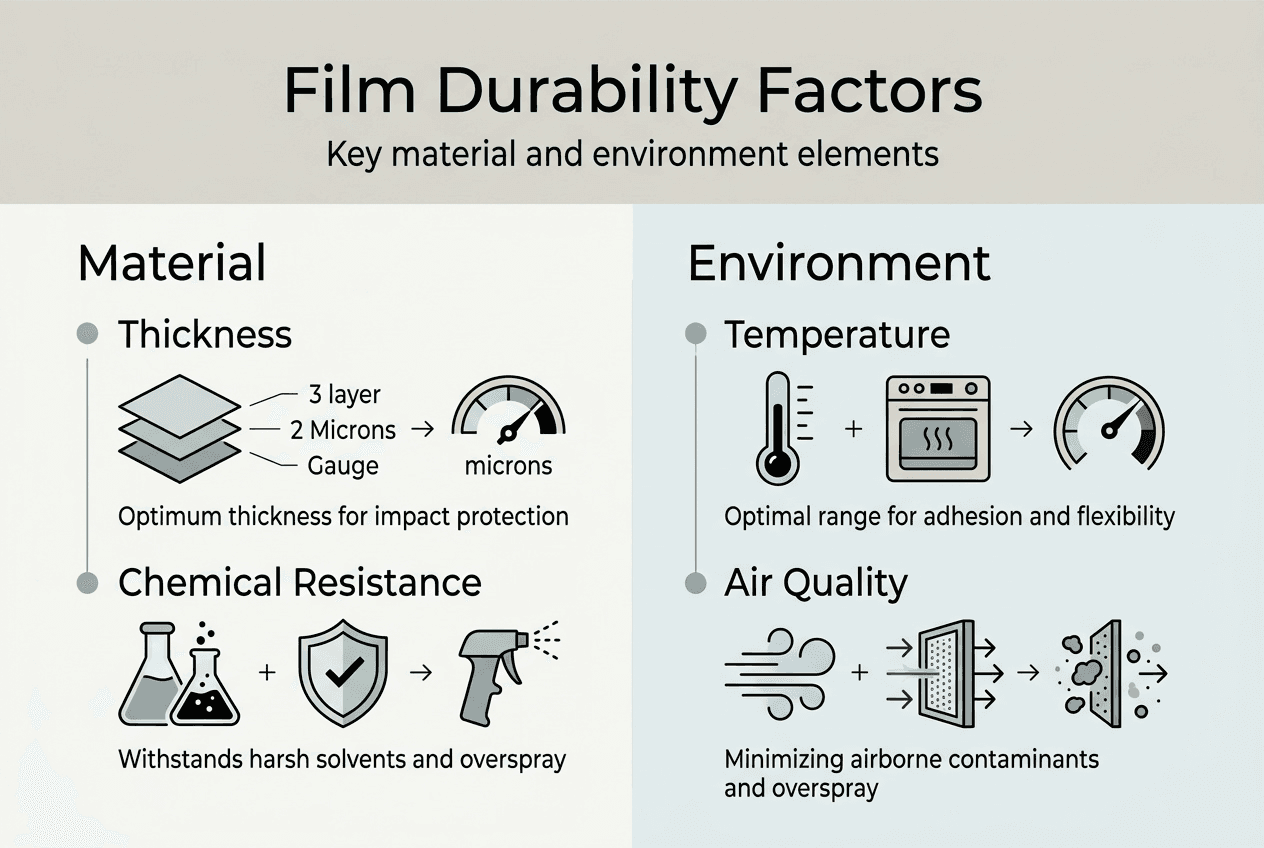
Material durability in protective films encompasses multiple performance characteristics that determine how well a film protects spray booth surfaces over time. The most critical properties include resistance to solvents, staining, smudging, and mechanical impact from equipment and foot traffic. These attributes directly influence how long a film remains effective before requiring replacement, impacting both operational costs and paint quality consistency.
Solvent resistance stands out as a primary durability indicator. 3M™ Booth Coating provides excellent solvent resistance for protection against paint and primer overspray, demonstrating how quality formulations maintain integrity when exposed to harsh chemicals. Films lacking this resistance quickly degrade, becoming tacky or discolored and attracting contaminants that compromise paint finishes. A non-tacky surface prevents dirt buildup and maintains the clean environment essential for defect-free coatings.
Durability extends product life by reducing reapplication frequency and minimizing downtime. When films break down prematurely, production managers face labor costs for removal and reinstallation, plus lost productivity during booth preparation. High-quality protective films maintain their barrier properties for months or even years, depending on usage intensity and environmental conditions.
Key durability factors include:
- Chemical resistance to solvents, thinners, and cleaning agents
- Mechanical strength to withstand impacts and abrasion
- Adhesion stability that prevents peeling or bubbling
- UV and thermal resistance for temperature-variable environments
- Surface properties that resist staining and dirt accumulation
Pro Tip: Selecting a protective film with water-based, fast-drying coatings improves ease of maintenance and reduces exposure to volatile organic compounds, supporting both worker safety and environmental compliance.
The benefits of removable protective films become evident when you consider total cost of ownership. Initial material costs matter less than long-term performance, as frequent replacements of inferior films quickly exceed the investment in durable solutions. Production managers should evaluate durability metrics alongside application ease and removal characteristics to identify films that deliver optimal value for their specific spray booth conditions.
How spray booth environment influences protective film performance
Spray booth environmental controls create the foundation for both superior paint finishes and extended protective film lifespan. Airflow balance, filtration efficiency, and temperature/humidity regulation interact with film materials in ways that either enhance or undermine durability. Understanding these relationships enables production managers to optimize both booth design and film selection for maximum performance.
Airflow management serves as the cornerstone of spray booth function. Paint booths with multi-stage filtration, including HEPA filters, significantly reduce defects in automotive paint finishes by removing sub-micron particles. Proper airflow balance minimizes turbulence, a primary source of paint defects like orange peel and dry spray. When airflow patterns create turbulence, they also accelerate protective film degradation by increasing particle deposition and mechanical stress on film surfaces.
Multi-stage filtration systems protect both painted surfaces and protective films from contamination. Intake filters remove large particles from incoming air, pre-filters capture medium-sized contaminants, and HEPA exhaust filters ensure clean air discharge while meeting regulatory requirements. This layered approach reduces the particle load that contacts protective films, minimizing abrasive wear and extending film life.
Environmental control systems maintain optimal conditions:
- Air makeup units balance pressure and provide conditioned air
- Temperature regulation ensures consistent curing and film stability
- Humidity control prevents moisture-related defects and film adhesion issues
- Exhaust systems remove overspray and maintain negative pressure
NESHAP regulations require high-efficiency exhaust filters in spray booths, impacting both booth design and contamination risk. These regulatory requirements drive filtration standards that benefit protective film performance by reducing airborne particulates. Facilities that exceed minimum compliance often experience better film durability and fewer paint quality issues.
| Environmental Factor | Impact on Film Durability | Optimal Range |
|---|---|---|
| Temperature | Affects adhesion and curing | 65-75°F |
| Humidity | Influences tackiness and dirt attraction | 40-60% RH |
| Airflow velocity | Controls particle deposition rate | 100 fpm |
| Filtration efficiency | Reduces abrasive particle load | 95%+ |
Pro Tip: Maintaining optimized environmental settings extends protective film life by minimizing chemical and particulate load, reducing replacement frequency by 30-50% compared to poorly controlled booths.
The impact of spray booth air quality on finish quality parallels its effect on protective film longevity. Both paint and film suffer when environmental controls fail to manage contaminants effectively. Production managers who invest in superior environmental control systems see returns through reduced material costs, fewer defects, and improved operational efficiency.
Comparing protective film materials and technologies
Protective film materials vary significantly in their chemical composition, application complexity, and durability characteristics. Understanding these differences helps production managers select solutions that match their facility’s specific requirements for chemical exposure, mechanical stress, and operational constraints. Material science advances continue to deliver innovations that simplify application while enhancing performance.
Conventional multi-coat systems layer different materials to achieve specific protective functions, but this approach raises risks of adhesion failures and cure incompatibilities between layers. Each additional coat introduces potential failure points where delamination or chemical reactions can compromise the entire system. Application complexity increases with layer count, requiring more labor and longer cure times.
TriFLEX™ combines three distinct resins into one unified formulation for direct-to-metal application, delivering exceptional performance and streamlined application. This integrated approach eliminates inter-coat adhesion concerns while providing the chemical resistance of epoxies, the flexibility of urethanes, and the rapid cure of polyaspartics in a single product. The result is superior durability with reduced application complexity and fewer opportunities for user error.
Common protective film chemistries each offer distinct advantages and limitations:
- Epoxies deliver excellent chemical resistance but limited UV stability
- Urethanes provide flexibility and impact resistance with moderate cure times
- Polyaspartics cure rapidly and resist UV degradation but require precise application
- Hybrid formulations balance multiple properties for versatile performance
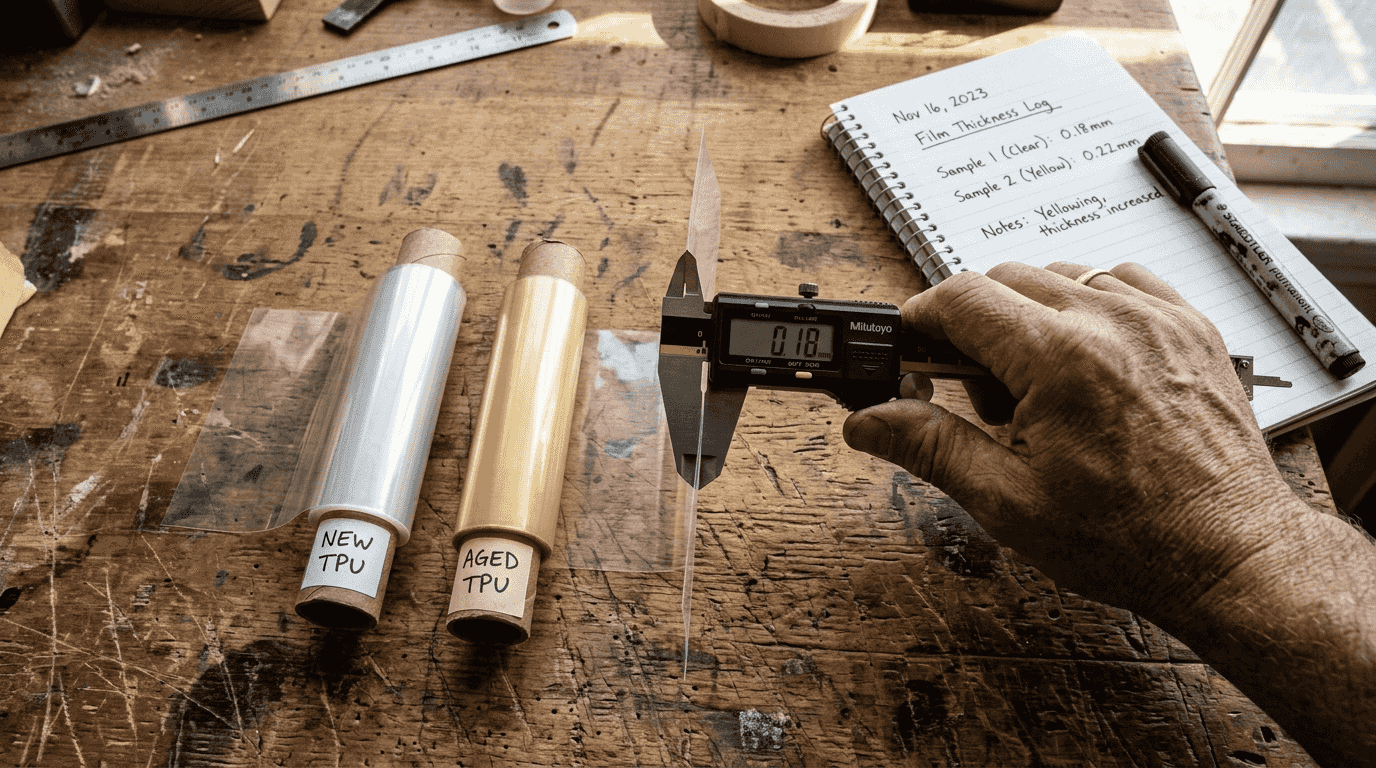
Film thickness significantly influences impact resistance and overall durability. An 8-mil film handles normal foot traffic and light equipment contact, while 10-mil films withstand higher impact speeds and more aggressive mechanical stress. Thicker films generally last longer in high-traffic areas but may be harder to apply smoothly and remove cleanly. Production managers should match thickness to actual usage patterns rather than defaulting to maximum thickness.
| Film Type | Chemical Resistance | Cure Time | UV Stability | Application Ease | Typical Use |
|---|---|---|---|---|---|
| Epoxy | Excellent | 12-24 hours | Poor | Moderate | Chemical storage |
| Urethane | Good | 6-12 hours | Excellent | Easy | High-traffic areas |
| Polyaspartic | Very Good | 1-4 hours | Excellent | Difficult | Fast turnaround |
| TriFLEX™ | Excellent | 4-6 hours | Very Good | Moderate | General purpose |
| Water-based | Moderate | 2-4 hours | Good | Very Easy | Light duty |
The advantages of multi-layer protective films become apparent in demanding applications where single-layer solutions fail to provide adequate protection. However, modern integrated formulations increasingly deliver multi-layer performance without the application complexity, representing the current direction of protective film technology evolution.
Best practices for maximizing protective film durability in spray booths
Selecting and applying durable protective films requires systematic attention to surface preparation, application technique, and ongoing maintenance. Production managers who implement structured processes achieve consistently better outcomes than those relying on informal approaches. These practices translate technical knowledge into measurable improvements in film longevity and paint quality.
Follow this selection and application process for optimal results:
- Clean all surfaces thoroughly to remove dust, oil, and previous coating residues that compromise adhesion.
- Verify environmental conditions meet manufacturer specifications for temperature and humidity before application.
- Select appropriate film thickness based on expected mechanical stress and traffic patterns in each booth area.
- Apply films using correct spray parameters including distance, pressure, and overlap to ensure uniform coverage.
- Allow adequate cure time before exposing films to solvents or mechanical stress to develop full protective properties.
- Inspect installation for bubbles, thin spots, or adhesion failures and address issues immediately.
Careful control of key parameters such as spray distance, pressure, temperature, humidity, speed, and viscosity can mitigate surface roughness issues when incorporating low-cost fillers in spray coatings. These same parameters affect protective film application quality and durability. Consistent technique produces consistent results, while variation introduces defects that reduce film effectiveness.
Maintaining environmental parameters supports film curing and longevity throughout the service life. Temperature fluctuations can cause expansion and contraction that stresses adhesive bonds, while humidity extremes affect surface chemistry and dirt attraction. Facilities with stable environmental control experience fewer premature film failures and more predictable replacement schedules.
Regular inspection and timely replacement prevent overspray buildup and discoloration that compromise booth cleanliness. Visual inspection schedules should align with production intensity, with high-volume facilities checking weekly and lower-volume operations monthly. Replace films when they show signs of degradation rather than waiting for complete failure, as deteriorating films shed particles that contaminate paint finishes.
Pro Tip: Use removable films to simplify cleaning and extend underlying coating lifespan, reducing total booth maintenance costs by eliminating aggressive cleaning that damages permanent surfaces.
Training staff on proper spray equipment settings and environmental monitoring optimizes outcomes and film durability. Operators who understand how their actions affect both paint quality and protective film performance make better decisions and catch problems earlier. Investment in training delivers returns through reduced material waste, fewer defects, and longer film service life.
Implementing spray booth protective practices systematically rather than reactively transforms protective films from a consumable expense into a strategic asset. The goal extends beyond simply covering surfaces to creating an integrated system where films, environmental controls, and operational procedures work together to deliver superior paint quality and operational efficiency. Production managers who adopt this holistic perspective achieve results that exceed the sum of individual improvements.
The connection between protective films and ensuring dust-free finishes becomes most apparent when facilities compare defect rates before and after implementing comprehensive protective film programs. Properly selected and maintained films eliminate a major contamination source, enabling paint technicians to focus on application technique rather than environmental remediation.
Explore durable dust-free films for spray booth protection
Your spray booth deserves protective films engineered specifically for the demanding conditions of automotive refinishing and industrial painting. Dust Free Film manufactures premium protective solutions that combine exceptional durability with easy application and clean removal, preserving booth surfaces while maintaining the pristine environment essential for superior paint finishes.
Our multi-layer electrostatic films deliver proven performance in high-traffic industrial settings, resisting solvents, impacts, and environmental stress that degrade inferior products. The patented dispenser system ensures bubble-free installation, while heat-resistant, static-free formulations maintain effectiveness throughout extended service periods. Whether you need wall protection or floor coverage, our solutions integrate seamlessly with your environmental controls for maximum performance and efficiency.
Explore Dust Free Film spray booth protection options tailored to your facility’s specific requirements. Our team helps you select the right film thickness, material chemistry, and application approach for your production volume and quality standards. European manufacturing standards ensure consistent quality, while flexible configurations accommodate operations of any scale. Request a quote today to discover how durable protective films can reduce your maintenance costs and improve paint quality outcomes.
Frequently asked questions
What factors most impact protective film durability in spray booths?
Durability hinges on chemical resistance to solvents and cleaners, film thickness for impact protection, application quality affecting adhesion, and environmental conditions including temperature and humidity. Material chemistry determines how well films withstand solvent exposure, with epoxies and polyaspartics offering superior resistance compared to basic vinyl films. Thickness directly correlates with mechanical durability, as thicker films absorb impacts better and resist punctures from equipment contact. Application quality matters because poor adhesion leads to premature peeling and contamination entry points that accelerate degradation.
How does spray booth airflow influence protective film performance?
The single most important function of a paint booth is to manage airflow, which controls dust and overspray distribution that affects both paint quality and protective film longevity. Proper airflow balance minimizes turbulence that causes paint defects while reducing abrasive particle buildup on film surfaces. Turbulent airflow accelerates film degradation by increasing particle velocity and deposition rates, creating mechanical wear that shortens service life. Facilities with optimized spray booth air quality see 40-60% longer film durability compared to poorly controlled environments.
What are the advantages of multi-resin coatings like TriFLEX™?
TriFLEX™ combines three distinct resins into one unified formulation for direct-to-metal application, delivering exceptional performance and streamlined application compared to conventional multi-coat systems. This integration eliminates adhesion and cure compatibility issues between separate layers while reducing application complexity and labor requirements. The unified chemistry provides the chemical resistance of epoxies, flexibility of urethanes, and rapid cure of polyaspartics without the failure risks of layered systems. Production managers benefit from fewer application steps, shorter cure times, and more predictable performance compared to traditional approaches. The technology behind multi-layer protective films continues evolving toward these integrated solutions.
Can protective films self-heal from minor scratches during use?
Modern PPF comes with self-healing capabilities that make minor scratches vanish with heat exposure, extending film lifespan and maintaining appearance without replacement. This technology uses thermoplastic polymers that flow when heated, filling surface scratches and restoring smooth appearance. Self-healing films prove particularly valuable in high-traffic spray booth areas where equipment contact creates frequent minor abrasions. The heat required for self-healing typically comes from normal booth operating temperatures or brief application of warm air, making the process practical for production environments. While self-healing extends service life for cosmetic scratches, it does not repair deep cuts or chemical damage that penetrates the film structure.