
TL;DR:
- Conventional cleaning methods often fail to prevent dust contamination on coated surfaces.
- Advanced protective films trap airborne particles continuously, reducing rework and improving finish quality.
- Implementing a systematic film replacement schedule enhances dust control effectiveness and operational efficiency.
Routine cleaning cycles, fresh filters, and good ventilation feel like a solid dust control plan. But even the most disciplined facility still sees contamination showing up in the final coat. Dust settles back between cleaning and spraying. Foot traffic stirs particles. Equipment surfaces shed debris that standard protocols simply cannot catch. The result is rework, wasted materials, and frustrated technicians. Innovative protective films address exactly these gaps, giving automotive refinishers and industrial paint operations a physical barrier that works continuously, not just during a cleaning window. This guide breaks down why conventional methods fall short, how advanced films perform, and how to build a strategy that sticks.
Table of Contents
- Understanding the problems with conventional dust control
- How innovative protective films transform spray booth performance
- Comparing advanced protective films: which features matter most?
- Practical applications: maximizing results with innovative films
- Our take: what most managers miss about protective films
- Ready to upgrade your dust protection strategy?
- Frequently asked questions
Key Takeaways
| Point | Details |
|---|---|
| Conventional controls fall short | Routine cleaning and basic dust management often allow costly defects to slip through. |
| Innovative films boost efficiency | Modern multi-layer and anti-static films trap dust better and are easy to replace, raising process quality. |
| Smart selection is critical | Choosing the right film type for your specific environment maximizes protection and cost-effectiveness. |
| Strategic use drives savings | Well-placed films lower rework, minimize downtime, and reduce operational costs long term. |
Understanding the problems with conventional dust control
Most spray booth operators rely on a familiar playbook: scheduled cleaning cycles, high-volume ventilation, sticky mats at entry points, and personal protective equipment for technicians. These practices are necessary, but they share a critical weakness. They manage dust reactively rather than preventing it from ever reaching a coated surface.
The sources of contamination in a spray environment are relentless. Consider what contributes to particle buildup on a typical shift:
- Foot traffic drags in debris from shop floors, even through sticky mats
- Airflow turbulence lifts settled dust off walls, floors, and equipment during spray cycles
- Equipment surfaces shed particles from aging seals, worn conveyor components, and fixtures
- Clothing and PPE release fibers that float in suspension long after a technician leaves the booth
- Residual overspray builds up on booth walls and becomes a secondary contamination source
The financial stakes are real. Rework on a single automotive panel can cost anywhere from labor time to full material replacement, and in high-volume industrial settings, even a 2% defect rate compounds quickly into significant losses over a quarter.
“Regular cleaning and maintenance do not fully prevent dust-related coating defects.” This is a critical insight that many facility managers only accept after experiencing repeated rework cycles despite strict cleaning protocols.
The uncomfortable truth is that manual cleaning redistributes dust as much as it removes it. Wiping walls and floors without a protective barrier simply moves particles into the air temporarily. They settle again before the next spray cycle begins. Without a physical layer that captures and holds contamination, you are essentially resetting the clock rather than solving the problem. Achieving consistent dust-free finishes requires a fundamentally different approach.
Now that you know why routine cleaning can fail, let’s see how modern protective films reframe the standard.
How innovative protective films transform spray booth performance
Protective films work on a simple but powerful principle: instead of trying to remove dust from surfaces repeatedly, you cover those surfaces with a film that traps particles and can be peeled away cleanly. The contamination leaves the booth with the film, not back into the air.
Advanced films designed for spray booth use share several key characteristics that separate them from generic plastic sheeting:
- Multi-layer construction provides multiple dust-capture zones within a single film, so particles that penetrate the outer layer are caught before reaching the surface below
- Static-free or anti-static treatment prevents the film from attracting airborne dust electrostatically, which would defeat its purpose
- Controlled adhesive strength holds the film securely without leaving residue on booth walls or floors when removed
- High optical clarity maintains visibility and does not interfere with lighting assessments during application
- Heat resistance allows films to remain stable during baking cycles without bubbling, shrinking, or releasing adhesive
Innovative protective films actively capture airborne dust and are designed for quick replacement, which means your booth is reset to a clean baseline between jobs without a lengthy manual cleaning process. This directly cuts the time between jobs and reduces the skill dependency of cleaning tasks.
Installation efficiency matters too. Patented dispenser systems allow a single technician to apply film to large wall and floor areas quickly, without bubbles or misalignment. This reduces downtime and eliminates the inconsistency of hand-applied solutions.
Pro Tip: When evaluating films for your facility, prioritize anti-static certification and confirmed heat resistance ratings over price per roll. A film that fails during a bake cycle or attracts dust electrostatically will cost far more in rework than you saved on the purchase. Look for suppliers who provide documented performance data, not just product descriptions. Films designed for boosting efficiency in spray booths will always specify these parameters clearly.
Understanding how these films work leads us to comparison, what makes advanced options notably better?
Comparing advanced protective films: which features matter most?
Not all protective films deliver the same results. The decision between single-layer, multi-layer, and electrostatic options has a direct impact on contamination rates, replacement frequency, and total cost per job.
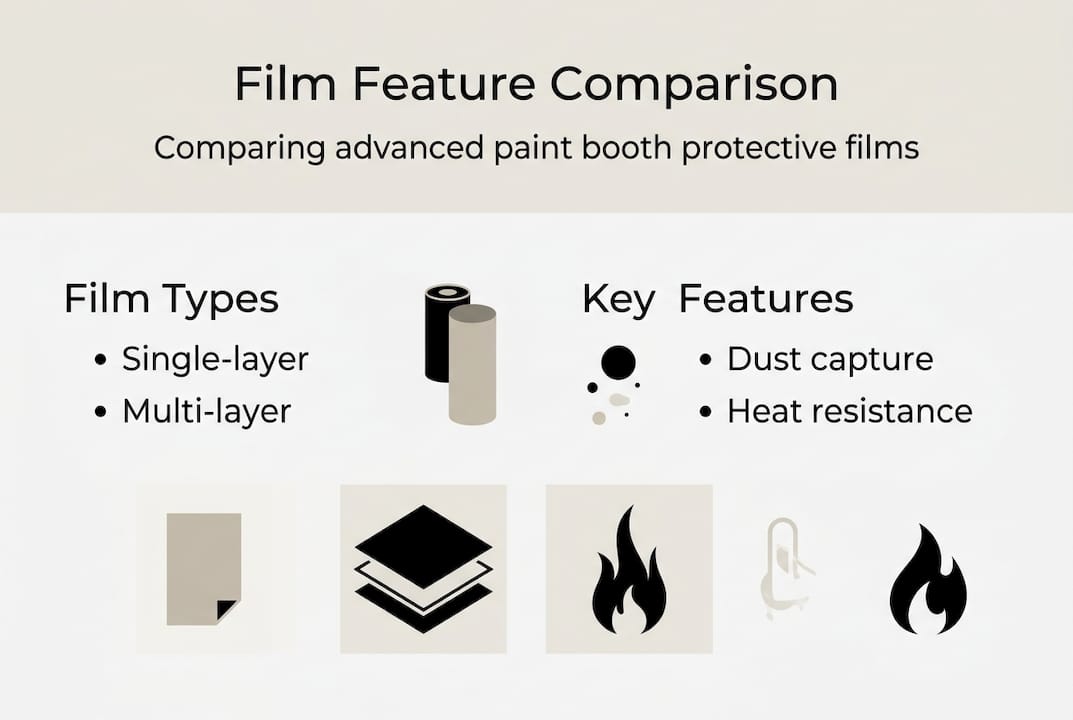
| Film type | Dust capture | Replacement frequency | Cost per roll | Best fit |
|---|---|---|---|---|
| Single-layer standard | Basic | High | Low | Low-volume shops |
| Multi-layer | High | Moderate | Medium | Mid to high-volume |
| Electrostatic/anti-static | Very high | Low | Medium-high | High-precision industrial |
Using multi-layer protective film or electrostatic protective film can reduce surface contaminants by up to 85% compared to unprotected booths. That is not a marginal improvement. It represents a fundamental shift in finish quality and rework rates.
Key performance trade-offs to evaluate:
- Dust-capture efficacy is the most important metric. A film that looks clean but allows fine particles to pass through to booth surfaces is not doing its job.
- Replacement frequency affects labor cost and downtime. Multi-layer films can often be peeled one layer at a time, extending the life of each installation and reducing total replacement events.
- Adhesive compatibility with your specific booth surface material prevents damage during removal and ensures no residue contaminates subsequent jobs.
- Heat resistance rating must match or exceed your baking cycle temperatures. Verify this against your oven specifications, not general product claims.
To evaluate which technology suits your facility, start with a simple audit. Document your current rework rate, cleaning time per job, and material waste. Run a 30-day trial with an advanced film type in your highest-volume booth. Compare the numbers. The data will make the decision straightforward.
Once you select a solution, practical implementation becomes key. Let’s explore real-world strategies.
Practical applications: maximizing results with innovative films
Knowing which film to choose is only half the equation. Where and how you apply it determines the actual results your facility achieves.
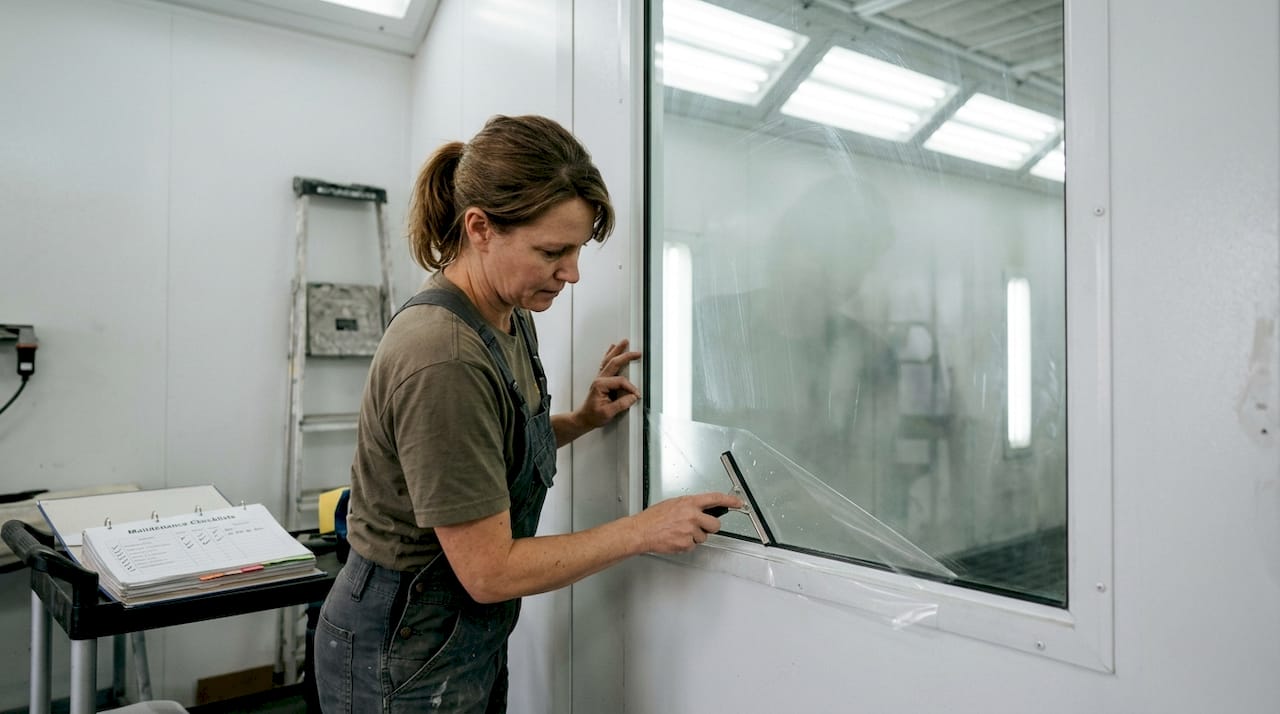
Specific areas like floors, walls, and equipment surfaces benefit most from targeted protective film application. In automotive refinishing, the floor directly beneath the vehicle and the lower booth walls see the highest contamination traffic. In industrial settings, conveyor entry points, fixture mounting areas, and overhead structures are additional critical zones.
Priority application zones by facility type:
- Automotive refinishing: booth floor, lower side walls, door jamb areas, prep station surfaces
- Industrial spray painting: conveyor side panels, floor under spray zones, equipment fixture bases, filter housing surrounds
- Both environments: entry and exit transition areas, lighting fixture surrounds, ventilation grille frames
| Application zone | Contamination risk | Recommended film type | Replacement trigger |
|---|---|---|---|
| Booth floor | Very high | Multi-layer | Every 5-10 jobs |
| Lower walls | High | Multi-layer or electrostatic | Every 10-15 jobs |
| Upper walls | Medium | Single or multi-layer | Monthly |
| Equipment surfaces | Medium-high | Electrostatic | Weekly inspection |
Maintenance scheduling should be systematic, not reactive. The benefits of removable protective films include the ability to build replacement into your standard job card workflow, so films are changed at defined intervals rather than only when a defect appears.
Pro Tip: Track your rework costs before and after implementing a film replacement schedule. Most facilities that do this find the film cost is recovered within the first month through reduced material waste and labor on corrections. Use a simple spreadsheet with rework incidents, materials used, and technician time. The savings become visible fast and justify investment in premium film options.
With practical steps in hand, it’s time for an honest perspective on what really sets advanced film strategies apart.
Our take: what most managers miss about protective films
After working with auto body shops and industrial paint facilities since 2012, we have seen the same pattern repeat. A facility invests in a good film product, sees improvement, and then gradually relaxes the replacement schedule. Costs creep back up. Defect rates inch higher. The conclusion drawn is that “the films stopped working” rather than “we stopped using them correctly.”
The real insight from high-performing facilities is that protective films are not a one-time fix. They are a system. The best operations treat film replacement as a quality checkpoint, the same way they treat filter changes or equipment calibration. It is built into the process, not left to individual judgment.
Cutting corners on dust protection is a hidden profit killer because the costs are distributed and invisible until you measure them. Rework is logged as labor. Material waste is absorbed into overhead. The connection to inadequate dust control is rarely made explicit.
Treating films as a strategic asset rather than a consumable cost changes how your team engages with them. Facilities that adopt this mindset consistently achieve clean, efficient finishes and sustain those results over time. The film is not an expense. It is the last line of defense between your work and a defect.
Ready to upgrade your dust protection strategy?
If the gaps in conventional dust control are costing your facility in rework and lost efficiency, the right film solution makes a measurable difference from the first installation.
Dust Free Film offers a full range of spray booth protection films engineered to the performance standards your operation demands, from multi-layer floor protectors to electrostatic wall films with patented dispenser systems. Whether you manage a single automotive refinishing booth or a large-scale industrial painting line, we can recommend the right configuration for your volume and application type. Take the next step and request a quote to get tailored product recommendations and pricing for your specific setup.
Frequently asked questions
What are the immediate benefits of installing innovative protective films?
Facilities see reduced rework, lower contamination, and improved paint finish from the first application. Protective films cut costly process interruptions and deliver measurable finish quality gains immediately.
How often should protective films be replaced in a spray booth?
Replacement schedules depend on film type and job volume, but most operations replace after a set number of spray cycles or when visible contamination appears. Films must be replaced as part of a preventive maintenance schedule for consistent performance.
Can innovative protective films help with static electricity in the booth?
Yes, advanced anti-static films are specifically engineered to reduce static charge buildup, which directly lowers dust attraction to booth surfaces. Electrostatic protective films offer anti-static properties for superior dust control in high-precision environments.
Do these films impact visibility or lighting in the spray booth?
High-quality films are manufactured for optical clarity, so they do not reduce visibility or distort lighting during spray and inspection. Transparent films keep visibility and lighting optimal while providing full dust protection coverage.
Are there cost savings with innovative films versus traditional methods?
Yes, the reduction in defects, rework labor, and cleaning time consistently offsets the film cost in most facilities within weeks. Targeted film use cuts operational costs tied to cleaning cycles and finish defect corrections.