

TL;DR:
- Static electricity causes contamination and finish defects in spray booths, even with advanced equipment.
- Electrostatic film dissipates charges, preventing dust attraction and ensuring uniform coatings.
- Proper implementation of film as a standard process significantly reduces rework and improves quality.
Static electricity is the silent saboteur of spray booth operations. Paint booths attract dust, distort spray patterns, increase overspray, and produce inconsistent finishes because of invisible charge buildup that most facility managers never directly measure or address. You invest heavily in premium coatings, skilled technicians, and precision equipment, yet a single charged surface can undo all of it in seconds. Electrostatic film offers a targeted, proven countermeasure. This article breaks down how static causes problems, how film neutralizes those problems, and how to implement it for real, lasting ROI in your facility.
Table of Contents
- Understanding static electricity in spray booths
- How electrostatic film works: Core principles
- Electrostatic film vs. alternative protection methods
- Implementing electrostatic film for maximum ROI
- The overlooked game-changer for flawless painting operations
- Discover premium electrostatic film solutions for your spray booth
- Frequently asked questions
Key Takeaways
| Point | Details |
|---|---|
| Static control is crucial | Invisible static buildup can attract dust and ruin paint finishes, so proactive static management is essential. |
| Electrostatic film offers unique advantages | It neutralizes static at the source, outperforming traditional dust control methods. |
| Synergy improves results | Combining film with humidity and airflow control maximizes paint quality and efficiency. |
| Implementation is straightforward | Electrostatic film can be adopted with little operational disruption and delivers measurable ROI quickly. |
Understanding static electricity in spray booths
Before examining solutions, it’s crucial to understand the problem static poses in high-value painting environments.
Static electricity is not just a minor inconvenience. In a spray booth, it’s a continuous, active threat to finish quality. Charges build up on booth walls, floors, vehicle surfaces, and even your technician’s clothing. When charged surfaces attract airborne particles, those particles embed themselves into fresh coatings, creating defects that are expensive to fix and nearly impossible to prevent without addressing the root electrical cause.
Here’s how the problem compounds during a typical paint cycle:
- Airflow from ventilation systems generates friction, which triggers charge buildup on plastic sheeting, freshly sanded panels, and ungrounded surfaces
- Atomized paint droplets carry their own charge, causing spray patterns to distort toward charged walls instead of landing uniformly on the target surface
- Dust that has already settled on booth walls or floors becomes electrostatically re-entrained the moment airflow picks up, sending contamination directly into wet paint
- Irregular charge distribution across a vehicle panel causes uneven coating thickness, which leads to orange peel texturing or premature delamination
Environmental conditions make this worse. Low humidity accelerates charge buildup because dry air is a poor electrical conductor. When relative humidity drops below 40%, surfaces hold charges for far longer, giving dust more time to migrate toward them. High-throughput facilities that run multiple paint cycles per day generate heat and friction continuously, which compounds static levels over time.
“Static electricity in a spray booth does not require dramatic sparks to cause damage. The everyday, low-level charges that go undetected are often the most damaging because they operate invisibly across every paint cycle.”
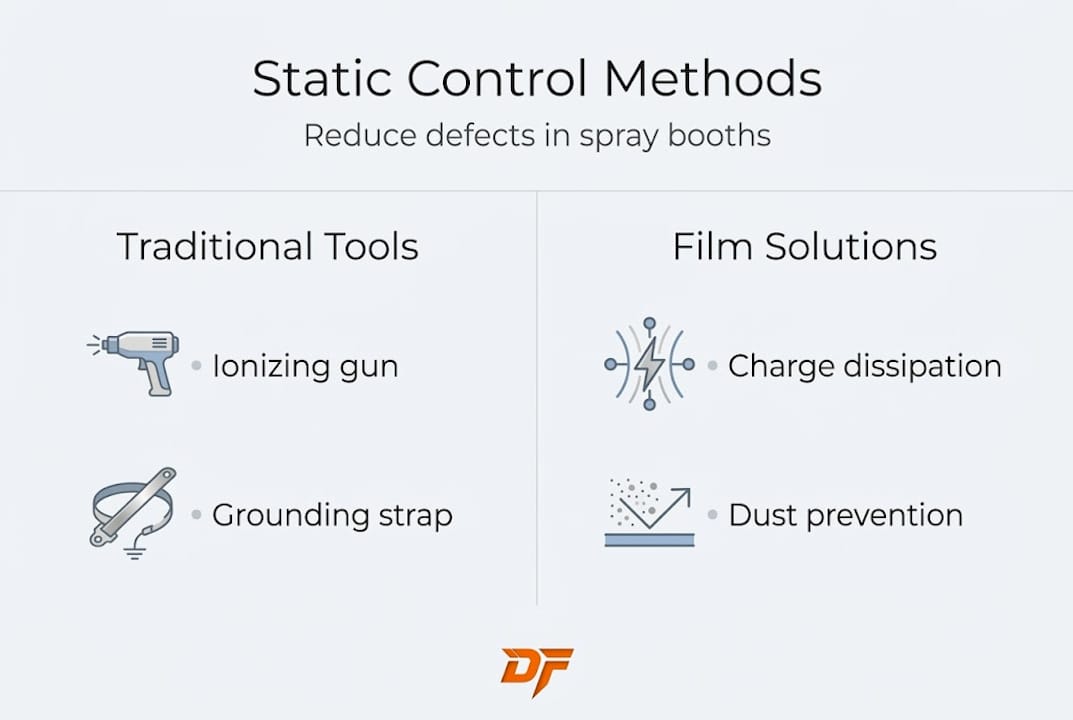
Traditional mitigation strategies include ionizing air guns, grounding straps, and humidity control systems. Each of these helps at the margins. But none of them provide a persistent, surface-level charge barrier across booth walls and floors the way electrostatic film basics explain in full. The film itself becomes a functional part of the booth environment rather than a periodic intervention.
How electrostatic film works: Core principles
With static’s dangers clarified, let’s look at how electrostatic film neutralizes these risks on contact.
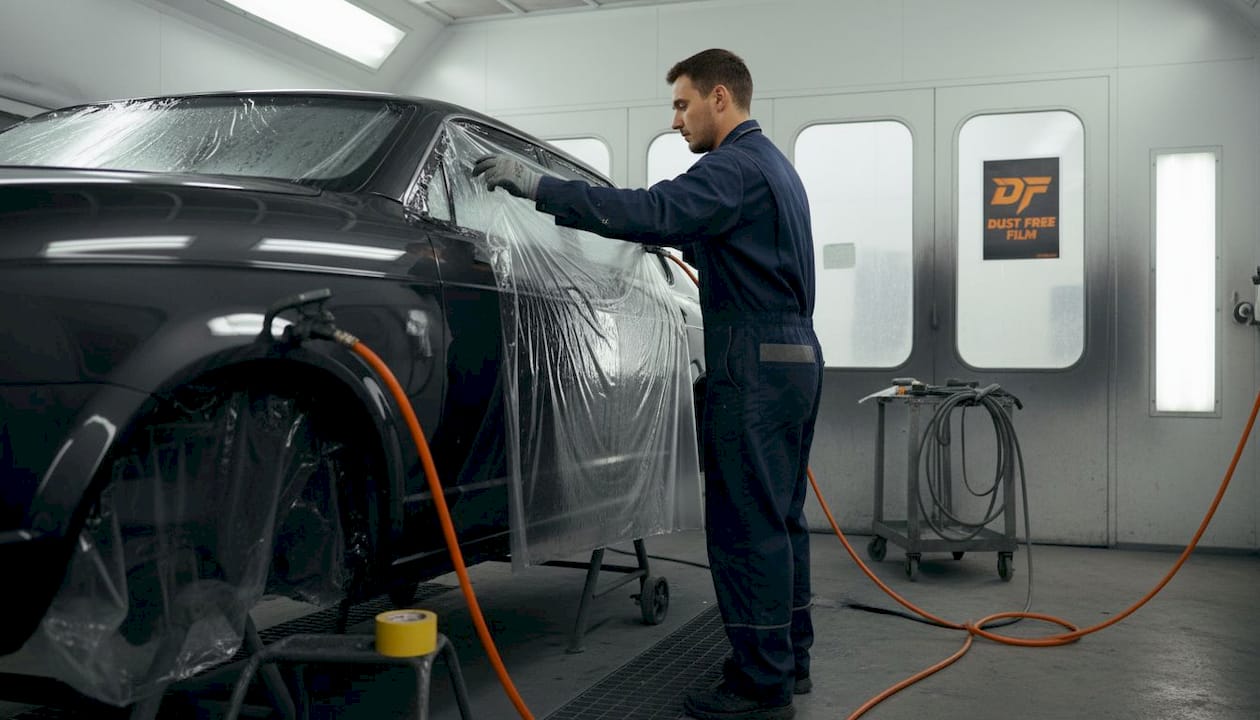
Electrostatic film is a specially engineered multi-layer material. The key distinction from ordinary protective sheeting is in its material properties. Standard plastic film can accumulate and hold a static charge, making it part of the problem. Electrostatic film, by contrast, is formulated with anti-static or static-dissipative additives throughout the material matrix. These additives allow the film to absorb incoming charges and safely dissipate them, rather than holding onto them and attracting more contamination.
The process works in four sequential stages:
- Charge absorption. When the film is applied to booth walls or floors, its dissipative layer immediately begins pulling ambient surface charges away from the substrate beneath it.
- Charge neutralization. The absorbed charge travels through the film’s conductive layer and equalizes, preventing buildup from reaching the levels that attract dust particles.
- Dust barrier formation. Without a charge differential to pull airborne particles toward surfaces, dust remains suspended in the booth’s controlled airflow and exits through filtration systems as designed.
- Finish integrity protection. With charge-driven dust attraction removed from the equation, atomized coatings land where they are directed, producing uniform thickness and true color match across the entire surface.
This is why enhancing booth performance with film goes beyond simple cleanliness. You’re actively modifying the electrical environment of the booth, not just wiping down surfaces between cycles.
| Film property | Effect on booth environment | Direct finish benefit |
|---|---|---|
| Charge dissipation | Reduces surface charge differential | Less dust migration toward panels |
| Anti-static additive | Prevents re-accumulation of charge | Consistent spray pattern delivery |
| Multi-layer construction | Mechanical debris barrier | No grit transfer from floor or walls |
| Heat resistance | Stable in high-temp cure cycles | No film degradation during baking |
| Quick-peel layers | Fast changeover between cycles | Reduced downtime between jobs |
The synergy with existing booth infrastructure matters too. Humidity control and air exchange systems are more effective when film is present because they don’t have to overcome high surface charges on their own. The static-free film benefits extend to your entire environmental control strategy, making every other investment in your booth work harder.
Pro Tip: Run your ionizing gun across a section of charged wall before and after applying electrostatic film. The measurable charge reduction confirms the film is working and gives you a defensible data point for management when justifying the investment.
Electrostatic film vs. alternative protection methods
Now that you know how electrostatic film works, it’s important to see how it stacks up against other options.
Facility managers typically have three primary tools for dust and static control: humidity regulation systems, upgraded air handling (including filtration and air exchange rate increases), and physical protective films. Each has genuine strengths. The question is which ones deliver reliable results across the widest range of operating conditions.
| Method | Upfront cost | Operating cost | Effectiveness in high-airflow booths | Response to irregular charge buildup | Ease of implementation |
|---|---|---|---|---|---|
| Humidity control | High | Medium | Partial | Low | Moderate |
| Air handling upgrades | Very high | High | Moderate | Low | Complex |
| Electrostatic film | Low | Low | High | High | Simple |
| Combined approach | High | Medium | Very high | Very high | Complex |
The table makes the cost advantage obvious, but the more important distinction is effectiveness in real-world edge cases. High-airflow booths exacerbate static, and humidity control alone is insufficient to compensate. When your booth runs at high air exchange rates to meet cure time targets or comply with VOC (volatile organic compound) regulations, the increased airflow generates more friction-based charge buildup. Humidity systems cannot fully counteract this because they operate on ambient air conductivity rather than surface-level charge control.
This is where facilities that skip film protection run into trouble. The most common pitfalls include:
- Over-relying on humidity targets that are never consistently maintained during summer months when outside air is already being conditioned
- Assuming upgraded HEPA (high-efficiency particulate air) filtration eliminates the need for surface charge control, when in fact filtration only catches particles already suspended in air, not those held to surfaces by static
- Using standard plastic sheeting as a cost-saving alternative, which actually increases charge buildup by adding more insulating surfaces to the booth
- Neglecting floor protection while investing in wall systems, creating a recontamination pathway as technicians walk through and disturb floor-level dust
The protective films advantages become clearest when you calculate rework cost. A single rework job due to dust inclusion costs far more in materials, labor, and customer delays than a season’s worth of film supply. When you examine superior paint finish tips, film consistently appears as the most direct variable between booths that produce rejects and those that don’t.
Pro Tip: If your booth already uses humidity control, don’t view film as redundant. The two systems address different failure modes. Humidity reduces ambient charge generation; film eliminates surface charge accumulation. Together they close nearly every route to contamination.
Implementing electrostatic film for maximum ROI
Armed with the comparisons, you’re ready to take practical steps toward integrating films for best results.
A common mistake facility managers make is purchasing film reactively, after a run of rejected finishes, rather than building it into their standard operating procedure. Reactive purchases often result in mismatched film specifications, rushed installation, and incomplete coverage. A structured implementation approach yields consistently better results and lower long-term cost.
Follow these four steps to get it right the first time:
- Site assessment. Walk your booth with a static meter before ordering film. Identify the highest-charge surfaces, typically upper walls, door frames, and the floor directly beneath spray zones. These are your critical coverage areas and should be prioritized in your initial installation.
- Film selection. Match film specifications to your operating conditions. Consider booth temperature during cure cycles, the frequency of film changeover, and whether you need single-layer or multi-layer options. Multi-layer films allow you to peel one used layer and expose a fresh surface without full reapplication, which dramatically reduces changeover time. Review top spray booth films to compare specifications against your facility’s requirements.
- Installation. Apply film using a dedicated dispenser system to eliminate air pockets and bubbles. Bubbles create localized charge concentrations that undermine the film’s dissipative function. Start from the top of each wall and work downward, overlapping edges by at least two inches to prevent gap-based contamination channels.
- Monitoring and cycle management. Establish a defined replacement schedule based on paint cycle volume, not calendar time. High-volume facilities may need to peel a film layer every two to three cycles. Lower-volume operations may get a full week of effective protection from a single layer. Track reject rates before and after installation to quantify actual ROI.
Your ongoing checklist for maintaining peak film performance:
- Inspect film edges and seams at the start of each shift for peeling or gaps
- Confirm floor film extends beyond the spray zone perimeter by at least 12 inches in all directions
- Document static meter readings at the same locations weekly to detect performance degradation trends
- Replace film proactively at first signs of visible contamination buildup rather than waiting for it to affect finishes
- Train all booth technicians on correct film peeling technique to avoid tearing and leaving residue
Long-term ROI comes from the compounding effect of reduced rework. When you review application examples across different facility types, a consistent pattern emerges. Facilities that implement film as a standard protocol see reject rates drop significantly within the first month, and those gains persist as long as the protocol is maintained.
The static-driven factors that attract dust, distort spray patterns, and cause inconsistent finishes are predictable and preventable. The implementation framework above removes guesswork from that process and gives your team a repeatable system for quality control.
Pro Tip: Calculate your rework cost per incident before installing film, then track it for 90 days post-installation. Most facilities find that film pays for itself within the first quarter based on rework reduction alone, which makes the business case almost effortless to present to ownership.
The overlooked game-changer for flawless painting operations
Here’s an uncomfortable truth most industry conversations avoid. Many facilities spend tens of thousands of dollars upgrading HVAC systems and humidity controls while treating electrostatic film as an optional add-on. That hierarchy is backwards, and it’s costing facilities real money every quarter.
The reason film gets undervalued is largely perceptual. HVAC upgrades look impressive on paper and in proposals. They involve contractors, equipment specs, and capital expenditure that signals commitment to quality. Film, by contrast, is a roll of material that gets applied by your own team between jobs. It doesn’t generate a compelling equipment purchase story, even though its effect on finish quality is often more direct and more measurable.
We’ve observed this pattern repeatedly: a facility will invest in upgraded filtration, see marginal improvement in reject rates, then invest again in humidity control, see modest gains, and still struggle with the 2% to 5% reject rate that erodes profitability. The missing variable is almost always surface-level charge control. When film is finally added, that residual reject rate drops faster than any prior investment achieved.
The strategic framing matters here. Electrostatic film is not a consumable expense in the same category as masking tape. It’s a quality control instrument. Real-world performance data consistently shows that facilities treating film as a systematic protocol rather than an occasional supply purchase achieve the most durable reductions in defects and rework.
Management buy-in shifts when you reframe the conversation. Don’t present film as a cost. Present it as the most cost-effective quality control measure your facility can deploy per square foot of booth space. That reframing turns a purchasing decision into an operational strategy, and it’s the difference between adopting film once and building it into your standard operating procedure permanently.
Discover premium electrostatic film solutions for your spray booth
If the patterns above look familiar in your own facility, you don’t have to keep tolerating avoidable defects and rework cycles. Dust Free Film has been supplying precision-engineered electrostatic protective films to automotive and industrial painting facilities since 2012, with products manufactured to European quality standards and tested in high-volume production environments.

Whether you manage a single-bay auto body shop or a multi-line industrial painting facility, Dust Free Film solutions include multi-layer wall and floor protectors with patented dispenser systems for fast, bubble-free installation. Every product is heat-resistant, static-free, and engineered for the cycle volumes your operation demands. If you’re ready to see specific configurations and pricing tailored to your booth dimensions and throughput, request a quote and our team will match you with the right solution for your exact requirements.
Frequently asked questions
How does electrostatic film reduce dust in paint booths?
Electrostatic film absorbs and neutralizes electric charges on booth surfaces, which prevents airborne dust from being pulled toward walls and floors by static attraction, keeping contamination out of fresh coatings. This charge control mechanism is what separates purpose-built electrostatic film from standard plastic sheeting.
Can humidity control alone prevent static issues in spray booths?
Humidity control helps improve air conductivity but is consistently insufficient in high-airflow environments, where increased air movement generates friction-based charges faster than ambient humidity can dissipate them. High-airflow booths exacerbate static in ways that make film the necessary complement to any humidity strategy.
How long does electrostatic film last in an industrial booth setting?
Most multi-layer films provide effective static suppression across several complete paint cycles per layer, and the peelable construction allows each used layer to be removed without disturbing the fresh layer beneath it, extending total product life significantly.
Is electrostatic film installation disruptive to ongoing operations?
No. Film systems with patented dispenser tools are designed for installation between production runs, with most full-booth applications completed in under an hour, making scheduled downtime the only operational interruption.