

Contamination is quietly draining your shop’s profits. A single re-do costs you materials, labor time, and a bay that could be generating revenue. Contamination-driven rework eats into margins faster than most shop owners realize, and the root cause is almost always a cleanliness gap in the booth. Whether you run a high-volume auto body operation or an industrial coating facility, the five best practices in this guide will help you eliminate defects, stay compliant, and get more jobs out the door every week.
Table of Contents
- Why paint booth cleanliness matters
- Key criteria for effective paint booth cleanliness
- Best practice #1: Routine housekeeping and surface care
- Best practice #2: Controlled airflow and humidity management
- Best practice #3: Personnel preparation and contamination control
- Best practice #4: Tool and material management for contamination prevention
- Best practice #5: Monitoring, documentation, and continuous improvement
- Comparison: Key best practices at a glance
- Boost your booth: Solutions for lasting cleanliness
- Frequently asked questions
Key Takeaways
| Point | Details |
|---|---|
| Clean daily and thoroughly | Routine surface and air filter cleaning prevents costly contamination and keeps booths compliant. |
| Monitor airflow and humidity | Maintaining 100-150 fpm airflow and 40-60% humidity is essential for flawless finishes. |
| Prep personnel properly | Clean suits and avoiding personal products prevent unexpected defects from human contaminants. |
| Limit booth tools | Only essential items in the booth minimize overspray and dust settling. |
| Document and review | Ongoing monitoring and training ensure best practices are maintained storewide. |
Why paint booth cleanliness matters
A dirty booth does not just produce bad-looking paint. It creates a chain reaction of problems that hits your schedule, your budget, and your reputation at the same time. Clean booths improve finishes by eliminating the particles that cause fisheyes, dirt nibs, and orange peel before they ever touch the surface.
Here is what is actually at stake when cleanliness slips:
- Finish quality: Dust and overspray residue embed in wet paint, forcing sanding, re-coating, or full re-dos.
- Safety and compliance: NFPA 33 and OSHA require routine housekeeping and cleanable surfaces to reduce fire risk from flammable vapors and residue buildup.
- Operational efficiency: Every re-do ties up your booth for hours, pushing back the next job and compressing your daily output.
- Customer satisfaction: A flawless finish on the first attempt is what keeps customers coming back and referring others.
“A contaminated booth is not a quality problem. It is a business problem. Every defect you catch after spraying represents money you have already spent and time you cannot recover.”
The financial impact is direct. Wasted paint, extra labor hours, and delayed vehicle returns all compound quickly across a busy week. Treating cleanliness as a core operational standard rather than a housekeeping afterthought is what separates high-performing shops from average ones.
Key criteria for effective paint booth cleanliness
Before you can fix a cleanliness problem, you need to know what a well-maintained booth actually looks like. There are three non-negotiable criteria that every shop should measure against.
- Surface condition: Walls, floors, and ceilings must be smooth and free of cracks. Cracked or rough surfaces trap paint residue and are nearly impossible to clean thoroughly, creating ongoing contamination sources and fire hazards.
- Airflow velocity: The booth must maintain consistent airflow. Refer to your spray booth maintenance guide to confirm your system is calibrated to push air at the right velocity to carry overspray away from the work surface.
- Humidity control: Relative humidity between 40 and 60 percent prevents defects like dry spray, blushing, and solvent pop. Too dry and the paint dries before it flows out. Too humid and adhesion suffers.
Pro Tip: Install a digital hygrometer inside your booth and check it every morning before the first job. A five-minute check can prevent a two-hour re-do.
These three criteria work together. You can have perfect airflow but still get defects if your walls are shedding dried overspray. Address all three as a system, not in isolation.
Best practice #1: Routine housekeeping and surface care
Reactive cleaning, wiping things down after you notice a problem, is the most expensive approach you can take. NFPA 33 and OSHA cleaning requirements exist precisely because accumulated residue is both a contamination source and a fire risk. Proactive, scheduled cleaning is the standard.
Here is a practical cleaning schedule that works for most shops:
- Daily: Sweep or vacuum floors to remove settled dust and overspray. Wipe down walls with a tack cloth or approved solvent wipe. Check and replace intake and exhaust filters if airflow feels reduced.
- Weekly: Deep clean all booth surfaces including light fixtures, door frames, and ceiling panels. Inspect spray equipment for overspray buildup that could flake off during the next job.
- Monthly: Walk the entire booth looking for cracks, peeling coatings, or damaged seals. Repair any surface defects immediately to prevent residue accumulation.
| Task | Frequency | Why it matters |
|---|---|---|
| Floor sweep/vacuum | Daily | Prevents dust from becoming airborne during spraying |
| Wall and surface wipe | Daily | Removes fresh overspray before it hardens |
| Filter inspection | Daily | Maintains airflow and prevents contamination |
| Full deep clean | Weekly | Eliminates buildup that daily cleaning misses |
| Surface integrity check | Monthly | Catches cracks and damage early |
For a detailed breakdown of each step, the spray booth cleaning practices guide covers materials, techniques, and common mistakes. You can also follow the spray booth maintenance guide 2026 for a step-by-step workflow.
Pro Tip: Use a dedicated vacuum with a HEPA filter for booth floors. Standard shop vacuums can recirculate fine particles back into the air, defeating the purpose of cleaning.
Best practice #2: Controlled airflow and humidity management
Airflow and humidity are the invisible variables that determine whether your booth performs or fails. You can clean every surface perfectly and still get contamination if your environmental controls are off.
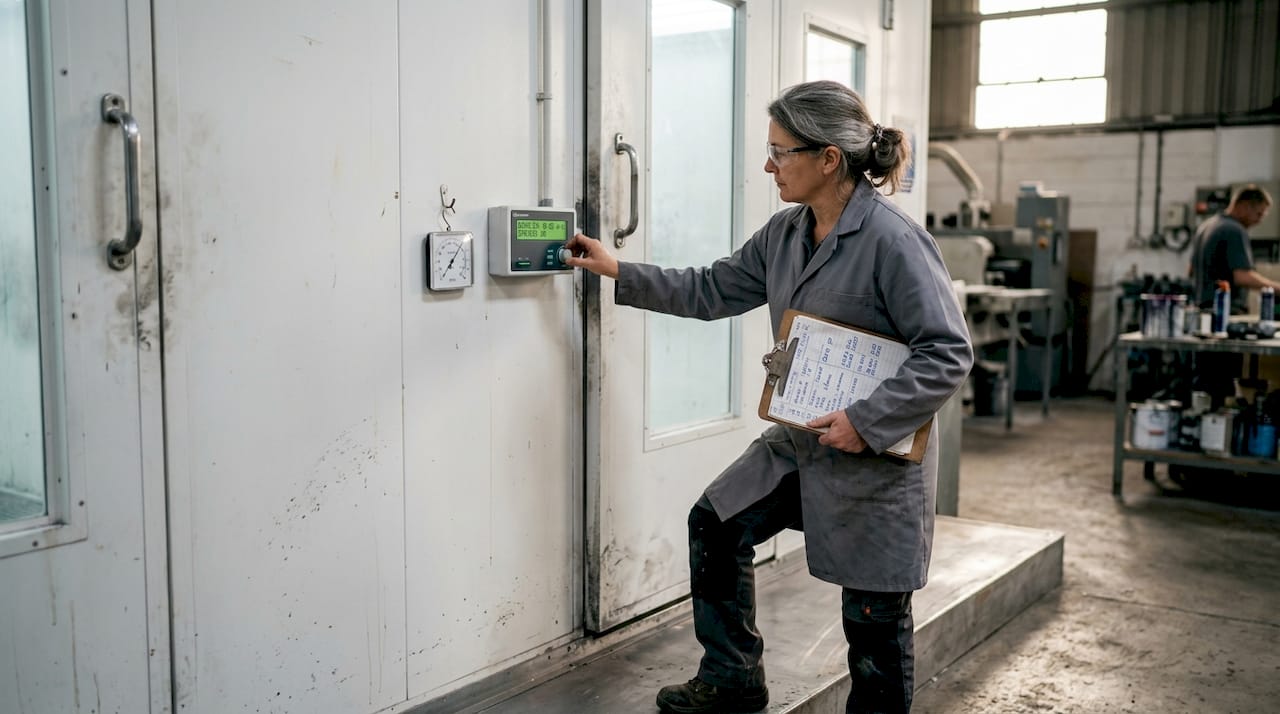
Target these numbers consistently:
| Parameter | Target range | Effect if out of range |
|---|---|---|
| Airflow velocity | 100 to 150 fpm | Below 100 fpm allows dust to settle; above 150 fpm causes dry spray |
| Relative humidity | 40 to 60 percent | Below 40% causes dry spray; above 60% causes blushing and adhesion failure |
| Air temperature | 65 to 75°F during spraying | Affects paint viscosity and dry times |
Maintaining 40 to 60 percent RH and airflow at 100 to 150 feet per minute is the industry standard for defect prevention. Automate your HVAC controls if possible so the booth reaches target conditions before the painter ever steps in.
Key actions for environmental control:
- Check filters every morning and replace them on a set schedule, not just when airflow drops noticeably.
- Use a manometer to measure pressure differential across filters. A rising differential means the filter is loading up and airflow is being restricted.
- Log temperature and humidity readings for each job. Patterns in your data will reveal seasonal issues before they cause defects.
For a complete setup walkthrough, the booth setup for dust-free finishes guide walks through HVAC positioning and filter selection. The spray booth maintenance checklist gives you a printable daily reference.
Best practice #3: Personnel preparation and contamination control
Here is the fact that surprises most shop managers: personnel account for 50 percent of all booth, vehicle, and painter contamination. The booth can be spotless, but one painter walking in with the wrong clothing or a trace of hand lotion can ruin a job.
Standard operating procedures for personnel prep:
- Dedicated clean suits: Every painter must wear a lint-free, dedicated booth suit. No street clothes, no fleece, no cotton that sheds fibers.
- Blow-off before entry: Use a blow-off gun at the booth entrance to remove any loose particles from the suit, gloves, and hood before stepping inside.
- No personal care products: Hair spray, hand lotion, and skin moisturizers all contain silicone or oil compounds that cause fisheyes. Painters should avoid these products on work days or wash thoroughly before suiting up.
- Limit booth access: Only the painter actively spraying should be in the booth. Every additional person is an additional contamination source.
Pro Tip: Post a laminated checklist at the booth entrance. A quick five-point self-check before entry takes 30 seconds and prevents the kind of contamination that costs two hours to fix.
Key behaviors to enforce:
- No eating, drinking, or touching the face inside or near the booth.
- Gloves must be clean and lint-free, not the same gloves used for sanding or prep work.
- Hair must be fully covered, including facial hair.
For a full breakdown of entry procedures, the operator prep steps guide covers everything from suit selection to tack-off technique. The contamination prevention steps article addresses the most common personal contamination mistakes.
Best practice #4: Tool and material management for contamination prevention
Clutter in the booth is contamination waiting to happen. Every extra item you bring in is a surface that collects overspray, sheds particles, or gets bumped and disturbs settled dust. The rule is simple: if it does not need to be there during spraying, it should not be there.
What belongs in the booth during a spray job:
- The vehicle being painted
- A single tack rag for final surface prep
- The spray gun in use
Nothing else. No extra rags, no paint cans sitting on the floor, no tools left over from prep work.
“Keep the booth empty except for the vehicle, tack rag, and spray gun. Use HVLP guns to reduce overspray volume and minimize the amount of airborne material that can settle back onto the surface.”
HVLP (high volume, low pressure) spray guns transfer more paint to the surface and generate less overspray than conventional guns. Less overspray means less airborne material, less residue on booth surfaces, and fewer particles that can settle into wet paint.
Organize your storage area just outside the booth so everything has a designated spot. When painters know exactly where tools go before and after a job, the booth stays cleaner by default. The step-by-step booth setup guide shows how to structure your workflow to minimize what enters the booth.
Best practice #5: Monitoring, documentation, and continuous improvement
The shops that consistently produce clean finishes are not just following best practices. They are tracking whether those practices are actually working. Documentation turns good intentions into measurable results.
Reactive cleaning fails because it addresses symptoms rather than causes. Proactive, documented SOPs (standard operating procedures) give you the data to find root causes and fix them permanently.
Here is how to build a monitoring system that works:
- Keep a cleaning log: Record the date, who cleaned, what was done, and any issues found. A simple paper log or shared digital document works fine.
- Track contamination incidents: Every time a job requires a re-do due to contamination, log the defect type, likely cause, and corrective action taken.
- Review monthly: Look for patterns. If fisheyes keep appearing on Monday mornings, that is a personnel prep issue. If dirt nibs spike in spring, check your intake filters for pollen loading.
- Train and retrain: Use your data to run targeted training sessions. Show your team the actual numbers so they understand why the procedures exist.
- Update your SOPs: As you learn what works in your specific booth and climate, update your written procedures to reflect it.
The maintenance workflow resource gives you a structured framework for building this kind of system into your daily operations.
Comparison: Key best practices at a glance
Use this table to prioritize implementation based on effort and impact.
| Best practice | Frequency | Effort level | Impact on finish quality |
|---|---|---|---|
| Routine housekeeping and surface care | Daily, weekly, monthly | Low to medium | Very high |
| Airflow and humidity management | Daily monitoring | Low (automated) | Very high |
| Personnel preparation and contamination control | Every job | Low | High |
| Tool and material management | Every job | Low | High |
| Monitoring, documentation, and improvement | Ongoing | Medium | High (long-term) |
The first two practices, cleaning and environmental control, deliver the highest immediate impact. Personnel and tool management are low-effort habits that prevent the most common defect causes. Documentation compounds all four over time.
Boost your booth: Solutions for lasting cleanliness
Knowing the best practices is the first step. Putting them to work consistently is where most shops struggle, especially when the team is busy and booth time is tight.
At Dust Free Film, we have been helping auto body shops and industrial painting facilities maintain cleaner booths since 2012. Our multi-layer electrostatic booth wall and floor protection films make surface care faster and more effective by giving you a fresh, clean surface in minutes rather than hours of scrubbing. Paired with the comprehensive maintenance guide on our site, you get both the tools and the knowledge to run a consistently clean operation. Explore our solutions and see how the right protection film changes what is possible in your booth.
Frequently asked questions
How often should a paint booth be cleaned to ensure quality?
Clean floors and wipe surfaces daily, perform a full deep clean weekly, and inspect for cracks or buildup monthly. Routine housekeeping is required for both compliance and consistent finish quality.
What is the ideal airflow for paint booth cleanliness?
Target 100 to 150 feet per minute of airflow to carry overspray away from the work surface and prevent dust from settling into wet paint.
Can personal hygiene products affect paint quality?
Yes. Lotions, hair spray, and skin moisturizers contain silicone and oil compounds that cause fisheyes in the finish, often more than booth dust does.
Which tools should be allowed in the paint booth?
Only the vehicle, tack rag, and spray gun should be present during spraying. Every additional item increases contamination risk.