

TL;DR:
- Paint booth warranties cover manufacturing defects, including structural parts, motors, and control panels, for 12 to 24 months. Proper maintenance logs and adherence to installation instructions are crucial to prevent claim denials. Extended warranties and support programs require separate agreements and do not affect the original warranty duration.
Paint booth warranty scope is defined as the specific range of defects, components, and conditions a manufacturer agrees to repair or replace at no cost during a set coverage period. Standard paint booth warranties span 12–24 months and cover defects in materials and workmanship under normal use. Knowing exactly what falls inside and outside that scope protects your facility from unexpected repair bills and keeps your operation running without costly surprises. This guide breaks down every layer of paint booth warranty terms so you can make informed decisions from day one.
What is paint booth warranty scope and what does it cover?
Paint booth warranty coverage centers on manufacturing defects, not operational failures. A manufacturer’s limited warranty confirms that the booth was built correctly and that its components meet specified quality standards at the time of delivery.
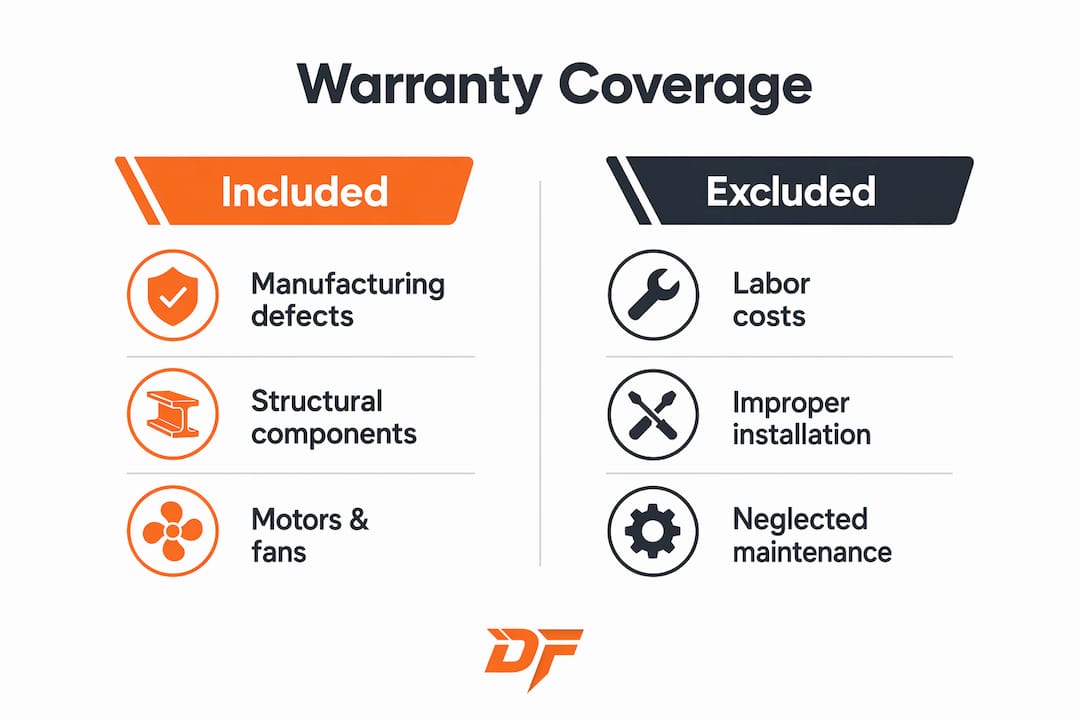
Covered items typically include:
- Structural components such as booth panels, frames, and doors, which often carry the longest coverage window
- Mechanical parts including motors, fans, and blower assemblies, though these may carry shorter terms since structural coverage outlasts mechanical parts in most policies
- Electrical control panels and wiring harnesses installed at the factory
- Replacement parts provided free of charge when a defect is confirmed during the active warranty period
Labor costs for repairs are rarely included. Most manufacturers cover the defective part itself but leave installation labor to the owner. That distinction matters when you are budgeting for a warranty repair, because a motor replacement can carry a significant labor charge even when the part arrives at no cost.
Pro Tip: Read the warranty certificate before signing a purchase agreement. Ask the distributor to identify which components carry the shortest coverage window so you can plan service contracts around those parts from the start.

What exclusions and conditions define paint booth warranty limits?
Exclusions are where most warranty disputes originate. Paint booth warranties explicitly exclude cosmetic damage, failures from improper installation, neglect of routine maintenance, and unauthorized modifications. Each of those categories represents a situation where the manufacturer had no control over the outcome.
The most common exclusions facility managers encounter are:
- Cosmetic damage such as surface scratches, dents from shop traffic, or paint overspray on exterior panels
- Improper installation including deviations from the manufacturer’s written installation instructions, which voids coverage immediately
- Neglected maintenance such as skipped filter changes, blocked airflow paths, or uncleaned exhaust systems
- Unauthorized modifications including adding non-approved lighting, altering ductwork, or installing third-party control systems without manufacturer approval
- Normal wear and tear on consumable items like filters, belts, and seals, which are expected to degrade through regular use
Maintaining detailed service logs is not optional if you plan to file a claim. Missing maintenance records frequently invalidate warranty claims because the manufacturer cannot confirm the booth received proper care. Log every filter change, airflow check, and inspection with dates and technician names.
Pro Tip: Use a dedicated maintenance logbook kept inside the booth control cabinet. When a warranty claim arises, you can hand the inspector a complete paper trail on the spot rather than scrambling to reconstruct records.
A spray booth maintenance checklist built around the manufacturer’s schedule gives you a ready-made documentation framework that satisfies most warranty compliance requirements.
How do extended warranties and manufacturer support programs work?
Standard warranty terms end, but the equipment keeps running. Extended warranties and lifetime technical support are sometimes offered separately, either negotiated at purchase or added later as service contracts.
Key distinctions between extended coverage options:
- Extended parts and labor warranties cover confirmed defects beyond the standard term, often for an additional one to three years, and typically require a separate purchase agreement
- Lifetime technical support programs provide advisory assistance by phone or email but do not cover the cost of parts or repairs. They are a resource, not a repair guarantee.
- Service contracts from third-party providers fill gaps when manufacturer programs are unavailable, though coverage terms vary widely and require careful review
The cost-benefit calculation for extended warranties depends on the booth’s expected workload. A facility running two shifts daily puts far more stress on mechanical components than a single-shift shop. Higher utilization justifies the added cost of extended mechanical coverage. Lighter-use facilities may find that a strong preventive maintenance program delivers better value than an extended contract.
Financing arrangements do not extend or modify warranty terms. A booth purchased on a 60-month lease carries the same 12-to-24-month warranty as one bought outright. Financial liability for repairs after warranty expiration stays with the owner regardless of how the equipment was funded.
How warranty knowledge shapes maintenance and repair decisions
A warranty is a conditional safety net, not an uptime guarantee. Warranties activate only on confirmed manufacturing failures, not on operational downtime caused by wear, misuse, or deferred maintenance. Treating a warranty as insurance leads to deferred upkeep and, eventually, a denied claim.
The decision to repair or replace aging equipment connects directly to warranty status. The table below outlines the key factors:
| Factor | Repair | Replace |
|---|---|---|
| Warranty status | Active warranty covers defective parts | Expired warranty; new unit resets coverage |
| Repair history | First or second incident on a specific component | Recurring failures on multiple systems |
| Parts availability | Manufacturer still stocks replacement parts | Parts discontinued or lead times exceed 8 weeks |
| Compliance requirements | Current booth meets OSHA and EPA standards | Booth fails updated airflow or emissions standards |
| Energy efficiency | Repair restores original performance | New equipment reduces energy costs significantly |
New equipment resets warranty coverage and may improve energy efficiency and regulatory compliance, reducing long-term operating costs. That reset has real financial value when an older booth is accumulating repair events across multiple systems simultaneously.
Proper maintenance also protects the warranty on ancillary equipment inside the booth. Dustfreefilm’s multi-layer electrostatic booth films, for example, protect wall and floor surfaces from contamination buildup that can accelerate structural wear. Keeping surfaces clean reduces the risk of damage that falls outside warranty coverage. The benefits of regular spray booth maintenance extend well beyond warranty compliance, but warranty preservation is a direct and measurable outcome.
What are the practical steps to file a warranty claim successfully?
Filing a warranty claim correctly from the first moment determines whether it succeeds or fails. Follow these steps in order:
- Document the defect immediately. Take clear photos of the failure from multiple angles. Note the date, the component involved, and any symptoms that preceded the failure.
- Check the Bill of Lading for shipping damage. If the defect originated during transport, note damage on the Bill of Lading at delivery. Failure to do so at the time of acceptance typically results in claim rejection, because the carrier’s liability ends once you sign.
- Gather your maintenance records. Pull your service log and compile documentation of every maintenance event since installation. This is the evidence that the booth received proper care.
- Contact the manufacturer or distributor promptly. Reach the customer service team by phone or email and provide your purchase date, serial number, defect description, and photo documentation.
- Follow the manufacturer’s return or repair authorization process. Most manufacturers issue a Return Merchandise Authorization number before any parts ship. Do not send components back without that authorization, or the claim may be voided.
Response timelines vary by manufacturer. Most acknowledge claims within 5–10 business days and provide a repair or replacement decision shortly after. Keep a written record of every communication, including the names of representatives you speak with and the dates of each contact.
Key Takeaways
Paint booth warranty scope covers manufacturing defects only, and owners who maintain proper service records and follow installation guidelines are the ones who successfully collect on that coverage.
| Point | Details |
|---|---|
| Standard warranty duration | Most paint booth warranties cover 12–24 months for materials and workmanship defects. |
| What is covered | Structural components, motors, fans, and control panels qualify; labor costs typically do not. |
| Common exclusions | Improper installation, neglected maintenance, and unauthorized modifications void coverage. |
| Maintenance records matter | Missing service logs are the leading reason warranty claims are denied. |
| Extended options exist | Extended warranties and technical support programs are available but require separate agreements. |
What I’ve learned after years of watching warranty claims go wrong
The most expensive mistake facility managers make is assuming the warranty covers anything that breaks. It does not. The warranty covers what the manufacturer did wrong, not what time and use eventually wear out. That distinction sounds simple, but it catches operators off guard constantly.
I have seen shops lose valid claims because they could not produce a single filter change record. The defect was real, the failure was genuine, and the manufacturer still denied the claim. A logbook costs nothing. A denied claim on a major component can run into thousands of dollars.
The second mistake is conflating financing terms with warranty terms. A five-year payment plan does not mean five years of warranty protection. Warranty expiration and loan maturity are completely separate events. Owners who understand this plan for out-of-pocket repair costs from year two onward, which is exactly the right approach.
My strongest advice: negotiate extended coverage at the point of purchase, when you have the most leverage. Once the booth is installed and running, the manufacturer has little incentive to offer favorable terms. Treat the warranty conversation the same way you treat the price negotiation. It is part of the deal, not an afterthought.
Pair that negotiation with a disciplined maintenance program from day one. The step-by-step spray booth maintenance guide for 2026 gives you a current, practical framework that aligns with manufacturer requirements and keeps your documentation airtight.
— Dust
Dustfreefilm’s tools for protecting your paint booth investment
Keeping your paint booth in warranty-compliant condition requires more than paperwork. Contamination buildup on booth walls and floors accelerates wear on surfaces that fall outside standard warranty coverage, and preventing that damage starts with the right protective products.
Dustfreefilm manufactures multi-layer electrostatic booth films designed specifically for automotive refinishing and industrial spray environments. The films are heat-resistant, static-free, and built for high-traffic use, making them a practical tool for protecting booth surfaces between maintenance cycles. Explore the full range of booth protection solutions at Dustfreefilm.com, where you will also find maintenance guides and expert resources to help you stay ahead of warranty requirements and keep your facility operating at full capacity.
FAQ
What does paint booth warranty scope typically include?
Paint booth warranty scope covers defects in materials and workmanship for structural components, motors, fans, and control panels during a standard 12–24 month period. Labor costs for repairs are usually excluded.
How long is a paint booth warranty?
Most manufacturers offer a limited warranty of 12–24 months covering manufacturing defects under normal use conditions. Extended warranties beyond that period require a separate purchase agreement.
What voids a paint booth warranty?
Improper installation, unauthorized modifications, neglected maintenance, and failure to maintain service logs are the most common reasons manufacturers deny warranty claims.
Does financing a paint booth extend the warranty?
No. Financing terms and warranty coverage are completely separate. Warranty expiration occurs on schedule regardless of how long the payment plan runs.
How do I file a paint booth warranty claim?
Document the defect with photos immediately, gather your maintenance records, and contact the manufacturer or distributor with your serial number and purchase date. Note any shipping damage on the Bill of Lading at delivery to preserve eligibility for transport-related claims.