

Prevent color contamination by combining thorough upstream surface prep, correct booth airflow and filtration, a separate mixing workflow, and disciplined process controls, with protective films as a productivity aid on top. Confirm booth performance with a thorough examination and test (TExT), track manometer readings and clearance times, and keep dated logs. Multi-layer protectors give facilities an added layer of particle capture between those checks.
TL;DR:
- Skipping routine surface cleaning, filter checks, or proper airflow balance significantly increases the risk of color contamination within spray booths.
- Proper booth design, including downdraft airflow and negative pressure, reduces contamination chances more effectively than relying solely on protective films.
- Maintaining filters by replacing ceiling filters twice a year and inspecting intake filters monthly helps prevent airborne pigment from escaping or recirculating.
- Conducting thorough examinations and tests every 14 months, along with daily pressure logging, ensures the booth’s contamination controls stay effective.
- Using multi-layer electrostatic films and dedicated staging tools can further reduce particle transfer, especially in high-volume or quick-turnaround environments.
Table of Contents
- Quick Checklist: Immediate Steps to Stop Color Contamination Today
- Airflow, Pressure Balance and Filters: How to Configure and Maintain Your Booth
- Surface Preparation and Handling to Keep Contaminants Out of the Booth
- Process Controls: Mixing, Staging, and Operator Technique to Avoid Cross-Color Contamination
- Materials, PPE and In-Booth Consumables That Reduce Contamination
- Inspection, Testing and Recordkeeping: How to Verify Your Controls Are Working
- How Dust Free Film’s Multi-Layer Protector Supports Contamination Control
- Practical Priorities for Facility Managers: Budget vs. Risk Trade-Offs
- Where to Get Multi-Layer Protector Films and Trial Guidance
- Sources
- FAQ
Quick Checklist: Immediate Steps to Stop Color Contamination Today
Most contamination incidents trace back to a handful of skipped steps, not some mysterious airborne mystery. Before the next job goes into the booth, run through this:
- Wipe down the vehicle or part with a tack cloth and remove loose grit, lint, or sanding dust before it enters the booth.
- Use dedicated tools and disposable rags per job. Cross-using rags between colors is one of the fastest ways to transfer pigment.
- Check the manometer or pressure indicator before spraying starts. A sudden pressure shift usually means a clogged filter.
- Run a quick visual on intake and exhaust filters for tears, saturation, or heavy loading.
- Never mix paint inside the active spray booth. Mixing releases fine pigment particles that settle on wet surfaces and equipment.
- Keep sealed containers for reduction and mixing, and ventilate the mixing station separately from booth airflow.
- Enforce basic housekeeping: no food, no dry sanding, and no personal items sitting on booth ledges collecting overspray.
These are five-minute checks. Skipping them costs hours in rework.
Airflow, Pressure Balance and Filters: How to Configure and Maintain Your Booth
Booth airflow design sets the ceiling on how much contamination control is even possible. Downdraft booths pull air from ceiling filters down through floor grating, which keeps overspray and dust moving away from the panel rather than recirculating past it. Semi-downdraft designs offer a similar principle at lower installation cost, while crossdraft booths, which pull air horizontally from one wall to the other, are the most contamination-prone configuration because overspray drifts across the work zone before exiting.
Pressure balance matters just as much as airflow direction. A booth running slightly negative keeps fumes and mist from leaking into adjacent work areas, but too much negative pressure pulls in unfiltered shop air from cracks and doorways, which then deposits dust straight onto wet paint. The standard field checks are a manometer reading and a simple tissue or smoke test at the door seams. HSE’s ventilation guidance recommends measuring clearance time with a smoke test and verifying pressure against booth specifications as part of routine practice.
Filters do the heavy lifting once airflow is set correctly. Intake filters keep incoming shop air clean; exhaust or overspray arrestor filters catch atomized coating before it hits the fan or recirculates. Properly selected and maintained filters remove 90% to more than 99% of atomized coating mist, and a clogged filter reverses that benefit fast by forcing air to find new paths, often carrying contamination with it.
A practical filter maintenance sequence:
- Log manometer or magnehelic readings daily and set your change threshold based on pressure drop, not the calendar alone.
- Replace ceiling filters roughly twice a year under normal use, and check intake filters monthly.
- Confirm the thorough examination and test happens at least every 14 months, with records kept for five years.
Filter and pressure quick reference:
| Check | Frequency | Tool used |
|---|---|---|
| Manometer/pressure reading | Before each shift | Manometer or magnehisic gauge |
| Filter visual inspection | Daily | Visual check |
| Clearance/smoke test | Per TExT cycle or after major service | Smoke pencil |
| Full TExT inspection | At least every 14 months | Competent-person examination |
Surface Preparation and Handling to Keep Contaminants Out of the Booth
No amount of filtration fixes a panel that was dirty going in. Surface preparation is the single biggest upstream factor in avoiding contamination, because pigment and dust that are already on the substrate get sealed under the next coat regardless of how clean your booth air is.
A reliable prep sequence looks like this:
- Wash the panel or part to remove road grime, oils, and loose debris before it ever reaches the finishing area with recommended techniques for bug splatter removal.
- Clay-bar or mechanically decontaminate bonded particles that washing alone won’t lift.
- Degrease with a silicone-free panel wipe. Silicone-based products cause fisheye defects that get mistaken for pigment contamination.
- Do the final wipe-down inside the booth with airflow already running, so loosened particles get carried into the exhaust instead of settling back onto the panel.
Incoming vehicles and parts are a contamination pathway most shops underestimate. A part rolled straight from a dusty staging area into the booth brings that dust with it, along with whatever pigment residue clings to jigs, hooks, and hand tools from the last job.
Pro Tip: Keep a dedicated set of clean rags, hooks, and jigs specifically for staging, separate from anything used in sanding or grinding areas. Cross-contaminated tools defeat even a spotless booth.
Process Controls: Mixing, Staging, and Operator Technique to Avoid Cross-Color Contamination
Where and how you mix paint matters as much as how clean the booth itself is. A sealed, separately ventilated mixing room keeps fine pigment dust from ever reaching the spray zone in the first place. Mixing inside or near an active booth, even briefly, puts airborne pigment exactly where it can land on wet work.
Operator technique closes the loop on process discipline:
- Set up a dedicated, ventilated mixing station physically separated from the spray booth, with its own exhaust.
- Spray toward the exhaust wall, working systematically from the intake side to the exhaust side so overspray travels with the airflow instead of drifting sideways.
- Assign color-coded mixing kits and sealed, single-color rag storage so no tool crosses between jobs without a documented clean.
- Train operators on gun distance (roughly six to ten inches depending on the system), perpendicular tip angle, and tuned fluid pressure. Correct gun setup meaningfully cuts stray overspray before it ever becomes a contamination problem.
Sequencing jobs by color family, lightest to darkest where practical, also limits how much residual pigment can carry forward between bookings.
Materials, PPE and In-Booth Consumables That Reduce Contamination
The right consumables catch what process discipline misses. Multi-layer electrostatic films use a charged surface to attract and hold airborne particles and overspray, and because they’re built in peel-away layers, operators expose a fresh clean surface between jobs without tearing down and reinstalling the whole system.
PPE discipline matters just as much as the materials on the walls:
- Wear disposable coveralls and overboots in the booth, and remove them before walking back through general shop areas.
- Use fresh tack cloths per job rather than reusing one across multiple colors.
- Choose tape-free overlapping film edges over adhesive masking where possible. Tape residue and torn edges are a common, overlooked contamination source.
- Bag and dispose of used filters and tack cloths promptly instead of letting them sit near active work.
Pro Tip: Static buildup on plastic parts and tools attracts dust like a magnet. Anti-static wipes on non-metal components before staging cut down particle pickup dramatically.
Inspection, Testing and Recordkeeping: How to Verify Your Controls Are Working
Controls you don’t measure tend to quietly fail. The regulatory baseline is a thorough examination and test by a competent person at least every 14 months, with records retained for five years, but daily and weekly checks are what actually catch problems before they become rework.
A workable routine includes:
- Daily manometer or magnehelic readings logged against a known baseline.
- Weekly filter condition checks, comparing pressure drop against replacement thresholds.
- Periodic smoke or clearance tests to confirm airflow direction and timing haven’t drifted.
- Escalation to a servicing technician when pressure readings or clearance times move outside your documented range.
A simple log needs only five fields to be useful:
| Field | Example entry |
|---|---|
| Date | March 3 |
| Operator | Initials |
| Filter pressure delta | + |
| Clearance time | 4 minutes |
| Corrective action | Filter replaced, retested |
Consistent logs turn contamination from a mystery into a trend you can see coming.
How Dust Free Film’s Multi-Layer Protector Supports Contamination Control
Certain multi-layer wall and floor protector films are built around catching contamination before it reaches wet paint, and making cleanup fast enough that operators actually keep up with it. Electrostatic charged multi-layer films attract and hold dust and overspray, and tape-free overlapping edges mean no torn masking residue working its way loose during a job. Visible layer numbering and integrated length markings let operators track how much surface life remains, and some materials hold up to operating temperatures commonly found in spray booths.
Wall protectors with slightly tacky surfaces suit vertical booth walls where particle capture matters most; heavy-duty floor protectors provide slip resistance in high-traffic staging zones. Because each system peels down to a fresh layer instead of requiring a full teardown, booth-cleaning downtime between jobs drops sharply. Some patented application boxes, incorporating rotating rolls and integrated cutting bars, can let one installer dispense a straight run solo, fitting neatly into a pre-job checklist step without disrupting airflow setup or safety walk-throughs.

Practical Priorities for Facility Managers: Budget vs. Risk Trade-Offs
If you’re deciding where to spend first, spend on surface prep and airflow before anything else. Neither protective films nor premium filters compensate for a panel that went into the booth dirty, or a booth balanced wrong. Filters come next because a clogged filter undermines every other control you’ve paid for.
Protective films earn their keep after those fundamentals are solid, particularly in high-mix shops running short-cycle jobs where cleaning time between colors eats into throughput. If your booth turns over multiple jobs a day, the cost of a film system tends to disappear fast against the labor hours saved on manual wipe-downs.

My advice: pilot films on one booth first. Track cleaning hours saved and any change in rework or defect rates over a month before rolling the approach out fleet-wide.
Where to Get Multi-Layer Protector Films and Trial Guidance
Everything in this playbook works better with a physical barrier catching what airflow and process discipline can’t. That’s exactly what Dust Free Film’s protective film systems are built for: less scraping and wiping between jobs, and a cleaner surface waiting under every peeled layer.
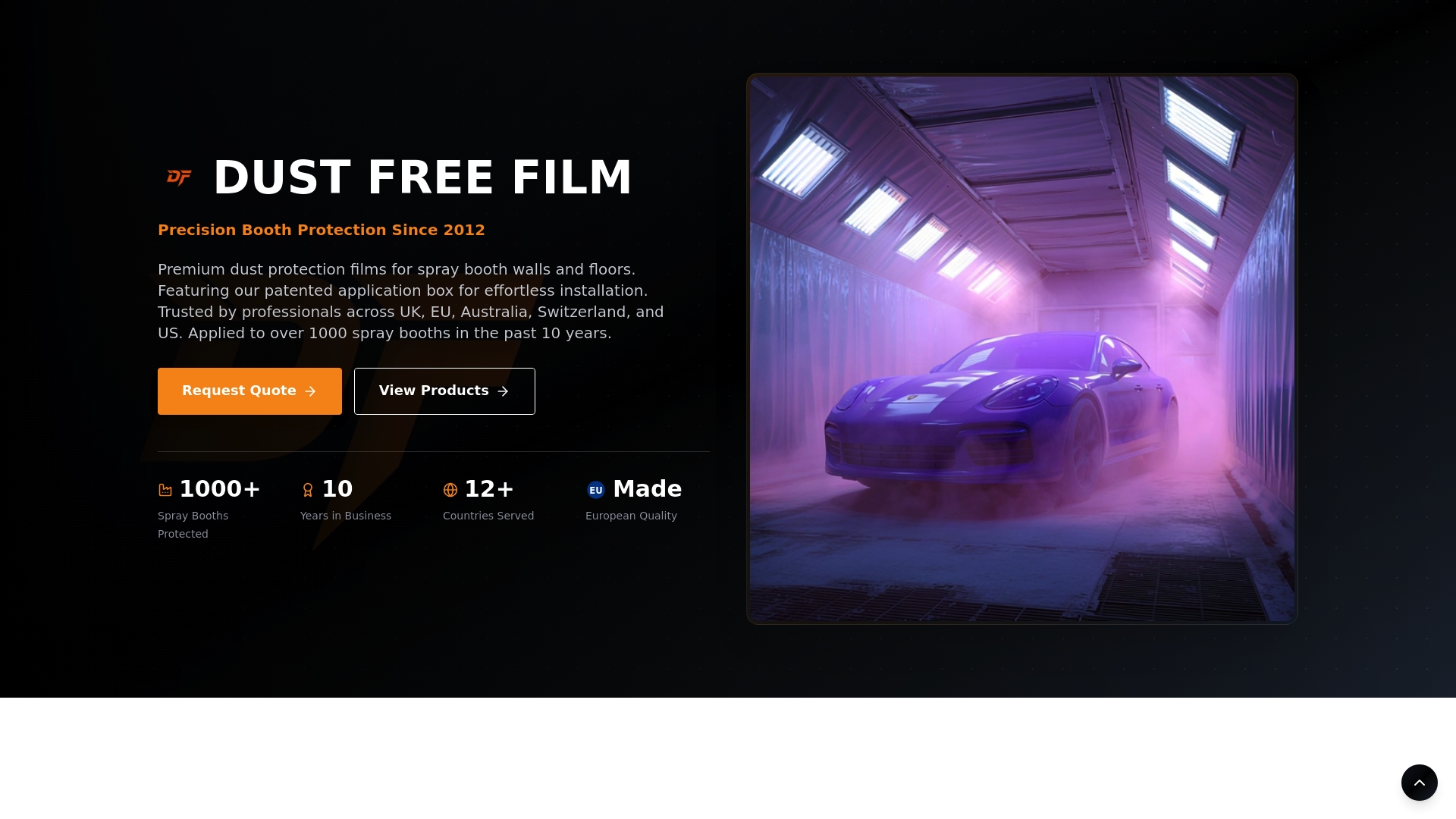
If your shop runs high job volume or juggles frequent color changes, request a sample or a quote to see how the Wall Protector and Floor Protector fit your booth layout. Support is available for bulk orders, custom configurations, and private-label runs for distributors and multi-site operators, with direct factory shipping available worldwide. Reach out for a pilot roll on one booth and measure the cleaning-time difference for yourself before committing fleet-wide.
Sources
- EPA — Spray booth filters and best practices for auto refinishing (fact sheet)
- HSE — Controlling airborne contaminants at work: local exhaust ventilation guidance (HSG276)
FAQ
What Causes Color Contamination in a Spray Booth?
Dust, overspray residue, dirty tools, and poor airflow balance are the main causes, along with mixing paint too close to an active spray zone.
How Often Should Spray Booth Filters Be Changed?
Ceiling filters are typically replaced about twice a year, while intake filters often need monthly attention, but the real signal is a rising pressure drop on your manometer rather than a fixed calendar date.
What Is a TExT Inspection?
A thorough examination and test (TExT) is a competent-person inspection of spray booth performance required at least every 14 months, with records kept for five years.
Can Protective Films Replace Filters or Booth Maintenance?
No. Protective films like Dust Free Film’s Wall Protector and Floor Protector work best as a complement to correct airflow and filter discipline, not a substitute for either.
What Booth Type Is Best for Preventing Color Contamination?
Downdraft booths generally outperform crossdraft designs for contamination control because airflow moves overspray straight down and out rather than drifting across the work zone.