

Up to 15% of paint defects in high-volume plants are caused by dust contamination, translating to daily costs between $50,000 and $150,000. For facility managers running spray booths, that number is not a warning buried in a quality report. It is a daily operational reality. Most managers know dust is a problem, but few realize how many defects they are attributing to the wrong source, or how much money is walking out the door in rework, material waste, and delayed throughput. This guide breaks down exactly how dust damages paint finishes, where it actually comes from, and what proven strategies will stop it.
Table of Contents
- How dust impacts paint finishes in spray booths
- Root causes: not all booth defects come from dust
- Why airflow and filtration matter most
- Electrostatic and advanced protective measures
- Daily practices: maintenance and cleaning for dust control
- Achieve dust-free results with proven spray booth solutions
- Frequently asked questions
Key Takeaways
| Point | Details |
|---|---|
| Dust causes costly defects | Even small amounts of dust can significantly increase paint rework and operational costs if left unmanaged. |
| Airflow and filtration are critical | Downdraft airflow and HEPA-grade multi-stage filters are most effective at keeping dust out of paint finishes. |
| Advanced films improve results | Electrostatic and static-free protective films reduce defects and paint waste in demanding spray environments. |
| Root cause analysis saves resources | Accurately diagnosing defects prevents wasted cleaning efforts and focuses resources on the real contamination issues. |
| Routine maintenance prevents failures | Consistent vacuum cleaning, scheduled filter changes, and regular inspection are essential for dust-free finishes. |
How dust impacts paint finishes in spray booths
Dust does not just land on a surface and look bad. It actively disrupts the chemistry and physics of a wet paint film. Dust particles cause defects such as dust nibs, dirt inclusions, craters, and fisheyes on wet paint finishes, each requiring a different correction strategy. Nibs are raised bumps from particles trapped under the clear coat. Craters form when a contaminant repels the paint film outward. Fisheyes appear as circular depressions caused by surface tension breaks. Every one of these defects means sanding, recoating, or scrapping the part.
Dirt accounts for the majority of paint defects in spray booth environments. The financial hit is direct: more rework cycles, higher material consumption, longer cycle times, and reduced throughput capacity. A single rework on a large industrial component can cost hundreds of dollars in labor and materials alone. Multiply that across a shift, and the numbers compound fast.
Reviewing your spray booth setup guide is a smart first step for any manager trying to get ahead of these losses. Understanding where dust enters and accumulates is foundational before any other fix makes sense.
Common dust sources inside spray booth areas:
- Contaminated incoming air through worn or undersized intake filters
- Operator clothing, hair, and skin shedding during the painting process
- Booth wall and floor surfaces that accumulate overspray and shed particles
- Unsealed gaps around doors, light fixtures, and utility penetrations
- Dirty equipment, hoses, and spray guns brought into the booth
| Defect type | Primary cause | Typical cost impact |
|---|---|---|
| Dust nibs | Airborne particles in wet film | Low to medium (sanding required) |
| Dirt inclusions | Process contamination, clothing | Medium (recoat often needed) |
| Craters | Silicone or oil contamination | High (full strip and redo) |
| Fisheyes | Surface tension disruption | High (substrate prep failure) |
“Consistent paint defect audits are the only reliable way to separate dust-related failures from process failures. Without them, corrective actions are guesswork.”
For a deeper look at how to structure your booth environment to minimize these risks, the guide on protecting spray booths covers practical layout and protection strategies.
Root causes: not all booth defects come from dust
Here is where many facilities waste significant time and money. They deep-clean the booth, replace filters, and retrain staff, only to see the same defects reappear. The reason is often simple: the defects were never caused by dust in the first place.
Many defects are misdiagnosed; sources of contamination also include oils, silicones, overspray, and oven dirt. Silicone from detailing products or hand creams creates fisheyes that look identical to dust-related craters under casual inspection. Oven dirt from baking cycles deposits on surfaces and gets attributed to airborne dust. Without forensic diagnosis, you are treating the wrong problem.
Common non-dust contamination sources:
- Silicone residue from wax, polish, or personal care products
- Oil mist from compressed air lines without proper moisture separators
- Overspray from adjacent painting operations or previous jobs
- Oven dirt and baked-on residue from curing cycles
- Chemical off-gassing from substrates or primers
Forensic methods like microscopy and surface swab analysis can identify the exact contaminant type. This matters because the fix for silicone contamination is completely different from the fix for airborne dust. Investing in a proper root cause mapping process, where defect patterns are logged by type, location, and shift, saves far more than it costs.
Pro Tip: Set up a weekly defect pattern review with your quality and production leads. Map defect types to specific jobs, operators, and time windows. Patterns will emerge within two to three weeks that point directly to the real source.
The resource on protecting spray booths includes practical guidance on separating contamination types during booth inspections.
Why airflow and filtration matter most
Once you know your actual contamination sources, booth technology becomes your most powerful lever. Airflow design is not just about moving air. It is about controlling where particles go relative to your painted surface.
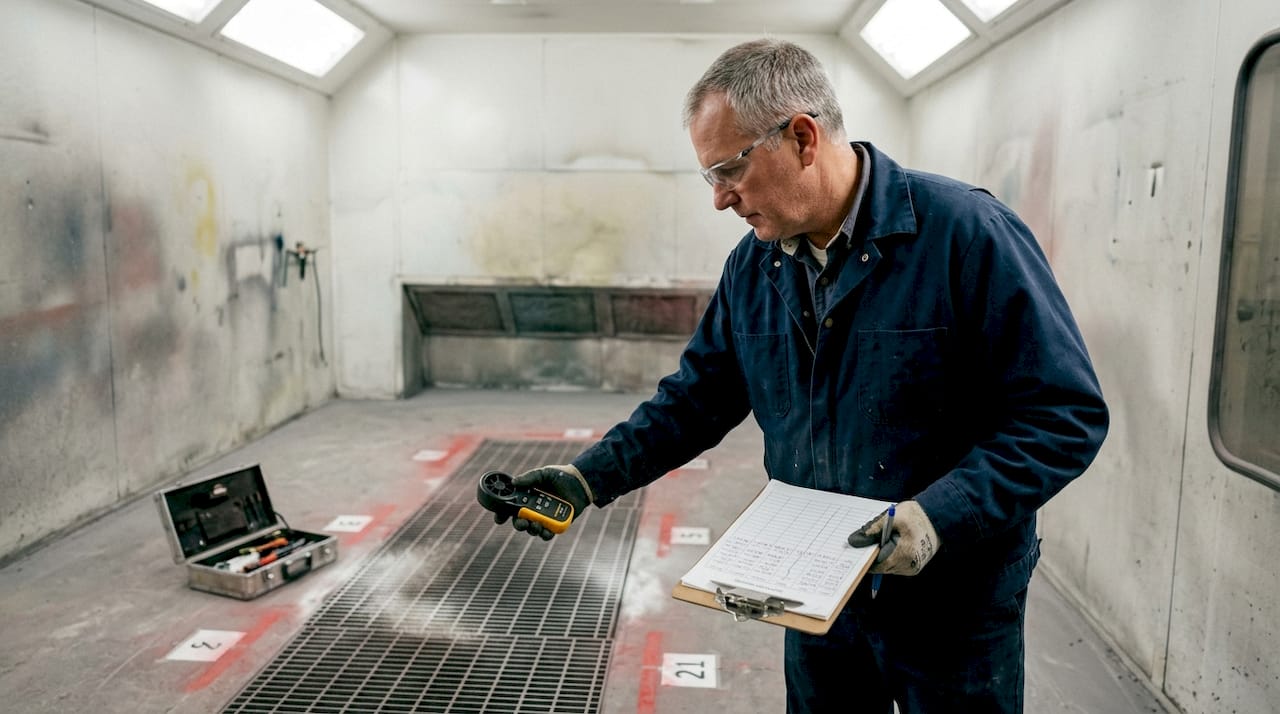
Downdraft laminar airflow and multi-stage filtration are the primary tools for dust prevention in professional spray environments. Downdraft booths push clean air from ceiling to floor, carrying particles away from the paint surface before they can settle. Crossdraft designs move air horizontally, which is less effective because particles travel across the work surface before exiting.
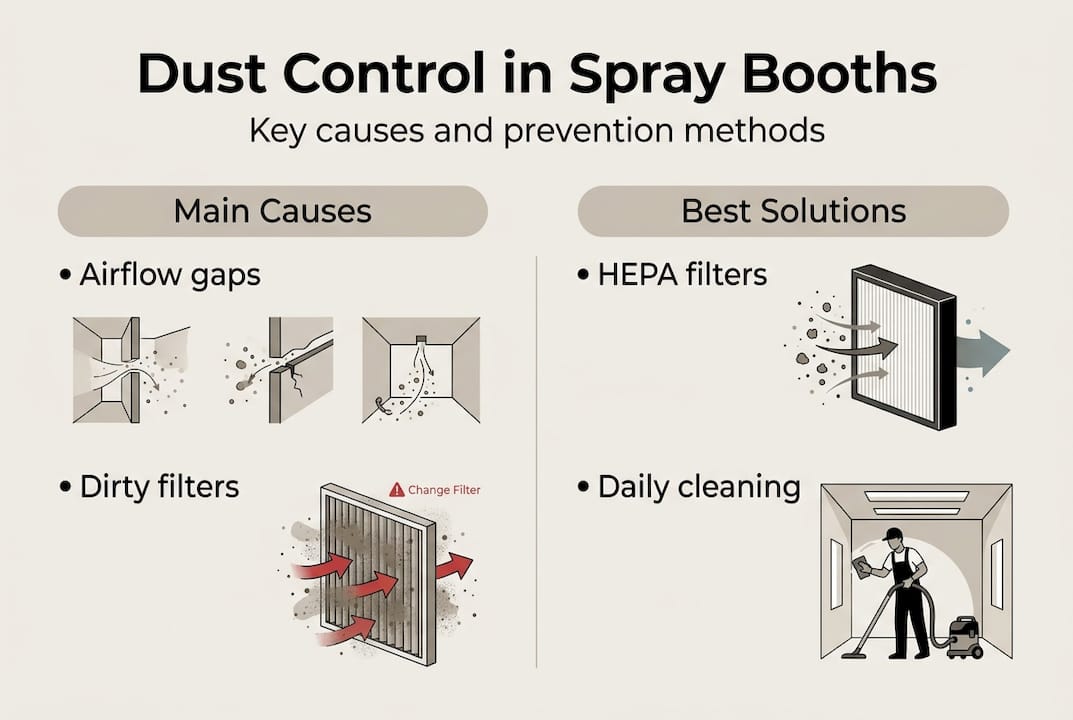
HEPA filters capture 99.97% of particles at 0.3 micrometers, making them the gold standard for final-stage filtration in high-quality finishing environments. Pairing HEPA output filters with a properly maintained pre-filter stage extends filter life and maintains consistent airflow velocity.
| Booth type | Dust control | Finish quality | Best use case |
|---|---|---|---|
| Downdraft | Excellent | Highest | Automotive, high-end industrial |
| Semi-downdraft | Good | High | Mid-volume production |
| Crossdraft | Fair | Moderate | Lower-volume or budget operations |
Steps for evaluating your booth’s airflow effectiveness:
- Measure air velocity at multiple points across the booth cross-section using an anemometer
- Check for dead zones or turbulence near corners, doors, and equipment
- Inspect filter loading and pressure drop across intake and exhaust stages
- Review filter change logs against actual defect rate trends
- Conduct a smoke test to visualize actual airflow patterns under working conditions
Pro Tip: Schedule quarterly airflow pattern tests and preventive maintenance on all filters. A 20% drop in airflow velocity can double particle settlement rates on painted surfaces.
For guidance on integrating filtration upgrades with your overall booth layout, the spray booth setup guide and the article on using protective films both offer actionable detail. You can also reference industrial air filtration standards for broader context on particle capture requirements.
Electrostatic and advanced protective measures
Even a well-designed booth with excellent filtration can still accumulate dust on walls and floors, and that settled dust becomes airborne again every time a door opens or a technician moves through the space. This is where electrostatic protective films change the equation.
Electrostatic films cut coating defects by up to 25% and contribute to paint savings of 15 to 25% by keeping booth surfaces clean and preventing re-entrainment of settled particles. The film adheres to walls and floors, trapping dust on its surface rather than allowing it to circulate back into the air.
Static buildup in low-humidity environments actively attracts fine dust to surfaces and painted parts, and anti-static coatings address this where filtration alone is not sufficient. In winter months or climate-controlled facilities with dry air, this effect is especially pronounced.
Key benefits of electrostatic and anti-static protective films:
- Trap and hold dust particles on booth surfaces instead of recirculating them
- Reduce cleaning frequency and time between jobs
- Protect booth walls and floors from overspray buildup
- Lower the risk of static-induced dust attraction on freshly painted surfaces
- Enable faster booth turnaround with peel-and-replace film layers
For facilities dealing with PM2.5 fine particle challenges, combining HEPA filtration with electrostatic protective film coverage on booth surfaces creates a layered defense that addresses both airborne and surface-settled contamination. The static-free protective films resource covers specific product options for different booth configurations.
Daily practices: maintenance and cleaning for dust control
Technology only works if the people using the booth follow disciplined daily routines. The best filtration system in the world will not compensate for a team that sweeps the floor before a paint job or walks in wearing street clothes.
Best practices include H-class vacuums, avoiding sweeping entirely, and performing daily cleaning before every production shift. H-class vacuums capture fine particles without releasing them back into the air, unlike standard shop vacuums that can actually increase airborne particle counts.
Recommended cleaning schedule:
- Daily: H-class vacuum all booth surfaces, check and log filter pressure drop, wipe down spray equipment with tack cloths
- Weekly: Inspect and replace pre-filters if loaded, clean light fixtures and ceiling baffles, check door seals for gaps
- Monthly: Full booth inspection including airflow velocity test, deep clean of exhaust plenum, review defect log trends
Process improvements for continuous defect reduction:
- Require booth-specific coveralls and head coverings for all personnel entering during painting
- Implement a tack cloth wipe-down protocol on all surfaces before spraying
- Log every defect by type, location, and job to build a searchable quality database
- Review the productivity checklist for cleaning routines to benchmark your current process
- Use the booth setup best practices guide to audit your current layout against proven standards
Building a root cause-oriented maintenance culture means your team stops treating defects as inevitable and starts treating them as solvable problems. The protective films for painting resource adds another layer of practical guidance for managers ready to formalize their dust control program.
Achieve dust-free results with proven spray booth solutions
The strategies covered in this article, from airflow optimization and forensic defect analysis to electrostatic film protection and disciplined cleaning routines, work best when supported by products engineered specifically for spray booth environments. Dust Free Film has been developing and manufacturing premium protective films for automotive and industrial spray booths since 2012, with multi-layer electrostatic and static-free options designed to integrate directly into the workflows described here.
Whether you are managing a single auto body shop or a multi-line industrial coating facility, the right protective film solution can reduce defect rates, cut cleaning time, and protect your booth investment. Explore the full range of Dust Free Film solutions to find the configuration that fits your operation, or request a quote for a tailored assessment of your facility’s specific dust control needs.
Frequently asked questions
How much can dust contamination increase paint shop costs?
Dust contamination costs high-volume plants between $50,000 and $150,000 per day due to rework, material waste, and quality failures. Even smaller facilities see significant losses when defect rates are tracked accurately.
What type of airflow is best for dust control in spray booths?
Downdraft laminar airflow is the most effective design because it moves clean air from ceiling to floor, sweeping particles away from painted surfaces before they can settle.
Can protective films lower the rate of paint defects?
Yes. Electrostatic films reduce defects by up to 25% by trapping dust on booth surfaces and preventing re-entrainment into the air during painting operations.
What cleaning practices most effectively control dust in a paint booth?
H-class vacuums and daily cleaning before every shift are the most effective practices. Avoid sweeping, which redistributes fine particles back into the air rather than removing them.
How should defects be analyzed to identify the true cause?
Forensic analysis methods like microscopy and surface swabs, combined with root cause mapping, are the most reliable way to distinguish dust-related defects from silicone, oil, or process contamination.