

TL;DR:
- Recirculating spray booths reuse 80 to 95 percent of internal air, reducing energy costs during painting. They maintain stable temperature and humidity, improving finish quality while meeting safety standards with explosion-proof components and continuous VOC monitoring. Proper maintenance of filters, dampers, and sensors is crucial for system performance and compliance.
Recirculating spray booth design is a closed-loop air management system that filters and reuses 80–95% of booth air during painting operations, dramatically cutting the energy cost of conditioning makeup air. Unlike traditional single-pass exhaust systems, which expel every cubic foot of treated air after one pass, a recirculating booth keeps that conditioned air working inside the chamber. The result is tighter environmental control, lower operating costs, and finish quality that single-pass systems struggle to match. Automotive refinishing shops, industrial coating lines, and manufacturing facilities running high-volume production all rely on this design to maintain consistent temperature, humidity, and cleanliness at the spray zone.
How does a recirculating spray booth work?
A recirculating spray booth operates on a continuous filtration loop. Air moves through the booth, picks up overspray and solvent vapor, passes through a multi-stage filter bank, and returns to the spray zone. The cycle repeats dozens of times per minute.
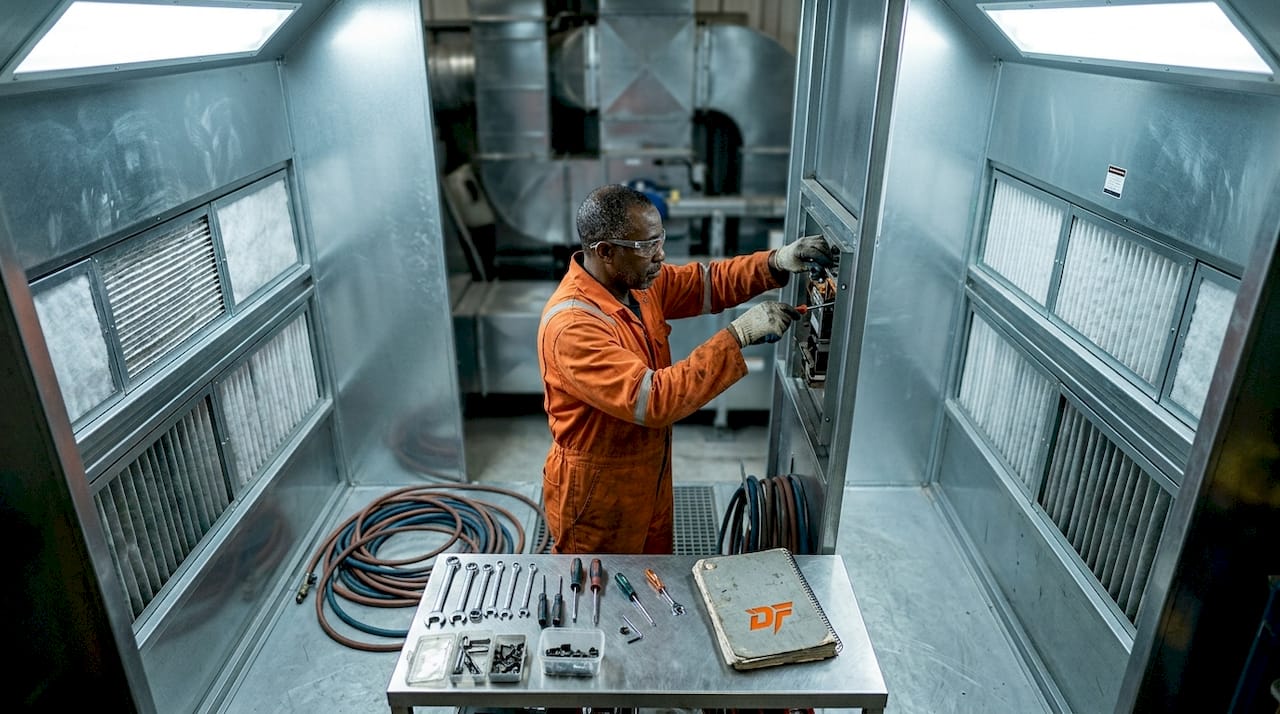
The recirculation ratio is the defining specification. Recirculation ratios range from 80% up to 95% depending on filter technology and process requirements. That means only 5–20% of air is exhausted and replaced with fresh makeup air during active spraying. The energy savings over a traditional 100% exhaust system are substantial, because heating or cooling that small fraction of fresh air costs far less than conditioning a full air change every cycle.
Fresh air introduction is not optional. NFPA 33 requires 10–20% fresh air in recirculating booths to prevent volatile organic compound (VOC) buildup and explosion risk. OSHA 29 CFR 1910.94© sets a minimum air face velocity of 100 feet per minute as the baseline for safe ventilation. These two standards together define the lower boundary of fresh air exchange in any compliant system.
The operational sequence typically runs in two distinct phases:
- Spray mode. The system maintains the 80–95% recirculation ratio. Filtration stages capture particulate overspray first, then address solvent vapor. Fresh air bleeds in continuously to keep VOC concentrations below the lower explosive limit.
- Bake or cure mode. Paint mist is absent, so the system safely increases recirculation to the upper end of its range. During baking, recirculation efficiency increases to 90–95% to accelerate curing and minimize heat loss. Programmable Logic Controllers (PLCs) manage the transition between modes automatically.
- Purge cycle. Before switching modes, the booth runs a brief purge to clear residual solvent vapor. This protects workers and prevents ignition risk during the transition.
- Idle mode. The system reduces airflow to a maintenance level, preserving filter life and cutting energy draw between jobs.
Pro Tip: Monitor your VOC sensor readings at the start of each shift. A baseline reading above normal before spraying begins usually signals a filter nearing saturation, not a leak. Replacing filters proactively costs less than an unplanned shutdown.
What are the key safety and technology features?
Recirculating spray booths carry a higher concentration of solvent vapor than single-pass systems during peak spray cycles. That reality drives every safety specification in the design.
Explosion-rated components are non-negotiable. Recirculating spray booths meet OSHA and NFPA safety codes when equipped with explosion-proof motors, lighting, and electrical enclosures. Every component inside the air stream must carry the appropriate hazardous location rating.
The critical safety and technology features of a compliant recirculating booth include:
- Continuous gas monitoring. Catalytic or photoionization sensors track solvent concentration in real time. The PLC responds automatically, increasing fresh air intake if VOC levels approach a threshold, typically 25% of the lower explosive limit.
- PLC-based mode control. The controller manages damper positions, fan speeds, and burner output across spray, bake, purge, and idle modes without manual intervention.
- Secondary overspray removal. Dry-filter reagent injection, such as dry limestone powder, coats filter media and duct surfaces to prevent sticky overspray from bonding and clogging. Without this step, filter loading accelerates and fire risk increases.
- Bypass dampers. These mechanical dampers divert airflow between recirculation and exhaust paths. Bypass damper actuators are critical for energy efficiency during cold-weather curing cycles. A failed actuator defaults the system to 100% fresh air intake, erasing all energy savings.
- Interlocked safety shutdowns. If gas monitoring detects a concentration spike or a filter differential pressure alarm triggers, the system shuts down the spray process and increases exhaust automatically.
Pro Tip: Schedule bypass damper actuator inspections quarterly, not annually. Actuator failure is the single most common cause of unexpected energy cost spikes in recirculating booths, and the part itself is inexpensive compared to the heating bill.
Recirculating vs. traditional single-pass exhaust booths
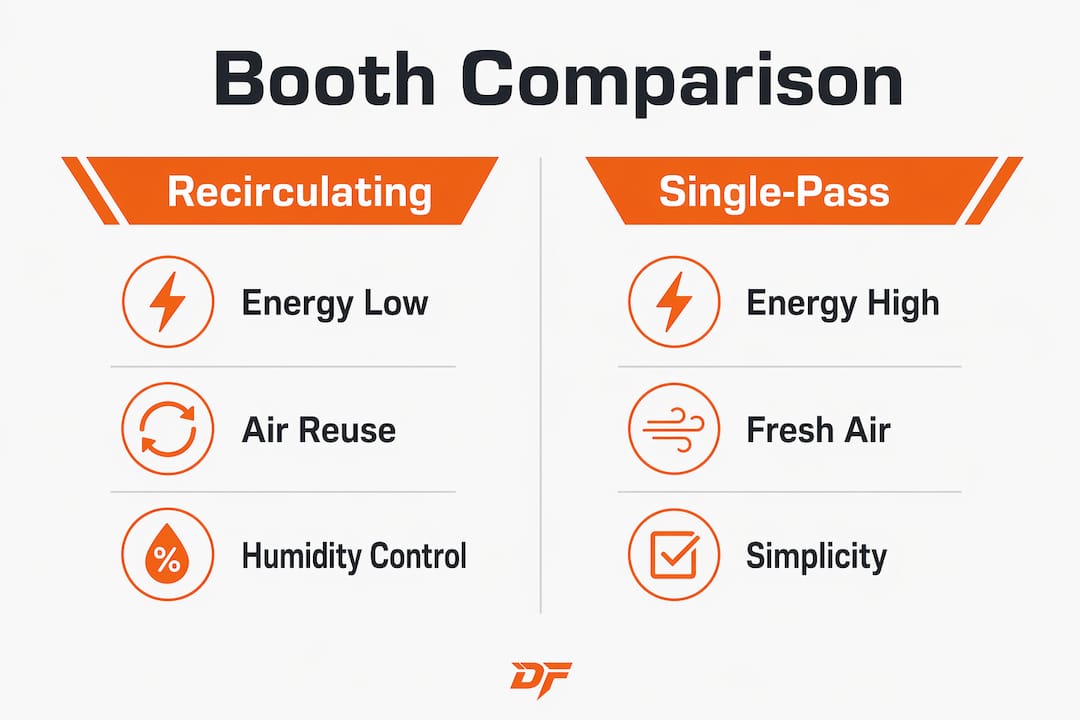
The choice between recirculating and single-pass design comes down to production volume, coating chemistry, and capital budget. Neither design wins in every situation.
| Factor | Recirculating booth | Single-pass exhaust booth |
|---|---|---|
| Energy consumption | Low. 80–95% air reuse cuts HVAC load sharply. | High. Every cubic foot of conditioned air is exhausted after one pass. |
| Environmental control | Tight. Temperature and humidity stay stable across the shift. | Variable. Outdoor conditions affect makeup air quality directly. |
| Initial capital cost | Higher. Filtration banks, PLCs, and gas monitoring add cost. | Lower. Simpler ductwork and fewer components. |
| Maintenance complexity | Higher. Filters, dampers, and sensors require scheduled attention. | Lower. Fewer moving parts and monitoring systems. |
| Regulatory compliance | Requires active VOC monitoring and explosion-proof components. | Requires adequate exhaust volume and face velocity. |
| Best application | High-volume automotive, industrial coating lines, climate-sensitive finishes. | Lower-volume shops, simpler coatings, limited capital budgets. |
Recirculating booths provide superior temperature and humidity control, which is the primary driver of finish consistency in automotive and high-end industrial coating. The energy savings matter, but the environmental stability is what makes recirculating design the standard for premium paint work.
Choosing a recirculating design requires assessing coating chemistry and production volume before committing capital. Waterborne coatings, for example, are more sensitive to humidity swings than solvent-based systems, making the tight environmental control of a recirculating booth especially valuable.
How are recirculating booths implemented in automotive and industrial settings?
Implementation varies widely based on product size, throughput, and coating type. The design principles stay constant; the physical configuration adapts.
Automotive refinishing shops typically use crossdraft or downdraft recirculating booths sized for passenger vehicles. The downdraft configuration, where air enters through ceiling filters and exhausts through floor grates, pairs well with recirculation because the vertical air column keeps overspray away from the vehicle surface and toward the filter bank efficiently. Air quality directly affects finish quality in these environments, so maintaining stable airflow patterns is as important as the recirculation ratio itself.
Industrial coating lines handling large components, such as agricultural equipment frames or commercial vehicle bodies, use modular recirculating booth sections that can be linked in series. Each section maintains its own recirculation loop, allowing different coating stages to run simultaneously at different temperatures.
Key implementation considerations for industrial settings include:
- Coating chemistry compatibility. Solvent-based coatings generate higher VOC loads, requiring more aggressive fresh air exchange and more frequent filter replacement. Waterborne coatings produce less solvent vapor but require tighter humidity control.
- Production cycle matching. The PLC program must align spray and bake cycle durations with actual production throughput. Mismatched cycles waste energy and reduce finish quality.
- Modular and mobile configurations. Smaller operations use mobile recirculating booths that can be repositioned within a facility. These units sacrifice some filtration capacity but offer flexibility that fixed installations cannot.
- Dust control at the booth boundary. Recirculation keeps internal air clean, but contamination enters through doors and personnel movement. Protective films on booth walls and floors, such as those supplied by Dustfreefilm, prevent accumulated dust from becoming an airborne contamination source during spray cycles.
- Overspray management. Advanced overspray control using dry limestone powder injection prevents duct clogging and fire hazards in liquid spray recirculating systems. This is especially critical in high-volume industrial lines where filter loading happens quickly.
What maintenance practices keep a recirculating booth performing?
Maintenance is where recirculating booth performance either holds or collapses. The system’s efficiency depends on every component in the filtration and control loop working within specification.
- Replace intake and exhaust filters on a fixed schedule. Do not wait for a pressure drop alarm. High-volume operations should check filter differential pressure weekly and replace filters before they reach 80% of their rated capacity.
- Inspect and lubricate bypass damper actuators quarterly. Neglected bypass dampers default to 100% fresh makeup air, which eliminates the energy advantage of recirculation entirely. A quarterly inspection catches actuator wear before failure.
- Calibrate VOC and gas sensors every six months. Sensor drift is common in high-solvent environments. An uncalibrated sensor either triggers false alarms or, worse, fails to detect a real concentration spike.
- Clean dry-filter reagent injection nozzles monthly. Clogged nozzles reduce reagent coverage, allowing overspray to bond to duct surfaces and filter media. This accelerates clogging and increases fire risk.
- Audit PLC mode transition logic annually. Control programs can drift from their original settings after firmware updates or manual overrides. An annual audit confirms that spray, bake, purge, and idle modes transition correctly and within the designed time parameters.
A spray booth maintenance workflow built around these five steps keeps a recirculating system operating at its designed efficiency. The most common mistake is treating maintenance as reactive rather than scheduled. By the time a recirculating booth shows visible performance loss, the underlying cause has usually been building for weeks.
Key takeaways
Recirculating spray booth design delivers superior finish quality and energy efficiency only when filtration, safety monitoring, and maintenance are treated as equal priorities alongside the recirculation ratio itself.
| Point | Details |
|---|---|
| Recirculation ratio | Systems reuse 80–95% of booth air, cutting HVAC energy costs sharply versus single-pass designs. |
| Safety compliance | NFPA 33 and OSHA 29 CFR 1910.94© require fresh air exchange, explosion-proof components, and active VOC monitoring. |
| Filtration technology | Dry-filter reagent injection prevents duct clogging and fire risk, making it critical for sustained system performance. |
| Bypass damper maintenance | Quarterly actuator inspections prevent default to 100% fresh air intake, which erases energy savings. |
| Implementation fit | Recirculating design suits high-volume, climate-sensitive operations; simpler single-pass systems fit lower-volume shops better. |
The detail most shops overlook
The energy savings number gets all the attention when facilities evaluate recirculating booth design. The 80–95% air reuse figure is compelling, and it should be. But after working closely with automotive and industrial painting operations for years, I have found that the facilities getting the most from their recirculating systems are not the ones with the highest recirculation ratios. They are the ones with the most disciplined maintenance programs.
The bypass damper actuator is the clearest example. It is a small, inexpensive component, and its failure is completely silent. The booth keeps running. The PLC keeps cycling. The only sign of trouble is a heating bill that creeps upward over weeks. By the time the facility notices, they have been running at 100% fresh air intake for a month. Dynamic management of recirculation rates based on real-time conditions is what separates a well-run recirculating booth from an expensive one that underperforms.
The other underappreciated factor is surface contamination inside the booth. Recirculation keeps airborne particles low, but dust that settles on walls and floors during idle periods becomes a contamination source the moment airflow increases. Protective films on booth surfaces address this directly. They trap settled dust and peel away cleanly, rather than letting it re-enter the air stream. For operations running industrial dust control as part of their quality program, this is not an optional detail.
Recirculating booth design is not a set-and-forget investment. It rewards the operations that treat it as a system, not a piece of equipment.
— Dust
Dustfreefilm solutions for recirculating spray booth protection
Recirculating spray booths create a controlled environment, but that environment is only as clean as the surfaces inside it. Dustfreefilm has supplied premium protective films for spray booth walls and floors since 2012, specifically for automotive refinishing and industrial painting facilities where finish quality is non-negotiable.

Dustfreefilm’s multi-layer electrostatic booth films trap settled dust and overspray on booth surfaces before it can re-enter the recirculation loop. The patented dispenser system allows quick, bubble-free installation, and the heat-resistant, static-free film holds up through bake cycles without lifting or releasing contamination. For operations that have invested in recirculating booth design, booth wall and floor protection from Dustfreefilm is the logical next step in maintaining the dust-free environment that makes the investment worthwhile.
FAQ
What is a recirculating spray booth?
A recirculating spray booth is a ventilation system that filters and reuses 80–95% of its internal air during painting, rather than exhausting all air after a single pass. This design reduces energy consumption and maintains stable temperature and humidity conditions at the spray zone.
How does a recirculating spray booth differ from a downdraft booth?
A downdraft booth describes the airflow direction (top to bottom), while recirculating describes the air management strategy (filtered and reused). A downdraft booth can be either single-pass or recirculating; the two terms are not mutually exclusive.
What safety standards apply to recirculating spray booths?
NFPA 33 requires 10–20% fresh air introduction to control VOC levels, and OSHA 29 CFR 1910.94© sets a minimum face velocity of 100 feet per minute. Explosion-proof components and continuous gas monitoring are required for regulatory compliance.
How often should filters be replaced in a recirculating booth?
Filter replacement frequency depends on production volume and coating type, but high-volume operations should check differential pressure weekly and replace filters before they reach 80% of rated capacity. Waiting for an alarm means the filter has already been restricting airflow.
Are recirculating spray booths suitable for waterborne coatings?
Yes. Recirculating booths are well-suited for waterborne coatings because their tight humidity control prevents the flash-off problems that occur when ambient humidity fluctuates. Coating chemistry does affect the required fresh air exchange rate, so the PLC program should be configured specifically for the coating type in use.